




Abstract

Recently, Lehmann et al. (2011) identified six different subtypes of triple negative breast cancer (TNBC) according to the gene expression profiles, including a luminal androgen receptor (LAR) subtype. The LAR subtype was notable by differences in androgen receptor (AR) signaling and luminal cytokeratin expression. Therefore, TNBC subtype is anticipated to be a highly heterogeneous group; the molecular understanding of this breast cancer type is critical to develop innovative and effective drugs. Moreover, the subtyping of TNBC is essential to better identify molecular biomarkers, and epigenetic understanding can contribute to this challenge.
In a previous study, we have observed a decrease in H3K27me3 and H3K9me3 markers with BRCA1, EZH2, and ER-α genes in tumor breast cell lines (MDA-MB-231 and MCF7) treated with 17β-estradiol and soybean phytoestrogens and an increase in H4K8ac and H3K4ac markers with these genes following suberoylanilide hydroxamic acid (SAHA) (Dagdemir et al., 2013). These epigenetic modifications have responded to different treatments and have been able to mediate silencing or enhancing genes. Thereafter, a high variability in H3 modifications (H3K27me3, H3K9ac, and H3K4ac) on a promoter gene panel (BRCA1, EZH2, P300, SCR3, ERS1, ERS2, and PGR) implicated in breast cancer was found within the TNBC subtype (Judes et al., 2016). In view of these results, we studied AR expression by immunohistochemistry (IHC) in these tumors and established a correlation with their epigenetic profile.
IHC was performed for 34 TNBCs, including those with positive nuclear staining for AR (n = 12) and presented an extensive staining for luminal markers (CK8/18 and CK19). The other groups presented a negative staining for AR (n = 22), displaying an expression of luminal markers and a notable staining for basal markers like CK5/6. Moreover, in the AR− group, 95.45% presented a Ki67 ≥ 20% compared with the AR+ group where 58.33% presented a 14% < Ki67 < 19%.
Collectively, we report here the presence of two groups (AR+ and AR−) inside the TNBC studied tumors. In Figure 1A, for AR+ tumors (n = 12), the staining significantly increased in CK8/18 (p = 0.02) and CK19 (p = 0.01) compared with AR− tumors (n = 22). CK5/6 and Ki67 were found significantly decreased (p = 0.02; p = 1.63 × 10⁻⁷) in the AR+ group in comparison with the AR− group. Among the studied TNBCs, a part of them was distinguished with higher AR expression, reduced proliferation, and strongly expressed luminal cytokeratins. This subtype is called LAR that was also characterized by ER− and PGR−, negative CK5/6 expression (Fig. 1B). AR mRNAs were evaluated by reverse transcriptase (RT)-quantitative polymerase chain reaction (Q-PCR) (Ngollo et al., 2014) as shown in Figure 2A and were found highly expressed in the LAR subtype compared with the basal-like subtypes with a significant difference (p = 0.029).

Differentiation of LAR subtypes by markers through IHC.
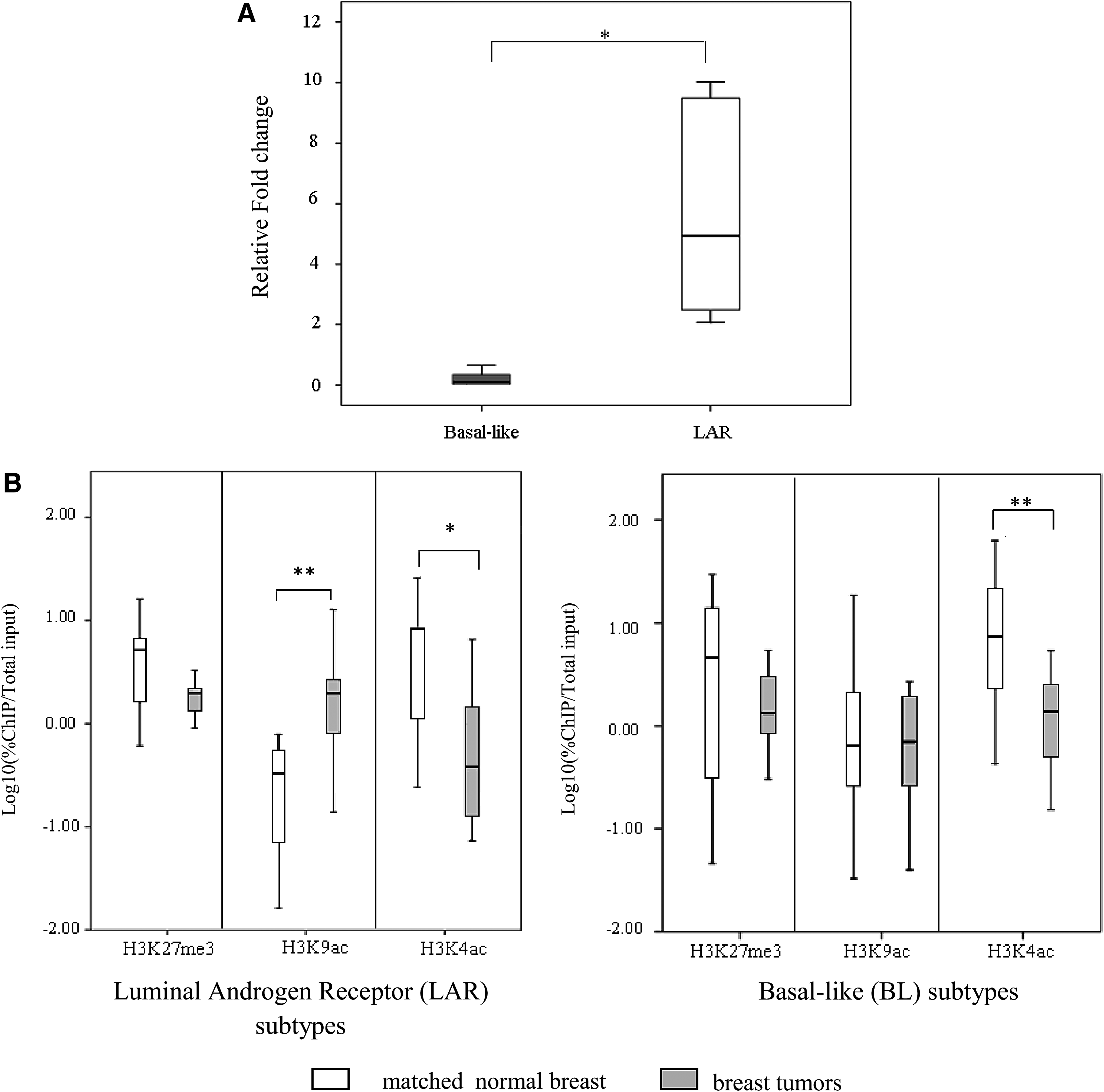
Therefore, H3 modifications on AR promoter gene were studied in LAR and basal-like subtypes by immunoprecipitation of chromatin (Dagdemir et al., 2013; Ngollo et al., 2014) following by Q-PCR (Fig. 2B). These results show significant decreases of H3K4ac in LAR tumors (p = 0.04) like in basal-like subtypes (p = 0.005) compared with adjacent normal tissues. Nevertheless, activating H3K9ac markers increased significantly (p = 0.005) in the LAR tumors compared with normal tissues. No variation of H3K9ac (p = 0.497) was shown in basal-like subtypes. H3K9ac marks seemed to play a role in the difference of AR expression between LAR and basal-like subtypes. This finding corroborated the previous results; that is, the LAR subtype was found AR+ and CK8/18+, CK19+ luminal markers, like luminal breast cancer subtypes. Therefore, the TNBC subtype appeared to include another subtype, the LAR exhibiting a H3-specific signature.
The LAR subtype is ER−, however, the gene ontologies of this group are enriched in hormonally regulated pathways, including steroid synthesis and androgen/estrogen metabolism (Lehmann et al., 2011). Genetic and epigenetic events were in relation with AR expression in breast cancer. Notably, the hypermethylation of the AR promoter is associated with loss of AR expression in breast cancer cells but not in primary breast tumors (Peters et al., 2012).
In this study, we investigated an epigenetic mechanism, H3 modifications, responsible for the difference of AR expression between LAR and basal-like subtypes. The results revealed that an increase of H3K9ac modification in AR gene promoter was associated with the high expression of AR in LAR subtypes. Conversely, H3K27me3 and H3K4ac markers did not appear to play a role in AR expression of LAR and TNBC subtypes. Previously, the majority of TNBCs were classified based on IHC or by correlation to the intrinsic molecular subtypes. However, TNBCs presented distinct phenotypes and not only TNBC phenotype (Lehmann et al., 2011). Concerning the epigenetic phenotype, our study shows that the LAR subtype displayed a different H3 signature compared with TNBC subtype. Previous studies indicated that AR-negative TNBCs showed significantly poorer outcomes with regard to the disease-free survival and overall survival than the AR-positive TNBCs, which suggested that AR expression could be a valuable prognostic marker in TNBCs.
In conclusion, LAR subtypes represented a part of TNBCs with a high expression of AR and luminal cytokeratins and showed a particular epigenetic profile. This study highlighted an epigenetic heterogeneity inside TNBC. Therefore, epigenetic modifications could be new potential biomarkers to identify and stratify different TNBC subtypes.
Footnotes
Acknowledgments
We thank “la ligue contre le cancer-Comité du Puy-de-Dôme.” A.D. was funded by Protema Saglik Hizm A.S, and S.K.-C. was supported by The Scientific and Technology Research Council of Turkey (TUBITAK-2219) project grants. K.R. was funded by Hariri Foundation.
Author Disclosure Statement
The authors declare that no conflicting financial interests exist.