




Abstract
Abstract
Original ideas and innovation cannot always be ordered like a courier service and delivered fresh to our desk at 9 am. Yet, most creativity-based organizations, careers, and professions, science and biotechnology innovation included, emphasize the speed as the prevailing ideology. But a narrow focus on speed has several and overlooked shortcomings. For example, it does not offer the opportunity to draw from, and stitch together disparate concepts and practices for truly disruptive innovation. Preventing false starts, learning from others' or our own mistakes, and customizing innovations for local community needs are difficult in a speed-hungry innovation ecosystem. We introduce a new strategy, the Fast-Second Winner, specifically in relation to global development of biotechnologies and precision medicine. This à la carte global development strategy envisions a midstream entry into the innovation ecosystem. Moreover, we draw from the works of the late David Bowie who defied rigid classifications as an artist and prolific innovator, and introduce the concept and practice of slow innovation that bodes well with the Fast-Second Winner strategy. A type of slow innovation, the Fast-Second Winner is actually fast and sustainable in the long term, and efficient by reducing false starts in new precision medicine application contexts and geographies, learning from other innovators' failures, and shaping innovations for the local community needs. The establishment of Centers for Fast-Second Innovation (CFSIs), and their funding, for example, by crowdfunding and other innovative mechanisms, could be timely for omics and precision medicine global development. If precision medicine is about tailoring drug treatments and various health interventions to individuals, we suggest to start from tailoring new ideas, and focus not only on how much we innovate but also what and how we innovate. In principle, the Fast-Second Winner can be applied to omics and other biotechnology responsible development in medical practice or any field of applied innovation.
Innovators don't do things that have never been tried; they do things that have never been done.
Introduction
W
We explain that the Fast-Second Winner, a type of slow innovation, is actually fast in the long term, efficient, and responsible, by reducing false starts in new precision medicine application contexts and geographies, learning from other innovators' failures, and shaping innovations for the local community needs. In principle, the Fast-Second Winner strategy can be applied to omics and other biotechnology applications in medical practice or any field of applied innovation.
Time for a “Slow Innovation” Moment?
Original ideas and innovation cannot always be ordered like a courier service and delivered fresh to our desk at 9 am. Yet, most creativity-based organizations, careers and professions, science and biotechnology innovation included, emphasize the speed as the prevailing ideology. If the new oil and currency of the 21st century are data economy, as suggested by The Economist (2017) recently, this might perhaps make sense.
But a narrow focus on speed has three, and often overlooked, problems.
First, it does not always offer the opportunity to draw from, and stitch together disparate concepts and practices for truly disruptive innovation. David Bowie, who defied classification as a singer and musician, transformed pop culture indelibly. Some claim that if innovation had a face, s/he would look like David Bowie (Chakravorti, 2016). From his early works with Space Oddity and Ziggy Stardust, he kept on reinventing himself and drawing from fields and literatures that do not always come together such as the Japanese theater, cinema, art, software and William Burroughs. Bowie was an artist in every imaginable and unimaginable way, creating brand new genres and transcending them. Had Bowie been under pressure for speed to innovate and report progress every quarter, he likely would not be able to bring together the ideas he borrowed from multiple fields. Bowie's innovation was one of “compositional innovation,” a term we introduce here, for the idea that ordinary objects, processes, or established knowledge can create something unusually disruptive and innovative if put together and composed in novel ways.
Second, speed does not permit opportunity for reflection, contextualization, and ultimately, learning from mistakes of others or of our own. Kevin Ashton, who coined the term “The Internet of Things” (IoT), has commented that innovators do things that are never done before (Gabbal, 2015). Indeed, by definition, innovation is an unprecedented process, product, or knowledge. Thus, innovators do fail many times as they navigate their way in unchartered territory before (and if) they succeed. Thomas Alva Edison, too, has failed numerous times before his discovery of the light bulb. Yet, for every Edison we are aware of, there are likely innovators in the order of millions in obscurity, who have tried two times, failed, ran out of resources and were unable to continue. Most do not get a second chance, or the biology and its materiality rear their head on experimental constraints such as limited sample size, tissue availability, among others. In sum, in developing countries and resource-limited settings of the developed world, one often has a single opportunity to experiment and succeed for innovation.
Third, speed can make us forget to tailor innovations for the needs of the user communities or think about the opportunity costs of a given technology. Scientific and other development aid can quickly turn into an authoritarian aid, if the pressing health needs and priorities of the recipient countries and local communities are not considered. Lack of appreciation of the opportunity costs and alternative technologies create further missed opportunities to innovate in a targeted, relevant, and efficient manner.
These are important enough and yet little debated shortcomings of the speed-hungry 21st century innovation ecosystem that slow innovation is worth considering, as an alternative concept and practice.
The Fast-Second Winner Strategy
An “à la carte” slow innovation approach for global development
An astutely global, and yet customized strategy for responsible diffusion and diversification of omics and other biotechnology innovations across the nation state borders is sorely missing. Such globalization of science cannot be “one-size-fits-all-countries,” however, in much the same way drug treatments ought to be customized through precision medicine.
Returning to the question posed by Mitropoulos et al. (2017) in the Introduction section, it is noteworthy that the two common reflex responses to assist global development of precision medicine have been the method of implementation consortia and/or full-scale infrastructure investments, often commencing upstream, from discovery science onward to translational research and implementation science. This cascade of science progression has long been known as the linear model of innovation. While such full-scale investment might be desirable, there are also opportunity costs when resources are limited. For every full-scale investment in a given geography, investments in another resource-limited setting may become not tenable. Beginning the innovation process invariably from discovery science prepares the innovators for possible failures and setbacks that cannot be offset easily in developing countries in the event of failure. If one does not have much ammunition, little reserves and insufficient buffer systems to absorb economic and other shocks, it is prudent to choose and target the innovation investments with a sound strategy and foresight, rather than a full speed dive into the innovation ecosystem. Speed is not invariably an advantageous strategy when it comes to innovations as noted earlier.
Transplanting innovations from developed countries to the developing world may not always work or be responsible. They need to be customized for each country. For example, in a bibliometric analysis of all human genetics studies that used Cameroonian DNA samples from 1989 to 2009, 52% of the publications were devoted to population genetics (variation/migration patterns) whereas only 10% of the studies involved the hemoglobinopathies such as sickle cell anemia that greatly impacts Cameroon (Mnika et al., 2016; Wonkam et al., 2011). The same is true for the plethora of discovery studies in the field of genotype-to-phenotype correlations that are often tested for replication in different population groups, as compared to studies that address the applications of these findings in the clinic, the latter being disproportionally fewer than the former. Tailoring scientific aid and knowledge-based innovation for country-specific needs means that research and innovation agenda ought to be shaped earlier than implementation science. Yet, such agenda setting need not always be at the very beginning when discovery science is in force either.
We propose a “Fast-Second Winner” strategy for global development of precision medicine and omics technologies (Fig. 1). This à la carte strategy envisions a midstream entry into the innovation ecosystem, and offers the following advantages:
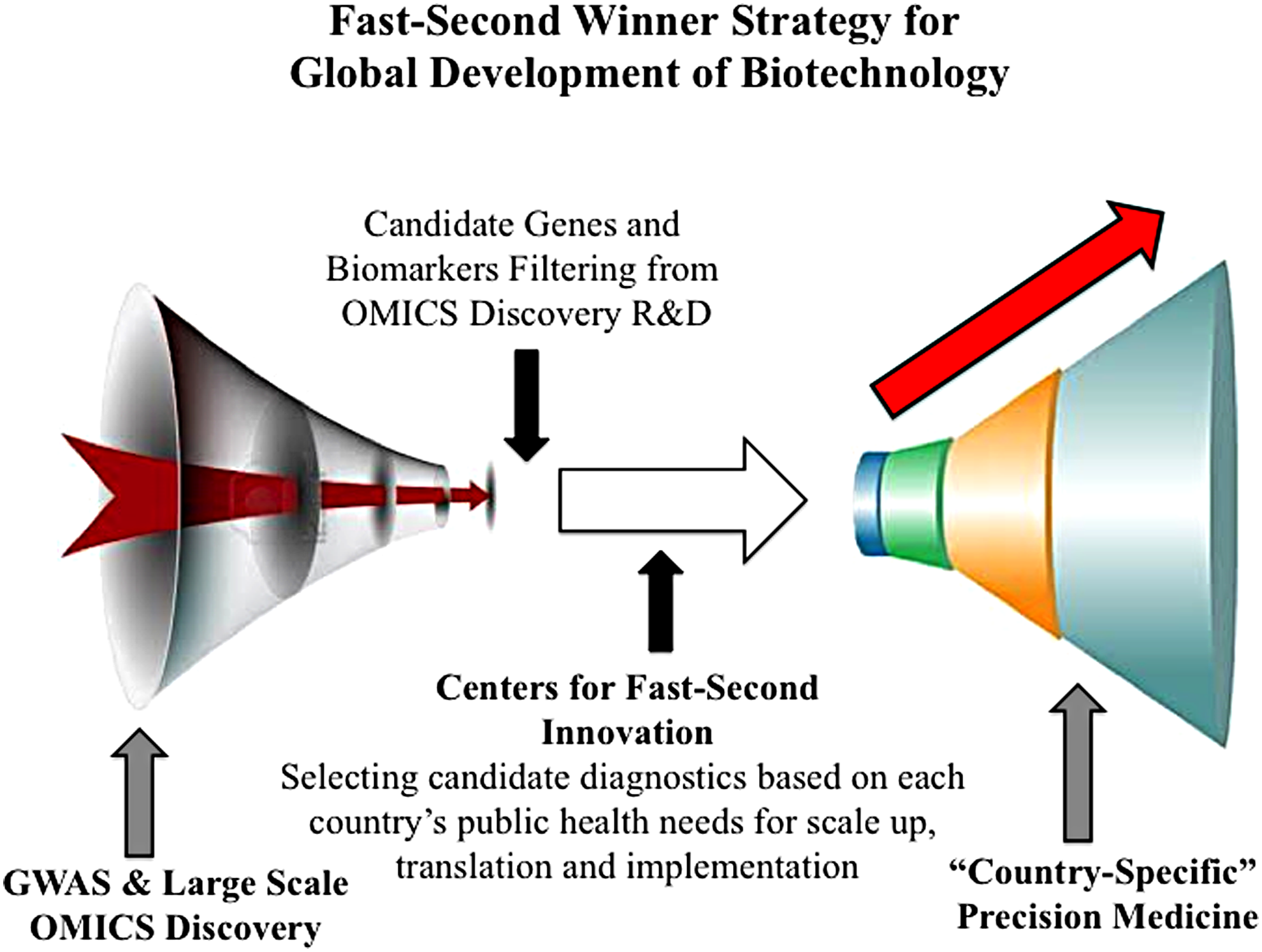
The Fast-Second Winner midstream innovation model to tailor omics and precision medicine global development strategy in a country-specific manner. GWAS: Genome Wide Association Studies.
• An opportunity to identify the emerging biomarker leads from the end of the discovery pipeline and early translational research worldwide, and harness those that are most appealing, for example, from genome wide association studies for the individual country pressing public health needs (Fig. 1). In this scenario, one can move forward with translational research or scale up for implementation in the relevant country. Alternatively, the identified promising biomarker discoveries are finessed further with targeted discovery, for example, characterization of population-specific genomic variants in the relevant country before further translation and implementation (Chikowore et al., 2015). The existence of well-curated population genetic databases for clinically relevant genomic variants' allele frequencies (e.g., FINDbase: www.findbase.org) (Viennas et al., 2017) would also help significantly to achieve this goal. Midstream entry to the innovation ecosystem offers the flexibility (hence, à la carte strategy) to move bi-directionally upstream or downstream and yet, permits investments only on the biomarker leads that have stood the initial test of discovery science, and addressing a health burden of unique fit for a given country. Reducing the odds for false starts and poorly targeted innovations empowers the resource-limited regions and developing countries.
• Midstream innovation through a Fast-Second Winner approach capitalizes on the lessons learned from other innovators' failures. Some of these “Fast-First” and failed innovation actors can be from academia, funding agencies and philanthropies, governments and industry. Moreover, what is considered a failure in one context and country may represent a unique niche for another country's innovation needs. For this learning and “match-making” among biomarker leads, countries, local disease burdens, drugs, and other health interventions to materialize, we propose the establishment of Centers for Fast-Second Innovation (CFSIs), and so as to assist global omics and precision medicine development and deployment responsibly. These centers can steer Fast-Second Winner midstream innovation for precision medicine across nations and borders.
• Finally, midstream innovation leaves ample room to shape and tailor the development of a diagnostic candidate consistent with the local community needs, thus contributing to responsible innovation.
In resource-limited settings and in the course of seeking hope to overcome poverty, the allure of new biotechnology and full-scale investment in all aspects of the innovation ecosystem may be seductively appealing. Yet, this may inadvertently forbid sound development strategies necessary to prevent false starts, learn from other innovators, and customize an innovation for a given country and local community. The Fast-Second Winner strategy and the accompanying CFSIs warrant further consideration as one of the new approaches to innovate the innovation processes as omics and precision medicine continue to diffuse and receive demands for capacity building in various geographies and countries (Rehman et al., 2016).
Whether one is a staunch subscriber to the linear model of innovation or not, midstream innovation and entry into the innovation ecosystem, in our view, should be explored further and might offer an appealing global development strategy for biotechnology and precision medicine in ways that are also country-tailored.
The Fast-Second, as a term, has been used in the business literature for companies to enter and capitalize on new markets successfully, and with emphasis primarily on scale-up for products and innovations created by others (Markides and Geroski, 2004). Our proposal is different, and does not focus on market capitalization but instead on responsible innovation, and empowerment of developing countries and underrepresented innovators with limited resources (Fisher, 2017; Nowotny et al., 2001; van Oudheusden, 2014; von Schomberg, 2013). The Fast-Second Winner has not been previously conceptualized in ways that also cultivate responsible innovation in health to address the local community needs, not to mention of developing countries. The Fast-Second Winner can include scale up but can also extend into upstream or downstream science so as to shape and customize an innovation responsibly for people and countries.
How can such an initiative be funded? As it is the case with many new ideas, it is often hard to fund them with the traditional mechanisms, as previously mentioned. A conceivable and independent solution could be the adoption of an innovative crowdfunding model. There are different types of crowdfunding methods available. Crowdfunding 2.0 builds on an initial kick-off donation by one or few angel investors that is then scaled up by smaller donations from many citizens and stakeholders (Özdemir et al., 2015). Citizens are also invited to offer their ideas for potential applications of a given technology that would be of use to them. This increases publics' participation in innovation upstream at the design stage, correct innovators' blind spots, and helps to “think the unthinkable” in relation to user and local community needs (Özdemir et al., 2015). Because crowdfunding is open to contributions globally, it is not limited to the nation state borders, and thus, can help reach out numerous local communities in the spirit of precision medicine without borders. It might also serve as a multidisciplinary forum for various stakeholders to learn from each other and calibrate their interests and expectations.
We support speedy innovation whenever possible, but without forgetting that speed is only one dimension of innovation, has several overlooked shortcomings, and that quantity also needs to have a quality dimension. The ends to which innovations serve, quality, and relevance of an innovation for individuals and populations, and responsibility also do matter. When we expand our own horizons as well as the time scale of an innovation, we might be pleasantly surprised that what appears to be slow innovation initially may actually be the fast and sustainable one in the long term, with fewer false starts and responsible returns on investments for knowledge-based innovation.
Conclusions and the Ways Forward
This innovation analysis does not suggest stopping innovation but that the scale of time also matters. An absentminded focus on quantity of innovation and compressed timelines may compromise quality, and how disruptive and original an innovation is. Instead, we should be willing to take the time needed to cultivate truly innovative ideas. Brainstorming sessions do not always encourage divergent thinking necessary for innovation; the latter comes with the counsel of time, context, and reflection necessary for sense making. Reliance on brainstorming sessions or hasty solutions occasionally amplifies the existing unimaginative ideas on steroids.
As Edison and others have noted in the past, game-changing innovation is not for the faint-hearted. Numerous failures inherent to the innovation process can strip of the already limited resources of an innovator, be it a person, company, or country. In this sense, learning from others' mistakes is essential, not only for boosting the capacity of developing countries to innovate but also for survival. A failure might do a greater damage for a resource-limited innovator than the one that has large resources to dampen the negative effects of failures in attempts to innovate.
Instead of a narrow focus on speed, perhaps we should take vacations more often and when we can afford it. If we cannot, we can go for a short walk every hour and away from the chains of our desk. We should be willing to talk to strangers and listen to them. We may not be fond of David Bowie and do not need to listen to his music (although one of us is a fan), but we can learn from how Bowie and others who courageously took time to learn from seemingly unrelated knowledge and objects, and seamlessly composed them to works of truly innovative music and art. Many like Bowie exist around the globe who are idea seamsters. The creative art of science, including postgenomic medicine and its branching arms such as precision medicine can usefully learn from Bowie and slow innovation.
If precision medicine is about tailoring drug treatments, nutrition, vaccines, and various health interventions to individuals, perhaps we can start from tailoring new ideas and focus not only on how much we innovate but also what and how we innovate. The Fast-Second Winner and slow innovation are only some of the many quality possibilities that exist.
Footnotes
Acknowledgments
No funding was received in support of this innovation foresight and science policy analysis. The views expressed are the personal opinions of the authors only and do not necessarily represent the views of their affiliated institutions.
Author Disclosure Statement
The authors declare that no conflicting financial interests exist.