




Abstract

To the Editor:
TAT-interactive protein 60 kDa (TIP60), a histone acetyltransferase, acts as a transcription factor in maintenance of plasticity and chromatin integrity. RNA and protein expressions of TIP60 have been shown to be reduced in breast cancer. These expressions are used to stratify breast cancers from the least to the most aggressive (Gorrini et al., 2007; McGuire et al., 2019). TIP60 can be recruited into heterochromatin by ATPase P400 when it has incorporated the H2Az variant into heterochromatin, as TIP60 is able to bind to mono- or trimethylated H3K9 (Rajagopalan et al., 2018). This recruitment would compensate for the loss of the heterochromatin maintenance skeleton (SUV39H1/H3K9me3/HP1) by overexpression of histone demethylase. This chromatin maintenance activity could unbalance the residual activity of TIP60 in breast cancer. Some studies have shown that inhibition of the residual activity of TIP60 in breast cancer would lead to tumor cell death by apoptosis (Brown et al., 2016).
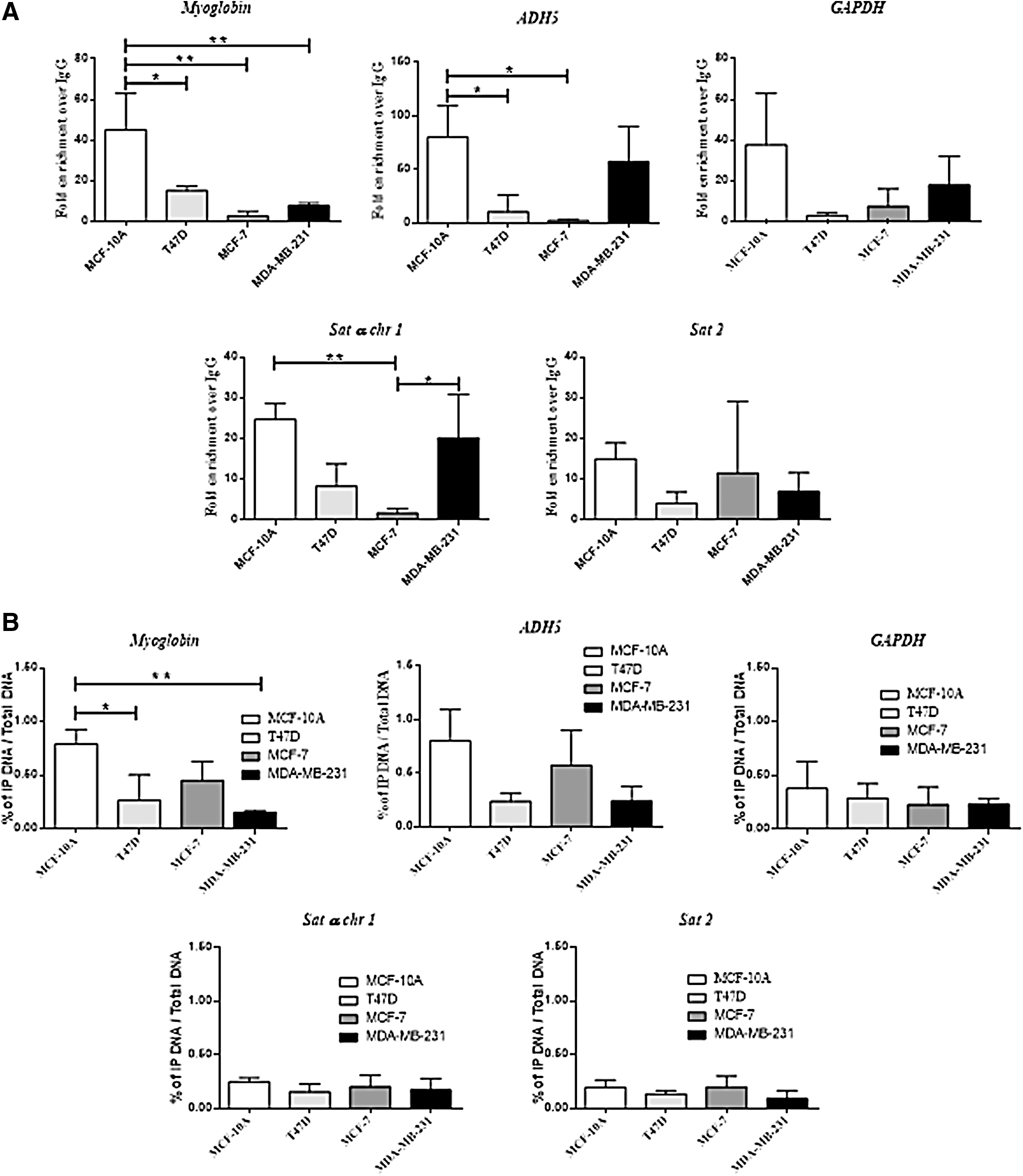
An earlier study in different molecular types of breast tumor was performed in our laboratory (Idrissou et al., 2020a). We demonstrated that there is an interaction between TIP60 and histone 4 lysine 12 acetylated (H4K12ac) in heterochromatin and euchromatin in breast tumors. To better understand these observations and the process of formation of the second skeleton TIP60/P400/H4K12ac of heterochromatin, this study was performed in breast cancer cell lines as shown and described in the figure legends. Specifically, we analyzed the variation of H4K12ac and its colocation with TIP60 in different chromatin compartments.
First, enrichment obtained by chromatin immunoprecipitation-quantitative polymerase chain reaction (ChIP-qPCR) showed that we have a higher enrichment of H4K12ac in MCF-10A noncancerous cells than in cancerous cells in heterochromatin and euchromatin. In the triple negative breast cancer (TNBC) cell line, a high level of enrichment compared with luminal cell lines on the promoters of the genes was obtained in different chromatin compartments (Fig. 1A). ChIP-re-ChIP demonstrates that there is colocalization of TIP60 and H4K12ac that does not vary in the studied breast cell lines (Fig. 1B).
The depletion induced by small interfering RNA (SiRNA)-TIP60 showed an underexpression of TIP60, which suggests that the inhibition was successful, but also an underexpression of P400 that suggests that TIP60 influences the expression of P400 in breast cell lines, except for the TNBC cell line (MDA-MB-231) where no great variation is observed (Fig. 2A). Depletion of P400 by SiRNA-P400 shows a decrease in P400 expression but no change in TIP60 expression. This suggests that the expression of P400 does not influence the expression of TIP60 in the different breast cell lines (Fig. 2A). These depletions are observed by Western blot and we can see that there is a decrease in accumulation of TIP60, H4K12ac, and P400 after SiRNA-TIP60, which confirms the observations obtained by RT-qPCR. However, a decrease in accumulation of P400 after SiRNA-P400 was observed that is not followed by a change in accumulation of TIP60 or H4K12ac (Fig. 2B).
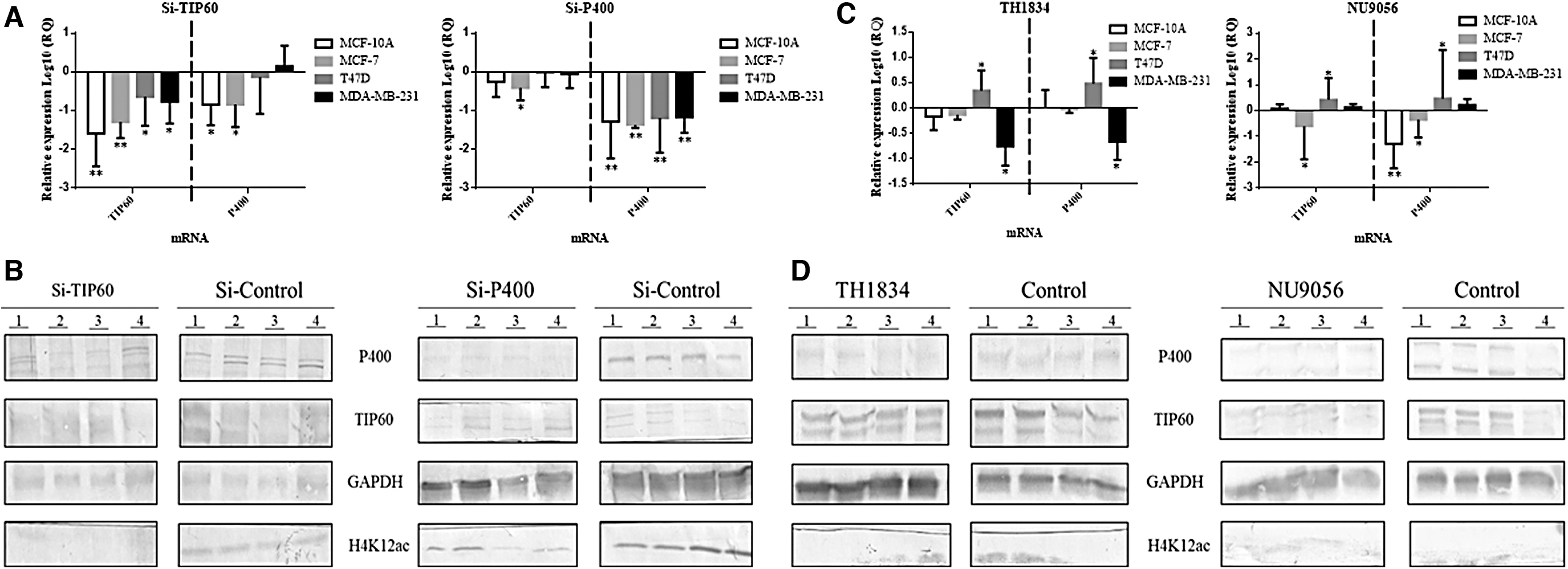
mRNA and protein expressions of TIP60 and P400 in breast cancer cell lines (MCF-7, T47D, and MDA-MB-231) and the fibrocystic breast cell line (MCF-10A).
To confirm whether these observations are due to the activity of TIP60 or to its protein expression, we inhibited the activity of TIP60 by TH1834 or NU9056. This inhibition does not show any variation in expression in the MCF-10A cell line except for the expression of P400 after inhibition with NU9056, where an underexpression was exhibited (Fig. 2C). For the inhibitor TH1834, we can see that we have the same expression profile between TIP60 and P400 in breast cancer cell lines. There is no variation in the expression of TIP60 and P400 in the MCF-7 cell line.
In the T47D cell line, we observed an overexpression of TIP60 and P400, but also an underexpression in the TNBC cell line (Fig. 2C). For inhibitor NU9056 in breast cancer cell lines, the same expression profile is observed for TIP60 and P400. In the MCF-7 cell line, an underexpression of TIP60 and P400 is observed, whereas in the T47D cell line, an overexpression is found. No variation in expression is revealed in the TNBC cell line (Fig. 2C).
Finally, the inhibition of TIP60 activity induced by TH1834 and NU9056 is shown by Western blot and demonstrates that there is no variation in TIP60 or P400, but only a decrease in the accumulation of H4K12ac in the different breast cell lines as seen in a previous study (Idrissou et al., 2020b) (Fig. 2D).
These findings collectively show that there is an interaction between TIP60 and P400, but also a link between TIP60 and H4K12ac in the different chromatin compartments, which could suggest its role in maintaining plasticity and chromatin integrity.
Footnotes
Funding Information
This study was supported by a grant from the French Ligue Régionale Contre Le Cancer—Comités du Puy-de-Dôme et de l'Allier.