




Abstract
We are currently facing and traversing in the thick of a twin pandemic: coronavirus disease 2019 (COVID-19) and disinformation. Disinformation is false information created and spread deliberately with the intention to mislead public opinion, obscure truths, and undermine trust in knowledge. The digital age we live in is quite different than the printing revolution and invention of the oil-based ink printing press centuries ago. Digital technologies can spread and repeat disinformation at extremely high speeds, while anyone, a qualified expert or not, and with internet access, can become an author. To fight disinformation, we ought to dismantle the entrenched and extractive epistemologies that act as upstream drivers and sites of disinformation production. Epistemology refers to the value-laden knowledge frames, overarching master narratives, and storylines, in which knowledge is produced. If the epistemologies in which we generate knowledge are false, then the knowledge products will be laden with disinformation. Moreover, the harms caused by disinformation can extend well beyond the immediate knowledge domain where disinformation has originated. This occurs when “false equivalence” is used as a form of rhetoric. False equivalence is a type of flawed sense making where equal weight is given to arguments with concrete material evidence, and those that are conjecture, untrue, or unjust. This article presents an analysis of the disinformation pandemic attendant to COVID-19, with an eye to its causes-of-causes: unchecked extractive epistemologies (e.g., technocracy), and the practice of false equivalence in pandemic discourses. We argue that holding the political agency of master narratives to account is essential (1) to fight the disinformation pandemic and (2) for prefigurative politics to build egalitarian and democratic societies in place of the instrumental/transactional relationships that typify the contemporary nation states and the neoliberal university whose ossified rituals lack the normative capacities for critical governance in a time of converging social, digital, and ecological crises. For liberation from disinformation, we should start with liberation from entrenched extractive epistemologies in science and society.
“In a time of deceit, telling the truth is a revolutionary act.”
- George Orwell (Venturini, 1982)
Introduction
COVID-19 is a crisis of planetary health and much more. There is another pandemic, one that is sinister and stealthy, evolving on the backstage of coronavirus disease 2019 (COVID-19), the disinformation pandemic. Disinformation is false information created and spread deliberately with the intention to mislead public opinion, obscure truths, and undermine trust in knowledge.
The concept of “truth” has undergone an insidious dissolution, over the past decade in particular (Somay, 2021). On the one hand, we have been witnessing post-truth movements and conspiracy theories in science and society that contest and deny material facts such as climate emergency. On the other hand, technocracy and essentialism in science have been on the rise in the course of COVID-19. Essentialism is a master narrative embodied in technocracy, an extractive, entrenched, uncritical, and de-contextualized epistemology that ignores the social, historical, and political contexts in which knowledge is produced and made sense of (Bayram et al., 2020; Feyerabend, 2011; Özdemir, 2020; Sarewitz, 2016).
Both post-truth and the reductionism attendant to essentialism are detrimental to veracity of knowledge. And both are on the rise with the COVID-19 pandemic.
Interestingly, while post-truth is often emphasized, and rightly so, as a driver of disinformation in planetary health and society, technocracy and essentialism that interpret science in this moment and in ways that are dogmatic and determinist were closed to critical scrutiny (Özdemir, 2020; Thorp, 2020).
Notwithstanding these tensions in science in this era of COVID-19, the proposed solutions to disinformation have been narrowly framed and technocratic in nature such as fact checking algorithms or deployment of digital health applications for population surveillance of the virus. Disinformation is, however, inherently and by definition political, particularly in an era of extreme digital transformation (Özdemir, 2018, 2021). Technology, alone, is unlikely to offer enduring and principled solutions to the disinformation pandemic.
Going forward, we need to acknowledge that disinformation is a crisis of both knowledge and epistemology. Epistemology refers to value-laden frames and framings of knowledge, the master narratives that precede and shape knowledge production (Fig. 1). In other words, epistemology is concerned with the question “how do we know what we know?”
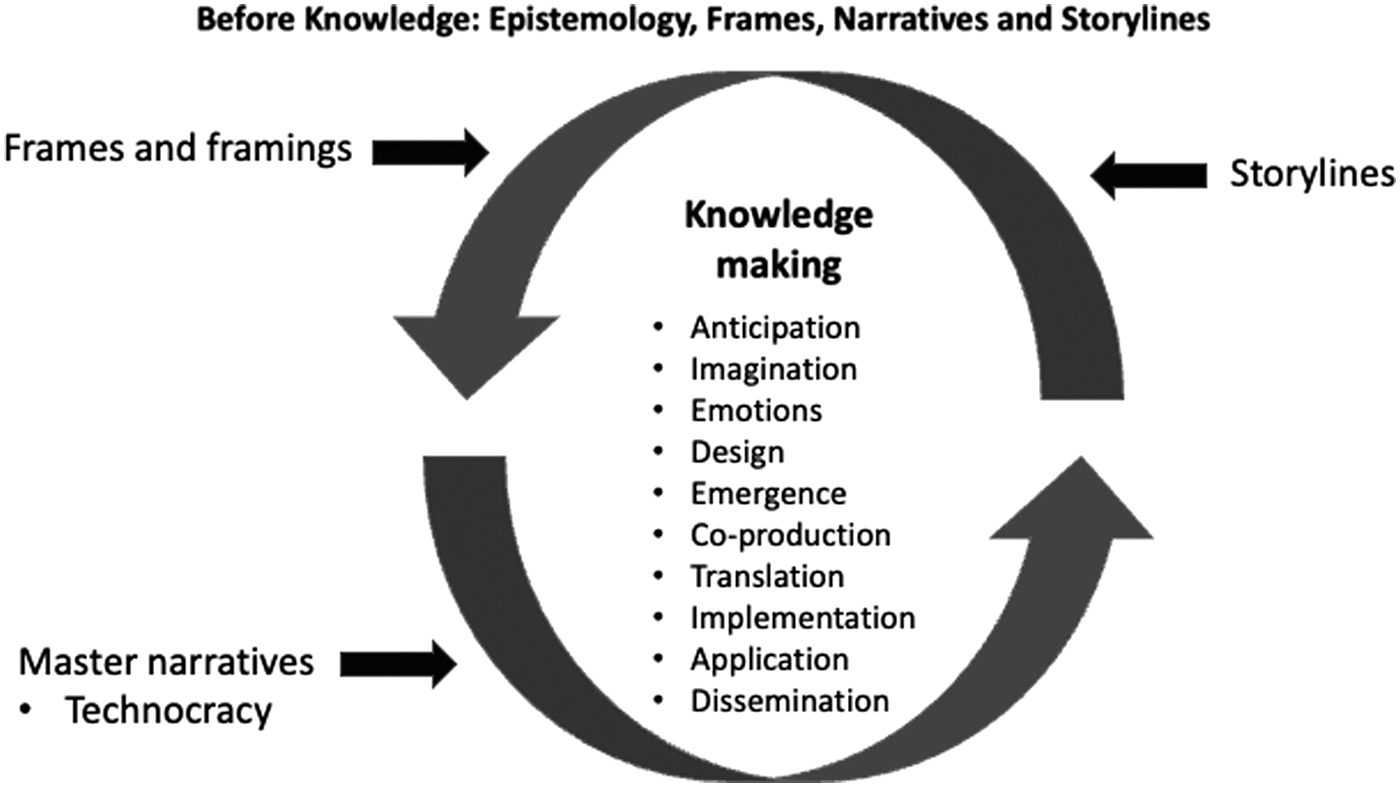
Epistemologies and their proxy master narratives and storylines serve as “scaffolds,” frames in which knowledge is imagined, emotionally triggered or suppressed, produced, and applied in science and everyday life. Epistemologies and the master narratives they embody are powerful forces that shape knowledge making.
Epistemology is, therefore, an “upstream” dimension of knowledge that is often overlooked, and one that determines the contents, production methods, actors, and legitimacy of knowledge (Özdemir, 2019). Importantly, epistemologies have political agency, and if left unchecked, they serve as the “causes-of-causes” for disinformation and loss of trust in science and medicine. If the epistemologies in which we generate knowledge are false and unjust, then the knowledge products will be laden with disinformation.
This article presents an analysis of the disinformation pandemic attendant to COVID-19, with an eye to its causes-of-causes: (1) unchecked extractive epistemologies (e.g., technocracy), and (2) the practice of false equivalence, a type of flawed rhetoric often deployed on digital media and in pandemic discourses.
Broadening the Analytical Lens on Disinformation
Throughout human history, lies and disinformation have always existed. Yet the first foray into broadening our analytical horizons is to appreciate how the rise of extreme digital connectivity, privatization, and commodification, and most recently, the COVID-19 pandemic, have collectively and literally obliterated the public sphere and spaces that allow for critical scrutiny of emerging data and information, and thus, the formation of critically informed public opinion and democratic public policies (Brabazon, 2021; Özdemir, 2018; Springer, 2011, 2016, 2020). These social, historical, and political contexts often remain unchecked within scientific cultures and are contributing to the current disinformation pandemic.
Second, to broaden our understanding of disinformation, we must recognize that democracy matters for open science, trust in knowledge, and the fight against propaganda and outright falsehoods (Von Schomberg and Özdemir, 2020). Nation-states, institutions, and communities that lack democratic governance and a critically informed public sphere are prone to disinformation because they are ill equipped to independently challenge a given body of alleged knowledge, its veracity and provenance. This is the first and most obvious relevance of democracy in the current struggles against the disinformation pandemic.
Third, instrumental/transactional relationships aimed at the commodification of technology, knowledge, and social networks, and of our bodies, inanimate objects, and all life in nature have long characterized the contemporary nation states, the neoliberal university, and institutions over the past five decades in particular. The ossified rituals of these organizations and governments, and the neoliberal forms of democracy they practice and enforce upon the public lack the normative capacities for critical governance of the disinformation pandemic in a time of converging social, digital, and ecological crises.
Fourth, to appreciate how disinformation thrives, we can look to how the responses to COVID-19 from governments have often been motivated by populist politics, playing to election cycles and interpreting the data in ways that reinforce a political line, rather than grappling with the difficulties of our limited understandings of a rapidly evolving health crisis in a transparent way. This has resulted in chaos, with health advice changing from day to day about who can do what and where. Most people just could not keep up with the ever changing content and high volume of conflicting information from governments and political leaders (Boschele, 2021).
In the face of such populist politics in governance of the COVID-19 pandemic, it has become much easier for fearful publics to do as they are told than to try and keep pace with the bewilderment of the shifting sands or engage in any form of critical public debate. And this too is a slippery slope into authoritarianism that further lends itself to disinformation.
If we look through the above larger lens, we are currently living through an interregnum where old ways of neoliberal governance of science and knowledge are dead, but the new cannot be born. This calls for prefigurative politics of direct action, mutual aid, and voluntary association to transform science and society toward radical democracies that are capable of decision-making processes, which do not play to populism, but are informed by the values, ideas, knowledge, and interests of communities who comprise them (Springer, 2014).
Prefigurative politics involves “ongoing opposition to hierarchical and centralized organization that requires a movement that develops and establishes relationships and political forms that ‘prefigure’ the egalitarian and democratic society that it seeks to create,” and importantly new definitions of community, for example, as “a network of relationships that are more direct, more total, and more personal than the formal, abstract, and instrumental relationships that characterize contemporary state and society.” (Farber, 2014; see also, Breines, 1982; Springer, 2014).
A Narrative Shift
How a core scientific term mutated and transformed like the virus itself
The prevailing science master narratives have moved on to essentialism with COVID-19. To reiterate the definition we have provided above, technocracy is “the age-old system of governance wherein decisions in science are made purely by technical knowledge, bracketing out the social and political context and the human values that co-produce scientific knowledge” (Bayram et al., 2020). Technocracy embodies essentialism as a master narrative. However, neither technocracy nor essentialism is new in science. Before COVID-19, we were already treading a slippery slope due to the sidelining of social sciences and humanities for many decades in favor of technocracy-centered, narrowly framed Science, Technology, Engineering, Mathematics STEM-based research programs de-contextualized from the societal dimension of science (Frodeman, 2020; Ozdemir et al., 2009). Yet COVID-19 and attendant extreme digital transformation in health and society have further exacerbated the predicaments of technocracy and essentialism.
For example, the word “hesitancy,” which is ordinarily an integral part of the scientific parlor, and important for interpreting any data in science or scholarly work, has mutated, like the virus itself, to new meanings. The term vaccine hesitancy, in the wake of an immense planetary health crisis, is increasingly used to refer to individuals subscribing to the antivaccine movement or post-truth claims. This is worrisome because such narrative shifts prevent adequate critical scrutiny of the pandemic-related medical products, not to mention othering of critical thinkers in science and society.
The contemporary narrative is so absolute with respect to hesitancy vis-à-vis the public heath orders, that some politicians in the Northern Territory of Australia have begun labeling anyone opposed to or questioning the vaccine mandates, even if they are vaccinated themselves, as “anti-vaxxers” (Gibson and Perera, 2021). Such attempts to foreclose public dialog and public engagement around the science of appropriate public health measures by way of derision, including focusing one's scorn on those who may well be very much pro-science, are frightening.
Social scientists and humanists have long alerted us on the politics of everyday life and the complex ways in which knowledge and false disinformation are socially and politically constructed. In social construction of the narrative shift in an otherwise core scientific term and practice, that is, hesitancy, there is also the contribution of emotions, existential fears in particular, due to the pandemic and people clinging on to the life, in the face of already existing historical and structural social injustices that caused disproportionately high adversarial impacts in marginalized communities.
Emotions can be a powerful means for social construction of disinformation and unchecked power, and often in ways that are nefarious. Seen through a lens of the field of psychosocial studies (Somay, 2021), one can then explain how emotions, fears, and populist politics of governments collectively paved the way for the rise of essentialist and technocratic narratives embedded in expressions such as “just trust in science,” which shuts down critical scrutiny of emerging or existing data and information. Such narratives built on essentialism and determinism conceptualize science in ways that are preordained and closed to independent critical scrutiny.
These extractive narratives also ignore the social and political construction of evidence itself (Ozdemir et al., 2009), and questions such as, whose evidence, funded and produced by whom, and deployed to what ends?, in evaluation of emerging health products. Are vaccines a planetary public good to end the pandemic (Von Schomberg and Özdemir, 2020), or are they a for-profit commodity that is being jealously guarded in ways that reinforce a global medical apartheid of those countries who can afford to pay, and those who cannot? (Nolen, 2021).
At 2 years into the pandemic, we might take note that new variants like Delta and Omicron are inevitable under the current corporate model of vaccine procurement and delivery. While it appears dubious and unethical to ignore large swaths of the human population, it makes good business sense as new variants mean new products and more sales.
The problem with privatization of planetary public goods such as vaccines in the current historical moment of the pandemic goes beyond unequal public access and instrumental concerns. It has a normative dimension as well by turning patients to customers, and health to a commodity, like cars or shoes. Health is a universal human right, but a commodity is not. Hence, when health is transformed to a commodity, its status as a human right is threatened.
In debates about market-based approaches to health innovation, we tend to forget that health is “part of the right to an adequate standard of living” as recognized by the 1948 Universal Declaration of Human Rights. The right to health was also recognized as a human right in the 1966 International Covenant on Economic, Social, and Cultural Rights (United Nations, 2008).
Why do the narratives that draw from essentialism have strong uptake in times of uncertainty, chaos, and planetary health crisis?
Essentialist and determinist narratives offer a temporary, but false relief for public fears through statements such as just trust science (Guston, 2004; Von Schomberg and Hankins, 2019). This essentialist approach, while making the futures in the making foreseeable and more certain in the public mind, however inaccurate the future imageries might be, the essentialist narratives bracket out and do not pay due attention to knowledge co-production by social and political systems and the power asymmetries in which science is embedded historically and in the present moment of the pandemic.
In effect, the essentialist and technocratic narratives weaken the critical scrutiny of emerging data and information, thus facilitating and deepening the disinformation pandemic. Absent a critical theory of technology, science and knowledge are at heightened risk for disinformation and manipulation of material facts (Özdemir et al., 2020).
Scholars in the field of psychosocial and cultural studies of science have long underscored that science is “never just science,” something that has been hitherto overlooked, not only for decades, but for several centuries during the course of the Enlightenment project called science:
“The scientific endeavor, since at least Enlightenment & Newton, tries to see its contributions as existing outside history and culture” (Steinberger, 2019).
For total liberation from disinformation in an era of extreme digital transformation in health and society, and future ecological crises lurking on the horizon in the 21st century, we should start with liberation from entrenched extractive epistemologies such as technocracy (Fig. 2).

Entrenchment of the extractive master narratives such as essentialism play a major “upstream” role in creation and sustenance of disinformation in the digital era in particular.
False Equivalence as Disinformation Multiplier
The harms caused by disinformation can extend well beyond the immediate knowledge domain where disinformation has originated. This situation can occur when “false equivalence” is used as a form of reasoning. False equivalence is a type of flawed sense making where equal weight is given to arguments with concrete material evidence, and those that are conjecture, untrue, or unjust.
For example, consider the climate science. It is now unequivocally established that “a global increase of 1.5C above the pre-industrial average and the continued loss of biodiversity risk catastrophic harm to health that will be impossible to reverse,” noted in a recent call by more than 200 health journals for urgent action on climate crisis (PA Media, 2021). As a form of deceptive rhetoric, false equivalence presents the disinformation by climate change deniers with dubious qualifications, as having equal weight to material facts from decades of rigorous research on climate change noted above. Of course we have seen a similar scenario play out in the fallout of the pandemic. Use of false equivalence on social media is common and broadens the reach and harms of disinformation to multiple knowledge domains.
The difficulty is maintaining a space for legitimate critical inquiry and public dialog in the face of such challenges, lest we descend into the authoritarianism of a technocratic rule of experts where science becomes its own brand of tyranny (Feyerabend, 2011).
Conclusions and a New Concept
As we face and continue to traverse in the thick of a twin pandemic with COVID-19 and disinformation, it is time we broaden our conceptual approach, including and beyond biology and technology, because pandemics often have long-standing historical and political causes-of-causes. Entrenched extractive epistemologies such as technocracy are among upstream causes-of-causes, and for the disinformation pandemic in particular. It is therefore worth reemphasizing: post-truth and conspiracy theories as well as reductionist ahistorical epistemologies/narratives such as technocracy/essentialism are detrimental to critical governance of knowledge production. They also prevent critically informed imagination and development of effective and principled solutions for the current disinformation pandemic.
Where do we go from here?
In 1980, David Collingridge wrote a prescient book on technology governance that remains relevant to date (Collingridge, 1980). He made the astute observation that new technologies become entrenched in a complex web of social, economic, and political interdependencies, and one might add, clientelism, as technologies transition from laboratory to applications in society. Seen through the lens of technology entrenchment, we need a new concept in social sciences and humanities that can adequately conceptualize and respond to epistemic entrenchment as well. This is sorely needed in an era typified with digital transformation in every facet of quotidian life, and loss of the much-needed critical public spaces.
We name this new concept here, as epistemic disobedience, a principled opposition to extractive entrenched epistemologies that threaten veracity and trust in knowledge. OMICS will soon feature a companion article on the concept of epistemic disobedience, and the ways in which it bears importance for the struggles against disinformation.
Footnotes
Disclaimer
The views expressed are the personal opinions of the authors only.
Author Disclosure Statement
The authors declare they have no conflicting financial interests.
Funding Information
No funding was received in support of this article.