




Abstract
Pharmacists play a pivotal role in pharmacogenomic (PGx) implementation in clinical practice, and their university education is considered a strong driver in holding favorable intentions toward PGx adoption. Using a survey developed based on the Theory of Planned Behavior (TPB), this study aimed to evaluate the determinants of senior pharmacy students' intentions to pursue postgraduate training in PGx and personalized medicine (PM), and with an eye to propose interventions to inform pharmacy students' career choices in the field. Students manifested considerably favorable attitudes toward PGx clinical practice and had acquired a relatively satisfactory level of knowledge. However, they conceded of having a hardly moderate level of confidence in PGx clinical application, and claimed to be moderately satisfied with their PGx training. Interestingly, students alleged to have a relatively limited interest to pursue postgraduate training studies in PGx and PM. Gender was a key and significant demographic moderator of the students' intentions to pursue postgraduate training in PGx and PM. We found that the students' attitudes exerted a strong positive impact on intentions for future PGx training, while self-confidence and training satisfaction had a moderate positive effect, respectively. We propose a set of key interventions that include, inter alia, the update of existing pharmacy curricula and the promotion of interdisciplinary collaborations with other health professionals, to reinforce the pharmacists' role in PM and PGx implementation in clinical practice. To the best of our knowledge, this is the first study using the TPB to identify the role of certain factors such as gender, attitudes, self-confidence, and training satisfaction on the final-year pharmacy undergraduate students' intentions to pursue PGx-related postgraduate studies in the future.
Introduction
Pharmacogenomics (PGx) is an important intervention that is gaining momentum all over the world. Owing to its clinical and economic benefits in drug management and patient management and experience, PGx is shown to be an important pillar for personalized medicine (PM) interventions. PGx testing results can be used to determine an optimal treatment regimen by either selecting the adequate medication or optimizing dosing, or both.
It is evident that pharmacists are among the key stakeholders in PGx implementation thanks to their qualifications, training, and expertise in drug management (Klein et al., 2017). Thus, they should play a pivotal role in the whole process by leading all efforts to improve PGx testing workflow. Based on the American Society of Health Systems Pharmacists, PGx testing results could have an impact on patients' long-term lifestyle and pharmacists could be their advocate and counselor on adapting their treatment scheme (Haidar et al., 2022). Nevertheless, the PGx adoption level remains low in clinical practice worldwide.
To deal with this challenge, it was demonstrated that pharmacists' exposure to PGx trainings helps them acquire new knowledge and ameliorate their attitudes toward PGx, a fact that may overcome the existing adoption barriers and highlight PGx significance (Kisor and Farrel, 2019; Koufaki et al., 2022). Moreover, pharmacists' societies commonly recommend that pharmacists have a basic knowledge of PGx and be familiar with the available PGx guidelines for drug response (Haidar et al., 2021). For all these reasons, the past two decades, several universities had tried to reform their curricula by incorporating courses, training sessions, and lectures focused on PM and PGx to empower the new generation of pharmacists' level of PM and PGx knowledge and to implant the idea of lifelong training (Kisor and Farrel, 2019) by introducing new pedagogies and teaching methods. Evidently, several institutions and organizations had created guidelines and set teaching standards in terms of PGx material in pharmacy schools (Coriolan et al., 2019).
Even if there are many initiatives in place, there has been a paucity of research interest to investigate pharmacy students' intentions to continue postgraduate studies or training on PM or PGx and the factors that affect it. Indeed, most published literature mainly focus on factors influencing pharmacy students' intentions to complete an internship or residency rather than a postgraduate course (Dupuis et al., 2016; Haghparast et al., 2020; Hickerson et al., 2017).
However, there are a few studies that investigate pharmacy students' willingness for postgraduate PGx training, but their findings were not uniformly consistent (Jarrar et al., 2019; Mahmutovic et al., 2018; Makrygianni et al., 2023; Shah et al., 2022). For instance, according to Mahmutovic et al. (2018), 66% of pharmacy students would like to continue their studies in PM, a finding that is similar to that by Shah et al. (2022), while in the study by Makrygianni et al. (2023), they were more reluctant. Makrygianni et al. (2023) also demonstrated that senior pharmacy students differentiated from the rest of their cohort in terms of attitudes, self-confidence, and intention to pursue a postgraduate training. More precisely, senior students were less willing to continue their studies in the field, and while in case they did, they preferred short courses or seminars.
Taking into consideration that they had acquired a short professional experience based on a 1-year internship in a pharmacy setting, this might have negatively impacted their intentions for further expertise to get involved in the field and expand their knowledge, since the PGx adoption rate still remains low.
Nonetheless, graduating or senior year pharmacy students are a unique cohort to take into consideration. They can serve as a model “inflection point” to try new educational interventions that can potentially inform their lifelong career, as they are about to take their professional steps as the next generation of pharmacists. Understanding their attitudes, opinions, and intentions to pursue postgraduate studies in the field is crucial for the academic community so that the students can make informed choices for postgraduate studies, including in PGx.
Using a survey developed based on the Theory of Planned Behavior (TPB), this study aimed to evaluate the determinants of senior pharmacy students' intentions to pursue postgraduate training in PGx and PM, and with an eye to propose interventions to strengthen their interest in making informed career choices in the field.
Materials and Methods
Survey instrument
This study used a questionnaire survey to examine the effect of chosen factors on pharmacy senior student's intentions to strive for PGx and PM-related training after graduation. The selected factors emerged from the prior research and interviews with pharmacy students and experts in relevant disciplines. Moreover, our questionnaire was developed on the TPB conceptual basis. The TPB is a theory widely utilized to explore health science students' intentions for further education, supporting that our intentions for future behavior are influenced by our attitudes on this issue (Haghparast et al., 2020; Heath et al., 2022; Hickerson et al., 2017; Tsai and Yan, 2021).
Literature review divulged that students' attitudes toward PGx and PM adoption and implementation are associated, inter alia, with their self-confidence in implementing PGx in clinical practice, the satisfaction from their education on this topic, and their level of knowledge (Cheung et al., 2021; Coriolan et al., 2019; Grace et al., 2021; Jarrar et al., 2019; Karas Kuželički et al., 2019; Mahmutovic et al., 2018; Nagy et al., 2020; Rahma et al., 2021).
The questionnaire design involved a multistage process as described previously by our team (Makrygianni et al., 2023).
All questions were close-ended, utilizing a 7-point Likert scale for the first five questionnaire sections, while students stated their agreement, disagreement, or unawareness with the 10 statements appraising their level of knowledge at the sixth section (Supplementary Data). At the beginning of the questionnaire, students were informed about the survey purpose and objectives, were given definitions of PM and PGx, and were assured about the anonymity of their identity and that data will be treated confidentially exclusively for academic purposes. The time to complete the questionnaire was ∼10 min.
This research, survey design, and questionnaire were reviewed and approved by the Research Ethics Committee of the University of Patras (13254/2022).
Study sample
Study sample included 96 senior students from the Department of Pharmacy of the University of Patras, Greece, representing the majority of the ∼110 active students of this study year. All students attending lectures were invited and the consenting students requested to fill in the questionnaire at lecture breaks during April 2022. Among the participants, 66% were female, in accordance with the gender distribution of the corresponding study year's population (Fig. 1). Two-thirds of the sample alleged to receive chronic medication themselves or a family member. Moreover, around 90% of the students stated that they (or a close relative) had not a recent PGx or genetic test, and around 10% of them also claimed to have another BSc degree.
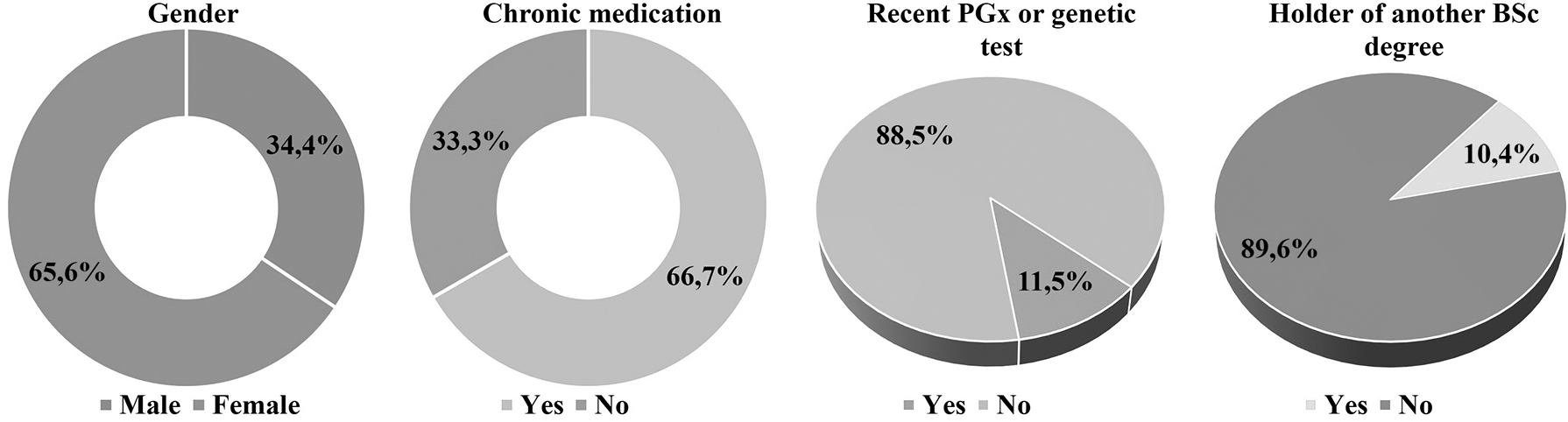
Description of study sample (N = 96).
Data analysis
Data analysis was performed by the SPSS and AMOS statistical programs (both versions 28; IBM). Initially, it involved the computation of frequencies and percentage of valid answers (valid %), and descriptive statistics. The nonparametric test of Mann–Whitney was used to examine any statistical differences between student demographic groups, as the survey data were not normally distributed according to the Kolmogorov–Smirnov test applied.
The effects of the selected factors, as well as demographics, on seniors' intentions of seeking postgraduate training in PGx and PM, were measured by structural equation modeling (SEM) analysis (IBM AMOS: generalized least-squares [GLS] method for parameter estimation, regression coefficient estimation, and statistical fits of the structural model evaluation) (Kline, 2016). Precedently, model fit statistics (chi-square statistics/degree of freedom [CMIN/DF], comparative fit index [CFI], Tucker–Lewis index [TLI], normed fit index [NFI], incremental fit index [IFI], relative fit index [RFI], root mean square error of approximation [RMSEA], standardized root mean square residual [SRMR]) by confirmatory factor analysis (CFA) and the factor loadings of each factor were calculated to explore the relationship between the latent variables and their measures in the context of the measurement model analysis. Cronbach's alpha and composite reliability (CR) test measured the selected factors' construct reliability.
Convergent validity was assessed by constructs' average variance extracted (AVE), and discriminant validity by the heterotrait–monotrait ratio of correlations (HTMT) method. Finally, the Harman's single-factor test was applied to investigate the possible influence of common method variance (CMV) (Collier, 2020).
Results
Evaluation of teaching tools
Students evaluated the teaching tools used in their PGx and PM training as moderate to rather useful (Fig. 2 and Supplementary Table S1 in the Supplementary Data). Supplementary Data in e-class were appraised as the most valuable tool, closely followed by lectures with mean values 5.0 and 4.8, respectively. Books, laboratory exercises, and online educational material were considered moderately effective, as their mean values ranged from 4.1 to 4.3. Optional assignments and research articles were perceived as the least useful teaching tools (mean 3.6–3.7).

Mean and standard error of means of student answers.
Student evaluation of teaching tools may be influenced, to some extent, by their experience from the COVID-19 restriction measures implemented during almost half of their study duration, which also affected the educational processes. Gender was the sole demographic characteristic to have an effect on students' evaluation of lectures, e-class material, and optional assignments (Supplementary Tables S2–S5 in the Supplementary Data), with female students claiming to be considerably more pleased than men (difference of means ranging from 0.6 to 1.2, on the 7-point scale).
Satisfaction with PGx training
Students stated to be moderately satisfied with their training about the PGx clinical implementation. The mean values of the three relevant statements, concerning the satisfaction from theoretical and laboratory training, and overall from department's curriculum, varied from 3.8 to 4.1, as only 30–40% of students agreed with them, and around 30% of the participants kept a neutral stance (Fig. 2 and Supplementary Table S1 in the Supplementary Data). The Mann–Whitney U test revealed that students' satisfaction with their PGx education was not associated with any of their demographics examined (Supplementary Tables S2–S5 in the Supplementary Data).
Self-confidence in implementing PGx in clinical practice
Senior students conceded of having a hardly moderate level of confidence in PGx medical application. Only 25–35% of them answered 5–7 (extremely confident), and the pertinent clauses' mean varied from 3.3 to 3.8, below the medium (4) of the 7-point Likert scale (Fig. 2 and Supplementary Table S1 in the Supplementary Data). They professed higher confidence in recommending a PGx test to a patient and discussing PGx test results with a physician than determining the therapeutic areas where PGx testing is necessary. Two independent samples test revealed that none of the participants' demographics affected their self-confidence (Supplementary Tables S2–S5 in the Supplementary Data).
Attitudes-intentions for PGx implementation
Senior students manifested considerably favorable attitudes for PGx medical practice, with nearly three-quarters of them agreeing that PGx should be an important part of pharmacy students' curriculum (mean 5.3) and that they would recommend PGx testing to patients or a family member (mean 5.0 and 5.1) (Fig. 2 and Supplementary Table S1 in the Supplementary Data). In addition, participants held a quite positive stance on updating their PGx knowledge, incorporating PGx testing in patient care, and undergoing a PGx testing in the future, as approximately half of them agreed with the related statements, and the mean values were around 4.4–4.5. Women were more supportive than men concerning the significance of PGx in their curriculum, as well as intending to be updated about future advances in the field and to integrate PGx in patient care. The rest of student demographics were not correlated with any of the attitudes' items.
Intentions for postgraduate training in PGx and PM
Students claimed to have a relatively limited interest to attend postgraduate studies in PGx and PM, as only a quarter of them agreed, and indeed very few (5%) totally agreed with the relevant statement (mean 3.3). However, they appeared considerably more inclined to attend relevant certified training or information programs, as more than half of them agreed with the corresponding sentence and only less than one-third disagreed (mean 4.4) (Fig. 2 and Supplementary Table S1 in the Supplementary Data). Female students were by far more predisposed than male to both attending postgraduate studies and training/information courses on PGx and PM, since the difference of means between these two groups approximated 1.4, on the 7-point scale (Supplementary Tables S2–S5 in the Supplementary Data).
Level of knowledge in PGx and PM
Graduands appeared to have acquired a quite satisfactory level of knowledge in PGx and PM, measured by the total number of correct answers to 10 relevant clauses. The mean of student knowledge index was 6.3 (standard deviation = 1.7). Almost three-quarters of the respondents scored between 5 and 8, and nearly 8.5% of them 9 or 10. More than 80% of the participants answered correctly in the 5 statements concerning the basic knowledge about PGx and PM (Fig. 3 and Supplementary Data). Rather interestingly, senior students shared a rather high level of self-awareness regarding their knowledge, as they mostly preferred to profess their lack of knowledge than giving a wrong answer to the other five statements related to more advanced PGx and PM issues.

Frequencies (%, N = 96) of students' valid answers to each statement of knowledge about PGx and PM. PGx, pharmacogenomics; PM, personalized medicine.
This finding is congruent with their self-confidence results since they alleged to be hardly moderately confident in implementing PGx in clinical practice. Moreover, statistical analyses indicate that seniors' level of knowledge was not affected by their demographics (Supplementary Tables S2–S5 in the Supplementary Data).
Factors affecting student intentions for postgraduate training in PGx and PM
The CFA appraised the measurement model, which consisted of the following four factors: Training Satisfaction, Self-Confidence, Attitudes, and Intentions. The level of knowledge was not included in the measurement model since it was estimated by an index (0–10). The model's overall goodness of fit was evaluated by the relevant model fit measures, all of which were found within or very close to the equivalent acceptance levels, namely CMIN/DF = 1.323 < 3–5, CFI = 0.969 ≥ 0.90, TLI = 0.960 ≥ 0.90, NFI = 0.887 ≈ 0.90, IFI = 0.970 ≥ 0.90, RFI = 0.855 ≈ 0.90, RMSEA = 0.58 (0.016–0.088) < 0.08, and SRMR = 0.063 < 0.08 (Collier, 2020; Kline, 2016).
Factor loadings for all items of the examined factors were much higher that the recommended threshold of 0.5, and thus, all of them were included in the next steps of analysis (Supplementary Table S6 in the Supplementary Data). However, ATT1 item (PGx should be an important part of pharmacy students' curriculum) was removed from further analyses because its factor loading (0.52) was just above the threshold and, mainly, to meet better the recommended acceptance levels of all measures of model's overall goodness of fit. In addition, ATT6 item (I would recommend pharmacogenomic testing to a family member) was discarded due to its high correlation with ATT5 item (0.865).
The construct reliability of the constructs included in the model was assessed by Cronbach's alpha and CR (Supplementary Table S6 in the Supplementary Data). Constructs' Cronbach's alpha values ranged from 0.81 (Intentions) to 0.90 (Self-Confidence), well above the usually accepted cutoff point of 0.70 (Nunnally and Bernstein, 1994). CRs were also quite higher the recommended value of 0.70, varying from 0.81 to 0.88 (Hair et al., 2010). The calculated values of factors' AVE affirmed the model's convergent validity, as they were higher than the established limit of 0.5 (Fornell and Larcker, 1981). The HTMT ratios ranged from 0.11 to 0.78 (Supplementary Table S7 in the Supplementary Data), below the threshold of 0.85 (Henseler et al., 2014), verifying the model's discriminant validity.
Finally, the common method bias was not a peril to the validity of our research findings, since according to the Harman's single-factor test, the total variance for a single factor was 42.55%, below the suggested benchmark of 0.5 (Fuller et al., 2016; Podsakoff et al., 2003).
Gender was included in SEM analysis, as a control variable, considering that female students hold more positive attitudes and expressed more favorable intentions for postgraduate training in PGx and PM than their male classmates. Figure 4, Table 1, and Supplementary Table S8 in the Supplementary Data depict the SEM analysis key results. First, the values of the global fit statistics are within or very nearby the critical thresholds, and the coefficient of determination (R2) was 0.62, implying a good model fit. The sole factor directly affecting seniors' intentions for postgraduate education in PGx and PM was attitudes. Indeed, attitudes' effect on intentions is considerably high and positive, given that its standardized regression weight was 0.69.

Synoptic SEM diagram of the factors influencing fifth-year pharmacy students' intention to pursue postgraduate training in PGx and PM. SEM, structural equation modeling.
Standardized Direct, Indirect, and Total Effects for the Fifth-Year Students' Structural Equation Modeling Model
Self-confidence, training satisfaction, and level of knowledge influenced senior students' intentions only indirectly. Self-confidence displayed a quite moderate positive impact on intentions (standardized total, and indirect, effect 0.44), due to its strong positive effect on attitudes (standardized regression weight 0.64). The training satisfaction's positive effect was rather low (0.12) and the level of knowledge's negative influence is practically marginal (−0.03). In accordance with the Mann–Whitney U test results, gender affected significantly seniors' intentions both directly and indirectly, given that women were more favorable to continue their studies and attend training programs, and expressed more positive attitudes toward PGx and PM than men.
Discussion
To the best of our knowledge, this is the first study using the TPB to examine the impact of selected factors (e.g., attitudes, gender, knowledge, self-confidence, training satisfaction) on final-year pharmacy undergraduate students' intentions to pursue PGx-related postgraduate studies in the future. Our study showed that final-year pharmacy students had a positive attitude toward PGx implementation in clinical practice and they were aware of PGx clinical and economic benefits in disease management. Their level of knowledge was satisfactory, but their level of training satisfaction was rather low. Students' intention to pursue postgraduate studies in the field was rather weak, whereas they were more predisposed for certified training or information programs. It was also illustrated that factors such as attitudes and self-confidence exerted a greater impact on their intentions to pursue postgraduate studies followed by training satisfaction and gender.
Based on our findings, gender is a key variable of our model and a significant demographic moderator. Females shared a more positive attitude and were more prone to pursue a postgraduate degree in the field compared with their counterparts, a finding that agrees with prior research (Filiptsova et al., 2015; Jarrar et al., 2019; Shah et al., 2022).
Moreover, senior students had a good level of knowledge, but they were lacking evidence-based training, since most students (almost 65%) did not answer correctly or were not aware of specific and more practical questions. Thus, not surprisingly, senior students alleged low self-confidence and were not ready to implement PGx-related activities in their future clinical practice. This finding is congruent with the literature. Bank et al. (2018) found that only 27.7% of pharmacist students thought that they were adequately trained and prepared to interpret PGx testing data, and change medication or dosage, while based on a recent systematic review of Li et al. (2023), in most reported studies less than 40% of pharmacy students claimed to feel confident to implement PGx testing results for a patient drug management.
Moreover, senior students were not satisfied with the training methods and material provided during their undergraduate studies and it was demonstrated that they preferred less theoretical teaching methods.
In accordance with Bukic et al. (2022), a quarter of the respondents were also interested in topics focusing more on clinical applications and evidence of PGx in clinical practice, a fact that pointed students' preferences. By adding an elective course in PM or PGx with advance material and case studies in this field, students will gain more insight into and be better prepared for a postgraduate program, a fact that is supported by Coriolan et al. (2019). Furthermore, it is highly important to further reinforce the existing national and, especially, international collaborations between research laboratories focusing on PM and genomic projects, and to set agreements for students' exchange programs or placements. Students would obtain more solid laboratory-based experience and develop their research skills.
Senior students shared a positive attitude toward PGx implementation in their clinical practice, a fact that is also indicated in Jarrar et al.'s (2019) study in which the vast majority of Palestinian pharmacy students (82.4%) were interested in adopting this intervention in their future clinical career. Similarly, Shah et al. (2022) pinpointed that most of the students were convinced that PGx will play a determining role in the future and were willing to apply PGx along with its interventions in a clinical setting. In addition, almost 60% of Pakistani students were thinking of continuing their studies in the PGx field via a postgraduate program, a finding that comes in contrast with our reported results.
In general, a favorable attitude and a good level of knowledge can positively influence student's intentions to pursue postgraduate studies (Mahmutovic et al., 2018), but in our case, students were more reluctant to pursue postgraduate studies and they would prefer to attend a seminar or a short course rather than a full course.
This tendency does not necessarily show that senior students have a low interest in postgraduate studies. Interestingly, it pinpoints that students may be unaware of all the available short or full courses, seminars, lifelong learning opportunities, and even upstream educational interventions offered. This is especially the case for PM and PGx training since radical advances take place constantly and new educational opportunities continuously emerge. For example, during the last 2 years, new PM postgraduate courses were launched in Greece to fulfill the academic and professional needs of pharmacists and other health professionals.
In this line, it is also pivotal to enhance the role and engagement of universities' career offices. To do so, organizing annually a career day event at a university's premises and hosting career specialists, human resource specialists, and key opinion leaders would help students to get informed about the available professional or academic pathways that they can follow upon graduation. During this event, it would be beneficial to include presentations dedicated to PM and PGx career opportunities to highlight this field's increasing importance in clinical practice and patient management.
In general, a key conclusion emerging from the survey results is that it is vital for senior students to understand and get convinced of the importance of pharmacists' role in PM implementation in clinical practice. To boost their role, it would be essential to promote interdisciplinary collaboration between different disciplines, even during studies, which will enhance senior students' self-confidence and improve their teamwork spirit and competence in working with others. For this reason, other courses should adhere to PM and genomic material in their content to emphasize that all disciplines are associated with PM and PGx. For instance, many pharmacy schools have already included courses (mandatory or elective) in health care interventions' evaluation (pharmacoeconomics) to prepare students for another professional perspective.
Given that all health technology interventions should be evaluated by national bodies using pharmacoeconomic studies before being reimbursed, it is significant for students to be informed about their indispensable role in these studies and suitably trained in that too.
Limitations
A study cohort represents pharmacy students from one university in Greece with a limited number of participants (n = 96), although the participation rate was ∼90%. However, based on R2 results, our proposed model fits in the cohort with robust reliability. In the future, studies in other universities, world regions, and with larger sample sizes are called for with senior pharmacy students.
Conclusions
PGx is a salient and promising PM application that can change the future of drug management in pharmacy clinical practice. Despite PGx clinical evidence, its adoption rate remains low. Senior pharmacy students have a very positive attitude on PGx clinical implementation and were willing to implement it, but they were reluctant to be specialized on it by pursuing postgraduate studies on the topic. In addition, they were not adequately satisfied with the available teaching tools and material, while they lack more practical knowledge. For this reason, it is crucial to implement key strategic interventions that will update the existing curricula to reinforce the pharmacist role and clinical significance of PM and PGx in clinical practice and provide them with a clear picture of the current available education opportunities in PM and genomic field. Moreover, living in a rapidly changing world, it is important to promote interdisciplinary collaborations and broaden students' horizons. PGx and PM require the collaboration of medical doctors with pharmacists and other health professionals. Finally, including courses on science communication and navigation and negotiation of the science and society interface in their curricula would, inter alia, enhance students' soft skills in advancing patient-centered high-value services in pharmacy, PGx, PM, and beyond.
Footnotes
Authors' Contributions
M.-I.K.: conceptualization; methodology; and writing—original draft, review, and editing. D.M.: methodology and writing—review and editing. G.P.P.: conceptualization (supporting); writing—original draft (supporting); and writing—review and editing. K.Z.V.: conceptualization; methodology; software (lead); formal analysis (lead); and writing—original draft, review, and editing.
Author Disclosure Statement
The authors declare they have no conflicting financial interests.
Funding Information
No funding was received for this report.

Abbreviations Used
References
Supplementary Material
Please find the following supplemental material available below.
For Open Access articles published under a Creative Commons License, all supplemental material carries the same license as the article it is associated with.
For non-Open Access articles published, all supplemental material carries a non-exclusive license, and permission requests for re-use of supplemental material or any part of supplemental material shall be sent directly to the copyright owner as specified in the copyright notice associated with the article.
