




Abstract
Systems biology and multiomics research expand the prospects of planetary health innovations. In this context, this mini-review unpacks the twin scholarships of glycomedicine and precision medicine in the current era of single-cell multiomics. A significant growth in glycan research has been observed over the past decade, unveiling and establishing co- and post-translational modifications as dynamic indicators of both pathological and physiological conditions. Systems biology technologies have enabled large-scale and high-throughput glycoprofiling and access to data-intensive biological repositories for global research. These advancements have established glycans as a pivotal third code of life, alongside nucleic acids and amino acids. However, challenges persist, particularly in the simultaneous analysis of the glycome and transcriptome in single cells owing to technical limitations. In addition, holistic views of the complex molecular interactions between glycomics and other omics types remain elusive. We underscore and call for a paradigm shift toward the exploration of integrative glycan platforms and analysis methods for single-cell multiomics research and precision medicine biomarker discovery. The integration of multiple datasets from various single-cell omics levels represents a crucial application of systems biology in understanding complex cellular processes and is essential for advancing the twin scholarships of glycomedicine and precision medicine.
Mini-Review
Over the past decade, the planetary health landscape has been laden with a dynamic kaleidoscope of prospects and challenges (Kelly et al., 2021; Laganà et al., 2024; Singer, 2017; and Yetiskin, 2022). On the one hand, multiomics research has expanded the possibilities for systems thinking and innovation in health systems and services, preventive medicine, and ecosystem health (Anwar et al., 2024; Kolenc et al., 2021; Peluso et al., 2024; and Robinson et al., 2024). Moreover, there has been a growing recognition of the linkages between public health and biodiversity, and the attendant needs to conduct rigorous research on the socioecological determinants of health and disease (Robinson et al., 2024). On the other hand, we witnessed a marked rise in severe health conditions, socioeconomic burdens, and escalating stress levels, not to mention the COVID-19 pandemic and the rise of zoonotic infections that jump from animals to humans (Wang et al., 2021).
Consequently, there has been a pressing need to explore novel biomarkers and shift toward more precise methods for early prediction, prevention, and personalized medicine (PPPM) in planetary health. Although personalized medicine has traditionally focused on drug–gene interactions, the underlying reasons behind individual variations in disease and medication responses have remained elusive. This underscores the need for a broader perspective beyond genomics. Integrating insights from glycomedicine and multiomics technologies is essential for driving innovative advances in this field.
Glycans, complex carbohydrates, are one of the four fundamental building blocks of life, alongside nucleic acids, proteins, and lipids. Comprised of simple sugar molecules called monosaccharides, glycans have diverse roles in cellular processes and disease mechanisms because of their modifications and unique arrangements (Ozdemir et al., 2020). These structural variations include glycosylic linkages, the position of the hydroxyl group on the anomeric carbon, the number and type of constituent monosaccharides, and the degree of branching (Wang, 2023a). Although nucleic acids and proteins are well established through the central dogma, the functions of glycans are still being elucidated, leading to the term “paracentral dogma,” reflecting the ongoing exploration of the roles of glycans in biology.
Research into the role of the sugar codes in the cell’s sociomateriality has been expanding, suggesting a novel dimension where glycans could represent a third code of life in molecular biology. Glycomedicine is a new field in medical science that uses glycomics techniques to enhance disease diagnostics, facilitate drug discovery, and improve PPPM strategies (Wang, 2023a). Glycomics involves systematic exploration of all glycan structures and sequences within specific cell types and organisms.
Unlike the traditional central dogma governing protein formation through gene transcription and translation, glycans are synthesized independently. This process, termed “glycosylation,” involves multiple enzymes that covalently attach or remove sugar moieties to proteins, primarily occurring in the endoplasmic reticulum and Golgi apparatus (Ma et al., 2018). Glycosylation affects over 50% of cellular proteins, representing a common and diverse form of post-transcriptional modifications (Wang, 2023b; Wang, 2019). It can be classified into types including N-glycosylation, O-glycosylation, C-glycosylation, glypiation, and phosphoglycosylation, based on how glycans bind to proteins, profoundly influencing protein structure, function, stability, folding, half-life trafficking, solubility, and interactions with other proteins (Wang, 2023a, 2023b). Through these processes, glycans play critical physiological roles as signaling molecules, mediating both intra and intercellular communication and coordinating biological networks in diverse disease and health contexts.
Glycans respond to various environmental, biological, and disease triggers, reflecting both pathological and physiological conditions (Miura and Endo, 2016). Disruptions in glycogenes, which encode for enzymes involved in glycosylation, or enzyme deficiencies can alter glycan structures that have been linked to a spectrum of major diseases including cancer, metabolic syndrome, infectious disease, autoimmunity, coronavirus disease 2019, and aging (Reily et al., 2019; Yu and Wang, 2021). Therefore, understanding the modifications, structures, and functions of glycans is crucial for unraveling their significance in health and disease, highlighting their pivotal role as the third life code alongside nucleic acids and amino acids.
Despite their significance in health and disease, glycans have not received as much attention as DNA and proteins, which can be attributed to two main reasons in our view. First, their structures are complex and heterogeneous and lack a direct template, unlike the finite-length genome that can be easily synthesized based on complementary base pairing (Ozdemir et al., 2020). Second, despite advancements in large-scale glycoprofiling techniques (Table 1), which facilitate the separation and identification of glycan populations, and thus improving the availability of extensive repositories of biological samples and glycoproteins supporting worldwide access to glycan research resources, these sophisticated methods are not yet widely adopted and require skilled personnel for experimentation and data analysis.
High-Throughput Techniques for Glycoprofiling
As glycomedicine progresses in understanding the complexities of glycans’ heterogeneity, single-cell technologies are positioned to emerge as key tools for glycoprofiling at the cellular level to capture diverse glycan expression within cells and discovering biomarkers. Unlike conventional bulk RNA sequencing, which averages gene expression across cells, potentially masking cellular diversity, single-cell RNA sequencing (scRNA-seq) provides insights into cellular heterogeneity and disease mechanisms. In recent years, single-cell technology has gained popularity, driven by advancements in two key dimensions: (1) improved protocols and cost reductions, enabling the study of larger patient cohorts, and (2) ongoing technical innovations have augmented the depth and breadth of information through integration with genomics, transcriptomics, and proteomics. This innovative approach unravels complex multicellular interactions, providing detailed insights into diverse molecular profiles at the cellular level, essential for personalized medicine and broader systems biology research endeavors.
However, the current technology falls short in systematic mapping connections between glycomics and other omics disciplines, primarily because of the challenge of amplifying glycans (Oinam and Tateno, 2022). For instance, O-GlcNAcylation, a post-translational modification linked to epigenetics, lacks a comprehensive understanding of its relationship with histone modifications and cell-specific regulation (Lu et al., 2022). In addition, it has been argued that genomics alone cannot fully unravel the biological determinants of type 2 diabetes mellitus (T2DM), emphasizing the importance of epigenetic regulation and post-translational modifications (Liu et al., 2019). These limitations highlight the critical need for advances in single-cell multiomics approaches to bridge the gap and elucidate the intricate interplay between glycans and other molecular processes.
Recent challenges have been tackled by the emergence of innovative technologies, including surface-protein glycan and RNA-seq (SUGAR-seq) and glycan and RNA in single cells (scGR-seq). Both methodologies use lectins conjugated with DNA barcodes (DNA-barcoded lectins), leveraging lectins’ specificity and affinity for glycans to facilitate carbohydrate–protein interactions and glycan separation (Haab and Klamer, 2020). As illustrated in Figure 1, both methods provide single-cell profiles of both glycans and gene expression in individual cells by next-generation sequencing (NGS). Although SUGAR-seq focuses on surface protein glycans and their interaction with genes, scGR-seq offers a more comprehensive view of glycan and RNA profiles within individual cells. This expanded capability is made possible by a library of 40 lectins that react with various glycans (Odaka et al., 2022).
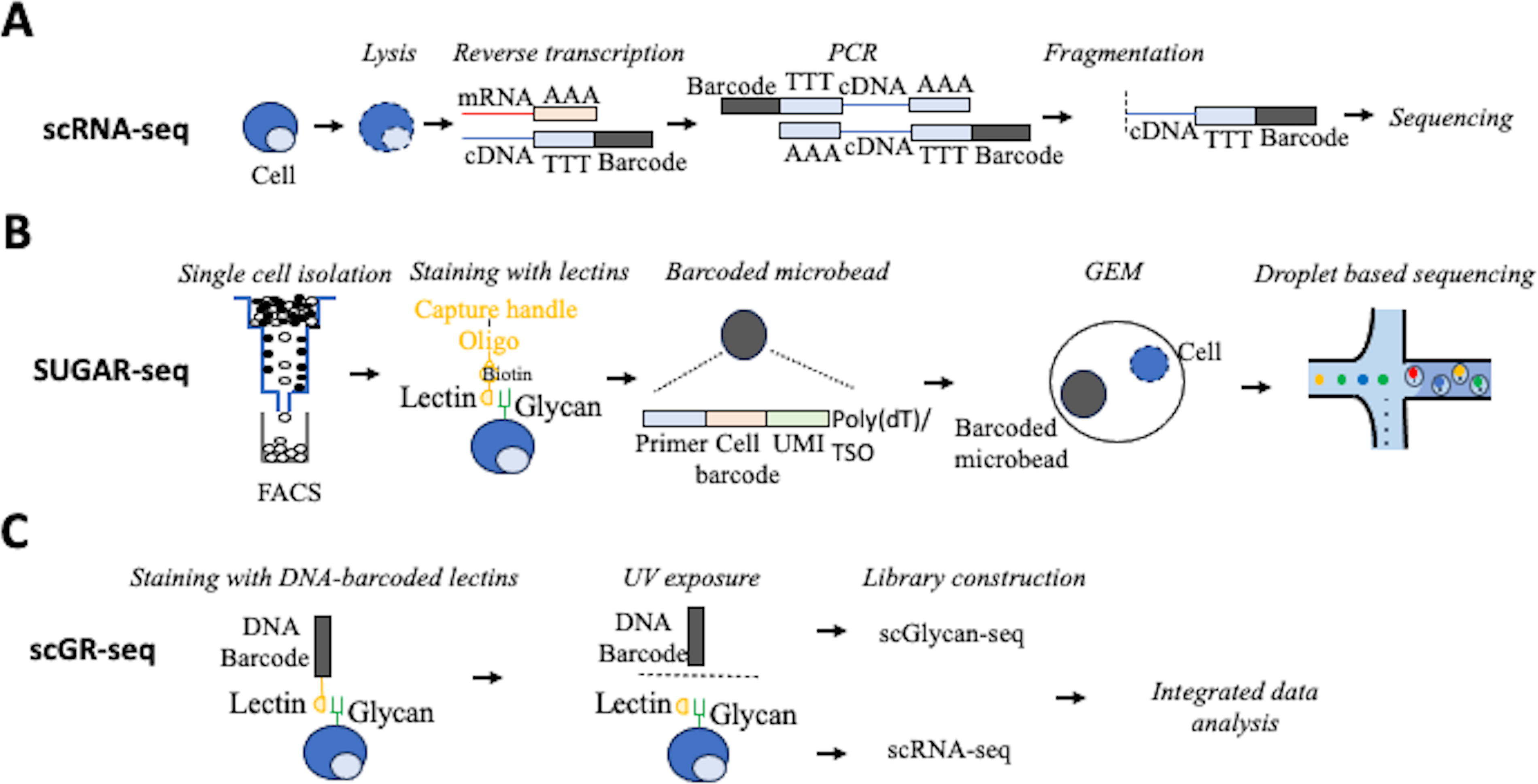
Schematic representation of experimental workflow of
The integration of unique DNA barcodes to lectins is pivotal as it allows for sample multiplexing, facilitating the identification of individuals cells and precise recognition of lectins. This capability enables discrimination between structural isomers such as anomers and linkage isomers of glycans, thereby predicting glycan profiles within heterogenous cell populations and translating glycan information into gene information (Kearney et al., 2021; Odaka et al., 2022). Furthermore, this facilitates the development of glycan markers of rare cells such as circulating tumor cells and cancer stem cells while aiding in the investigation of glycans’ soles in intracellular and intercellular communication.
However, significant limitations persist in the field. A primary concern is throughput, whereas scGR-seq enables full-length total RNA sequencing; it is limited to processing hundreds of cells owing to its plate-based platform. In contrast, droplet-based methods like SUGAR-seq can handle thousands of cells but only target 3′ ends of poly(A) transcripts. Therefore, continued innovation is required to improve the capture, amplification, and bioinformatics analysis of single-cell glycans transcriptomics. Moreover, there is a need to broaden this integration to combine glycan analysis with other omics data. For example, integrating spatial information with glycan research yields detailed glycan expression patterns within tissues, elucidating tissue-specific glycan functions and disease pathology. Similarly, merging chromatin and glycan data provides critical insights into how glycan modifications impact chromatin structure and accessibility, thereby influencing gene expression and cellular functions.
Exploring these connections is crucial for gaining deeper insights into the complex realm of glycans and their multifaceted roles in precision/personalized medicine. Analyzing these modalities simultaneously in single cells could improve our understanding of cellular heterogeneity, functional insights of glycans, cell–cell interactions, and the identification of rare cell markers. In this context, glycosylation is emerging as a fundamental pillar of biology, thus shaping our understanding of cellular processes and disease mechanisms and playing a pivotal role in advancing the twin scholarships of glycomedicine and precision/personalized medicine.
Footnotes
Acknowledgments
We thank the editor and anonymous reviewers for their constructive comments on the article.
Authors’ Contributions
S.O. wrote the original draft and edited it. S.O., W.C., and M.S. contributed to the discussion of the topic and conceived the original idea. All authors contributed to the drafts and approved the final article.
Author Disclosure Statement
The authors declare that there are no conflicting financial interests.
Funding Information
This work was supported by the Western Australian Future Health Research and Innovation Fund (Grant ID WANMA/Ideas2023-24/10) and an Australia-China International Collaborative grant (