




Abstract
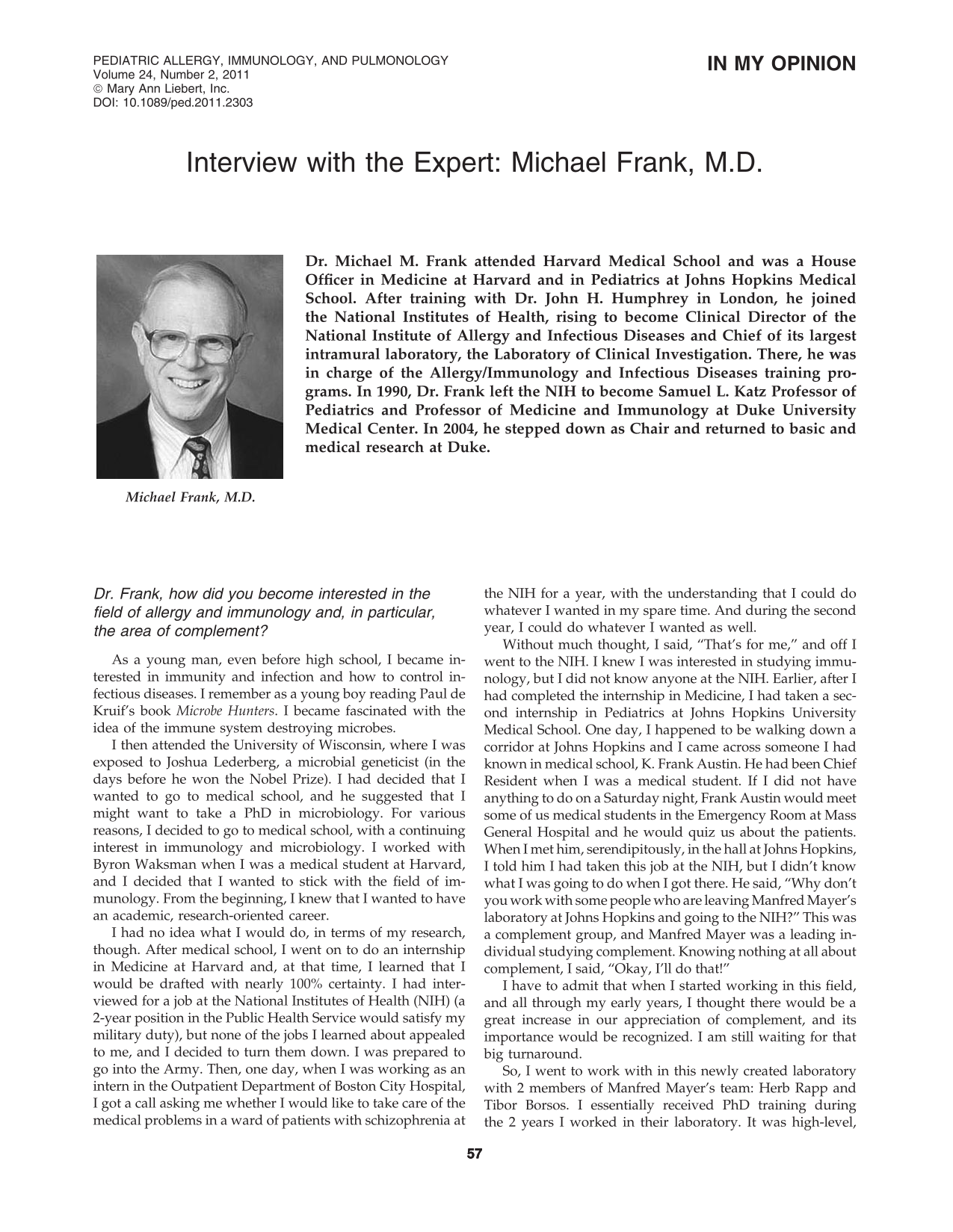
Dr. Frank, how did you become interested in the field of allergy and immunology and, in particular, the area of complement?
As a young man, even before high school, I became interested in immunity and infection and how to control infectious diseases. I remember as a young boy reading Paul de Kruif's book Microbe Hunters. I became fascinated with the idea of the immune system destroying microbes.
I then attended the University of Wisconsin, where I was exposed to Joshua Lederberg, a microbial geneticist (in the days before he won the Nobel Prize). I had decided that I wanted to go to medical school, and he suggested that I might want to take a PhD in microbiology. For various reasons, I decided to go to medical school, with a continuing interest in immunology and microbiology. I worked with Byron Waksman when I was a medical student at Harvard, and I decided that I wanted to stick with the field of immunology. From the beginning, I knew that I wanted to have an academic, research-oriented career.
I had no idea what I would do, in terms of my research, though. After medical school, I went on to do an internship in Medicine at Harvard and, at that time, I learned that I would be drafted with nearly 100% certainty. I had interviewed for a job at the National Institutes of Health (NIH) (a 2-year position in the Public Health Service would satisfy my military duty), but none of the jobs I learned about appealed to me, and I decided to turn them down. I was prepared to go into the Army. Then, one day, when I was working as an intern in the Outpatient Department of Boston City Hospital, I got a call asking me whether I would like to take care of the medical problems in a ward of patients with schizophrenia at the NIH for a year, with the understanding that I could do whatever I wanted in my spare time. And during the second year, I could do whatever I wanted as well.
Without much thought, I said, “That's for me,” and off I went to the NIH. I knew I was interested in studying immunology, but I did not know anyone at the NIH. Earlier, after I had completed the internship in Medicine, I had taken a second internship in Pediatrics at Johns Hopkins University Medical School. One day, I happened to be walking down a corridor at Johns Hopkins and I came across someone I had known in medical school, K. Frank Austin. He had been Chief Resident when I was a medical student. If I did not have anything to do on a Saturday night, Frank Austin would meet some of us medical students in the Emergency Room at Mass General Hospital and he would quiz us about the patients. When I met him, serendipitously, in the hall at Johns Hopkins, I told him I had taken this job at the NIH, but I didn't know what I was going to do when I got there. He said, “Why don't you work with some people who are leaving Manfred Mayer's laboratory at Johns Hopkins and going to the NIH?” This was a complement group, and Manfred Mayer was a leading individual studying complement. Knowing nothing at all about complement, I said, “Okay, I'll do that!”
I have to admit that when I started working in this field, and all through my early years, I thought there would be a great increase in our appreciation of complement, and its importance would be recognized. I am still waiting for that big turnaround.
So, I went to work with in this newly created laboratory with 2 members of Manfred Mayer's team: Herb Rapp and Tibor Borsos. I essentially received PhD training during the 2 years I worked in their laboratory. It was high-level, on-the-job scientific training, and I was also able to take courses in biochemistry, statistics, immunology, and so on, at the NIH night school. After 2 years there, I felt I was in a good position to pursue a career as a clinical investigator. I knew then that I was interested in the detailed aspects of immunity, and particularly the role of complement in immunity and in disease.
A leading immunologist at that time was John Humphrey at the National Institute for Medical Research in London. I went back to Johns Hopkins to finish my pediatric training, with the arrangement that I would then go to John Humphrey's laboratory for at least a year. By that time, I had also received a job offer from the Child Health Institute at the NIH. They supported my going to England first, and that turned out to be one of the most rewarding years of my life. I learned a great deal of basic immunology and was able to contribute to the work of the laboratory. I had never been out of America, and being in England was a wonderful experience.
When I returned from England and began work at the Child Health Institute, it was still in the process of getting started and did not have much in the way of resources. After a while, it became clear that I would not be able to start a laboratory-based career there, at least not for another 4 or 5 years. I was offered a job in the National Institute of Allergy and Infectious Diseases (NIAID) by Sheldon Wolff, who at that time was the Clinical Director and Chief of the largest intramural laboratory within NIAID, the Laboratory of Clinical Investigation (LCI). Shelley was an amazing man and probably the best medical administrator I had ever met. That was a very rewarding time for me, and I stayed at NIAID for the rest of my career at the NIH. When Sheldon moved on to become Chair of Medicine at Tufts University Medical School in 1977, I became Clinical Director and Chief of the LCI and continued in the tradition that Shelley Wolff had set. It was a fine laboratory in which people working on infectious disease and allergy/immunology developed new methods of therapy and new ways of looking at disease. The quality of the people in the laboratory was extraordinarily high. I stayed in this position until 1990, when I was offered the position of Chair of the Department of Pediatrics at Duke University.
That was an interesting challenge for me, as I had not worked in a department of pediatrics since the day I finished my training. It was challenging for Duke as well! However, I have been here for the past 20 years, and things have gone very well.
I would point to 2 main factors: being around very smart people who were committed to their work and to understanding disease in man; and being around people who had tremendous expertise in training people to think critically (knowing what questions to ask and not to ask) and in completing studies.
There have been many challenges and many things of great satisfaction. The 2 things that immediately jump to mind in terms of satisfaction are, first, my history of training junior people who have gone on to positions of tremendous importance. There were too many to mention each by name, but we had enormously talented trainees. In my own personal laboratory, I usually did not have more than 1 or 2 persons per year for training. Nevertheless, in going back over the years, 14 have gone on to become full professors at various institutions across the country, 2 have become chairs of departments of medicine, 2 became deans, and many became division chiefs in their areas of expertise. That is an enormously satisfying record to have had a role in training young people who went on to have important roles in academic medicine.
The other most satisfying aspect of my career is another example of serendipity. I was interested in complement and clinical medicine, developing tests, and figuring out the pathophysiology of disease. There is a disease called hereditary angioedema that I initially had no real knowledge of; I only knew that it existed. This disease can cause life-threatening swelling of the throat and severe attacks of abdominal pain due to swelling in the gastrointestinal tract. Very little was known about the illness until the early 1960s, when Virginia Donaldson, an investigator at Case Western Reserve Medical Center, discovered that these patients had low levels of the serum protein C1 inhibitor. It was assumed that this was a complement-related disease.
One day, a young man who had experienced frequent attacks of abdominal pain noticed some swelling in his mouth. He went to his dentist who did not see anything unusual, but prescribed penicillin in case of a developing dental abscess. The man left the dental office and, just outside, in the corridor, suffered a total respiratory obstruction and collapsed. Someone picked the man up and carried him across the hall where there happened to be an ear, nose, and throat (ENT) office, and the staff performed an emergency tracheostomy. They saved his life. Afterward, people started asking for help in treating this disorder. There was no known therapy for the disease at the time. An internist in Washington, Oscar Mann, called me and asked whether I would see this particular patient.
I started to work with the patient to see what we could do. When people found out I was interested in this disease, they started referring other patients to me. I became the “expert,” because no one else was interested. That turned out to be very rewarding, because we were able to develop treatment that became the standard therapy for the disease. In the last few years, new therapies have come along, but the treatment that we developed was the mainstay of treatment in this country for decades.
What has been most frustrating during my career? I think anyone who pursues an academic career feels frustration. I stepped down as Chair of Pediatrics at Duke in 2004, after 14 years, and am now back in the laboratory and am competing in the grant-writing process with all the junior people in my field and in other fields. Given what is happening with support for biomedical research these days that is a tremendous challenge and one that I am still learning how to face. When you are on staff at the NIH you don't write any grants; you are on salary. This is something new to take on rather late in my career, and I don't expect the funding situation to improve.
At NIAID, I helped expand the LCI, and our team did some very important work. I helped develop the allergy program and helped recruit people who are now chiefs of allergy programs around the country. Overall, at least 5 of our trainees later became presidents of the American Academy of Allergy. One of the members of the LCI during the time when I was chief was Tony Fauci, who is now the director of the NIAID. He was an extraordinary clinician and investigator and, during that time, together with Shelley Wolff, worked out much of the therapy for chronic vasculitis. He and his group later made major contributions to the understanding of acquired immunodeficiency syndrome (AIDS). Much work was also done on the treatment of patients with fungal infections of the central nervous system by Jack Bennett. John Gallon was recruited into the laboratory, and he and Harry Malach worked on chronic granulomatous disease and made a series of important discoveries. I recruited Warren Strober, who is now one of this country's leaders in the area of immunology of the GI tract, and he and Steve Strauss, whom I also recruited to the NIH—Steve later became Director of the Alternative Medicine program—worked out the mechanism of a disease in which the lymphocytes lose normal down-regulatory control, which leads to a series of autoimmune diseases. Study of these patients has also led to a greater understanding of how the immune system functions. Both Mike Kaliner and Dean Metcalfe made important contributions to allergy, and both became presidents of the American Academy of Allergy, Asthma, and Immunology, the major academic society in allergy. Much work was also done on cryptococcal genetics by J. K. Chung. Charles Kirkpatrick contributed to mucocutaneous candidiasis. David Alling was a master at study design and statistics.
When I came to Duke, there were 63 faculty in the Department of Pediatrics, and the department was going through some financial challenges. During the 14 years that I was chairman, the department grew to 125 faculty, and its financial success improved enormously. Research funding for the department also grew enormously during those 14 years. I was able to talk “the powers that be” into developing a children's building, and was given the challenge of raising the money to fund it. We recruited Steve Rum to manage the development campaign, and he was successful. Steve went on to become the head of fundraising for Johns Hopkins Medical Center. I recruited a wonderful young man to be the business manager of the Department of Pediatrics and he has gone on to become the CEO of the entire Barnes Hospital system.
During my entire career I have been interested in how complement functions and in the function of immune complexes. Neither of those areas is among the top topics of immunology in the year 2011 but both remain very important! Complement consists of a series of proteins, some of which circulate in the blood and some of which are on cell surfaces. These proteins play a major role in host defense. If patients have a major defect in the complement system, they are much more susceptible to infection and death.
These proteins were first discovered over 100 years ago and, in the early days, 3 Nobel Prizes were given to people who spent a lot of their time thinking about and publishing on complement—Bordet, von Behring, and Paul Ehrlich. This whole area of research became more complicated over the years as people discovered that the system was not simple. People became less interested. Since very few patients are missing any of the major complement proteins or regulators, diseases of the complement system and the role of the complement system in immunity and host defense received little attention.
My program at Duke, in the Department of Pediatrics, has one of the world's great immunodeficiency experts, Rebecca Buckley. She admits to the hospital patients with severe combined immunodeficiency that are referred from all over the world. This disorder is associated with a loss of T cells, and often a loss of B cells. These people have a profound immunological defect and, over the years, she has worked out methods of treating them. It is interesting to me that those patients seem to be far more common than patients with complement deficiencies. That probably reflects the importance of the complement system. We have done a poor job working out all the details of how it functions.
We do know that there are multiple pathways of complement activation, and even primitive organisms such as sea urchins have elements of the complement system, so it goes way back in phylogeny. We are slowly learning more about the system. In my “old age,” I have gone back into the laboratory, and we are learning some wonderful things about how complement affects the development of immunity.
Interest in complement has risen more recently in large part due to progress in the field of genetics that allows us to do very complex genetic screens. For example, one group did a genome-wide screen for genes associated with the development of macular degeneration in the aged. The group had no particular interest in complement. Nevertheless, several years ago, 3 papers appeared in the same issue of Science from different investigators, saying that they had identified a variation in one of the complement regulatory proteins as being important in macular degeneration of the elderly. Suddenly, a spotlight shone in that area, and a number of additional complement-related genetic variations have been associated with macular degeneration. Atypical hemolytic uremic syndrome in children has turned out to be a disease of disordered complement regulation. Another example is asthma. The teaching for decades has been that that complement plays no role in asthma, but now some researchers are changing that thought process and finding situations in which complement does seem to be important. It may be important in the immunization phase of asthma and may be important in the generation of symptomatology during attacks.
We were one of the first groups to develop a colony of complement-deficient animals, and we decided to make our colony of C4-deficient guinea pigs generally available to the immunologic community. These animals were critical in figuring out whether more than one complement activation pathway exists. My laboratory also performed many of the studies on the factors that control the clearance from the blood stream of immune complexes and of antibody- and complement-coated red cells. In a similar fashion, we examined the factors that control the clearance of bacteria from the blood stream. Using data from these studies, we were able to examine for the first time the status of receptors for antibody and complement in vivo in patients with a variety of diseases.
What we find now is quite surprising. We find that complement plays a major role in the development of immunity—and in the immune response—and we are performing studies to determine how that occurs. It has been known for 30 years that there is a link between complement and immunity, but understanding that this is an interesting issue and understanding the biological processes involved are 2 different things. The latter has taken a long time to develop. I think we are now starting to make that connection.
One of the other projects in our laboratory at present is to try to understand why the human immunodeficiency virus (HIV) envelope vaccines developed to date have not been effective. We think we are making some real progress in that area.
We worked out some of the first treatments that became the standard of care for hereditary angioedema in the United States. That mostly involved the discovery and proof that androgens are quite effective in the majority of people. These discoveries were based on both empirical observations and double-blind trials. You recall Pasteur's quote: “Fortune favors the prepared mind.” As I mentioned earlier, Virginia Donaldson, almost by serendipity, found a protein in the blood called C1 inhibitor that is present in low levels in hereditary angioedema. She had a friend who worked in the same institution and was interested in complement. He discovered a protein that dampened the classical complement pathway, and he named the protein C1 esterase inhibitor. It inhibits C1, the first protein in the classical complement pathway. He made an antibody to the protein, and she asked for some of the antibody to use in her allergy clinic to screen some of her patients with unusual allergy; this work led to her critically important discovery.
It didn't take a genius to figure out that if you could purify the C1 inhibitor, the protein that was deficient in patients, it might be useful in the treatment of this disease. In the late 1960s to early 1970s, we arranged with the Red Cross to have their pilot plasma facility purify some C1 inhibitor, and we published a report showing that the C1 inhibitor could correct the plasma biochemical defect and terminate attacks of hereditary angioedema. Our paper, showing the ability to terminate attacks, was not based on a double-blind study. The paper was published in 1980 in the New England Journal of Medicine. If you think back, in the early 1980s, the presence of an AIDS epidemic began to become clear. It also became clear that the blood supply might be contaminated. It was recognized that people receiving blood transfusions could become infected with HIV virus in donated blood. With this new challenge, the Red Cross lost all interest in making C1 inhibitor for treating hereditary angioedema in the United States. However, there were groups in The Netherlands and in Germany that continued to make preparations of plasma-derived C1 inhibitor. However, the companies in Europe were not interested in making the drug available for use in the United States. Then, along came the Orphan Disease Act, which provided financial incentives.
It is important to point out that the treatments I had worked on were all prophylactic and were not effective in actual attacks of hereditary angioedema. C1 inhibitor did work acutely. People continued to study the pathophysiology of angioedema, and this led to the critically important discovery that it is not a complement-related disease. Although the C1 inhibitor is a complement inhibitor, it also inhibits other mediator pathways, and one of the pathways it inhibits is the kinin-generating pathway. Bradykinin was found to be the principle cause of the angioedema and, therefore, it might be possible to intervene in this pathway, either by inhibiting the generation of bradykinin or by blocking the receptor for bradykinin.
Five companies set out to make products in America: 2 serum C1 inhibitor products; one recombinant C1 inhibitor; one drug that prevents kinin generation; and one that blocks the type 2 bradykinin receptor. It turns out that all 5 of these products are effective. Three of the products have already been approved by the Food and Drug Administration—the 2 serum products and the product that blocks bradykinin generation—and the 2 remaining products are likely to be approved within the next year. The receptor blockade product has already been approved in Europe. Suddenly, the lives of these patients have been altered enormously, and they have multiple treatment choices. Unfortunately, given the small market all of these products are very expensive, and people are starting to explore other diseases in which these drugs might have a role.
As I briefly mentioned, I am very interested in understanding how complement controls the ability to make an immune response, and what we are learning is interesting. One of the complement pathways, the classical pathway, was discovered because people were trying to understand how an antibody damages or kills bacteria. They found that fresh serum was required for bacterial lysis, and in defining the proteins responsible for lysis discovered the classical complement pathway. It turns out that the classical pathway was the last complement pathway to evolve. It evolved at the time that the antibody was first seen. Animals more primitive than those that can synthesize antibody (that is more primitive than the shark) have a complement system, but they do not have the recognition protein of the classical pathway. We have found that the classical pathway not only damages bacteria and cells but also facilitates the ability to make antibody.
I have had the pleasure to give advice to many trainees over the years. I think the most important thing in academic medicine is that you have to enjoy what you are doing and want to go to work every day. Having said that, I recommend that young physicians planning to go into academic medicine learn some basic science early in their training. I think it was a tremendous amount of help to me.
In this regard, it is interesting to look back at the history of the NIH. The NIH is more than 100 years old. It underwent an enormous expansion after World War II, when suddenly dollars that had been used for the war effort became available. Some of those dollars went to support medical research, allowing all of the institutes to expand tremendously. During most of our wars—in particular, the Korean and Vietnam wars—almost everyone in medical school was male, and there was a draft rather than a volunteer military. People finishing medical school sometimes had a choice of going into the military and going off to war, or taking a position in the United States Public Health Service and going to the NIH in Washington, D.C. to do 2 years of research. Many chose to go to Washington and do research. Due to this, a certain number of people ended up doing research that would not have done so if the circumstances had been different.
After several years of doing research, some were surprised to find that they enjoyed it enormously and, when they left the NIH, they became the foundation of many of the scientifically based medical programs all around the country. Based on that experience, I tell young people that getting some training in basic research is an excellent start to a career in academic medicine. They can always move to clinical research from basic research, as they learn how to frame questions and understand what the appropriate controls should be in a clinical study. They can even move to clinical practice and be successful clinical practitioners. On the other hand, it is unlikely that they will pick up basic research skills later in their careers, or even have the time to do so once they complete their fellowship training. It is an opportunity I would not miss.
It is also important to have good mentors along the way, people whose advice they can trust and who can point them in the right direction. I think it is even more important now than when I started out, and it was important then. Given the level of funding and the level of competition, a career in academic research is hard—it is not a simple choice. It is a highly challenging career and you have to love it. However, it is a career in which by hard work you can change the face of medical practice and make enormous personal contributions.