




Abstract
Potatoes and lentils are highly consumed throughout the world. Adverse reactions to potatoes among children are considered uncommon and usually result from ingestion. Allergy to raw potato has mainly been described in adults, usually in the form of oral-contact dermatitis or contact urticaria, but also may manifest as asthma, rhinoconjunctivitis, wheezing, or even anaphylaxis. Lentils, chickpeas, beans, and peas are the most commonly consumed legumes in Turkey and the Mediterranean region. In the literature, type I hypersensitivity to lentils and legumes is rare. We report a case of a 16-month-old boy with both urticaria induced by raw potato and lentil-induced anaphylaxis.
Introduction
W
Case Report
A 16-month-old boy had previously suffered from contact urticaria and 2 episodes of anaphylaxis related to lentils. There were no symptoms during the first 6 months of his life. Complementary foods had been started after 6 months of age, and it was the first time that he threw up the egg he had eaten. Because of this vomiting, his parents discontinued eggs. Then, he experienced 3–4 urticarial symptoms before the age of one, but the parents did not know the etiology. The patient presented to our department because of contact urticaria on his right eyelid. From the history, we learned that the mother had been peeling potatoes for dinner, and the patient had taken a piece of raw potato. After that, the patient had touched his right eye with the same hand, resulting in contact urticaria that cleared up 45–60 min after ceasing contact. The lesion was limited to the areas that had been in contact with the piece of potato. There were no late contacts or systemic reactions to the raw potatoes. From the history, it was learned that cooked and fried potato (ingestion and contact) produced no reaction. The same patient reported suffering from facial erythema followed by generalized urticaria, edema of the eyelids, lips, and tongue, wheezing, and dyspnea within 30 to 60 min after ingestion of lentil soup 2 times around 13 months of age. The patient was treated in an hospital with antihistamines and methylprednisolone and short-acting β-2 agonist. A prick-test using commercial antigens was strongly positive for nuts, peanuts, egg white, and yolk. Skin testing to tree pollens was negative (Table 1). A blood test showed his eosinophil count (% 9.1, 1,070/mm3) and IgE; 532 (0–90 IU/mL) levels to be high. Finally, a prick-by-prick test with raw potato (Fig. 1) and boiled lentil (Fig. 2) showed positive results after 15 min, supporting the diagnosis. Also, a piece of raw potato was rubbed to the patient lips, and he showed contact urticaria within 5 min (Fig. 3).
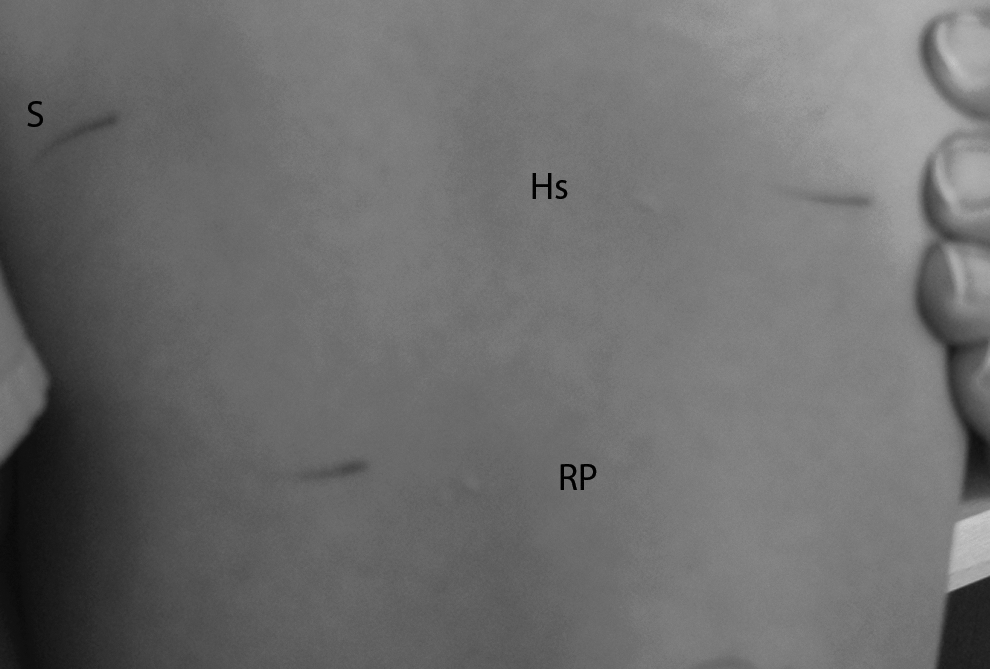
Positive prick-by-prick to raw potato. S, saline; Hs, histamine; RP, raw potato.
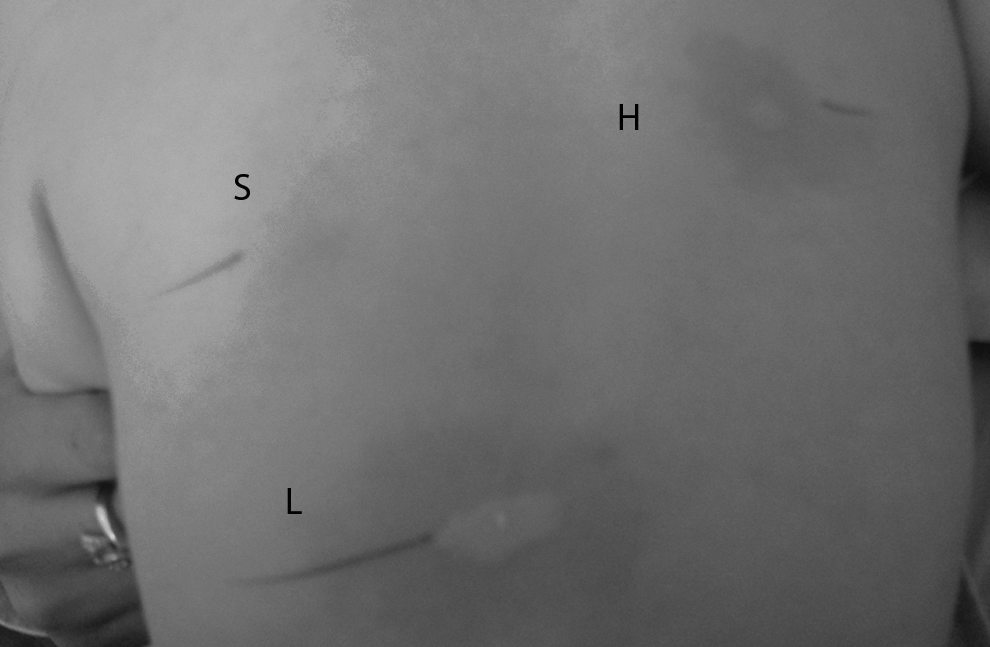
Positive prick-by-prick boiled lentils. S, saline; H, histamine; L, boiled lentil.
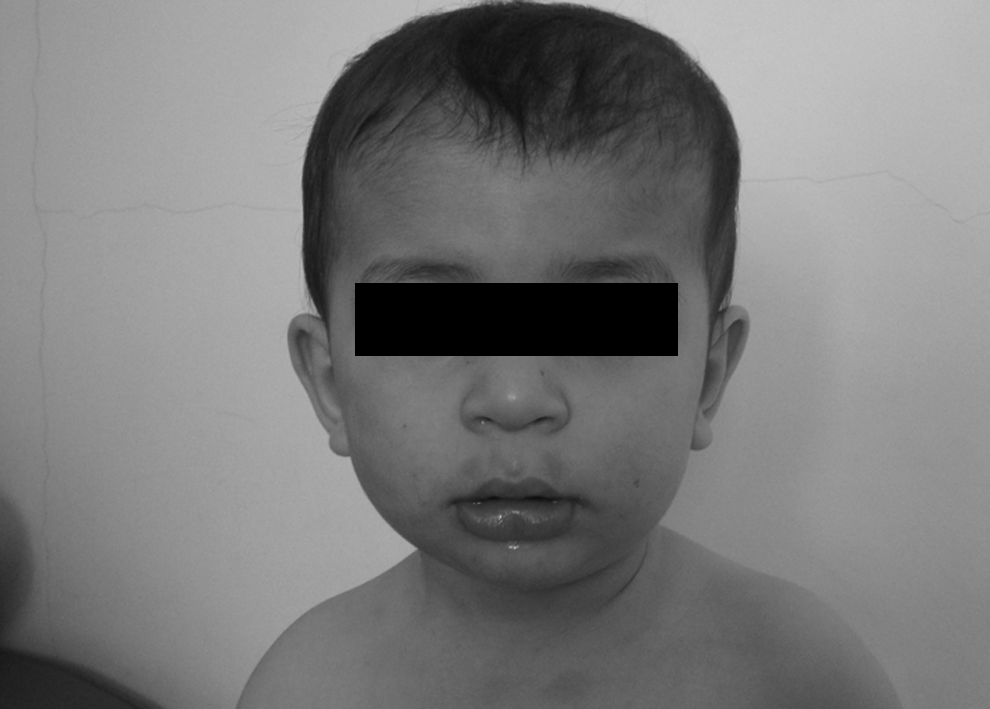
Positive raw potato challenge (labial contact urticaria).
++++, strong positive.
Discussion
Food exposure through ingestion, inhalation, and mucous membrane or skin contact can cause adverse reactions. Skin-contact reactions most commonly manifest as irritant contact dermatitis, allergic contact dermatitis, or contact urticaria. 7 The term contact urticaria was described by A.A. Fisher in 1973 and represents pruritus, whealing, and erythema occurring within minutes after mucosal or cutaneous contact with the causative agent and resolving completely within a maximum of 24 h. Contact urticaria is frequently restricted to the contact areas. It may be present in distant locations or as generalized urticaria. Sometimes, internal organs can be involved, and the reaction can even result in an anaphylactic shock. 8 Allergy to raw potato has mainly been described in adults, most frequently as a cause of OAS or contact urticaria.1,9 Castells et al. reported an infant 5 months old who had developed anaphylactic symptoms after ingestion of cooked potato. 10 Our contact urticaria case is the youngest patient to react to raw potato in the literature.
Different potato allergens have been identified. Patatin (Sol-t-1) is the most important of these 11 and shows a significant homology with a latex allergen, leading to the possibility of cross-reaction. 12 Four IgE-binding potato proteins were (cathepsin D-, cysteine-, and aspartic protease inhibitors) identified and designated Sol t 2, Sol t 3.0101, Sol t 3.0102, and Sol t 4, belonging to the family of soybean trypsin inhibitors (Kunitz type) by Seppälä et al. 11 Although patatin is considered to be a heat-labile allergen, it has been shown that the heat lability of its IgE interaction is strongly influenced by other potato proteins 13 With increasing temperature above 60°C, the structural properties of the Kunitz-type soybean trypsin invert. 14 The existence of heat-labile potato proteins (unstable in the presence of digestive enzymes and gastric acid) that lose their allergenic properties when cooked or eaten explains why some subjects show symptoms only after contact with raw potatoes and not with processed potatoes or after oral intake. 1
Lentils, chickpeas, beans, and peas are the most common consumed legumes in the Mediterranean area. There is little information about legume allergy. Allergy to lentils is the most frequently diagnosed legume allergy. Most lentil allergy symptoms begin under 4 years of age.5,6 Lentil allergy was found to be 7.0% by Yavuz et al. Lentil allergy is the sixth most common cause of food allergy in Turkish children. 15 The case of bronchial asthma induced by inhaling steam from cooking lentils has rarely been described. 16 Lentil-induced anaphylaxis and lentil-dependent exercise-induced anaphylaxis have rarely been reported in the literature.17,18 Our case is the youngest patient with anaphylaxis induced by lentils in the literature.
Peanuts (Arachis hypogaea) belong to the botanical family of legumes (Leguminosae). Serological cross-reactivity between peanuts and other legumes has been reported in several studies. 19
There are some immuno-cross-reactivities between legume seed proteins that are based on similarities of their sequence and molecular structure. 20
Legumes produce a diversity of allergen proteins, including protease inhibitors, α-amylase inhibitors, arcelins, lectins, and antifungal proteins. Kuntz-type soybean trypsin inhibitors can be isolated from legumes. 21
In our case, both contact urticaria with raw potatoes and lentil-induced anaphylaxis may be explained by Kunitz-type soybean trypsin inhibitors. Potatoes and legumes (lentil) contain this cross-reactive allergen protein. 22
To our knowledge, our patient is the first and youngest instance of a child with both contact urticaria from raw potatoes and anaphylaxis induced by lentils to be reported in the literature. We documented prick-by-prick test with raw potatoes (and raw potato challenge) and boiled lentils. The patient will be followed for the development of seasonal allergic rhinitis.
Footnotes
Author Disclosure Statement
No competing financial interests exist.