




Abstract
Elevated levels of exhaled carbon monoxide have been reported in patients with active or persistent asthma or allergic rhinitis. With the recent availability of a noninvasive pulse CO-Oximeter that measures carboxyhemoglobin, measurements were made on healthy clinic staff as well as children with controlled or active asthma and asymptomatic or active allergic rhinitis to assess whether this test might have applicability in these diseases. Carboxyhemoglobin (SpCO%) was measured by a pulse CO-Oximeter during an initial clinic assessment of patients by a single physician in a Pediatric Pulmonary Clinic. Fifty-one patients with uncontrolled asthma (average age 7.8 years) had an average SpCO% of 4.8%, and 87 patients with controlled asthma (average age 8.8 years) had an average SpCO% of 0.3%, a significant difference, P<0.001. Seven patients with vocal cord dysfunction (average age 13.6 years) had an average SpCO% of 0.43%. In regard to allergic rhinitis, 122 symptomatic patients (average age 6.9 years) had an average SpCO% of 7.3%, while 40 asymptomatic patients (average age 7.4 years) had an average SpCO% of 1.5%, P<0.001%. These preliminary observations suggest that SpCO% may be a useful, noninvasive measure of asthma or allergic rhinitis activity.
Introduction
Methods
Observations were made from March through October 2009 on consecutive patients of one physician (LEK). Carboxyhemoglobin (SpCO%) was measured by the Rainbow-SET Rad-57 Pulse CO-Oximeter, which allows for a range of ±2% (Masimo, Inc., Irvine, CA). 17 A weight-appropriate sensor was placed on a finger for 30 seconds to allow equilibration. A clinic nurse measured and recorded the value along with vital signs and pulse oximetry at the beginning of the visit. Asthma was diagnosed in patients, and the patients with asthma were treated in accordance with the recommendations of the Expert Panel Report 3. 18 Asthma control was assessed using the Asthma Control Test 19 : a score of >20 was considered good control. Vocal cord dysfunction (VCD) was diagnosed by published criteria 20 and lack of response to asthma therapy. As VCD usually has a behavioral or neurological etiology rather than an inflammatory one, 20 it served as an control group with pulmonary symptoms. Allergic rhinitis diagnosis was based on nasal mucosa exam and positive allergy skin tests or elevated serum IgE RAST testing to environmental allergens. The clinical status was assessed by the published criteria. 21 Patients with a known history of passive smoke exposure were excluded. Statistical analysis of controlled versus uncontrolled asthma or allergic rhinitis patients was done with the Mann–Whitney U test. As this study presents data analyzed retrospectively, this study was submitted to and exempted from review by the Upstate Medical University Institutional Review Board.
Results
Fifty-one patients (31 boys) with uncontrolled asthma (average age 7.8±standard deviation 4.2 years) had an average SpCO% of 4.8%±3.5% (median=4). Eighty-seven patients (56 boys) with controlled asthma (8.8±4.3 years) had an average SpCO% of 0.3%±0.8% (median=0) (P<0.001). Seven patients (1 boy) with VCD (13.6+2.2 years) had an average SpCO% of 0.4%±0.5% (median=0). One hundred twenty-two patients (76 boys) with symptomatic allergic rhinitis (6.9±3.8 years) had an average SpCO% of 7.3%±4.2% (median=7), whereas 40 patients (26 boys) with asymptomatic allergic rhinitis (7.4±4.3 years) had an average SpCO% of 1.5%±2% (median=0)(P<0.001). To make sure that there was no confounding environmental influence during clinic visits, 23 healthy clinic staff or pediatric residents in the clinic served as a control group with an average SpCO% of 0.1+0.3 (median=0). Results are described in Fig. 1, using the median and interquartile range.
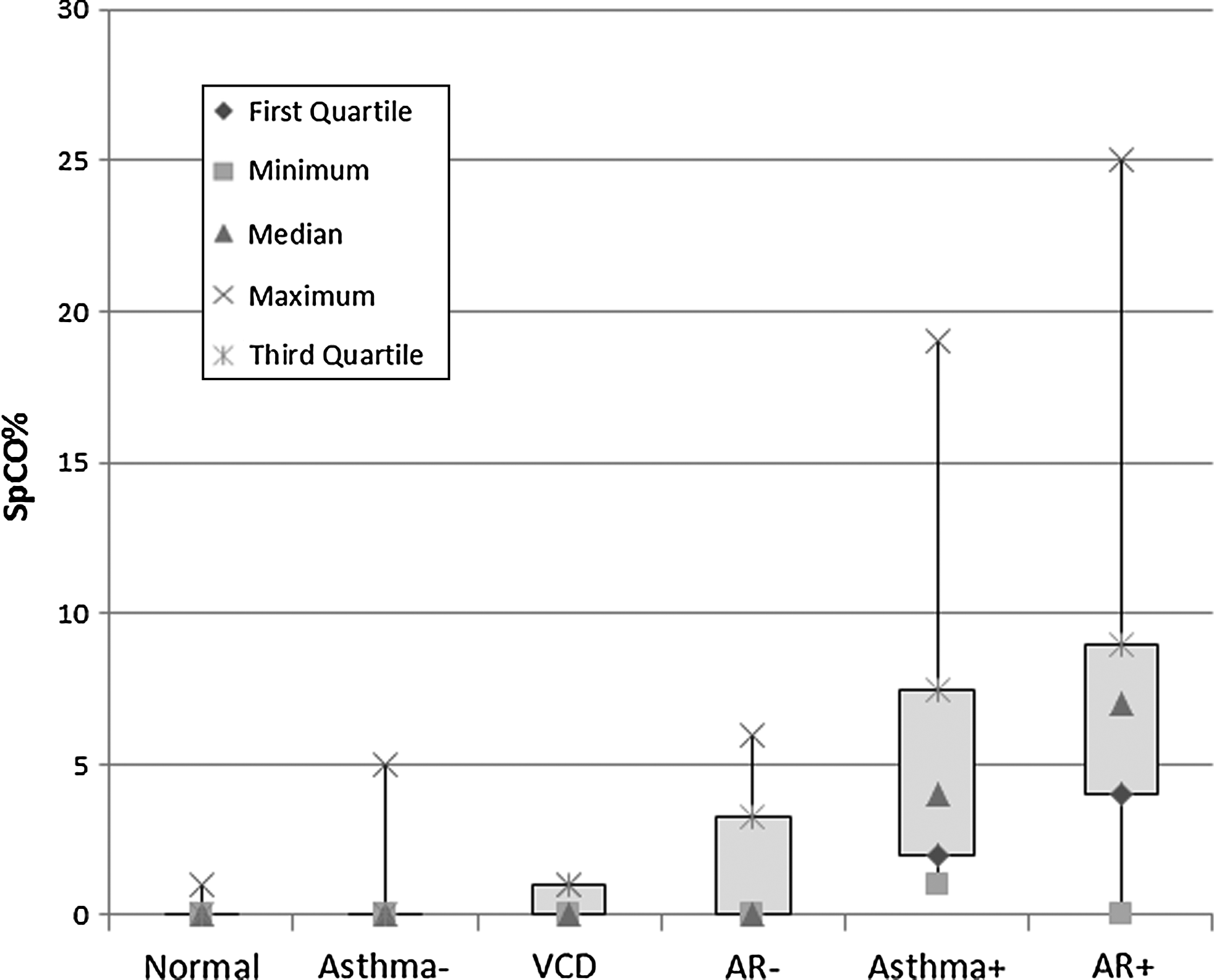
Median SpCO% and interquartile range (IQR) for these patients: Normal: healthy control (n=23); asthma: asymptomatic, controlled asthma (n=87); VCD: vocal cord dysfunction (n=7); rhinitis-: asymptomatic allergic rhinitis (n=40); asthma+: symptomatic, uncontrolled asthma (n=51); rhinitis+: symptomatic allergic rhinitis (n=122). The difference between controlled and uncontrolled asthma and allergic rhinitis was significant at the P<0.001 level.
Discussion
Similar to studies of exhaled carbon monoxide, the observations reported herein suggest that endogenous carbon monoxide as measured by a noninvasive pulse CO-oximeter of carboxyhemoglobin is significantly elevated in children with symptomatic asthma and allergic rhinitis in comparison to their respective asymptomatic conditions and to controls. These initial findings are tentative and require prospective, controlled confirmation. One of the major limitations of these observations is that an insufficient number of repeat patient visits were available to assess changes in SpCO% in relationship to changes in clinical status. Nevertheless, these results seem tantalizingly enough to encourage further studies. Results, if confirmed, also suggest that the activity of endogenous heme oxygenase activity may be measured by an easy, noninvasive test, which may be useful in monitoring inflammatory diseases in which heme oxygenase may play a role.
Footnotes
Acknowledgment
Observations herein reported were supported in part by funding from the Children's Environmental Health Centers of New York, used to purchase the Pulse CO-Oximeter.
Author Disclosure Statement
The author does not have any actual or potential financial or other conflict of interest.