




Abstract


Dr. Rubin, you have a background in biomedical engineering, and I read that you “look at biomaterials like mucus and aerosol therapy as engineering problems.” In what way are these engineering problems and how is an engineering approach intrinsically different from the traditional way clinical researchers go about finding solutions to medical problems?
In addition to being a physician, I am a professor of engineering at Virginia Commonwealth University (VCU) and teach engineers. The clinician's and engineer's approaches to solving problems are complementary and distinct. The clinician takes a complex problem, controls confounding variables as much as possible, and then tests for effects on a clearly defined outcome, like FEV1. Difficulties with this approach include controlling variables to assess a precise outcome and translating findings to a more diverse patient population.
The engineering approach is to take a complex problem and break it down into smaller component parts. Engineers then solve each smaller part and reassemble to get the big picture. When I began medical school, I had degrees in math and physics and was in an engineering graduate school program. I bombed my very first examination in medical school, on the origins and insertions of the muscles of the arm. The professor wrote, “See Me” on my paper. I went to see him and was asked “You're an engineer aren't you?” He told me that while I had designed a functional arm, it was not the one that the Creator designed. “I don't care if anatomy makes sense, you engineers need to memorize,” he said. Thinking like an engineer is a liability for learning anatomy and the Krebs's cycle, but it can be a unique advantage for creative research ideas and approaches.
Overall, how have you married your degrees and interests in medicine and engineering throughout your career to develop new therapeutic strategies and to treat your young patients with respiratory disorders?
I have applied engineering training throughout my career as a scientist. As a Rhodes Scholar, I was in the Oxford John Radcliffe Hospital Paediatric Bioengineering Unit under Peter Rolfe, in the late 1970s, working on bio-sensing devices and auto-control mechanical ventilators for babies. Since the early 1980s, most of my work has focused on medical aerosols and on mucus as a biomaterial. When I was a fellow at Sick Kids in Toronto, Dr. Mike Newhouse, a young physician inventor, came up from Hamilton, Ontario, to show his invention to our group. It was a prototype of something he called a valved holding chamber, and he had named it the Aerochamber. Henry Levison, who was a senior paediatric respirologist, thought this was a bad idea. Henry believed that the only way to give medication effectively to children was by jet nebulizer. I thought this Aerochamber was one of the most sublime and intriguing ideas I had seen, so I rushed up to Dr. Newhouse and begged him to leave me the prototype. I started fiddling with masks that would let me use it on young children. Michael sucked me into the world of aerosol medicine. I am still studying the patient–device interface to this day; what makes masks effective or ineffective, barriers to adherence, testing of novel aerosols, and increasingly, looking at the nose, nasal aerosols, nasal clearance, and nasal mucus. I became active with the International Society of Aerosols in Medicine (ISAM) and am on the editorial board of the Journal of Aerosol Medicine and Pulmonary Drug Delivery. I have remained close friends with Mike and Carol Newhouse who are surrogate grandparents to my sons.
As a Fellow, I worked with Jennifer Sturgess and Peter Turner in Toronto on what was then called immotile cilia syndrome. Dr. Sturgess wanted me to engineer how the ciliary motor worked, what abnormalities would keep the ciliary motor from propelling mucus, and how to distinguish between congenital and acquired ciliary disorders that accompany inflammation. Not many people were studying cilia back then. Last summer, I spoke at the CHEST meeting in a symposium on ciliary dysfunction, and in the audience were Jonathan Rutland and Paul Stillwell who, like me, were studying cilia before cilia were cool!
After my fellowship in Toronto, I went to Queen's University in Kingston, Ontario, in a predominantly clinical position as the only paediatric respirologist and intensivist. The hospital had a small Pediatric Intensive Care Unit (PICU) and a surprisingly busy cystic fibrosis (CF) center and pulmonary service. As well, I was the only respirologist doing paediatric flexible bronchoscopy in Ontario in the early 1980s, having taken Bob Wood's course in Chapel Hill and performed dozens of adult bronchoscopies under the tutelage of Dr. Tony Rebuck at Toronto Western. I was on call 24/7/365 for PICU and pulmonary. At Queen's, Doug Geiger directed the CF Centre, and we co-managed patients with severe asthma. I recall that we cared for a really sick adolescent with CF who was smoking, and we wondered how tobacco affected CF. There was nothing in the literature. A few weeks later I went to camp Couchiching, a CF camp, and I measured the lung function, growth, dietary intake, and self-esteem of the campers, and looked for differences related to the amount of reported environmental tobacco smoke (ETS) exposure. After 2 weeks in the non-smoking camp environment, we saw improvements in weight, self-esteem, and pulmonary function in the home ETS-exposed kids; these improvements were significantly greater than in the non-exposed children, with an indication of an ETS dose response. We published a paper in Chest on the psychosocial benefits of attending CF camp; but then CF camps closed in 1994. However, we also published the first paper on the effects of ETS on CF in the New England Journal of Medicine.
Because of my fellowship training in cilia I had many referrals to evaluate children with recurrent pneumonia for cilia dysfunction, although this was rarely the cause of their problems. I wondered if there was something different about their mucus. As an engineer, I had studied the fluid dynamics of how oil flows in pipelines; how changes in the oil, in pipeline materials and construction, temperature, and so on can affect oil flow. I had an epiphany that mucus clearance is a fluid dynamics problem, where oil is the mucus and the pipeline is the airway. Dr. Sturgess introduced me to a chemist named Malcolm King, who had just returned from a post-doc in Israel where he had studied bovine mucus. I got in touch with Malcolm, who was back in Montreal, and he told me that he didn't work with human mucus. With a bit of friendly persuasion we began to look at a disease called fucosidosis, in which the mucus doesn't crosslink so it is thin and too watery to transport. We published our first paper together 25 years ago and, when Malcolm moved to Alberta, I followed him as an Alberta Heritage Foundation for Medical Research clinical investigator. We remain very close friends.
You have had a long history of being interested in mucus. What is mucus and why is it interesting? Has it been misunderstood over the years and unfairly blamed for respiratory problems that it does not cause or exacerbate?
Mucus is comprised of a mucin protein core covered with sugars. It is a natural defensive barrier. The mucin proteins give mucus its gel consistency. Mucus is essential for airway defense. It lines the airways, traps particles, and prevents airway dehydration. But mucus is not the same as sputum or phlegm. Sputum, which we cough up when we are ill, is a product of inflammation. The difference is essential.
I began by looking at CF mucus, to determine if it is abnormally thick and viscous. Surprisingly, we (and since then, many others) have shown that it is not at all viscous when compared to sputum from patients with bronchitis or asthma. We were the first to show that CF sputum is exceptionally adhesive and tenacious and thus poorly cleared by cough. We have used image analysis to examine CF sputum and shown that there is almost no intact mucin! CF sputum looks like pus, with lots of polymeric DNA, which is why the drug Pulmozyme is effective in CF but not in other diseases. We have hypothesized that mucin degradation in the CF airway leads to decreased mucus and may make the airway more vulnerable to chronic infection.
There are disorders caused by mucus over-production or abnormal mucus clearance. We use the term “secretory hyperresponsiveness” to describe conditions like severe, life-threatening asthma, middle lobe syndrome, bronchorrhea (especially associated with malignancy), and plastic bronchitis. This last disease is of particular interest in my group. In plastic bronchitis the airways fill with mucus casts. Plastic bronchitis is associated with congenital heart disease and single ventricle physiology, sickle cell disease, severe asthma, and influenza A infection. It has only been reported once in CF.
We set up an international registry for plastic bronchitis that now contains information for more than 200 patients. We are looking at animal models and at milder forms of plastic bronchitis that fall within the secretory hyper-responsiveness spectrum of disorders.
How is an understanding of mucus relevant to and important for understanding and managing respiratory diseases as diverse as asthma and CF?
Patients dying from asthma in hospitals do not die of beta agonist or steroid deficiency. They drown in secretions. We have shown that some of the important mechanisms causing mucus hypersecretion in asthma are resistant to corticosteroids and may be made worse by beta agonists.
In studying plastic bronchitis, we began to investigate how the heart and airways talk to each other. We wondered if something in the failing heart contributes to airway mucus hypersecretion. Drs. Kanoh and Tanabe in my group developed a model in which they grew cardiomyoblasts in growth (repair) stage—as they would be after heart surgery—and we grew them together with lung cells, separated by an air–liquid interface. Although this co-culture did not cause these bronchial epithelial cells to increase mucus production, the cardiomyoblasts caused a pile-up of airway cells, or squamous metaplasia, and we showed that this was due to cardiac-induced transforming growth factor beta. This seems to be an important, new, and potentially treatable mechanism for an old disease called cardiac asthma.
I have had a long and productive relationship with Japanese investigators, and I currently have three post-docs from Japan working in my lab. One of my first Japanese post-docs had never seen a patient with CF and asked to come to the CF clinic. She met a very sick young woman who had not improved with any available therapy, and she suggested giving the patient a low-dose macrolide. I had never heard of this back in 1991, and so Dr. Kishioka told me that in Japan a disease called diffuse panbronchiolitis was similar to CF and responded dramatically to immunomodulatory therapy with macrolides. We put this young woman on clarithromycin, and within a few months she was off supplemental oxygen and her lung function was so good that they took her off the transplant list. I have never seen such a dramatic response. I wrote a grant proposal to the CF Foundation to evaluate macrolide therapy in CF and they soundly rejected it, stating that it was an absurd idea to use macrolides in CF. Twenty years, 22 papers, and one published book later, we now have developed animal and cell models for testing this theory, have documented how immune-modulation is different from immunosupression or anti-inflammation, discovered the primary signaling mechanism of action for macrolide immunomodulation through ERK1/2, and have evaluated non-antimicrobial macrolides and other drugs with similar mechanisms as new therapies. We are currently very excited about the therapeutic possibilities of an aerosol form of dapsone.
My Andy Warhol 15 minutes of fame came about because of the tools we developed for studying airway inflammation and mucus secretion and clearance, and because of a motivated resident. Carlos Abanses, a pediatrics resident, was working in the Emergency Department (ED) when grandparents brought in a toddler who had a mild upper respiratory tract infection but was hypoxemic and struggling to breathe. She had a normal chest x-ray and no response to inhaled albuterol or epinephrine. Concerned that she might have aspirated a radiolucent foreign body he asked the grandparents what happened just before she suddenly started struggling to breathe, and the grandmother responded that it happened right after she put Vicks Vaporub in her nose. The toddler recovered quickly and spontaneously. I knew nothing about Vicks Vaporub, but Carlos wanted to write this up as a case report. I suggested instead that he give up all of his free weekends to work with Dr. Arima in my lab to determine if this was reproducible in our experimental models and to assess the mechanism in vivo. We scraped together funding from discretionary sources and, after some very nice work, they showed that Vaporub fumes increased mucus secretion and inflammation. When this work was published 3 years ago, there was a surprising firestorm of publicity; it was as if we had attacked motherhood and apple pie. However, since then, nearly 30 additional children have been reported to have acute respiratory distress after having Vaporub placed under their noses, and last year it was confirmed that stimulation of the menthol-activated transient receptor potential melastatin 8 in airway cells induces mucin hypersecretion (J Allergy Clin Immunol 2011; 128:626–634). Most satisfying is that Dr. Abanses is now an academic pediatric ED physician still doing research!
Since moving to VCU and the Children's Hospital of Richmond two-and-a-half years ago, I have worked with colleagues here to pull together two multidisciplinary teams to look at new frontiers in mucus therapy. We have a “nose group” with two new grants to look at nasal and sinus secretion and clearance, aerosol therapy, and novel ways to detect nose and sinus disease, and we are part of a funded group looking at mucus clearance in the intubated patient and risks for ventilator-associated tracheitis and pneumonia.
You often incorporate magic into your work with patients. Can you give us some examples? How did you get interested in magic, and can magic contribute to the practice of medicine?
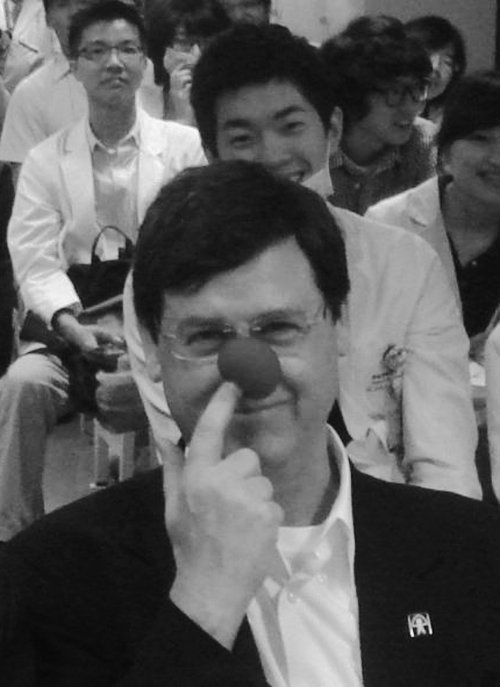
I have taught magic to pediatricians for years and have had the joy of teaching magic in 22 countries on five continents. I have developed new magic effects for doctors, and I have worked with Dr. Hunter “Patch” Adams, a VCU medical school graduate, to introduce medical students to pediatrics, clowning, and magic. Physicians are naturally magicians; we wear special clothing, use cryptic language, have tools that look into the body, and we give out magical potions to cure disease. For pediatricians especially this can be a great deal of fun.
There are as many kinds of magic as there are types of medicine: there are street magicians, illusionists, people who do card tricks, people who do gospel magic, mentalists (mind readers and spoon benders), and those who do children's shows. I do close-up magic, like the performer who moves from table to table in a restaurant. My “tables” are hospital or clinic rooms, and my magic is done with ear specula, tongue depressors, rubber bands, and so on. I don't carry cards, I don't do magic shows, and I never do more than 1 minute of magic at one time during a visit. My patients really look forward to the magic. What a nice change to actually have patients look forward to seeing us!
When patients say, “Show me how you did that,” I remind them that magicians are not allowed to give away their secrets except to another magician. I tell them that if they learn a magic trick and come back and teach me, then I will teach them a trick. Some children do this, and a few of my patients have become accomplished magicians. Magic is part secret and sleight of hand, but mostly it is performance, misdirection, and timing. I think that performing magic has improved my lectures and presentation timing as well.
Based on your involvement in the leadership of the International Congress on Pediatric Pulmonology (CIPP), how would you describe the value of international collaboration among pediatric pulmonologists?
CIPP started in 1994, in France, by Dr. Annie Bidart with representatives from 16 countries attending the first Congress. It is still the only international meeting completely devoted to pediatric pulmonology. We will be holding our 11th meeting in June of this year in Bangkok, and it promises to be the best CIPP we have ever put on. The focus of CIPP has always been to promote international collaboration and learning, and to promote and reward research and presentations by young investigators and trainees. The meeting has a major focus on international health and on research, clinical, and educational collaboration. It is the Congress to attend to meet with the leaders from our field from around the world, and because of the setting, with 1,000–1,200 attendees, everyone is approachable. We have an international advisory board with global representation from more than 70 countries. We are in the process of making CIPP a platform for developing a federation of national pediatric pulmonary associations. Many nations have their own associations, and CIPP can help bring these groups together in the form of a federation to enhance collaboration and cooperation.
What can pediatric pulmonologists in the United States learn from pediatric pulmonologists abroad?
The world is small and becoming smaller. Here in Richmond, 2 years ago, we cared for a baby with congenital malaria. In November 2011, we separated conjoined twins from the Dominican Republic. We learn about TB, HIV, and other disorders from our colleagues around the world, and we can apply the knowledge they have gained to our own work. There are great opportunities for collaboration, training, and bringing in diverse and fresh perspectives on bedside care, research, and ways to educate.
What would you identify as the main challenges facing pediatric pulmonology at present? Drawing on your talents as an accomplished magician, may I ask you to predict the future of pediatric pulmonology?
Pediatric pulmonologists deal with chronic diseases—CF, tuberculosis, severe asthma, chronic lung disease (CLD) of the newborn—and this puts many demands on our time. There are too few pediatricians going into subspecialty training. The mean age of pediatric pulmonologists in North America is now the mid-50s, and there are too many open positions. Pediatric pulmonologists work hard and seem to have less time to engage in research, less access to research funding, and less time keep up with the explosion of information. They also have less time to enjoy some of the opportunities I have enjoyed, such as collaborating with physicians around the world.
On the other hand, there is a great need for pediatric pulmonologists, and we tend to be a really nice group of people, professionally and personally. There are new models of caring, like the “medical home,” which are well suited to our work with chronically ill children. A young pediatric pulmonologist can certainly have a rewarding career. As an optimist and magician (but no mentalist), I see a bright and exciting future.