




Abstract
Asthma is an inflammatory disease of the lower airway and the most common chronic disease in childhood. Interleukin 9 (IL-9), as a proinflammatory cytokine, has major effects on both proliferation and function of the immune cells, whereas its gene is located on 5q31-q32 which is consistent with the previously identified susceptibility loci for asthma. This study was performed to analyze the association between rs2069882, an intronic gene variant in the IL9 gene, and IL-9 serum levels and susceptibility to pediatric asthma. Sixty-one children with asthma and 63 healthy pediatric controls participated in this study. We determined allele frequencies of rs2069882 in IL9 gene, using real-time polymerase chain reaction assay, while serum levels of IL-9 were measured in 45 asthmatic patients and 45 healthy subjects, using enzyme-linked immunosorbent assay method. There was no significant association between different alleles of rs2069882 and susceptibility to asthma and its severity. Serum levels of IL-9 were significantly higher in patients group. Patients with TT and TC genotypes in rs2069882 had significantly higher levels of IL-9. In addition, patients with severe asthma had significantly higher serum IL-9 levels. Although there was not any significant association between different alleles of rs2069882 and susceptibility to asthma, this study showed that genotypes in this single nucleotide polymorphism can influence the serum levels of IL-9 in asthmatic patients, which in turn can influence its severity.
Introduction
A
Asthma is considered to be a multifactorial disease, which results from a complex interplay between genetic and environmental factors.5,6 Asthma has a strong heritability component of 92%; therefore, genetic factors are major determinants of predisposition to asthma.7,8 In the last decade, researchers used both candidate gene and positional cloning studies to determine underlying genetic factors of asthma and they found several susceptibility loci including 4q24-q27, 3q13, 5q31–q33, and several other regions.5,9
Genetic variants within cytokine genes are able to change the secretory levels of cytokines at several levels from expression patterns to post-translation modifications; therefore, they have a great influence on the immune response and consequently, they are major determinants of susceptibility to immune-mediated diseases such as asthma.5,9–11
Interleukin 9 (IL-9), as a proinflammatory cytokine, has major effects on both proliferation and function of immune cells.12,13 IL-9 enhances IgE production of B cells, promotes Tcell growth, specially CD4+ T cells and mast cell growth and function.12–15 In addition, IL-9 indirectly induces allergic inflammation in airway epithelium through enhancing production of IL-13. 16 IL-9 enhances chemokine release from bronchial epithelial cells and airway smooth muscle and induces goblet cell hyperplasia.13–15
The gene encoding for this cytokine has been located to 5q31-q32, which is consistent with the previously identified susceptibility loci for asthma.12,17 In addition, polymorphisms of IL9 gene have been previously associated with the development of atopy and bronchial hyper responsiveness.18,19
Having these facts in mind, IL9 gene could be considered as a good candidate gene in asthma. Therefore, in this study, we investigated the relationships between a common single nucleotide polymorphism (SNP) of IL9 gene, rs2069882, and susceptibility to asthma. In addition, we evaluated serum levels of IL-9 in children with asthma and its association with disease severity.
Materials and Methods
Study population
In this study, 61 children with asthma who were referred to the Children's Medical Center Hospital, the Pediatrics Center of Excellence in Tehran, Iran, were enrolled as the patient group. Exclusion criteria were presence of parasitic or pulmonary infections, heart abnormalities, and endocrine and hematologic disorders. An allergologist established the diagnosis of asthma, based on the clinical history, physical examination, pulmonary function tests, and by following the guidelines of the National Asthma Education and Prevention Program (Expert Panel Report-3). 20 Demographic and clinical data were gathered by interviewing patients and reviewing their medical records. As a reference for background population allele frequencies, we determined allele frequencies of 63 healthy volunteers from the same ethnicity of the patient with no history of allergy, asthma, and other inflammatory diseases at the time of sampling.
An approval was obtained from the Local Ethics Committee of the Tehran University of Medical Sciences. Written informed consents were taken from all participants in the study.
SNP genotyping
Five milliliters of peripheral blood were collected in 5% EDTA tubes. The standard phenol chloroform method was used to extract genomic DNA. Allele frequencies for 1 intronic polymorphism of IL9 gene (315 + 76T>C; rs2069882) was determined, using TaqMan SNP Genotyping Assay by 96-well 7300 ABI Real-Time PCR System. Polymerase chain reaction products underwent electrophoresis on a 2% agarose gel containing ethidium bromide and we visualized them under ultraviolet illumination.
Measurement of serum levels of IL-9
We measured serum levels of IL-9 in 45 children with asthma and 45 healthy volunteers, using sandwich enzyme-linked immunosorbent assay (Commercial enzyme-linked immunosorbent) (R&D Cat. No. BMS2081). The assay was performed using the protocols recommended by the manufacturers for the quantitative sandwich enzyme immunoassay technique.
Statistical analysis
We used SPPS statistical software, version 18 (SPSS, Inc., Chicago, IL) to do statistical analysis. Pearson's Chi-square test or Fisher's (when appropriate) were used to compare patient genotypes with the control genotypes and to test association between allele frequencies and susceptibility to pediatric asthma. One-way ANOVA test was used to test associations between IL-9 serum levels and genotypes. In all statistical tests, a P value of <0.05 was considered significant.
Results
At the end of study, we gathered the clinical information and frequencies of 1 SNP in 61 children with asthma and 63 healthy individuals. The mean age of the patients at the time of study was 8.44 years (SD = 2.17) and the mean age of participants in the control group was 9.97 years (SD = 2.05). Twenty-nine patients had mild disease and 24 patients had moderate disease.
Allele frequencies
Table 1 shows frequencies of genotypes and alleles in patients and healthy individuals. The frequencies of alleles were in accordance with Hardy–Weinberg equilibrium in both groups.
Although the frequencies of the T allele and TT genotype in rs2069882 were lower in the patients than controls, these differences were not statistically significant. In stratified analysis for gender, there was not any significant association between allele frequencies and asthma susceptibility.
The majority of patients with CC genotype had mild disease, while patients with T allele mostly had moderate or severe disease. However, such relationships between different genotypes and severity of disease were not significant. In stratified analysis for gender, still, these relationships remained statistically insignificant.
Associations between genotypes and IL-9 levels
As shown in the Fig. 1, serum IL-9 levels were significantly higher in patients, compared with controls (P = 0.03). In addition, patients with severe asthma had significantly higher serum IL-9 levels, compared with controls (P < 0.001) (Fig. 2).
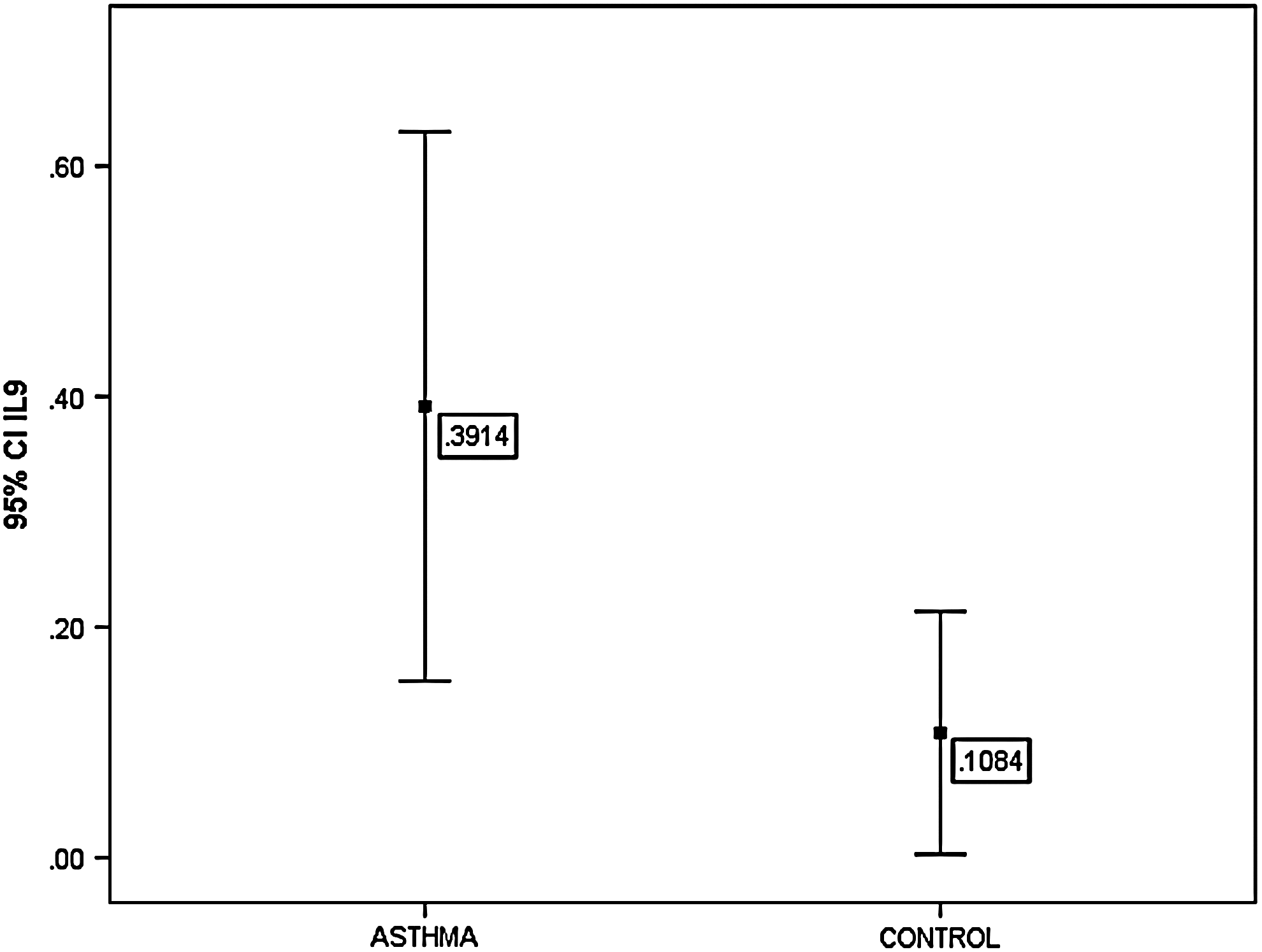
Serum levels of interleukin 9 (IL-9) in children with asthma (n = 45) and healthy controls (n = 45). CI, confidence interval.
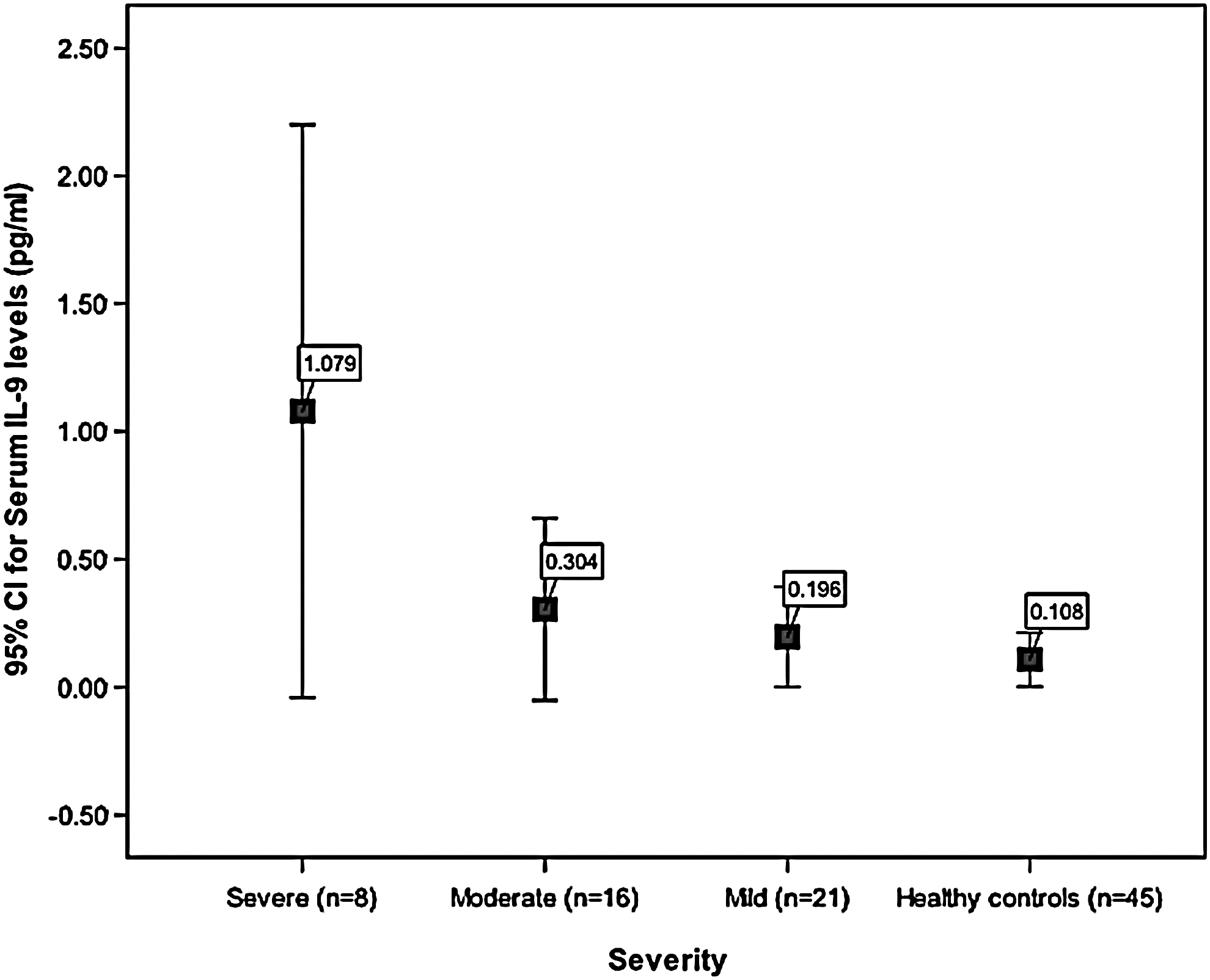
Serum levels of IL-9 in different groups of children with asthma (based on severity) and healthy controls.
Patients with TT and TC genotypes in rs2069882 had significantly higher levels of IL-9, while there was not such an association in control group (Fig. 3). Using stratified analysis for gender, we found these associations were not dependent on gender.

Serum levels of IL-9 in different groups of children with asthma (based on genotypes in rs2069882).
Discussion
In this case–control study, we studied associations of 1 intronic SNP within IL9 gene with pediatric asthma. There was no significant association between different genotypes of rs2069882 in IL9 and susceptibility to asthma or asthma severity. In stratified analysis for gender, still no statistically significant association was found. Aschard et al. previously showed significant associations between genotypes of rs2069882 and FEV1/H 2 (forced expiratory volume in 1 second divided by height square), which is a measure of lung function and quantitative score of skin prick testing, a measure of polysensitization. 18 This inconsistency between that study and our results might be due to the complex interactions between genetic variants, different genes, environmental factors, and different linkage disequilibrium patterns in different ethnic groups.5,9,11
To our best knowledge, our study for the first time showed that patients with TT genotype had higher levels of IL-9. Therefore, the association reported by Aschard et al. might be a result of higher expression and higher levels of IL-9 in the presence of T allele; however, it was not found in our study.
We found that pediatric asthma patients had higher levels of IL-9 in serum. In addition, our results showed an association between increased serum levels of IL-9 and severity of disease. In accordance with our results, several studies have shown associations between IL-9 levels and both susceptibility to and severity of allergic diseases such as atopic dermatitis, allergic rhinitis, and asthma.14,21–25
IL-9 can influence susceptibility to asthma and allergic diseases with several mechanisms. IL-9 signaling induces mast cell proliferation, goblet cell hyperplasia, mucus overproduction by the pulmonary epithelial cells, eosinophilic activation, and IgE production by B cells.12,26–29
In conclusion, our study showed that genotypes in rs2069882 can influence the serum levels of IL-9 in children with asthma, which in turn can influence its severity. Therefore, further studies are required to illuminate possible mechanisms by which this SNP influences the IL-9 levels. Although based on our results, there was not any significant association between different alleles of rs2069882 and susceptibility to asthma, further studies should evaluate such association in different ethnic groups and the effect of this SNP on IL-9 levels in patients with asthma.
Footnotes
Acknowledgments
This study was supported by a grant from Tehran University of Medical Sciences (91-04-30-19310).
Author Disclosure Statement
No competing financial interests exist.