




Abstract
Background:
In the past two decades, the prevalence of asthma, eczema, and allergic rhinitis has increased among school-aged children in the Central Black Sea region of Turkey. This increase is consistent with national and international data, reflecting the impact and temporal changes of allergic diseases on the community. A similar increasing trend is also observed worldwide. This study aims to contribute to the development of health policies related to allergic diseases among Turkish children in the Central Black Sea region.
Materials and Methods:
This study compares the results of two cross-sectional surveys conducted in schools in and around Samsun, Turkey, between the years 2006 and 2022, examining changes in the prevalence of specific allergic diseases such as asthma, allergic rhinitis, and atopic eczema. Utilizing the Turkish translation of the International Study of Asthma and Allergies in Childhood protocol, the research encompassed a total of 1,310 and 3,219 children, respectively.
Results:
In the recent study conducted in 2022, the prevalence of asthma and allergic bronchitis diagnosed by physicians was found to be 10.5% and 4.6%, respectively. In addition, the prevalence of allergic rhinitis was determined to be 3.1% and the prevalence of atopic dermatitis was 2.5%. Moreover, previously unidentified rates of food allergy were determined to be 2.5%, and drug allergy was found to be 2.4%. Furthermore, a comparison with a cross-sectional study conducted in the same region 20 years ago revealed a statistically significant increase in the prevalence of physician-diagnosed asthma and allergic bronchitis (with P-values of 0.0375 and 0.0107, respectively).
Discussion:
The findings of this study suggest a similar trend of increasing prevalence of allergic diseases when compared with similar studies at national and global levels. Consistent with trends identified in the international literature, Turkey is also affected by the rising prevalence of allergic diseases.
Introduction
Significant changes have been observed in the prevalence of allergic diseases worldwide over the past 20 years. These changes encompass advancements in our understanding of the etiology and pathophysiology of allergic diseases, as well as the development of preventive measures and treatment methods. Particularly in the last 5 years, research on the mechanisms of allergic diseases has led to effective treatments. Some of these treatments are currently in advanced clinical trial stages. 1
Moreover, global interest in the epidemiology of allergic diseases in the 20th and 21st centuries stems from the unprecedented pandemic-scale increase in the prevalence of these diseases. According to the “Allergy White Book” report published in 2011, the prevalence of allergic conditions is significantly increasing in both developed and developing countries. For instance, asthma rates range from 1% to 20%, allergic rhinitis from 1% to 18%, and skin allergies vary between 2% and 10% across various populations. The increasing prevalence of allergies in children, especially in the last two decades, is noteworthy. 2 This has become a growing public health concern worldwide, leading to high socioeconomic costs. Factors such as increasing air pollution, environmental pollutants, indoor allergens, changing lifestyles, and dietary habits are believed to play a significant role in this trend. 1
A study examining trends in the prevalence of asthma and other allergic diseases worldwide is the Global Asthma Network (GAN) Phase I study. 3 This study aimed to determine whether there has been a change in the global burden of asthma symptoms in childhood. This updated cross-sectional study used the same methods as the International Study of Asthma and Allergies in Childhood (ISAAC) Phase III. From 1993 to 2020, 119,795 participants from 27 centers in 14 countries were included. The research findings showed a significant decrease in the prevalence of severe asthma symptoms in adolescents (−0.37 percentage points) over a decade, whereas there was an increase in asthma history (1.25) and night cough (4.25). The prevalence of current wheeze decreased in low-income countries but increased in low-middle-income countries. These results indicate that the trends in the prevalence and severity of asthma symptoms vary by age group, country income, region, and center. 3 Although Turkey was not included in this study, we planned a cross-sectional study in our country to examine what has changed in asthma and allergy-related diseases in the past 20 years. However, due to limited resources for conducting a nationwide study in our country at present, we conducted a second cross-sectional study, which serves as a follow-up to a previous study conducted in our region, in the city of Samsun located in the Central Black Sea region.
Diagnoses Made by a Doctor (Study Conducted in 2022)
Distribution of Children According to the Conditions Causing Wheezing Complaints in the Last Year
CI, confidence intervals.
Methods
Study population and design
In this study, the prevalence of specific allergic diseases such as asthma, allergic rhinitis, and atopic eczema was examined in schools located in the Middle Black Sea region of Turkey, particularly in the city of Samsun and its surrounding areas. The list of schools was obtained from the Samsun Provincial Directorate of National Education, and schools were randomly selected using a random number table from this list. Direct communication was established with school administrations, and written consent was obtained from parents to administer the Asthma and Allergic Diseases Screening Questionnaire in Turkish, to be returned within 2 weeks. The questionnaire included demographic information about the child and family and collected information about past allergic disorders and related diagnoses. The translation of the questionnaire used in the study was validated through previous studies conducted in Turkey. Additional questions regarding drug and food allergies were added to the questionnaire. Furthermore, the data from the cross-sectional study conducted in the same region in 2006 were statistically compared with the current findings.
Statistical evaluation
The statistical software package SPSS 21 was used for data analysis in this study. Descriptive statistics were presented as frequencies (n) and percentages (%) for categorical variables and as means and standard deviations for numerical variables. The normality of quantitative data was assessed using the Kolmogorov–Smirnov test. The chi-square test was employed for comparing categorical variables. A significance level of P < 0.05 within a 95% confidence interval was considered statistically significant.
Ethical committee
The ethical approval for this study was obtained from the Clinical Research Ethics Committee of Ondokuz Mayıs University. Our study was conducted in accordance with the principles of good clinical practice based on the Helsinki Declaration. Ethical approval confirms that research studies are conducted in compliance with ethical standards and human rights and that the rights of participants are protected.
Results
The study included a total of 3,219 students aged between 5 and 18 years, comprising 1,590 males and 1,629 females. It was observed that 634 (19.7%) students reported wheezing complaints at any point in their lives, 337 (10.5%) were diagnosed with allergic bronchitis or asthma by a doctor, and 359 (11.1%) reported asthma complaints in the past year (Tables 1 and 2).
In the study, it was found that 47.7% of children had allergic rhinitis complaints at any point in their lives (1,537 children), 4.6% were diagnosed with allergic rhinitis by a doctor (148 children), and 35.3% reported allergic rhinitis complaints in the past year (1,137 children). Similarly, complaints of atopic dermatitis (AD) at any point in time were reported by 12.8% of children (412 children), 3.1% were diagnosed with AD by a doctor (101 children), and 8.1% reported AD complaints in the past year (262 children). A statistically significant increase was observed in diagnoses of asthma and allergic bronchitis. However, while there was not a statistically significant increase in symptoms of allergic rhinitis, chronic itching, and eczema cases, an increase was observed (Table 3). 4
Comparison with the Research Findings from Anlar et al. 4
Bold values indicate statistically significance results (p < 0.05).
When evaluating the environmental factors causing wheezing in the children included in the study in the past year, it was determined that pollen was the cause in 132 (4.1%) children, dust in 51 (1.6%) children, and other factors in 42 (1.3%) children.
When evaluating school absenteeism due to wheezing or asthma in the children included in the study in the past year, 170 (5.3%) children were absent from school for 1–5 days, 28 (0.9%) children for 6–10 days, and 13 (0.4%) children for >10 days. In total, 148 (4.6%) children had wheezing complaints but did not miss school due to this reason.
Among the children examined for food allergy in the study, it was determined that 200 had a food allergy. In detail, 1.2% (39 children) had peanut and tree nut allergies, 0.9% (29 children) had milk allergies, 0.6% (19 children) had egg allergies, and 0.2% (7 children) had red meat allergies. On the other hand, 93.8% (3,019 children) were in the group without food allergies or with unknown status.
Among the children evaluated for drug allergy, 2.8% (89 children) showed allergic symptoms to antibiotics, and 0.7% (22 children) showed allergic symptoms to other drugs (such as ciprofloxacin, zinc, metamizole, and Vicks). The most common allergy among these drugs was to penicillin derivatives, with a rate of 1.5%. In the study, 96.6% (3,108 children) were recorded as children without allergies to any medication.
This study compared the results with those of the study conducted in the same region by Anlar et al. in 2006 and statistically evaluated these current findings, as presented in Table 3.
Including other studies covering the changes in allergic diseases over the past 20 years in our country, these alterations are illustrated in Figure 1.5–24
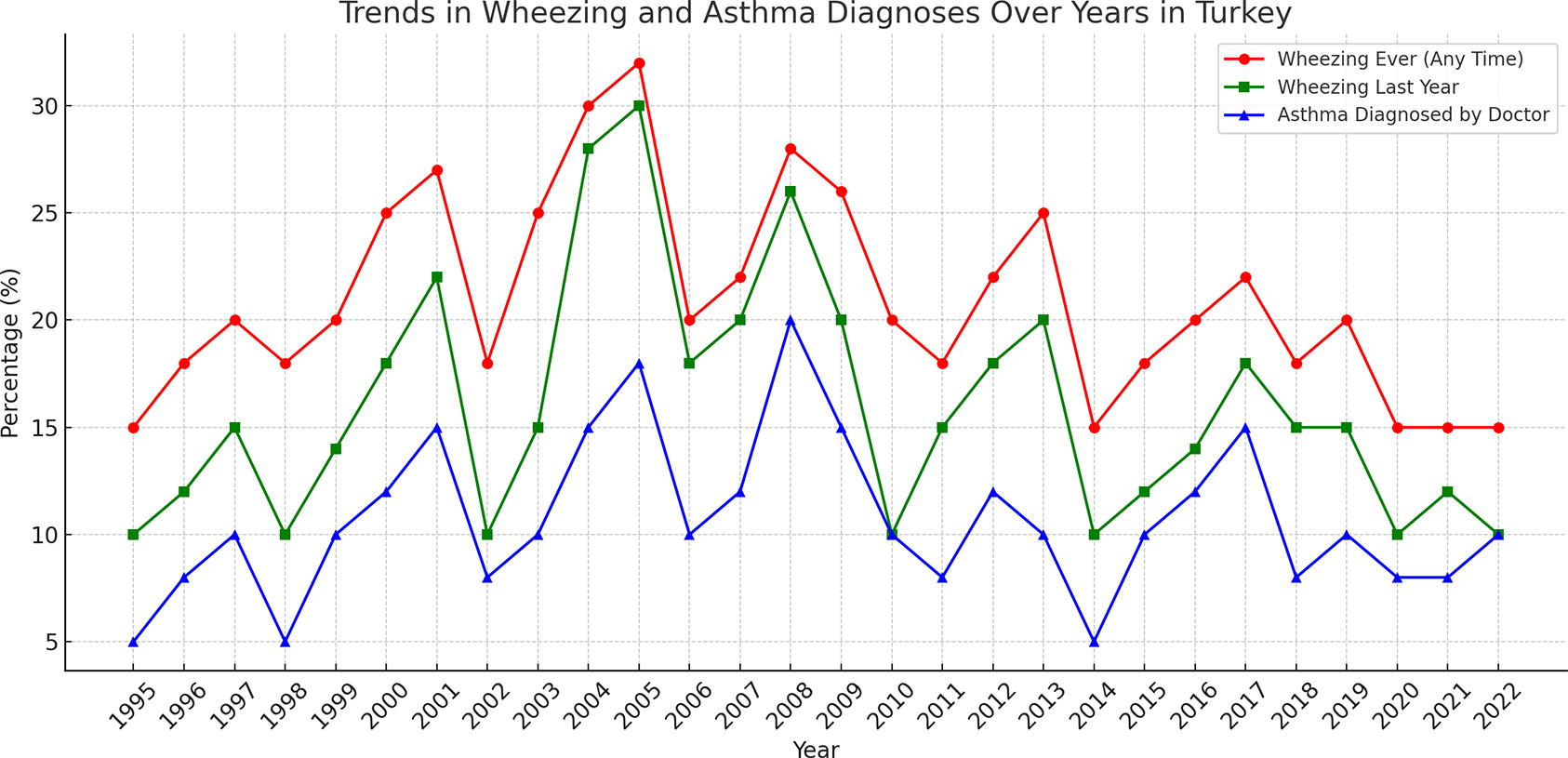
Trends in Wheezing and Asthma Diagnoses Over Time in Turkey.
Discussion
In the past 20 years, a significant increase in the prevalence of allergic diseases has been observed worldwide and in our country. A study evaluating the global burden of allergic disorders and risk factors in 204 countries and regions from 1990 to 2019 reported a total of 262 million cases of asthma and 171 million cases of AD worldwide. 25
The prevalence of asthma and AD was highest in children aged 5–9 years and more common in individuals with a high sociodemographic index. The study highlighted that a high body mass index is the most significant risk factor for asthma, greatly impacting disability-adjusted life years and mortality. While the overall prevalence and incidence of asthma and AD increased, the age-standardized prevalence rates decreased. These findings can inform the development of improved management strategies and policies to mitigate the global health impact of asthma and AD. 25
The GAN was established in 2012 as a collaborative initiative by members of the ISAAC and the International Union Against Tuberculosis and Lung Disease. This initiative followed the co-production of the first Global Asthma Report (GAR), which was launched in 2011 during the United Nations high-level meeting on noncommunicable diseases. The estimates of the global burden of asthma presented in that report were primarily based on data from the ISAAC Phase III surveys conducted between 2001 and 2003, which included adolescents aged 13–14 and children aged 6–7. In addition, it incorporated time trends from centers that participated in ISAAC Phase I (1994–1995) and data from the World Health Surveys of adults conducted in 2002–2003. The necessity for updated surveillance of asthma prevalence, severity, diagnosis, and management, emphasized in GAR 2011, has become increasingly urgent. Over the last decade, very few studies globally have evaluated trends in asthma prevalence and associated risk factors. 3
The most recent global research, the GAN Phase I study, found significant changes in the prevalence of asthma symptoms in most centers worldwide, indicating more than random variation. Decreases in the prevalence of asthma symptoms were observed in seven countries, whereas increases were observed in seven others. An increased prevalence of current wheeze and severe asthma symptoms was noted in Africa and the Eastern Mediterranean, whereas a decrease in average prevalence was observed in Southeast Asia and the Western Pacific regions. Using the same tools and methods as ISAAC, the study included nearly 120,000 children from 27 centers in 14 countries. The research found that asthma symptoms constitute a significant burden on school-aged children; ∼1 in 10 children had experienced wheezing in the previous year, with nearly half of them exhibiting severe symptoms. 3 Three separate cross-sectional studies conducted in our country in 1994, 2004, and 2014 have shown an increase in the prevalence of asthma, allergic rhinitis, and AD over time. 26 A study conducted in Poland demonstrated an increase in the prevalence of asthma, respiratory symptoms, and allergic diseases in four separate surveys conducted from 1993 to 2014. 27 Another national cross-sectional study conducted in Japan, examining allergic diseases across a wide age range, found that approximately two-thirds of the population had some form of allergic disease. This study covered bronchial asthma, AD, food allergies, allergic rhinitis, allergic conjunctivitis, metal allergies, and drug allergies. The results of the same study indicate that allergic rhinitis is the most common allergic disease. 28
In our research, an increase in the prevalence of asthma, eczema, and allergic rhinitis in Turkey from 2006 to 2022 has been identified. The increase in the prevalence of doctor-diagnosed asthma has risen from 2.3% to 10.5%. This increase is consistent with the national trends reported in the 2020 report by the Turkish Association of Allergic Diseases and Asthma 29 and parallels the global trends reported in the 2021 report by the GAN. 30 Similar increases have been observed for eczema and allergic rhinitis. However, interestingly, while there has been an increase in the prevalence of doctor-diagnosed asthma, the prevalence of current wheezing has decreased over the past decade. This may be attributed to the increased accessibility of healthcare services and advancements in diagnostic methods. On the other hand, evidence from published studies suggests that environmental factors and lifestyle changes have also played a role in this increase. 31 This situation reflects the urbanization and industrialization processes in Turkey and can be associated with increased air pollution and exposure to allergens.
In a recent study conducted in another region of our country, the prevalence of wheezing at any time during their lives was determined to be 10.5%. This rate was found to be 4.9% in the past year. 4.9% of the participants reported that their child had been diagnosed with asthma by a doctor. The rate of participants diagnosed with allergic rhinitis by a doctor was 3.1%. 32 The difference in results from our study is noteworthy. This indicates that the frequency of allergic diseases can vary even in different regions of the same country. The Central Black Sea region where our study was conducted is located by the sea and is a humid area. House dust allergy is highly prevalent in our region, and asthma and allergic bronchitis diseases may be higher compared to other regions of our country. 33 These data demonstrate that asthma symptoms and diagnoses vary among different regions and groups. Factors such as industrialization, geographical factors, and lifestyle are thought to contribute to these variations.
The main findings of ISAAC Phase Three present regional tables and figures related to the prevalence and severity of asthma, rhinoconjunctivitis, and eczema symptoms worldwide. The scope of the study is extensive, with ∼1,200,000 children, 233 centers, and 98 countries participating, making it the most comprehensive research on these diseases. Globally, the current prevalence of asthma, rhinoconjunctivitis, and eczema in the 13–14 age group is 14.1%, 14.6%, and 7.3%, respectively. In children aged 6–7 years, the current prevalence of asthma, rhinoconjunctivitis, and eczema is 11.7%, 8.5%, and 7.9%, respectively. The study shows significant regional and national differences in the prevalence and severity of asthma, rhinoconjunctivitis, and eczema. However, it also notes differences between centers in the same country and even within the same city. This study conclusively demonstrates that the prevalence of these diseases can be very high in centers with low socioeconomic conditions. The considerable variation also suggests that local environmental factors play a critical role in determining differences in prevalence between different locations. 34
Asthma and AD impose a significant burden on global health, highlighting the need for global and regional policies and interventions for managing these diseases. 35 A study conducted among fifth-grade students in five cities in Turkey found that 11% of participants reported wheezing more than once a month in the past year, whereas 14% of those diagnosed with asthma by a doctor reported waking up due to wheezing at least once a week. Approximately 30% of those diagnosed with asthma reported school absenteeism or hospitalization due to asthma. 35 In our study, annual rates of school absenteeism, hospital admissions, and medication use among students were evaluated, indicating a significant social burden on the community.
A study in China showed a higher prevalence of asthma (6.6% versus 2.5%), rhinitis (23.2% versus 5.3%), and eczema (34.1% versus 25.9%) in urban children compared to rural children. This study emphasized the importance of urban/rural environmental exposures in the development of allergic diseases and allergen sensitivities. 36 Consistent with the literature, our study found a higher rate of allergic diseases in urban areas, indicating urbanization as a significant risk factor for allergies. In addition, our study examining risk factors associated with asthma and allergic diseases showed variations in prevalence based on gender. Specifically, a higher risk of asthma was found in male children. Prematurity (premature birth) and cesarean section delivery were found to increase the risk of childhood asthma. Maternal smoking during pregnancy was also shown to increase the risk of asthma in children.
The paradoxical findings of an increase in asthma and a decrease in wheezing are widely discussed in the scientific community and involve numerous interacting factors. 37 To understand this complexity, it is important to consider specific factors such as advancements in health care services, environmental factors, and viral infections.
First, the increase in access to healthcare services and advancements in diagnostic methods may have led to better recognition and management of asthma. This could have resulted in more individuals receiving an asthma diagnosis and accessing appropriate treatment. Second, the role of environmental factors is significant. Urbanization, air pollution, and exposure to allergens can influence the prevalence of asthma. These factors may have a more pronounced effect, particularly on infants and young children.
The role of viral infections cannot be overlooked. Improved hygiene measures and reduced risk of viral infections may decrease the number of wheezing and asthma attacks. However, the exact cause of these paradoxical findings is not yet fully understood, and further research is needed. Data limitations may hinder reaching definitive conclusions on this matter. Therefore, future studies will need to comprehensively address this complexity to better understand it. Globally, the prevalence of allergic diseases, particularly in developing countries, is on the rise. International studies indicate that lifestyle changes and environmental factors play a role in this increase. The results of our study reflect these international trends and demonstrate that Turkey is also affected by global health changes. Furthermore, the increase can be attributed to various factors such as increased air pollution, changes in urban lifestyles, and genetic factors. These rising prevalence rates necessitate a review of national health policies for the management and prevention of allergic diseases. Developing strategies for preventive health care and protection against allergens can reduce the burden of these diseases. Our research plays a critical role in understanding the burden and trends of these diseases over time and aims to contribute to the direction of health policies.
Conclusion
Our study has demonstrated a significant increase in the prevalence of asthma, eczema, and allergic rhinitis in Turkey. These findings can contribute to the development of policies and strategies for the management of allergic diseases at both national and international levels. Multidisciplinary approaches and cross-sectoral collaborations are necessary to reduce the burden of allergic diseases. Efforts to reduce allergic diseases require comprehensive approaches that include environmental and lifestyle factors. Limitations of our study include the inability of the cross-sectional design to establish cause–effect relationships and the limited sample size. In addition, the lack of data collection from various geographical regions may limit the generalizability of our results. Future research should aim to better understand cause–effect relationships and include larger sample sizes from various geographical and socioeconomic groups. Furthermore, in-depth examination of environmental and genetic factors contributing to the emergence of allergic diseases is important.
Sources of Report
The authors declare that they didn’t use any source of support.
Footnotes
Authors’ Contributions
In this study, all authors have made significant contributions. Ş.İ.K.K., A.S., and B.S. developed the concept and design of the study. Data collection and analysis were carried out by Ş.İ.K.K., B.S., A.S., and A.Y. The task of writing the draft article and developing critical content was undertaken by Ş.İ.K.K. and B.S., and A.Y. All authors reviewed, revised the article draft, and approved the final version. Each author acknowledges that they are accountable for all aspects of the published work.
Author Disclosure Statement
The authors declare no potential conflicts of interest.
Fundıng Informatıon
This study did not receive any funding.