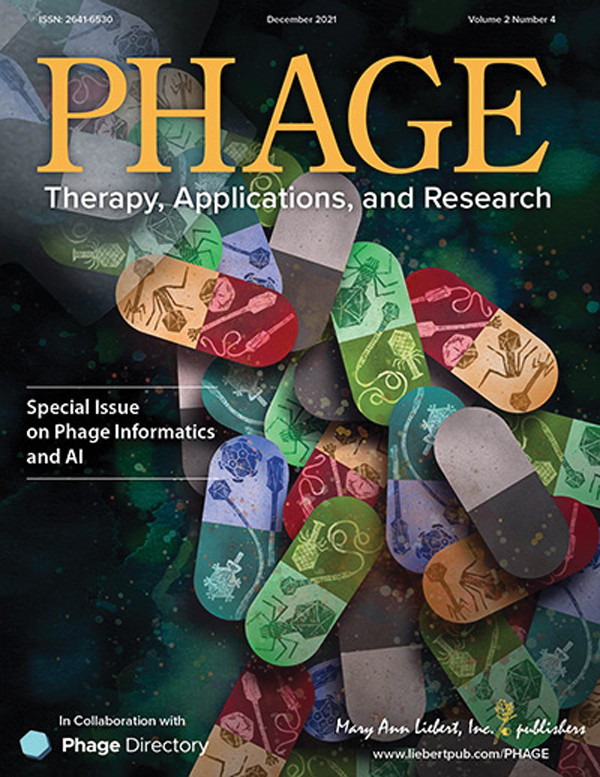
PHAGE: Therapy, Applications, and Research
is pleased to announce a call for papers for a Special Issue on phage genes involved in phage/host interactions and applications that use such genes to disrupt host functions.
As coined by Graham Hatfull, the “dark matter” of the biosphere constitutes a vast majority of phage genes, which have no homologs within prokaryotic or eukaryotic genomes. Recent work has shown that many of these genes encode functions that work in host takeover and/or optimization of the phage infection. Understanding the molecular mechanisms of these phage genes may provide insights into new ways to generate anti-bacterial strategies, information that is crucial in light of the global crisis of growing antibiotic resistance. This issue will focus on the identification, characterization, and mechanisms of phage genes involved in phage/host interactions, applications that use such genes to disrupt host functions, and host responses to these phage strategies.
Papers reporting new data, reviews, or hybrids of both are welcome. Please submit your article for the special issue by July 1, 2022.
PHAGE: Therapy, Applications, and Research
is the only peer-reviewed journal dedicated to fundamental bacteriophage research and its applications in medicine, agriculture, aquaculture, veterinary applications, animal production, food safety, and food production. Under the distinct leadership of Editor-in-Chief Martha Clokie, PhD, University of Leicester, United Kingdom, the Journal showcases groundbreaking research, reviews, commentaries, opinion pieces, profiles, and perspectives dedicated to defining the roles of phages in all facets of microbiology and microbial ecology and exploring their potential to manipulate bacterial communities and treat infection.
PHAGE
is the critical resource for molecular biologists, microbiologists, bacteriologists, bioengineers, immunologists, clinicians, and translational biologists, and aims to unify this evolving cluster of innovative researchers, industry leaders, clinicians, and policy makers. The Journal also advances knowledge and development in this re-emerging area of research and opens doors for new ideas and funding opportunities for researchers and clinicians in the field.
To begin your submission, log into the PHAGE Manuscript Submission Site at https://mc.manuscriptcentral.com/phage, and please include in your cover letter that you are submitting for the special issue.
Visit the
PHAGE: Therapy, Applications, and Research
Instructions for Authors at www.liebertpub.com/phage for more information, including manuscript guidelines and available author services.
Contact the PHAGE Editorial Office at phage_eo@liebertpub.com with any questions you may have.
Visit the Instructions for Authors:
www.liebertpub.com/phage
Submit your paper for peer review online:
https://mc.manuscriptcentral.com/phage





