




Abstract
Introduction
This study was originally aimed at using an animal model for depression to understand whether the potential antidepressant effect of IR irradiation was merely due to hyperthermia or had seasonality. In order to explore seasonality, the mice were not kept in the experimental animal center where temperature, humidity, and luminosity for light/dark cycle were well controlled during the study period. Instead, they were housed in cages in a room with a natural light/dark cycle and subject to the outdoor temperature. Unfortunately, two episodes of cold current occurred unexpectedly during the study period and some of the experimental mice died as a result. Possible pathogenesis of death may have been cold-induced vasoconstriction that raised plasma viscosity. In this situation, the stability of red corpuscle aggregates increases, multiple emboli line the microvessels, and progressive thrombosis leads to anoxia. 9 Drobnis et al. 10 established that cold shock damage resulted from lipid phase transitions in cell membranes, and reducing this damage could increase the survival of animals at low environmental temperatures. 10 Chludzińska et al. 11 revealed the protective action of IR radiation on the erythrocyte membrane. Another pathogenesis could have been that the forced swimming test in cold resulted in significant immobility. 12,13 Marked immobility in water can lead to aspiration and cause mortality in turn.
Thus the target of the study evolved into a comparison of the survival rates in different groups of the experimental mice encountering cold conditions.
Materials and Methods
Animals
The study was approved by the Institutional Animal Care and Use Committee of the Buddhist Tzu-Chi General Hospital. Forty-four Naval Medical Research Institute (NMRI) mice were obtained from the Experimental Animal Center of Tzu-Chi University. All the mice were fed with food and clean tap water ad libitum and allowed to adapt to the experimental conditions for at least one week. All experiments were performed between 6:00 AM and 6:00 PM.
Apparatus
The IR emitter (Lucybelle Biological Technology Inc., Taoyuan, Taiwan) had the highest emissivity within the wavelength range 3–15 μm (Fig. 1) and a calculated maximal radiation intensity of 33 J/cm2. Heat was provided with a 800 W heater, and the forced swimming test was conducted using a clear acrylic, cylindrical container (40 cm tall × 12 cm diameter) filled to a 25 cm depth with clean water at room temperature.
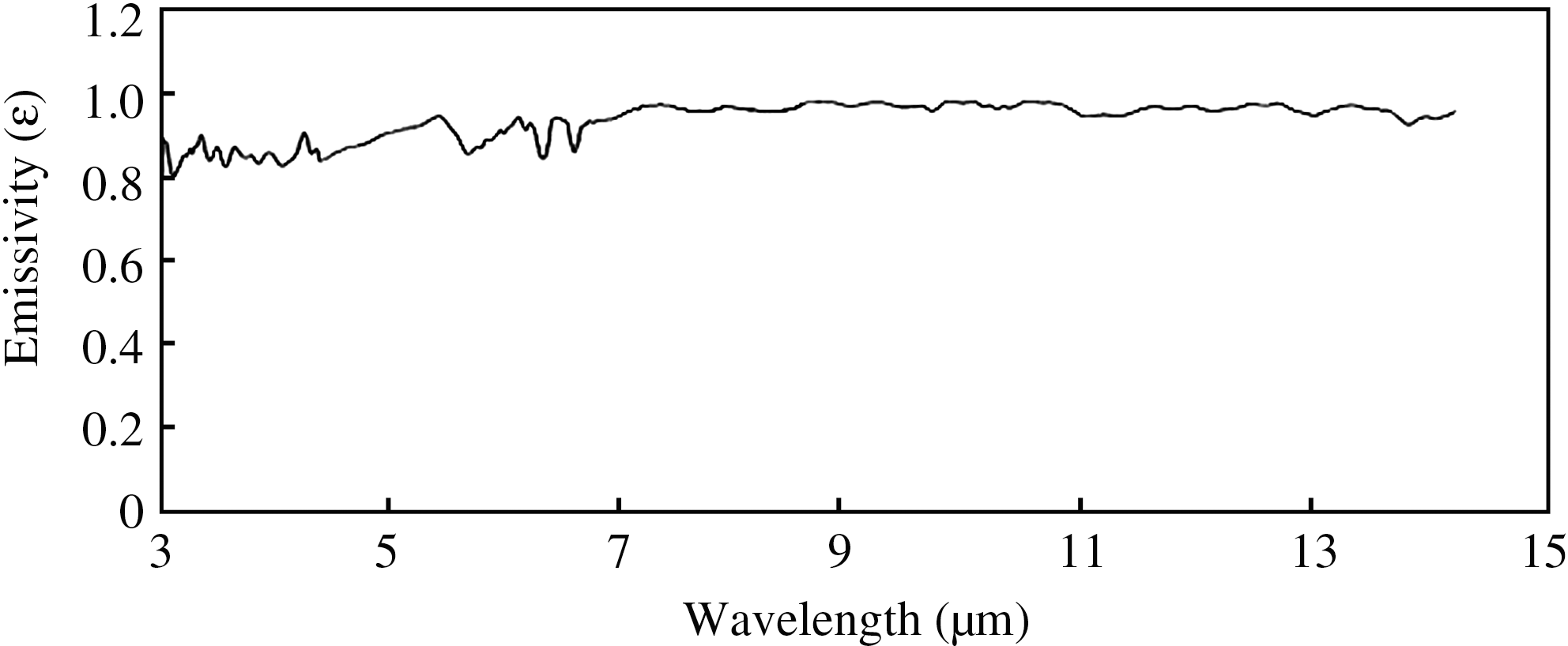
The emitting spectrum of the infrared emitter. The average emissivity (ɛ) within the range of 3–15 μm was 0.919, with a maximal radiation intensity of 33 J/cm2.
Experimental procedure
The mice were randomly assigned to the IR-treated group (n = 15), the heat-treated group (n = 14), and the control group (n = 15). The following procedure was originally planned to perform (Fig. 2). The IR-treated group received whole-body IR irradiation with an intensity of 33 J/cm2 for 60 min daily between 4:00 PM and 5:00 PM on Day 1 and Day 42. At the same time the heat-treated group received heat diffusion 60 min daily, reaching the same temperature as in the cage of the IR-treated group. Since the spectrum of the heater was unspecified, the heater was shielded by black curtain to screen any invisible light, but heat diffusion was possible. The control group did not receive any IR irradiation or heat diffusion. Every week, the mice of the three groups underwent a forced swimming test modified from that developed by Porsolt et al. 14 to assess the immobility times as the severity of depression. Each mouse of all three groups was placed individually in the cylinder containing clean water for 6 min. Mice would swim or struggle to climb at first, but then become immobile, remaining afloat and making only minimal movements to keep its head above water. The immobility time during the last 4 min was recorded as the severity of depression, since it was found to be reduced by various antidepressants in many psychopharmacological studies.
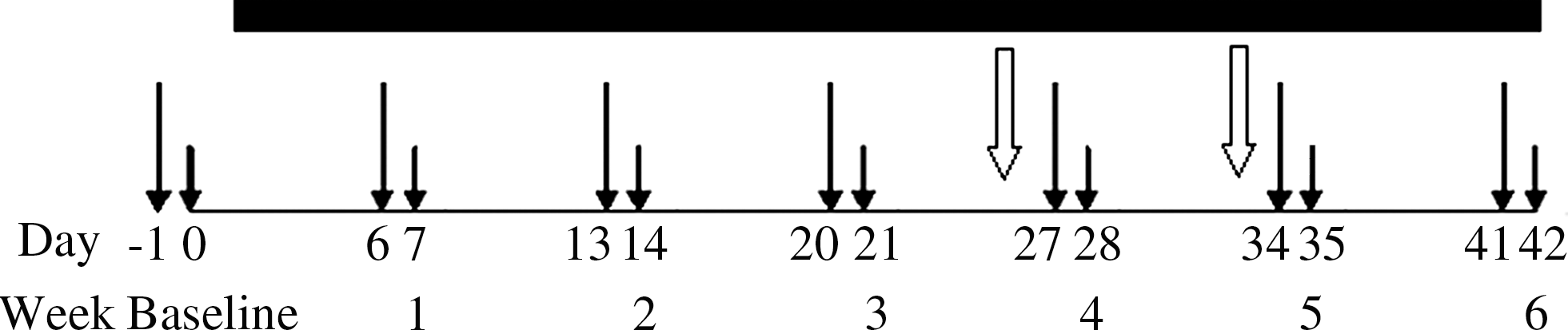
The original protocol. The numbers below indicate the days and the weeks in the study. The bar stands for the period for the infrared (IR)-treated and the heat-treated groups to receive 60 min of IR irradiation and heat diffusion daily, respectively. The long arrows indicate the days that mice of the three groups were put into water for 15 min to make them despaired; the short arrows indicate the forced swimming tests; the empty arrows indicate the two episodes of cold current.
Unexpectedly, two episodes of cold current occurred around Day 25 and Day 33. The lowest local ambient temperatures during the cold spells were 9.7°C and 8.7°C, respectively. (The average local ambient temperature during the study period was 17.1°C.) Some of the experimental mice died following the cold current. Therefore, the study had to be terminated after the completion of the winter part, lasting 42 days.
Statistic analysis
JMP, version 6.1 (SAS Institute, Inc., Cary, NC) was employed to assess the survival rates of the three groups. Log-rank test was employed to compare the pairwise survival rates against the control group; p-values <0.05 were considered statistically significant.
Results
Since the aims of the present study turned into exploring an incidentally observed phenomenon, the results of the forced swimming test are not presented here.
The survival curves of the three groups are shown in Fig. 3. The Kaplan–Meier estimates of the survival rate were 93.3% (14/15) for the IR-treated group, 85.7% (12/14) for the heat-treated group, and 53.3% (8/15) for the control group. The log-rank test revealed a significantly reduced relative risk for the IR-treated group when compared with the control group (RR = 0.34; 95% CI for the hazard ratio = 0.08–0.82; p = 0.013), but not for the heat-treated group (RR = 0.54; 95% CI = 0.21–1.09; p = 0.087).
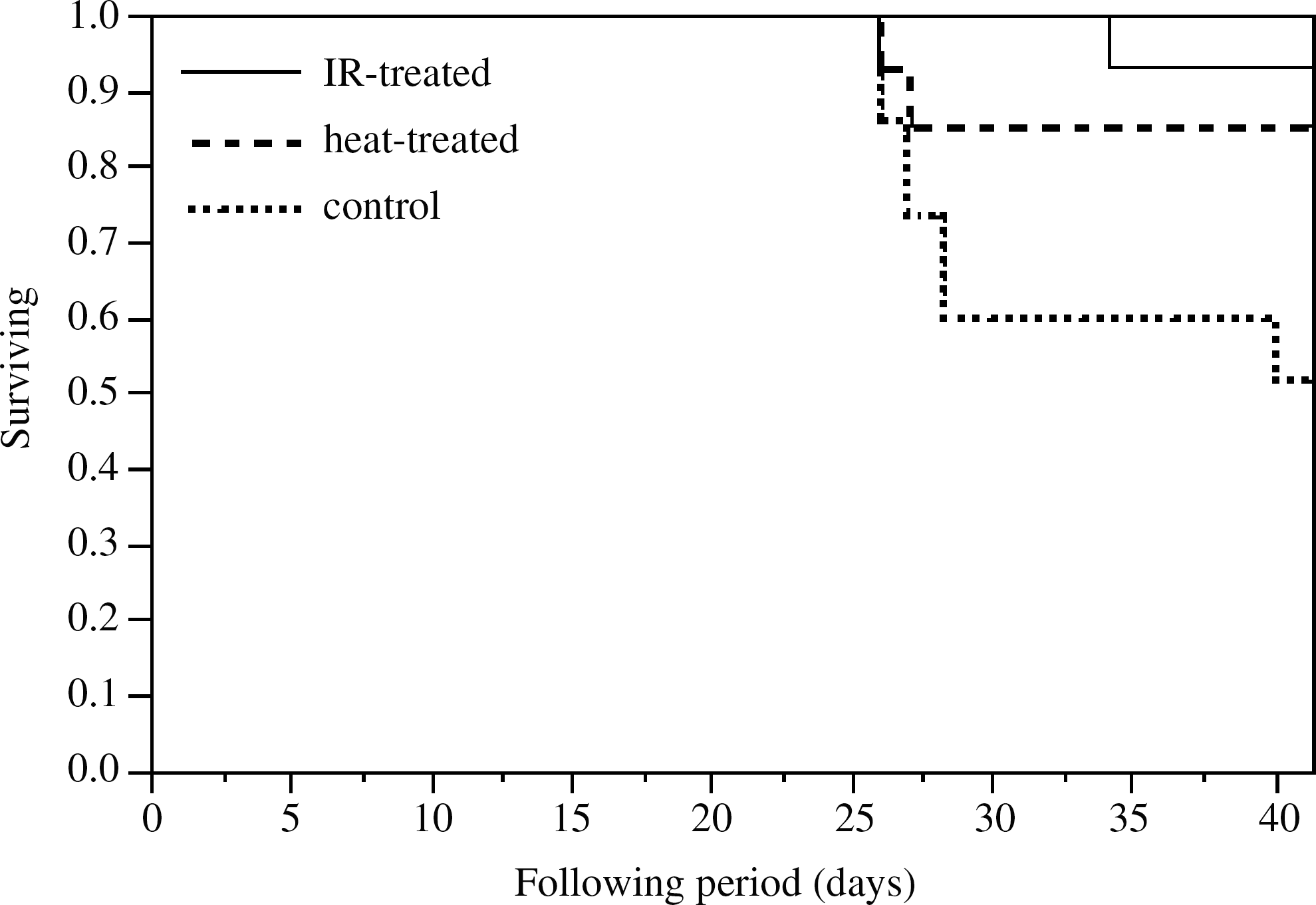
The survival curves for mice in the IR-treated (solid line, n = 15), heat-treated (dashed line, n = 14), and the control (dotted line, n = 15) groups. The IR-treated group had a significantly reduced relative risk when compared with the control group (RR = 0.34; 95% CI for the hazard ratio = 0.08–0.82; p = 0.013), while the heat-treated group did not show any significant reduction (RR = 0.54; 95% CI for the hazard ratio = 0.21–1.09; p = 0.087).
There was no significant difference in the mean rectal temperatures between the groups of the mice before (ANOVA: F 2,17 = 0.89; p = 0.427) and after (F 2,17 = 0.52; p = 0.603) the irradiation. Furthermore, no significant difference within the groups was noted before and after the irradiation, either (paired t-test: p = 0.082, p = 0.664, and p = 0.566 for IR-treated, heat-treated, and control group, respectively).
Discussion
The preliminary nature of the results was recognized since they were observed under an unexpected condition. For ethical reasons, the author did not repeat the experiment.
The results showed that IR irradiation, but not heat diffusion, significantly reduced the death of NMRI mice that encountered cold weather, although neither the mean body temperature of the IR-treated mice nor the heat-treated mice was significantly higher than that of the control group.
On investigating the hyperthermic as well as the biological effects of IR on wound healing, Toyokawa et al. 2 found that the skin temperature did not change significantly before or during IR irradiation and suggested that wound healing was independent of skin temperature. This is compatible with the results of the present study. The effects of the various methods of thermotherapy on circulation differ depending on their physical attributes. 15 Yu et al. 16 suggested that IR therapy exerts a NO-related biological effect to increase the skin microcirculation in rats.
Kujawa et al. 17 investigated the effect of IR laser radiation on the structure of protein and lipid components of red blood cell membranes, and found that IR laser radiation changes the ATPase activities of the membrane ion pumps in a dose-dependent manner, inducing long-term conformational transitions of membrane, which were related to the changes in the structural states of both erythrocyte membrane proteins and lipid bilayer. It was suggested that the optimization of the structural–functional organization of the erythrocyte membrane as a result of IR laser irradiation may be the basis for improving the cardiac function in patients under a course of IR laser therapy. 17 To examine the effect of IR laser irradiation on the energy metabolism of the rat brain, Mochizuki-Oda et al. 18 established that the tissue ATP content of the irradiated area was 19% higher than that of the nontreated area. They suggested that the increase did not result from the thermal effect, but from a specific effect of the IR laser with a certain wavelength. That may explain why IR irradiation, but not heat diffusion, significantly reduced the death of NMRI mice that encountered cold weather. That is, the protective effect of IR for cold injury may be more than a thermal effect.
In addition, IR-induced reduction of immobility in the water may also contribute to the higher survival rate. Compatible with previous studies, immobility during forced swimming in cold water in a time-dependent manner was observed in the experimental procedure. Marked immobility led to choking due to aspiration. According to Tsai et al., 8 IR irradiation resulted in a significant reduction of immobility in the forced swimming test. Thus, as a consequence, it may lead to less chance of aspiration, which could contribute to lower mortality of mice.
Further, the protective effect of IR is not limited to rat. In a study investigating the lagged effect of cold temperature and wind chill on cardio-respiratory mortality in Scotland, Carder et al. 19 found that mortality increased more steeply as temperatures fell below 11°C. For temperatures below 11°C, a 1°C drop in the daytime mean temperature on any one day was associated with an increase in the cardiovascular and respiratory mortality of 3.4% and 4.8%, respectively, over the following month. Kihara et al. 20 treated patients suffering from chronic heart failure with ventricular arrhythmia using 60°C IR dry sauna for 15 min daily for 5 d per week. They found that the total numbers of premature ventricular contractions in 24 h in the IR sauna-treated group significantly were decreased when compared with the nontreated group. 20
Conclusion and Summary
In summary, this study incidentally found that IR irradiation, but not heat diffusion, significantly reduced the death of mice that were concurrently subjected to cold condition and forced swimming test. These results may be beyond a thermal effect.
Footnotes
Disclosure Statement
No competing financial interests exist.