




Abstract
Introduction
Of interest is whether the antidepressant effect of IR has seasonality, that is, does IR irradiation exert antidepressant effects in the summer as well as in the winter? The present study explored the seasonality of the antidepressant effect of IR irradiation using two animal models of depression-like behavior: the forced swimming test (FST) developed by Porsolt et al. 11 and the tail suspension test (TST) by Steru et al. 12 In short, mice put in the water or suspended from their tails will struggle at first, then keep immobile in a time-dependent manner. Immobility indicates that the animal has given up its effort to escape from stress and is regarded to be a sign of “behavioral despair” or “helplessness”. The immobility times are considered to be a measure of the severity of depression in mice. The FST and TST are two of the most widely used models to screen potential antidepressants, since the immobility times of both tests can be reduced by a variety of different antidepressants, despite their working via different mechanisms. 13,14
The present study aimed to test whether IR irradiation could reduce the immobility time in FST and TST mice in the summer. Combined with the previous finding that IR irradiation has potential antidepressant effects in the winter, 10 the question of whether there is seasonality for the antidepressant effect of IR irradiation can be answered. The author hypothesized that there would be significant differences between mean immobility times in the FST and TST for mice receiving IR irradiation and control mice.
Materials and Methods
Subjects
The study was approved by the Institutional Animal Care and Use Committee of the Buddhist Tzu-Chi General Hospital. Subjects were fourteen Naval Medical Research Institute (NMRI) mice (25–35 g) purchased from the Experimental Animal Center of Tzu-Chi University. To explore seasonality, rather than keeping the mice in conditions of constant temperature, luminosity, and humidity, they were housed in cages in the same room as in the winter on a natural light/dark cycle in the summer (June and July) in Taiwan during a study period of six weeks. The average temperature was approximately 29°C. The sunlight hours during the study in Taiwan were approximately 5:10 AM to 6:40 PM. The average humidity was ∼80%. All mice were fed with diet and clean tap water ad libitum, and allowed to adapt to experimental conditions for at least two weeks. All experiments were performed between 9:00 AM and 3:00 PM. The procedure was in accordance with the National Institute of Health Guide for the Care and Use of Laboratory Animals.
Apparatus
IR irradiation: The IR emitter (Lucybelle Biological Technology Inc., Taoyuan, Taiwan) had the highest emissivity within 3–15 μm and a calculated maximal radiation intensity of 33 joules/cm2.
FST: A clear cylindrical glass container (40 cm tall × 12 cm diameter) filled with clean water 25 cm in depth at room temperature was used.
TST: A stand with a clamp located 40 cm above the ground was used.
Experimental procedure
The mice were randomly assigned to the exposure group (n = 7) or the control group (n = 7). The following procedure was performed (Fig. 1):
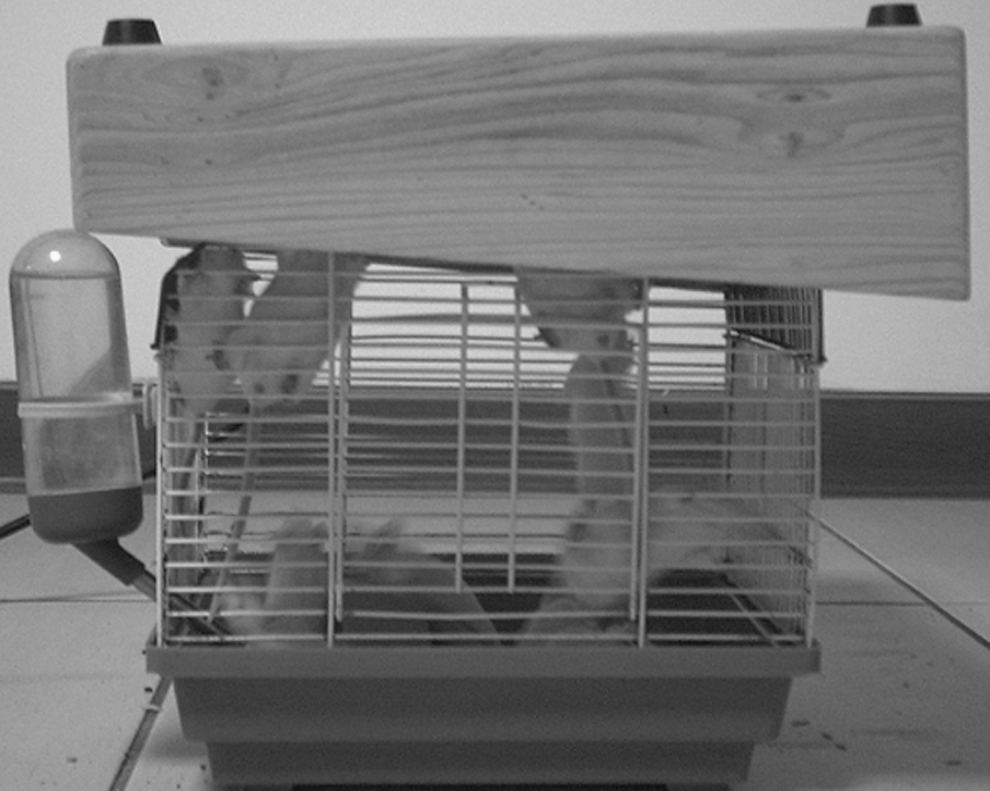
Exposure group mice receiving whole body infrared ray (IR) irradiation. The device over the top of the cage is the IR emitter.
IR irradiation: The mice of the exposure group received whole body IR irradiation 60 min daily between 4:00 PM and 5:00 PM from Day1 to Day 42, with a radiation intensity of 33 j/cm2, while the control group received no IR irradiation.
FST: The procedure was modified from that developed by Porsolt et al. 11 The mice of the two groups were, in an alternating order, placed individually in the cylinder containing clean water for 15 min between the hours of 9:00 AM and 3:00 PM on Days 1, 6, 13, 20, 27, 35, and 41 for training. On Day 0 (baseline), 7 (week1), 14 (week 2), 21 (week 3), 28 (week 4), 35 (week 5), and 42 (week 6), each mouse was placed in water for 6 minutes to evaluate the immobility times. A mouse was judged to be immobile when it remained afloat, making only minimal movements to keep its head above water. The test was videotaped and the total period of immobility during the last four minutes was timed by an observer blind to the groups.
TST: Since the same mice were used to evaluate immobility in both FST and TST, TST was administrated the day after each FST so that it was not affected by FST. Each mouse was hung 1cm from the end of its tail on a stand with a clamp located 40 cm from the floor for 6 min on Day 2 (baseline), 8 (week1), 15 (week 2), 22 (week 3), 29 (week 4), 36 (week 5), and 43 (week 6) between the hours of 9:00 AM and 3:00 PM to evaluate the immobility times. A mouse was judged to be immobile when it remained still, hanging upside down, without moving or bending the body or twitching the tail. The test was videotaped and the total period of immobility during the 6 minutes was timed by an observer blind to the groups.
Statistical analysis
Repeated measures two-way analyses of variance (ANOVAs) by SPSS (Chicago, FL), version 10.0 for Windows was used to assess the overall weekly mean immobility times of the two groups during the study. Two-sample t-tests were employed to compare the immobility times between groups, and repeated measures ANOVAs with Dunnett post hoc tests were used to compare the immobility times against the baseline level within the exposure group. p-values less than 0.05 were considered statistically significant.
Results
The mean FST and TST immobility times ± standard error of the mean (SEM) for the exposure group and the control group during the 6-week study period are shown in Fig. 2. For the FST, a repeated measures two-way ANOVA indicated no statistically significant difference among the mean immobility times during the study (F 6,7 = 0.719, p = 0.648). At baseline (week 0), the immobility times for the mice in the infrared-irradiated and the control groups were 26.3 ± 37.5 seconds and 42.9 ± 45.6 seconds, respectively. At the end of the study (week 6), the immobility times for the mice in the irradiated and control groups were 43.0 ± 48.5 and 45.1 ±32.2 seconds, respectively. Weekly comparison of the groups revealed no significant difference at baseline (two-sample t-test: t 12 = −0.743, p = 0.472) or at the end of the study (t 12 = −0.097, p = 0.924). A repeated measures ANOVA showed no significant difference for the exposure group during the study period (F 6,42 = 0.765, p = 0.602).
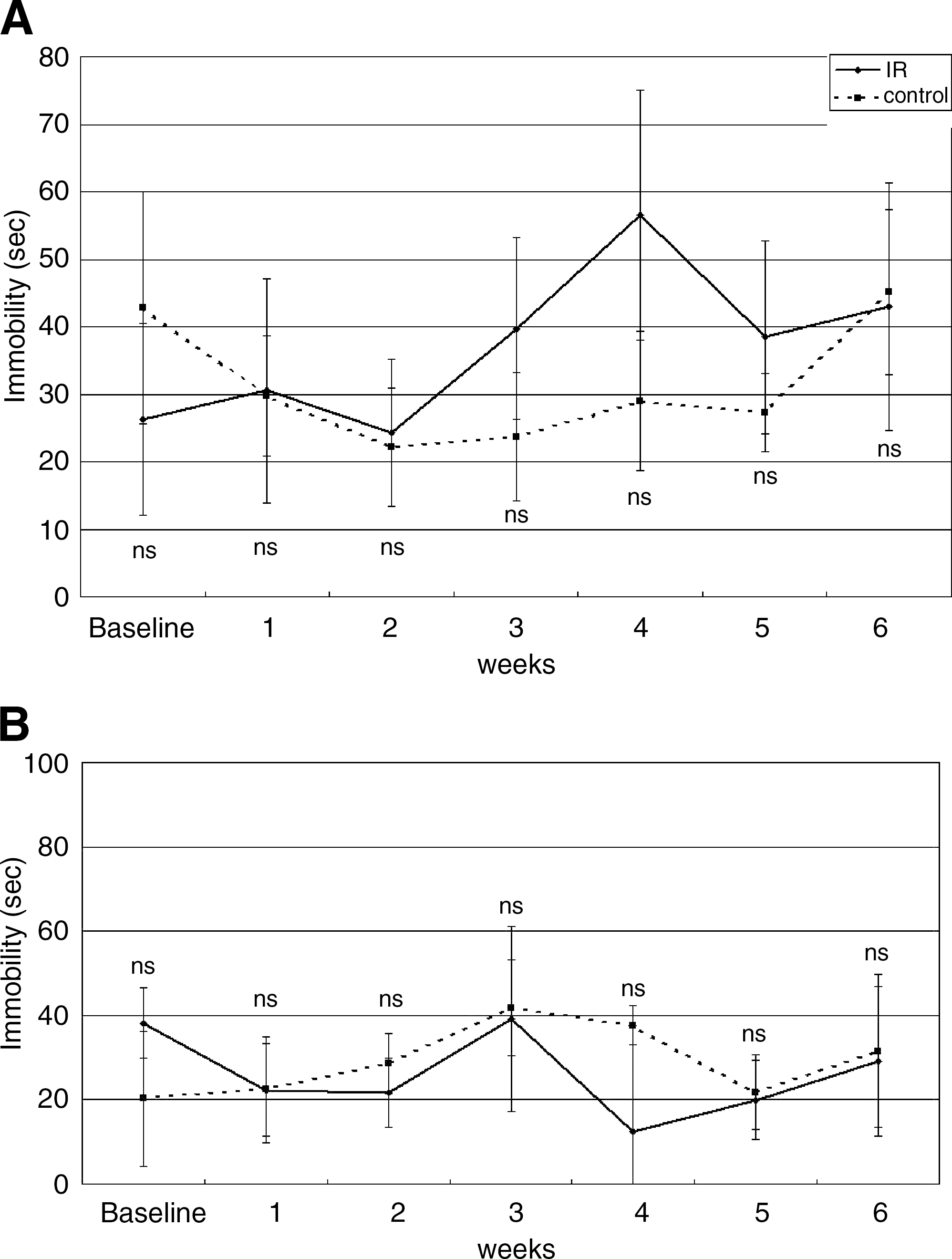
Immobility times of the exposure group receiving IR irradiation (n = 7) and the control group (n = 7) during the study period of six weeks during the summer.
In the TST, there were also no statistically significant differences among the mean immobility times during the study (F 6,7 = 0.574, p = 0.742). At baseline (week 0), the immobility times for irradiated mice and control mice were 38.1 ± 42.5 and 20.1 ± 22.4 seconds, respectively. At the end of the study (week 6), the immobility times for the irradiated and control groups were 29.0 ± 48.0 and 31.4 ± 47.2 seconds, respectively. Weekly comparison of the groups showed no significant difference at baseline (t 12 = 0.992, p = 0.341) or at the end of the study (t 12 = −0.096, p = 0.925). A repeated measures ANOVA revealed no significant difference for the exposure group during the study period (F 6,42 = 0.962, p = 0.465).
Discussion
The results show that IR irradiation for six weeks did not significantly reduce immobility times for either FST or TST for NMRI mice receiving IR irradiation in the summer. However, results from the author's previous study showed that IR irradiation significantly reduced immobility in FST in the unspecified strain laboratory mice in the winter by the end of the fourth week. 10 Taken together, the present results suggest there is seasonality for the antidepressant effect of IR irradiation. That is, IR irradiation may exert antidepressant effects in the winter, but not in the summer.
Although the author used a smaller sample size in this study, this is unlikely to be the reason for the present negative findings because, unlike in the previous study, no reduction of immobility was seen in this study.
The author used the same intensity, daily duration, and schedule for the IR irradiation as used in the previous study in the winter for an even longer period. The negative findings therefore can not be due to insufficient dosage or an inadequate phase of IR irradiation.
Bai et al. studied inter-strain differences in screening sensitivity, and concluded that despite face value similarity, the neurochemical pathways involved in mediating performance in these two widely used tests, FST and TST, were not identical. 14 Bourin et al. also suggested that both tests are necessary to draw conclusions regarding mechanism of action. 15 Two animal models of depression were used in the present study in order to avoid arguments about differences in depression models.
According to van der Heyden et al., the NMRI mice almost all showed the expected reduction in immobility in TST when various types of antidepressants were tested. 16 Porsolt et al. also reported that NMRI mice were immobile in the FST for 40% of the recording period when imipramine was tested. 17 The present negative finding can not therefore be due to differences in sensitivity between the mice strains.
The present negative results were unlikely to be due to smaller sample size, dosage or phase of the IR irradiation, differences in animal models of depression, or differences in sensitivity in the different mouse strains. Therefore, according to Tsai et al., the remaining factor affecting the different results is the season. 10 These results indicate that IR irradiation is effective in the winter, but not in the summer; i.e., it possesses seasonality. Hence, the clinical implication would be to use IR irradiation to treat depression in the winter only.
The seasonality of the potential antidepressant effect of the IR irradiation could be explained by the seasonality of serotonin. Sarrias et al. found that the concentration of serotonin in the plasma possessed significant seasonal change, highest in the summer and lowest in the fall. 18 Rosenthal et al. further found the relationship between serotonin transporter promoter polymorphism and seasonality. The population with s/s form of serotonin transporter promoter have significantly higher risk of seasonal affective disorder. 19 Ceylan et al., in a double blind randomized trial for treating myofacial pain syndrome with IR laser, found that the urinary excretion of serotonin and its metabolites was significantly higher in the IR laser treatment group than in the placebo group, 8 and serotonin is a major neurotransmitter involved in the modulation of pain as well as depression. Therefore, IR irradiation could significantly increase serotonin in the winter when the intrinsic serotonin level is low, but not in the summer when the level is high. Subsequently, the significantly increased serotonin concentration induced by IR irradiation in the winter but not in the summer reduced the immobility times in the FST and TST.
One limitation of this study is the lack of an automatic apparatus to measure immobility times, so the results could be subject to a certain degree of human error. Another weak point is that testing of the same animals on a weekly basis may influence the results. However, this mixed within-subject (repeated measures) and between-subject (control) study design is able to minimize the number of experimental mice needed.
Conclusion and Summary
In summary, the present study, using FST and TST, found no significant reduction in immobility in mice receiving IR irradiation in the summer. Taken together with the previous findings, the results indicated that although IR irradiation exhibits a potential antidepressant effect, this effect is seasonal. The seasonality could be due to the seasonality of the intrinsic serotonin concentration.
Footnotes
Acknowledgments
The author appreciates the grants from Buddhist Tzu Chi General Hospital (Project number: TTCRD-9704).
Author Disclosure Statement
No competing financial interests exist.