




Abstract
Introduction
Between November 2007 and September 2008, one of us irradiated the skin around the corner of the eyes with light delivered by arrays of light-emitting diodes (WARP 10, Quantum Devices, Inc., Barneveld, WI). Operating in the range of 600 to 720 nm (central wavelength 670 nm) the light field covers an area of 10 cm2 with an integral intensity of 72.8 mW/cm2. Irradiation doses were 4 J/cm2—the golden standard in phototherapy. 1 The representative photographs of the facial zones (Figure 4 in 2 ) show the change in wrinkle levels for 9 consecutive weeks of daily treatment. The change for 10 months is displayed on the cover of the journal. 2 The principal discovery described in our previous work is that facial wrinkle levels could be significantly reduced by extended irradiation of the skin with the red light.
Materials and Methods
In the second facial rejuvenation program, starting in December 2008, the same person continued to irradiate the skin around the corner of the eyes using the previously established protocol. The principal difference from phase I of the rejuvenation program was stays in megacities in China (1 month) and Africa, including Cairo (1 month), directly before phase II of the light treatment. This exposed the skin of the test person to massive environmental stresses, including high levels of ultraviolet radiation and heat stress from the interplay of high levels of infrared radiation with extreme particulate matter concentrations in the air, expected to influence the thermoregulatory capacity of the facial skin (5% of the total body skin surface). Figure 1 (left) shows the condition of the facial skin in Africa, 1 day before the end of the journey. Apparently, 2 months of strong sun and air pollution was sufficient to completely undo the 10 months of light treatment. This was the starting point of phase II, which continued for 2 months according to the aforementioned protocol until February 2009, virtually without change in wrinkle levels. At this point, we modified the routine and introduced topical application of green tea. The motivation emerged from insight into remarkable complementarities between the biological actions of green tea and red light.
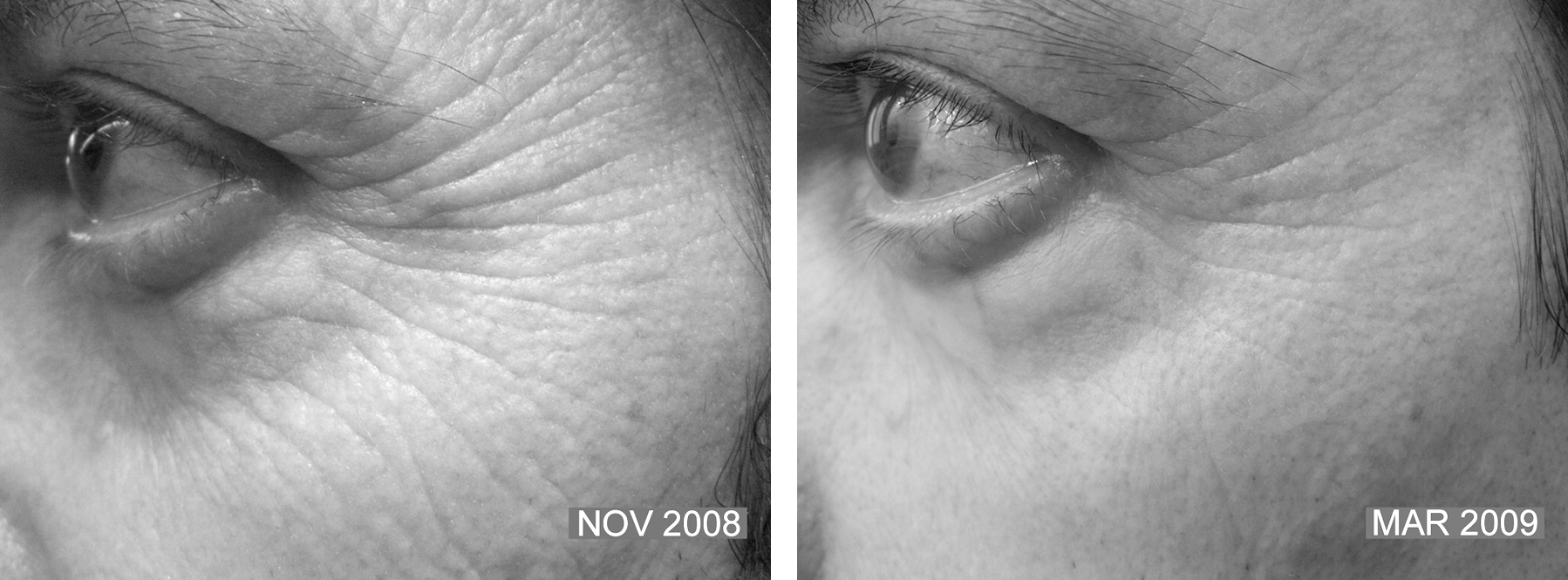
Photographs show the skin before phase II of the rejuvenation program and after 1 month of green tea–assisted red light application. Less-pronounced wrinkle levels with shorter wrinkle valleys and juvenile complexion after including green tea in the program.
The targets of the light used in phototherapy are the cells and the extracellular matrix (ECM). In the ECM, it can undo cumulative physiological degradations, as illustrated in our model study. 2 In the cells visible to near-infrared light is absorbed by photosensitizers, for instance, cytochrome c oxidase, 3 and generates intensity and dose dependently reactive oxygen species (ROS). 4 Whereas small amounts of ROS have been found to stimulate cell activity 5 —probably a key element in the mechanism of photobiomodulation—larger amounts can inhibit cellular processes. 6 However, higher light doses, exceeding the associated upper limit set by the classical Arndt-Schultz concept, can be necessary, for instance, when targeting deeper tissue layers or addressing the ECM. 2 Thus, control of ROS levels can be crucial to prevent oxidative damage to cell components. A powerful natural ROS scavenger is green tea, known for its extraordinary antioxidative and photoprotective capacities, in some cases, clinically exploited simply by drinking it. 7 Its major and most protective polyphenolic component is epigallocatechin gallate (EGCG). 8 Modalities of administration, oral and topical are both effective, as confirmed in animals 8 and humans. 9 The action spectrum of green tea includes the ECM, where EGCG can undo ROS-related degradations, 10 and cells, where EGCG can increase cell survival rate (keratinocytes) 11 —a surprising parallel to the effects of red light. In sum, the combination of green tea and red light appears to be a most effective rejuvenative duo. To test it, we filled cotton pads with green tea (concentration, 3 g dry leaf mass per 250 mL of water; brewing temperature, 100°C; cooling time, 30 min) and placed them for 20 min onto the skin around the corner of the eyes before irradiating the wrinkled zones directly according to the protocol. Recent work indicates that the extracting efficiency of EGCG from green tea is dependent on solvents, temperature, and duration, with highest recovery yields at 90°C for 60 min brewing in 35% ethanol. 12
Results
The representative photographs in Figure 1 show facial wrinkle levels after 2 months of exposure to extreme oxidative stress (left) and wrinkle levels after 1 month of daily application of green tea for 20 min and a dermal dose of 4 J/cm2 of red light (right).
Discussion
The skin, in particular that of the face, is a major target of environmental stress such as provoked by air pollution and ultraviolet and infrared radiation, potentially contributing to an increase in ROS levels, which can cause significant damage to cell structures: the oxidative stress. Remarkably, by liberating moderate or excessive ROS levels, the light employed in phototherapy has the potential to stimulate or inhibit cellular processes, respectively. Green tea has the capacity to compensate for environment-induced oxidative stress 13 and, as recommended by the results of our study, to act as a powerful ROS scavenging agent that could accelerate the therapeutic effect of light. From considering the complementary action of visible light and green tea with regard to ROS, this is not surprising. Presumably, the complementarity is not limited to compensational effects. As recently reported, EGCG at 1 μg/mL extended the lifespan of Caenorhabditis elegans—the standard tool in anti-aging research—under heat and oxidative stresses by 8.0% and 177.7%, respectively. 14 The longevity-extending effects in the worm were absent in the absence of stresses—a remarkable analogy to the biostimulatory effect of visible light, which is virtually absent in balanced systems. Possibly, topically applied green tea extends the survival of the cells involved in transporting ECM metabolites from the basal layer to the stratum corneum. Indeed, the model, which inspired the design of our first facial rejuvenation program, indicated the instrumentality of the applied light in a coordinated process: liberation of ECM metabolites and simultaneous stimulation of cells to incorporate them. The interplay of the three processes offers one explanation for the juvenile complexion accompanying the reduced wrinkle levels. Could temporally and dose-optimized combinations of green tea and red light have further biomedical potentials? Further investigation into this issue is underway.
Conclusion
In an exceptional case of oxidative stress, we demonstrated that the combination of green tea and red light can accelerate the rejuvenative effect of the light. The accelerated skin rejuvenation based on the coordinated interplay of the physicochemical and biological effects of the light with the ROS scavenging capacity of green tea extends the current action spectrum of phototherapy. This could open the gate to a multitude of biomedical and cosmetic applications of the combination green tea and red light, for instance, novel irradiation techniques considering the transepidermal penetration of EGCG and compatible skin rejuvenation formulas. Potential applications include but are not limited to the reversal of topical deterioration related to anomalous levels of reactive oxygen species, such as graying of hair. 15