




Abstract
Introduction
For the adhesive bonding of ceramics such as feldspathic, leucite, lithium disilicate–based, and silica-based ceramics, it is well established that adhesive techniques such as hydrofluoric acid etching and silanization of the material enhance the resin bond. 6 –10 However, these techniques do not improve the bond strength of Y-TZP ceramics because of the absence of a silica and glass phase in these ceramics. 11 –16 To facilitate the formation of resin–Y-TZP ceramic micromechanical interlocks, air-particle abrasion is usually presumed to roughen these ceramic surfaces, increasing the bonding area and modifying the superficial energy and wettability. 11,17 –19 It has been reported that the air abrasion of a Y-TZP ceramic surface with silica-coated aluminum particles (tribochemical silica coating) of different grain size ranging from 30 to 110 μm can be used to improve the bond strength of resin cement. 12,16,20,21
Laser irradiation is another method for roughening the surface of ceramics to improve the adhesion of resin composite. 7,22 –27 The Er:YAG laser is often used on dental ceramics because its wavelength coincides with the main absorption peak of water, and it is well absorbed by OH− groups in hydroxyapatite. 7 A previous study showed that Er:YAG laser irradiation at 2-W power output induces a mild surface alteration effect between air abrasion with aluminum oxide and higher laser output (4 and 6 W) on Y-TZP ceramic surfaces. 25
The Nd:YAG laser is also used in dentistry. 28 One study reported that the Nd:YAG laser promotes the formation of ceramic surface irregularities and consequently improves the adhesion of composite resins. 23 Additionally, Y-TZP is a recommended material for Nd:YAG laser processing due to its toughness and lower heat conductivity. 29 It has been reported that Nd:YAG laser irradiation after air abrasion improves the bond strength of resin cement to zirconia-based ceramic. 26,27
Another laser used in dentistry is the carbon dioxide (CO2) laser. This laser is well suited for the treatment of ceramic materials because its emission wavelength is almost totally absorbed by the ceramic. 6 During the process of heat induction of ceramic surfaces with a focused CO2 laser, conchoidal tears appear. These tears are believed to provide mechanical retention between resin and ceramic. 6 In addition, a previous study showed that CO2 laser irradiation creates roughness on the surface Y-TZP material at the different laser power output ranging from 4 to 6 W. 30
The aim of this study was to evaluate the shear bond strength of resin cement to a Y-TZP material surface submitted to (1) air abrasion, (2) silica coating, (3) Er:YAG, (4) Nd:YAG, and (5) CO2 laser irradiation, and (6) air abrasion followed by laser irradiation. We hypothesized that laser irradiation on a Y-TZP surface would improve the bond strength compared to that of an untreated Y-TZP surface. In addition, it was hypothesized that the bond strength would be greater with laser irradiation after air abrasion than with laser irradiation alone.
Materials and Methods
In this study, 141 tetragonal yttrium oxide–stabilized zirconium discs (95% ZrO2 stabilized by 5% Y2O3, Copran zircon blank, White Peaks Dental Systems GmbH) were used. The discs had a diameter of 8 mm and a thickness of 2 mm. All specimens were ultrasonically cleaned in 96% isopropanol for 3 min 19,31,32 and dried in oil-free air before surface treatment.
Pilot study
To determine the laser parameters to use in this study, a pilot study was performed, based on previous studies. 25 –27,29 A superficial area (19.63 mm2) of the specimens was delineated with adhesive tape to demarcate the irradiation area 24,25 and coated with graphite powder before each laser application to increase the absorption of laser energy. 24,25,30 The laser beam was directed over the Y-TZP surface in a noncontact mode at a working distance of approximately 1 mm. 26,27,30
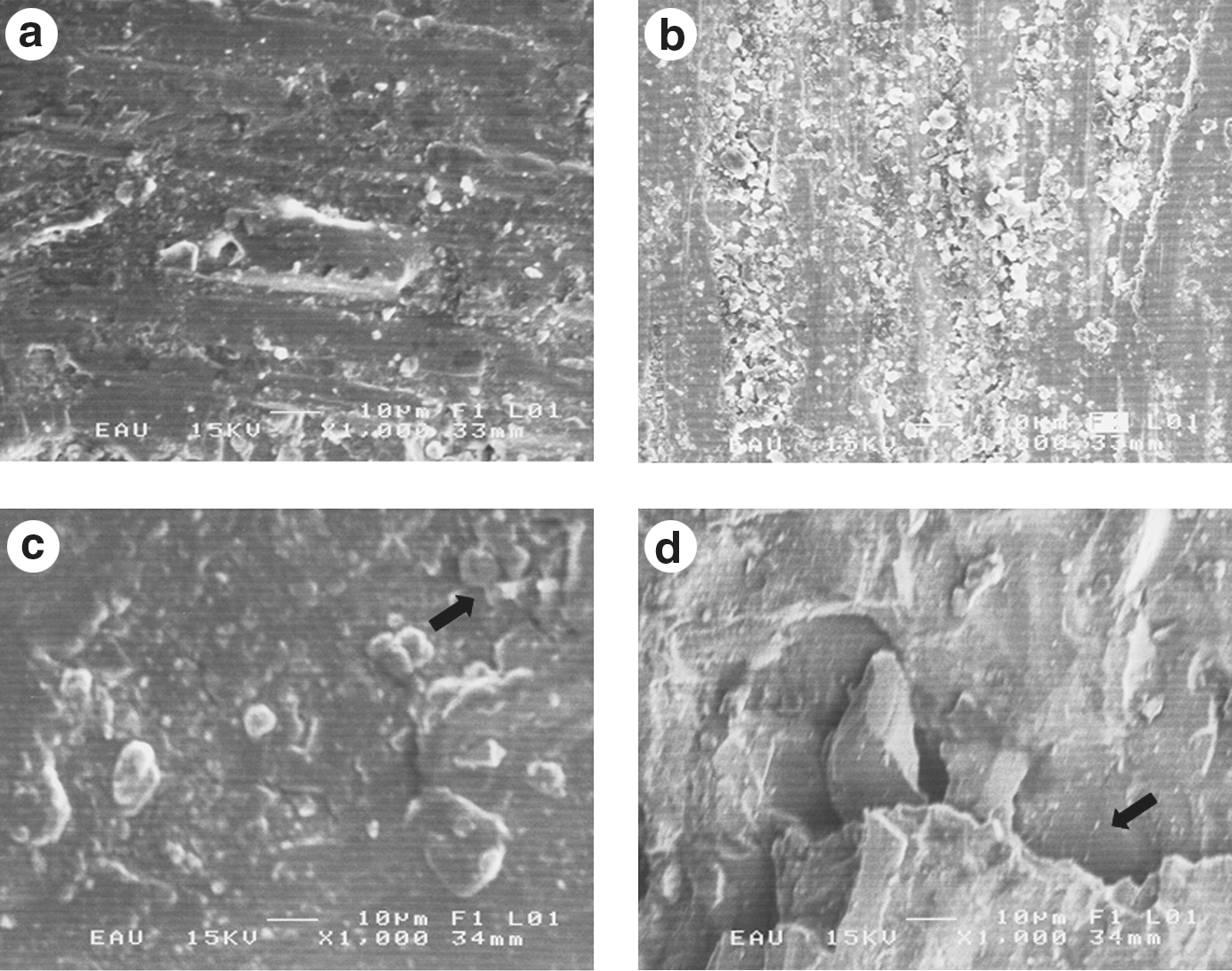
The Y-TZP specimen surfaces were irradiated with CO2 laser (Smart US-20 D, DEKA) with a 1060-nm wavelength in continuous mode by a 4-mm diameter titanium articulated arm transmission system. The laser beam was delivered by a 2-mm-diameter perio tip with a 2-msec pulse length at power outputs of 2, 3, 4, or 5 W for 50 sec, and alienation through the use of an adjustable air and water spray. 24,25,30 After irradiation, specimens were sputter-coated with gold-palladium for 3 min at a current of 10 mA and vacuum of 130 mTorr (Hummer VII; Anatech Ltd.). They were then examined with a scanning electron microscope (SEM; Jeol JSM-6400 SEM, JEOL Ltd.) at 1000 × magnification. SEM analysis of the specimens' surfaces showed that the laser irradiation at 5 W caused perceptible loss of Y-TZP material (Fig. 1d), although irradiation at 2 and 3 W exhibited no significant surface alteration (Fig. 1a and b). The laser irradiation at 4 W created a rough surface, with voids and a plaque-like scaly appearance (Fig. 1c).

Scanning electron micrographs of yttrium-stabilized tetragonal zirconia (Y-TZP) surfaces after CO2 laser irradiation at power outputs of
The Y-TZP specimens were irradiated with Er:YAG laser (Doctor Smile Erbium and Diode laser, Lambda Scientifica SpA) with a 2940-nm wavelength and 1-mm-diameter optical fiber transmission system. The laser beam was delivered with a 400-μm-diameter sapphire tip at a 75-μsec pulse length at power outputs of 1, 2, 3, and 4 W (100, 200, 300, and 400 mJ/pulse, respectively, at 10 Hz) for 10 sec and alienation with an adjustable air and water spray. 24,25,30 SEM observation of the irradiated specimens showed that the laser irradiation at 3 and 4 W caused wide cracks and loss of material despite producing no surface alteration at 1 W (Fig. 2c, d, and a, respectively). The laser irradiation at 2 W created a rough surface similar to that of air abrasion (Fig. 2b).
Scanning electron micrographs of Y-TZP surfaces after Er:YAG laser irradiation at power outputs of
Another group of Y-TZP specimens was irradiated with Nd:YAG laser (Smarty A10, DEKA) with a 1064-nm wavelength and 600-μm diameter optical fiber transmission system. The laser beam was delivered by a 300-μm flexible optical fiber tip with a 150-μsec pulse length at power outputs of 1, 2, 3, and 4 W (50, 100, 150, and 200 mJ/pulse, respectively, at 20 Hz) for 2 min followed by alienation with an adjustable air and water spray. 24,25,30 SEM at 1000 × and 500 × magnification showed no surface alteration of the specimen irradiated at 1 W (Fig. 3a). However, the laser irradiation at 3 and 4 W caused widely melting areas and large cracks (Fig. 3c and d). The surface irradiation at 2 W produced a blister-like bubble appearance and unusual micro cracks (Fig. 3b).
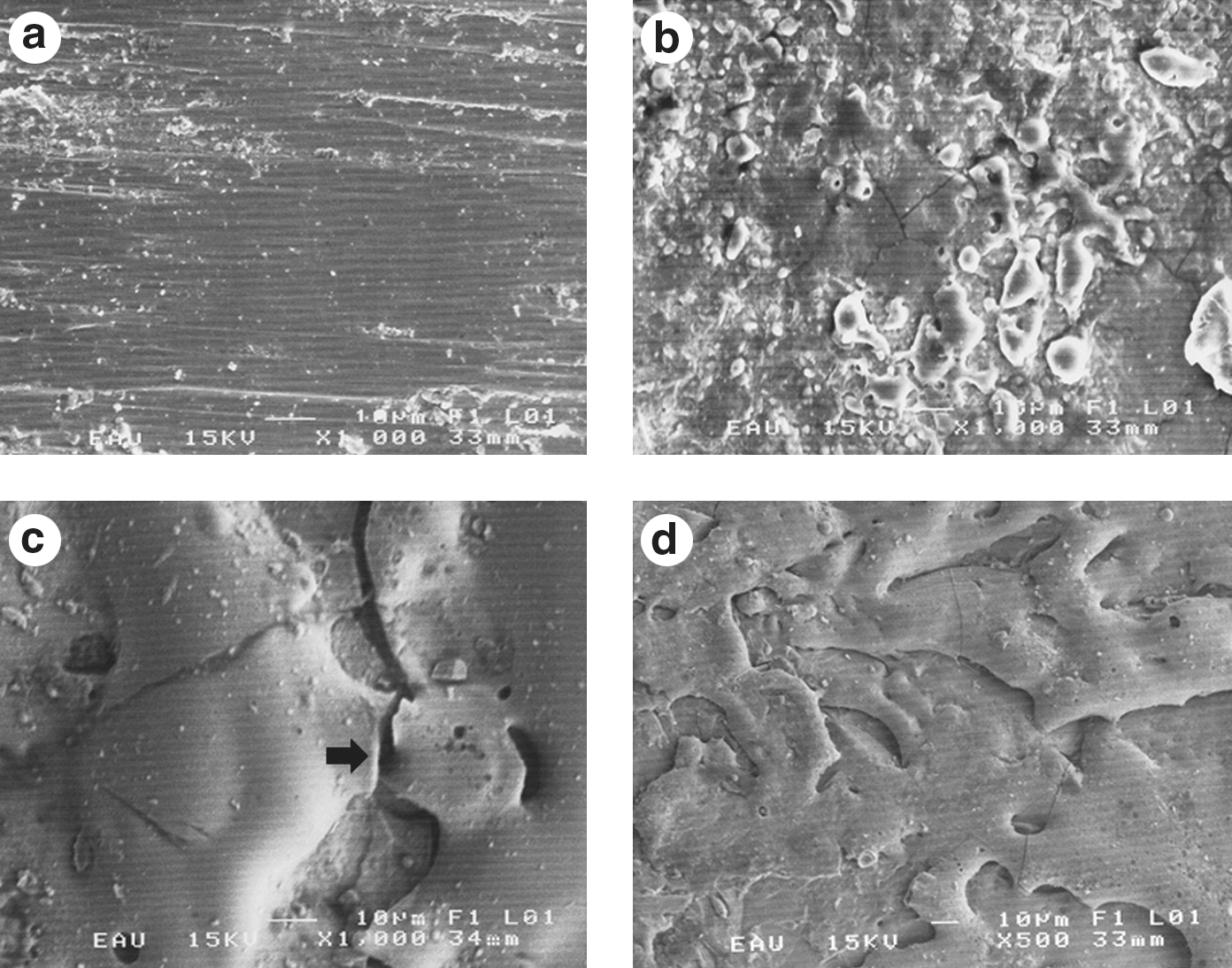
Scanning electron micrographs of Y-TZP surfaces after Nd:YAG laser irradiation at power outputs of
Based on the results of the pilot study, it was decided to use laser parameters as follows: (a) 4 W in continuous mode for 50 sec for the CO2 laser, (b) 2 W (200 mJ/pulse, 10 Hz) for 10 sec for the Er:YAG laser, and (c) 2 W (100 mJ/pulse, 20 Hz) for 2 min for the Nd:YAG laser.
Experimental groups
Nine surface treatment groups were assigned in this study: C, no treatment; AA, air abrasion; CJ, silica coating; ER, Er:YAG laser; ND, Nd:YAG laser; CO, CO2 laser; AA+ER, air abrasion + Er:YAG laser; AA+ND, air abrasion + Nd:YAG laser; AA+CO, air abrasion + CO2 laser. The surface treatment groups and treatment methods are described in detail in Table 1. Each laser irradiation was applied as described in the pilot study.
After the each laser irradiation, and air abrasion with a sandblasting machine (Rotaks Sandblasting Machine, Rotaks-Dent, Istanbul, Turkey), the samples were ultrasonically cleaned with 96% isopropanol for 3 min. 24,25 However, the specimens were not ultrasonically cleaned after the silica coating with 30-μm silica-modified Al2O3 particles (CoJet Sand) using a silica-coating system (CoJet System, 3M ESPE) because the ultrasonic cleaning of silica-coated Y-TZP surfaces decreased the adhesion efficacy to resin luting material. 33 The samples of AA+ER, AA+ND, and AA+CO groups were ultrasonically cleaned with 96% isopropanol for 3 min both after air abrasion and laser irradiation. 24,25
After the surface treatments, one specimen from each group was randomly selected to determine the effect of the various surface treatments. These specimens were sputter-coated with gold-palladium and were examined by SEM at 1000 × magnification.
Bonding procedure
To fabricate the composite resin (Clearfil Majesty Esthetic, Kuraray) cylinder, 3 mm in diameter, the holes (3-mm internal diameter and 3-mm length) were fabricated using a plexiglass plate (Pınar Metal-Plastik GmbH, Konya, Turkey) of 3-mm thickness. Two 1.5-mm composite resin increments were applied to the hole and were polymerized separately for 40 sec under a conventional halogen lamp (Elipar II, 3M ESPE) with a polymerization light intensity of 500 mW/cm2.
A silane coupling agent (Clearfil Ceramic Primer, Kuraray) was applied to all Y-TZP specimen surfaces using a brush and then air-dried using oil-free compressed air. After the application of silane, composite resin cylinders were bonded to the specimens using resin cement (Clearfil Esthetic Cement, Kuraray). The application of resin cement was performed according to the manufacturer's instructions. The Y-TZP–resin cement–composite resin combination was placed under a load of 1000 g 31,32,34 in a press, and excess resin was removed with a brush. The resin cement was polymerized for 20 sec on each side of the bonding area. The specimens were then stored in distilled water at 37°C for 24 h. Afterwards, the specimens were thermocycled between 5°C and 55°C for 500 cycles 35 at 30 sec in each water bath.
The shear bond strength was determined with use a load cell (Instron Universal Test Machine, Model: 2519-106, Instron Corp.) at a crosshead speed of 0.5 mm/min until rupture occurred. All the ruptured samples were examined under a light microscope (Micro Science, Digital Microscope, Eastcolight (H.K.) Ltd., China) to which a digital camera was attached at 100 × magnification to capture the image to determine the type of failure.
Statistical analysis of the data was performed using a computerized statistical software program (SPSS 12.0 for Windows, SPSS Inc.). Shear bond strengths (MPa) from the nine treatment groups were analyzed by one-way analysis of variance (ANOVA; α = 0.05). Multiple comparisons were made using Duncan's test. The level of statistical significance was set at 5%.
Results
Shear bond testing
There were statistically significant differences among the surface treatment methods on the bond strength values (p < 0.05). The mean shear bond strength, standard deviations, and Duncan test results are shown in Table 2. The highest bond strength was obtained in the AA group. This value was similar to that of the CJ group, and they were significantly different (p < 0.05) from that of the other groups. The lowest value was obtained from AA+ER group. The bond strength of the ND group was lower than that of the control group, but they were not statistically different from each other. In the other groups, the bond strengths were similar to each other.
SD, standard deviation.
D, differences according to the results of the Duncan's test. Different letters indicate dissimilarity of groups (p < 0.05).
Analysis of failure type
Adhesive failures between the Y-TZP material and resin cement were rupture types in all groups. No cohesive failure of the substrates (Y-TZP material or resin cement) was observed.
Scanning electron microscopic observations
The SEM photograph of an untreated Y-TZP surface is shown in Fig. 4a. The SEM image revealed that air abrasion created clearly rougher surfaces compared to the untreated specimen (Fig. 4b). The silica-coated Y-TZP surface exhibited a surface texture consisting of micro-mechanical irregularities with shallow pits (Fig. 4c). The specimen surfaces of the AA+CO and AA+ND groups exhibited a less rough surface texture compared with the AA group, but similar to each other (Fig. 5a and c). However, in group AA+ER, the surface texture was less rough than that of the AA+CO and AA+ND groups (Fig. 5b).

Scanning electron micrographs of the

Scanning electron micrographs of Y-TZP surfaces after
Discussion
In this study, the effect of different surface treatments on the shear bond strength of resin cement to Y-TZP material surface was evaluated. It was found that the highest bond strength value was obtained with air abrasion, and the silica-coating results were similar to those of air abrasion. Our findings confirmed the results of a study by de Oyague et al., 36 in which silica coating with 50 μm Al2O3 particles modified by silica oxide on Y-TZP surface achieved lower bond strength than that of air abrasion with 125 μm Al2O3. However, there were several studies that reported that the silica coating with CoJet system on Y-TZP surface achieved better bond strength than air abrasion for resin bonding. 12,14,19,37,38 In these previous studies, longer storage periods and more thermocycling were applied. However, in this study, all specimens were stored in water for 24 h and thermocycled 500 times. This shorter storage time and less thermocycling may have caused a lower bond strength compared with the CJ group.
In this study, we found that CO2 laser irradiation improved bond strength. Similarly, Akova et al. 6 found that the CO2 laser produced adequate texture on ceramic surfaces for resin bonding at a power output of 2W. Stübinger et al. 30 found that CO2 laser irradiation created distinct surface changes on Y-TZP ceramics at different laser power outputs ranging from 4 to 6 W. They determined that the highest roughness and depth profile was produced by CO2 laser irradiation at 4.5 W for 60 sec. However, they observed that the Y-TZP surface was characterized by material cracking, which looked like a sheet of ice at these parameters. In this study, we chose the CO2 laser parameters 4 W for 50 sec because this laser setting created the best surface alteration among those tested. It was observed that the laser irradiation at 4 W created a rough surface appearance with voids and a plaque-like scaly appearance.
In this study, we found that the Er:YAG laser irradiation increased the bond strength. SEM evaluation showed that the Er:YAG laser irradiation at a power output of 2 W (200 mJ/pulse, 10 Hz) for 10 sec created a rough surface similar to that of air abrasion. In contrast with our findings, Stübinger et al. 30 observed that the Er:YAG laser at power output 10 W was not effective on Y-TZP surfaces. They concluded that the Er:YAG laser should not be recommended for the Y-TZP material because it could be emitted from the opposite surface. These conflicting conclusions may be derived from application of graphite powder in this study. Likewise, Cavalcanti et al. 25 found that Er:YAG laser irradiation at 200 mJ/pulse, 10 Hz, for 5 sec on Y-TZP surfaces provided a mild surface alteration effect between air abrasion with aluminum oxide and higher laser energies (400 and 600 mJ/pulse, 10 Hz). They concluded that Er:YAG laser irradiation at this power setting was a potential method of surface treatment for Y-TZP material. However, another study by Cavalcanti et al. 24 stated that an Er:YAG laser irradiation power setting of 200 mJ/pulse, 10 Hz for 5 sec did not improve the bond strength as well as air abrasion and it decreased the bond strength compared to that of untreated surface. In our study, it was found that Er:YAG laser irradiation achieved lower bond strength than air abrasion, but improved the bond strength compared to that of untreated material. This may be due to the longer irradiation time (10 sec) in our study.
In our study, it was found that Nd:YAG laser irradiation decreased the bond strength compared to that of untreated material. In contrast to these results, Minamizato 29 found that Nd:YAG laser irradiation at 13 J/pulse and frequency ranging from 1 to 10 Hz can be effective on Y-TZP surfaces for creating abrasions. In the current study, SEM evaluation showed that the surface irradiated at a power output of 2 W exhibited a bubbled blister-like appearance and unusual micro-cracks. The appearance may have been due to the development of a heat-damaged layer caused by the application of Nd:YAG laser on the Y-TZP surface. This heat-damaged layer, which consisted of bubbles, may be poorly attached to the infra layer of the substrate and may account for specimen rupture when a low force was applied during the shear bond test.
When each laser irradiation was applied after air abrasion, the Er:YAG and CO2 laser irradiation decreased the bond strength, but Nd:YAG laser irradiation increased bond strength compared to that of each laser irradiation alone. Similarly, da Silveira et al. 26 and Spohr et al. 27 found that the highest bond strength value of resin cement to In Ceram Zirconia was obtained from Nd:YAG laser irradiation at a power output of 2 W (100 mJ/pulse, 20 Hz) for 2 min after air abrasion. In this study, it was concluded that the application of air abrasion before Er:YAG or CO2 laser irradiation created a rough surface texture on Y-TZP surfaces, but afterwards the application of lasers may destroy this structure. SEM observation showed that the specimen surfaces of the AA+ER and AA+CO groups were less rough than those of the ER and CO groups, respectively. In Nd:YAG laser–treated group, laser irradiation may have caused less damage to the air-abraded surface. SEM observation showed that the surface appearance of the Y-TZP surface in AA+ND group was rougher than that of the ND group.
The failure mode results showed that the type of rupture in all groups was completely due to the adhesive. In addition, all specimen surfaces were free of remnants of adhesive materials. This finding confirmed results of previous studies 24,39 and suggested that the bond strength between Y-TZP surfaces and resin cement is not as strong as the adhesion between the dentin and resin cement. 24
We concluded that CO2 or Er:YAG laser irradiation may be an alternative surface treatment method for Y-TZP material to improve the bonding of Clearfil Esthetic Cement. We accepted our first hypothesis that the bond strength of resin cement to laser-irradiated Y-TZP surface would be greater than that to untreated surfaces. Although Nd:YAG laser irradiation after air abrasion was able to increase the bond strength more than Nd:YAG laser irradiation alone, the standard deviation for bond strength was very high in the AA+ND group. Additionally, CO2 and Er:YAG laser irradiation decreased the bond strength after air abrasion compared to either laser irradiation alone. For these reasons, we rejected the second hypothesis that the bond strength would be greater with laser irradiation after air abrasion when compared to that of laser irradiation alone.
Conclusions
Within the limitations of this study, it was concluded that: Air abrasion and silica coating are the most effective methods for improving the bond strength of resin cement to Y-TZP material surface. Both Er:YAG and CO2 laser irradiation can increase the bond strength. Nd:YAG laser irradiation can decrease the bond strength. CO2 or Er:YAG laser irradiation after air abrasion can decrease the bond strength, but Nd:YAG laser irradiation can increase it.
Footnotes
Acknowledgments
The authors gratefully acknowledge Dr. Veysel Balkaya from Samsun, Turkey, for kindly supplying the CO2 laser equipment.
Author Disclosure Statement
No competing financial interests exist.