




Abstract
Introduction
Materials and Methods
We supplemented HeLa cells seeded in 24-well plates (well size, 1.9 cm2, 100,000 cells in 1-mL cell-culture medium per well) with 10, 50, and 100 μL green tea, respectively. The filtered aliquot (filter pore, Ø 0.45 μm) was prepared from green tea brewed in ultra-pure water according to the protocol provided in our previous work. 4,5 Subsequent to the supplementation with green tea, HeLa cells were irradiated with laser light (wavelength, 670 nm; power, 33 mW; beam geometry, 2 × 15 mm; local intensity, ∼1,000 Wm2) 8 by scanning the line-shaped beam over the wells at a frequency of about 1 Hz for 1 min, yielding a total dose of ∼1 × 10⁴ Jm2 per well. Immediately after irradiation, cells were incubated under standard cell-culture conditions for 52 h and counted by using a CASY cell counter (Innovatis, Reutlingen, Germany).
Results and Discussion
Results are shown in Fig. 1. Importantly, doses between 1 and 4 × 10⁴ Jm2 were shown to accelerate the proliferation in various cells, 8 including HeLa cells. 9 Indeed, a moderate increase in cell number was observed in the control group, representing wells without green tea. This trend was reversed in the green tea–supplemented samples in general (c.f. Fig. 1) and in those with the highest green tea concentration, in particular, where the inhibition of the irradiated HeLa cells surpassed that of the “only green tea” group by 1,460%. To calculate this number, we define ΔNa as the increase in cell number in group 4 (non-irradiated cells), relative to the initial cell number of 1 × 10⁵, and ΔNb as the increase in cell number in group 4 (irradiated cells) relative to the initial cell number of 1 × 10⁵. We obtain ΔNa = 3.34 × 10⁵ − 1 × 105 = 2.34 × 10⁵ and ΔNb = 1.16 × 10⁵ − 1 × 105 = 0.16 × 10⁵. Dividing ΔNa by ΔNb, we are left with an inhibition of 1,460%. In other words, in group 4, the combination of green tea and red light stopped the growth of the cancer cells. From the perspective of the aforementioned activation of cellular metabolic processes by the red light, this result is not surprising. If EGCG has an inhibitory effect on HeLa cells, then we are justified in expecting that periodic irradiation of the wells is instrumental in forcing the cells to incorporate EGCG contained in the medium, in agreement with the observed inhibition.
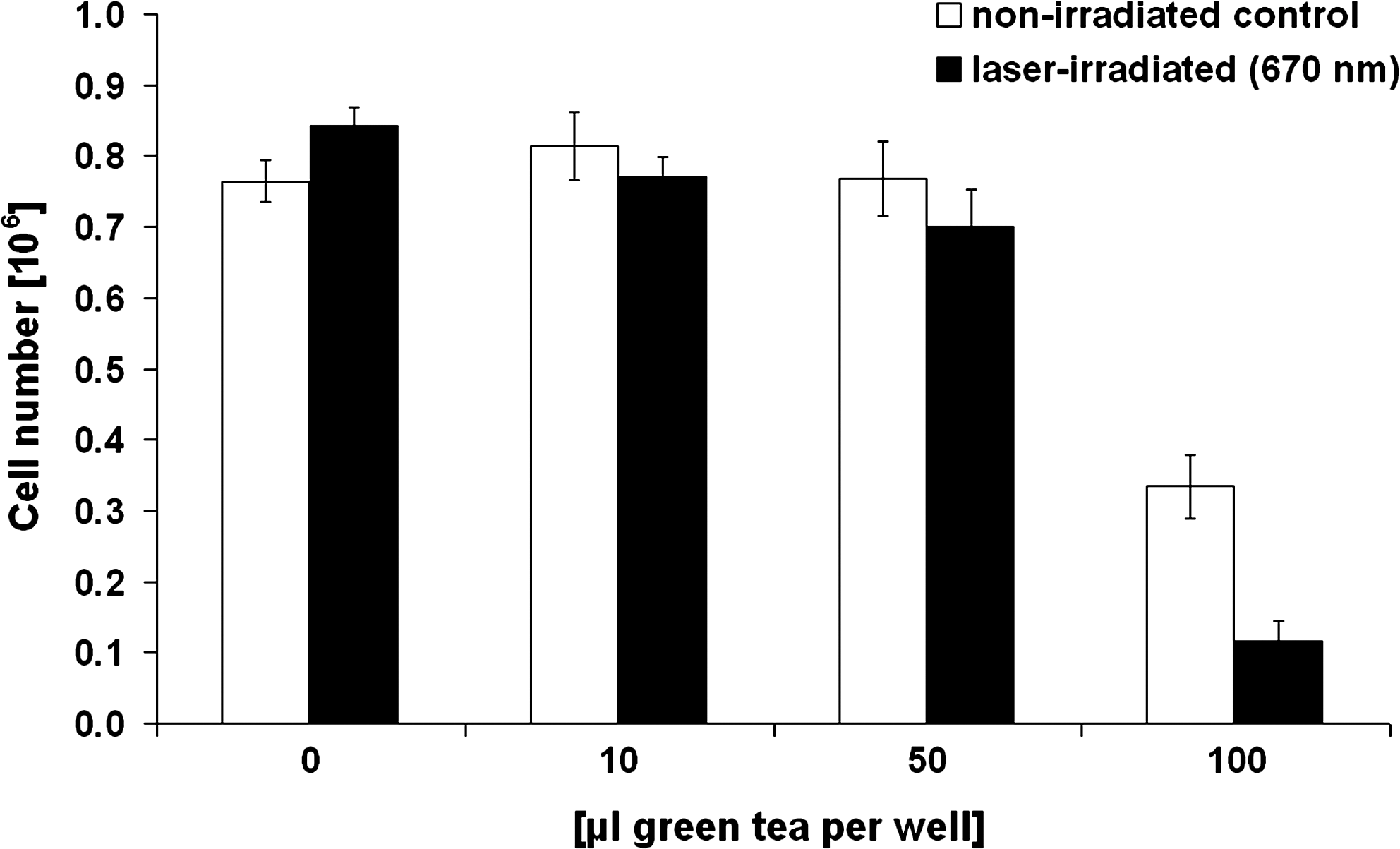
Influence of green tea and red laser light (670 nm) on the multiplication of HeLa cells grown in 24-well plates. Error bars show standard deviations.
A physicochemical mechanism for the incorporation was put forward in our earlier work. 10 It is based on the effect of visible light on the viscosity and density profile of interfacial water layers and confined water at room temperature, in particular, on the finding that exposure to moderately intense red light (670 nm) instantly increased the fluidity and decreased the density of interfacial water layers on hydrophilic surfaces. 11 Because of the hydrophilic nature of the total surface found in cells (macromolecules and organelles), most of the water confined in cells is necessarily interfacial water. This led to the expectation that on exposure to pulsed red light, virtually converting interfacial water into bulk water and back, cells would push out a fraction of their aqueous content, incorporating substances dissolved in their immediate environment in the reflux phase. Recent model experiments suggest that interfacial water has a density of ∼1.2 g/mL at room temperature (Fabio Bruni, personal communication). The importance of the metabolic activation by bidirectional flow processes induced by pulsed red light consists of its general applicability to both cells and pathogenic biosystems. Because the method is not restricted to green tea, it promises to become a valid tool in various fields of medicine.
Conclusions
Our results, although established only in vitro, promise to open a new avenue in cancer research. Eventually this avenue may lead to a radical breakthrough in the treatment of cancer, specifically of melanoma. Our conclusion receives justification from a recent report on the effect of EGCG in suppressing the growth of melanoma in vivo. 12 From the perspective of practical applicability, the combination of green tea and red light recommends itself for superficial treatments, where green tea (or EGCG) is injected, applied as a lotion, or administered orally. We hope that our work will initiate further study.
Footnotes
Author Disclosure Statement
No competing financial interests exist.