




Abstract
Introduction
Treatment of psoriasis is challenging. Topical treatment modalities (such as corticosteroids, calcipotriene, and tazarotene) have been the mainstay of the treatment of localized plaque psoriasis. Compliance is an issue because these topical agents might not be effective, can be messy and malodorous, and daily application requires time and motivation.
Ultraviolet B (UVB) phototherapy (narrowband and broadband) and photochemotherapy-psoralen plus ultraviolet A radiation (PUVA) are well-established, effective forms of treating psoriasis. However, the uninvolved skin, which is much more sensitive to UV light than is psoriatic skin, is also irradiated when using these therapies, which results in greater risks of short-term adverse effects, such as burning and pruritus, as well as long-term effects such as photoaging and carcinogenesis. Parrish and Jaenicke 1 demonstrated that the best spectrum of wavelength for treating psoriasis is 300–313 nm. The 308-nm excimer laser uses a monochromatic and coherent beam of light that has the ability to treat the target selectively. Its capacity to deliver high fluencies allows a reduction in the number and duration of treatment sessions needed. Moreover, it is possible with this laser to treat difficult anatomic locations, such as the scalp, palms, and soles.
Materials and Methods
The 308-nm excimer laser (Xtrac; PhotoMedex, Radner, PA) has been approved by the Food and Drug Administration for the treatment of psoriasis. It generates single-wavelength UVB radiation with a spot size of 2 x 2 cm and a pulse-repetition rate ≤200 Hz. The pulse width is 30 nanoseconds. Laser intensity (energy density is 3 mJ/cm2 per pulse). The average laser power delivered by the hand piece is 2–3 W. Exposure time is varied by changing a setting on the laser termed minimal erythema dose (MED). Potential adverse effects with the 308-nm excimer laser include pain, erythema, burning, blistering, and discoloration.
Ninety-eight patients with various forms of stable psoriasis (lesions unchanged for ≥2 months) were treated with the 308-nm excimer laser. The treatment was fully explained to patients in regard to how much improvement they might expect and possible side effects. Informed consent was obtained from each patient. Patients with <20% body-surface-area involvement were included. Before the first treatment, each patient's MED was determined on unexposed, uninvolved skin. The MED was defined as the minimal fluence of laser light capable of producing a well-defined, macular, pink erythema. Delivered fluences were 100, 150, 200, 250, 300, and 350 mJ/cm2, corresponding to MED levels of 1 through 6. The initial dose was 1 to 2 times the patient's MED, depending on the thickness of the lesion and patient's Fitzpatrick skin type. Thereafter, the same dose was repeated twice if redness developed. The treatment was subsequently increased in a stepwise fashion by increments of 50 to 100 mJ/cm2 until redness developed, in which case, the dose was reduced by 1 MED or skipped (if burning or blistering developed). Treatment was given twice weekly (never on 2 consecutive days). The eyes were protected with UV-protective goggles.
Results
Ninety-eight patients (41 male and 57 female patients) with stable psoriasis were treated with the 308-nm excimer laser. Their ages ranged from 10 to 84 years (mean, 51.4 years).
Duration of the disease ranged from 3 months to 30 years. Fifty-nine patients (60.2%) of the 98 patients achieved 70% clearance or greater. The average number of treatments required to achieve this was 17 (see Figs. 1 and 2), and the average cumulative dose was 6.46 J/cm2 (Table 1). Twenty-four (24.5%) of the 98 patients had 50% to 70% clearance of their lesions after an average of 12 sessions. The average cumulative dose needed was 5.36 J/cm2 (Table 1).
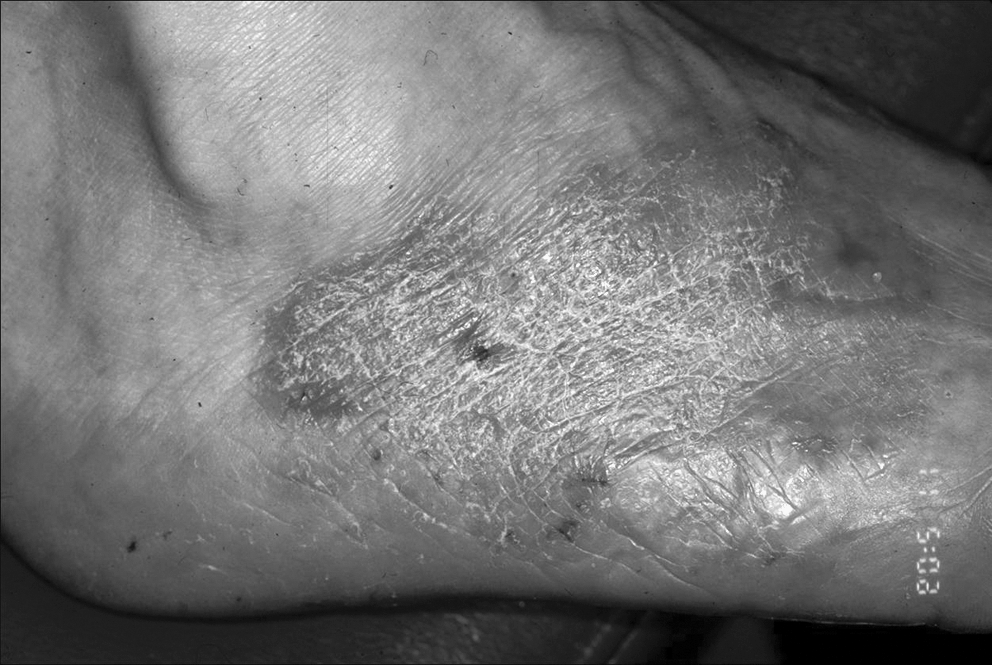
Psoriasis of the foot before treatment.
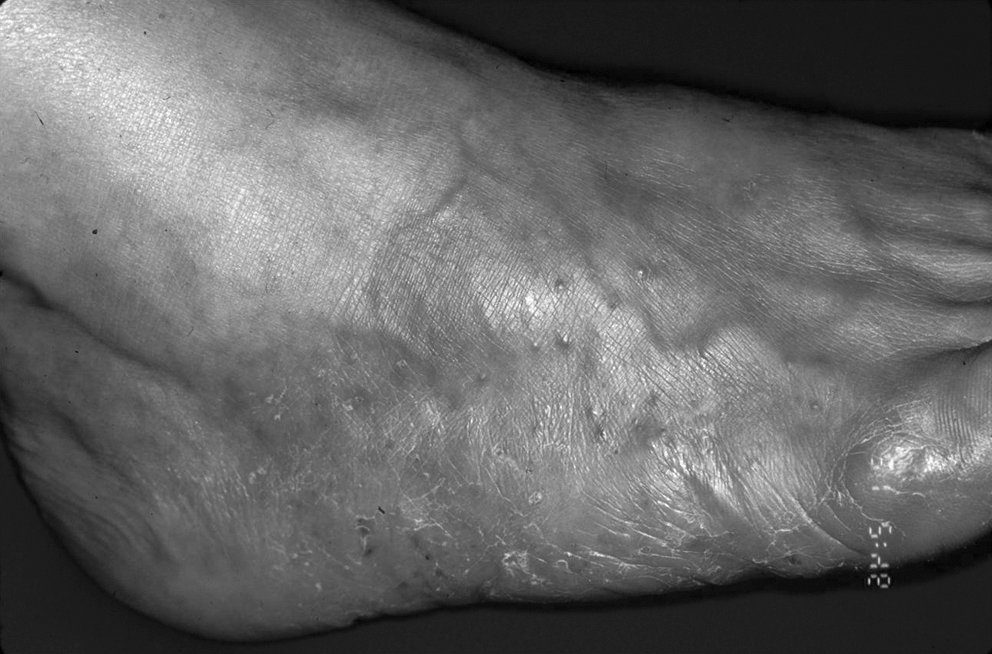
Result after 10 sessions with the 308-nm excimer laser.
Response to treatment was studied in different body locations, including resistant sites such as palms, soles, and the scalp (Table 2). In the patients studied, 37 had involvement of the palms, 21 had involvement of the scalp, and 30 had involvement of the soles. It was found that 66.7% of patients with scalp involvement achieved >70% clearance of their lesions, whereas 60% of those with sole involvement and 59.5% of those with the palm involved achieved similar results.
Discussion
The 308-nm excimer laser has been shown to be very effective in clearing psoriasis plaques with a small number of treatments in a relatively short time. 2 It is possible to clear psoriasis with as little as one treatment with moderately long remission. 3
In a multicenter study, Feldman et al. 4 reported that 72% of patients achieved ≥75% clearing in an average of 6.2 treatments, and 35% achieved ≥90% clearing in an average of 7.5 treatments.
In an early study using the 308-nm excimer laser for the treatment of chronic plaque psoriasis, Bonis et al. 2 reported the clearance of 100% of the plaques after 7 to 11 treatment sessions (mean, 8.6). Doses are usually chosen based on the MED on normal unaffected skin. Initially, high fluencies (8 to 16 times the MED) were used with excellent clinical results. 3 However, because of the side effects and the potential long-term carcinogenic risk associated with high fluencies, medium doses (about 3 times the MED) are now being recommended. 5
It might be feasible to counteract the possible carcinogenic effects of the 308-nm excimer laser by introducing green tea into the treatment protocol. The combination of green tea and light (red LED light) was successfully used in a recent skin-rejuvenation study. 6 The photoprotective effect of green tea due to its antioxidant properties has been documented by others. 7,8
Trehan et al. 5 achieved >95% clearance with a mean cumulative dose per plaque of 6.1 J/cm2 (1.9 J/cm2 to 18.3 J/cm2). Asawanonda et al. 3 reported that remission seen in the areas that received the high dose (8–16 MED) was approximately 6.5 months. In another study 5 that used medium doses, the mean remission time was 3.5 months. Bonis et al. 2 also compared results of the 308-nm excimer laser with 311-nm narrowband UVB. The number of treatments was 3.6 times fewer, and the duration of phototherapy was 2.27 times shorter with the excimer laser than with the 311-nm narrowband UVB therapy. Also, the cumulative dose needed for clearing was 6.47 times less with the excimer laser than with the narrowband UVB therapy. Because side effects of the different UV therapies are thought to increase with the cumulative UV dose during life, 9,10 one can argue that excimer laser has a potentially lower risk of side effects. In a dose–response study using the 308-nm excimer laser, Asawanonda et al. 3 demonstrated that fluence was the single most important determinant in the clinical clearing of psoriasis. The number of treatments, conversely, was not so important. Remissions obtained with this treatment were also fluence dependent, with higher fluencies resulting in longer-lasting remissions.
Some factors seem to influence response to excimer laser therapy. Localization of the plaques is one of them. Gupta et al. 11 reported a case of scalp psoriasis in which 90% improvement in the patient's PASI score was achieved at treatment 23. In a case series of scalp psoriasis, Morison et al. 12 achieved 95% or greater improvement in 49% of patients and 50% to 95% improvement in 45% of patients. In this series, only 5% of patients had less than 50% clearance. The mean number of treatments to achieve clearance was 21 (range, 6–52). Although these are very good results, the number of sessions to obtain improvement is greater than that reported for other areas.
Mafong et al. 13 reported a case of inverse psoriasis that attained 90% improvement after six treatments with the 308-nm excimer laser. Different plaque characteristics also seem to interfere with the response, with thicker, scalier plaques responding more slowly. 3,5
Our findings showed that ≥70% clearance could be achieved in >60% of the patients with an average of 17 sessions. The usually resistant sites showed a response that is close to the response in other body sites. This modality of treatment may be safer than PUVA or conventional UVB phototherapy in regard to skin aging and carcinogenesis. This is, in part, because uninvolved skin is not targeted, unlike phototherapy (in which both involved and uninvolved skin are exposed to UV radiation). Moreover, with this modality, the cumulative dose is substantially less than that with phototherapy. Our results show that this method of treatment for psoriasis is effective, relatively safe, and more convenient compared with other available modalities of treatment. Additionally, our findings demonstrate that the remission period can last several months in many patients.
Conclusion
This study demonstrates the efficacy of the 308-nm excimer laser in the treatment of various forms of localized, stable psoriasis. This finding is particularly evident in treatment of resistant areas, such as the palms, the soles, and the scalp. The 308-nm excimer laser may be used as an effective and safe alternative to other modalities in the treatment of recalcitrant lesions of localized stable psoriasis.
Footnotes
Author Disclosure Statement
Mount Sinai holds a patent in the use of the excimer laser for vitiligo and receives royalties from Photomedex.