




Abstract
Introduction
Although burning mouth syndrome is relatively common, it is also often misunderstood by clinicians, in part because of confusing terminology. The literature is replete with synonyms to describe this phenomenon such as “stomatodynia,” “stomatopyrosis,” and “oral dysesthesia.” “Glossodynia” and “denture sore mouth” connote burning sensation limited to the tongue and denture-bearing areas, respectively.
Low-level laser therapy has been used in a variety of chronic and acute pain conditions, including neck, back and myofascial pain, 5 –8 degenerative osteoarthritis, 9 –12 and headache. 13 Here we describe an approach for using low-level laser therapy for burning mouth syndrome.
Study Design
Patients with a diagnosis of burning mouth syndrome 14 were recruited at the Oral Medicine Clinic at the Oral Medicine Center, Chung Shan Medical University Hospital, Taichung City, Taiwan, between October 2008 and October 2009 under the approved Institutional Review Board protocol. All patients complained of burning, stinging, pain, and a “salty taste” on the tongue without any mucosal abnormality. They were otherwise healthy and not taking any medications for systemic diseases. None of participants was a current or previous smoker.
Low-level energy diode laser, K-Laser with a wavelength of 800 nm (Eltech srl), was applied directly to the symptomatic areas. A straight handpiece was used with an end of 1 cm diameter and the laser fiber 4 cm away from the end of the handpiece (Fig. 1). When the laser was applied, the handpiece was in direct contact or immediately above the painful tongue surface (Fig. 2). The output used was 3 W with 50 msec intermittent pulsing and a frequency of 10 Hz, which is equivalent to 1.5 W/cm2 (3 W × 0.05 msec × 10 Hz = 1.5 W/cm2). Depending on the involved area, laser was applied for 70 sec to a 1-cm2 area until the entire involved area was covered; i.e., an energy density of 105 J/cm2 was applied (1.5 W/cm2 × 70 sec = 105 J/cm2). Patients received the laser treatment once a week. Overall pain and burning discomfort, before and after treatment, was assessed by a 10-cm visual analogue scale (VAS). Each patient was required to score his or her burning discomfort with a VAS at the end of each visit. The therapeutic course was ended when patients felt they no longer required the treatment, and the VAS of the final visit was used for analysis. After termination of the laser therapy, all patients were instructed to return for follow-up once every month to once every 3 months.
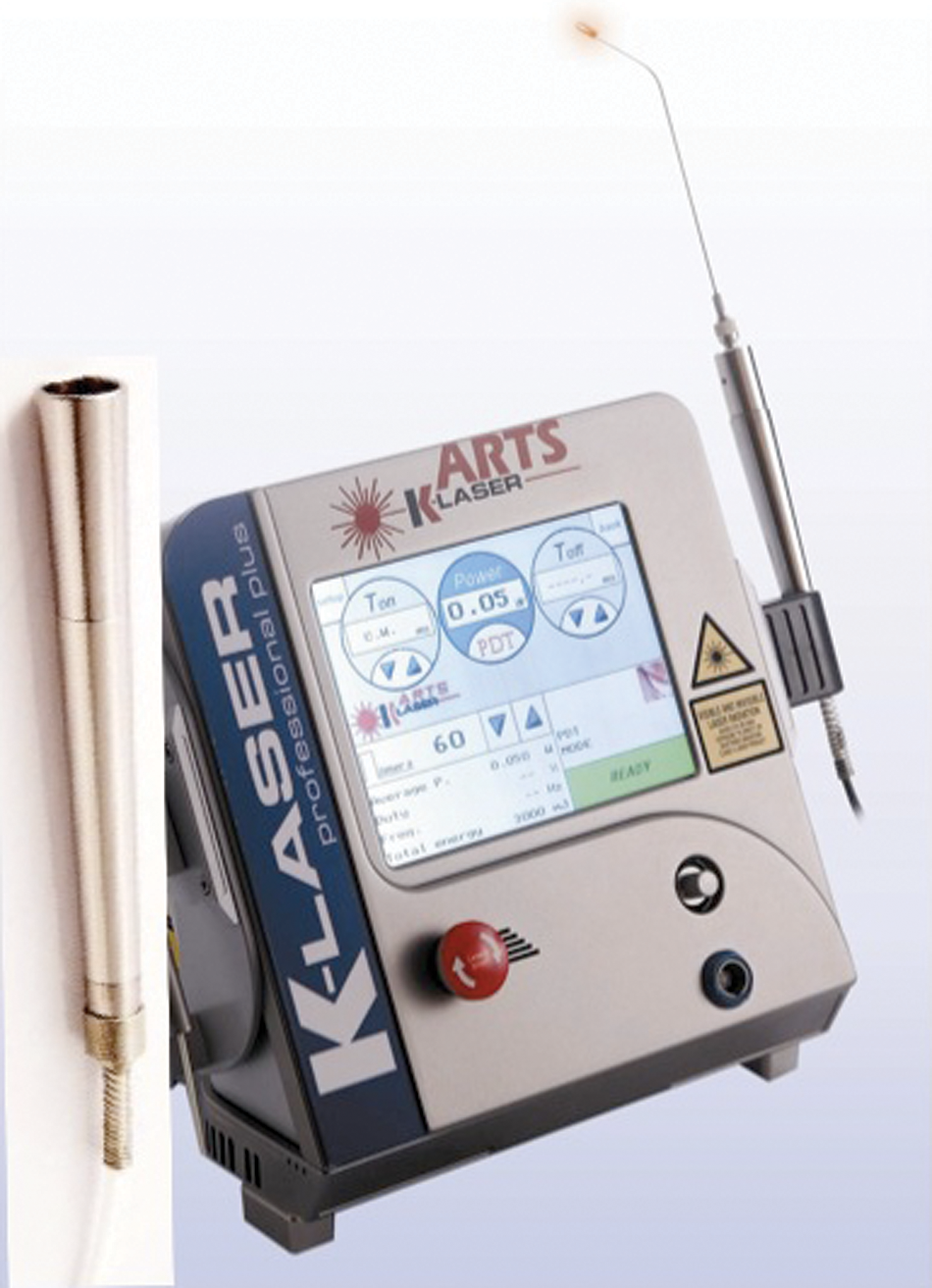
Diode laser machine with a straight handpiece.

Laser handpiece in direct contact or immediately above the involved area for treatment.
Results
Seventeen patients with a diagnosis of burning mouth syndrome were recruited, 4 men and 13 women. The mean age was 50.6 y, ranging from 31 to 75 y. The average treatment course was 2.6 visits (range, 1–7 visits).
Average pain score before treatment was 6.7, more towards the right end of the VAS (range, 2.9–9.8). The average pain score after laser treatment fell to 3.5, shifting towards the left end of the VAS (range, 0.6–7.8). When analyzing the percent reduction in the pain score for each patient, the average percent pain reduction after treatment was 47.6% (ranging from 9.3% to 91.8% reduction), with pain intensity being halved after treatment. Although still present, the pain after treatment was much lower and more acceptable to the patients. No discomfort or side effects were reported during or after laser treatments. All patients were followed up once a month to once every 3 months for up to 12 months, and none of them reported change on the pain and/or burning level after termination of laser therapy.
Discussion
For the patient in whom no clear causative factor for pain emerges during evaluation and in whom empiric measures have failed, potential therapies include those used in the treatment of other poorly understood chronic pain conditions. Amitryptiline (75–150 mg daily) and doxepin (75–150 mg daily) are the most commonly prescribed antidepressants. Although these medications have yielded slight to marked improvement in about 20% of patients, therapeutic efficacy can be limited by the drug-associated xerostomia. 15 Koblenzer and Bostrom 16 reported the efficacy of pimozide alone or in combination with either fluoxetine or a tricyclic antidepressant in three patients with burning mouth syndrome. The newer serotonin uptake inhibitors typically cause less xerostomia and therefore may be more beneficial than tricyclics in patients with burning mouth syndrome. The benzodiazepine chlordiazepoxide led to complete remission in 15% and some relief in 52% of treated patients. 15 Topical capsaicin provided complete remission in one patient and moderate benefit in another with burning mouth syndrome. 17 Concurrent use of topical local anesthetics may be helpful in improving tolerance to the burning that may occur with initial application. 18 Recently, lingual nerve block was tested on burning mouth syndrome without success. 19
Infrared laser therapy for five consecutive days improved symptoms in patients with burning mouth syndrome. 20 Low-level energy diode laser showed several effects that can be helpful in reducing the burning sensation. The laser shows a significant analgesic effect, mainly by increasing the secretion of endorphin, 21 blocking the depolarization of c-fiber, 22,23 increasing action potential, 23,24 and decreasing the production of bradykinin. 23 In addition, diode laser may reduce inflammation by increasing production of PG-I2 25 and PG-E2, 26 increasing blood vessel formation. 27 Although no “sham-treatment” group was included as a control, at least half of the patients recruited in this study were tested without laser emission before actual laser treatment. No patients reported change in the pain intensity. As a result, we only treated the patients with laser irradiation in order to solve patients' discomfort and improve their quality of life.
In summary, we demonstrated the effectiveness of low-level energy diode laser treatment on treating burning mouth syndrome patients with satisfactory results. Further studies, including long-term follow-up and a larger number of patients, will be conducted to confirm the therapeutic mechanisms of the diode laser.
Footnotes
Author Disclosure Statement
No competing financial interests exist.