




Abstract
Introduction
Here we describe an approach using a low-level laser therapy to treat PIFP successfully.
Methods
All patients with PIFP were recruited according to diagnostic criteria provided by the International Headache Society 2 in the Oral Medicine Clinic at the Chung Shan Medical University Hospital, Taichung City, Taiwan between October 2008 and October 2010. All patients complained of persistent pain at various locations (Table 1) along one region of trigeminal nerve distribution, without any mucosal abnormality. They were otherwise healthy and not taking any medications for any systemic diseases. None of the participants was a current smoker, or had ever smoked.
The low-level energy diode laser used to treat these patients was K-Laser series (Eltech srl, Treviso, Italy), with a wavelength of 800 nm. A straight handpiece with an end diameter of 0.8 cm attached to a laser fiber, which is 4 cm from the end of the handpiece, was used. Occasionally, an angled handpiece with an end of 0.5 cm diameter was used (Fig. 1). When laser was applied, the handpiece directly contacted the painful region (Fig. 2). The output used was 3 W, 50 ms intermittent pulsing, and a frequency of 10 Hz, which is equivalent to 1.5 W average power (3 W×0.05 sec×10 Hz=1.5 W). Depending upon the involved area, 70 sec were applied to 1 cm2 area until all involved area was covered. That is, an energy density of 105 J/cm2 was applied (1.5 W/cm2×70 sec=105 J/cm2). In certain cases, innervation orifice (such as infraorbital foramen or nasopalatine canal) was additionally treated for 134 sec with 1.5 W, 0.025 ms intermittent pulsing and a frequency of 20,000 Hz, which is equivalent to 0.75 W average power (1.5 W/cm2×0.025 ms×20,000 Hz=0.75 W/cm2). That is, an energy density of 100.5 J/cm2 was applied (0.75 W/cm2×134 sec=100.5 J/cm2) to the orifice of the nerve. Patients received laser treatment once a week until they decided to terminate the treatment based on their symptoms. Overall pain discomfort, before and after treatment, was assessed by a 10-cm visual analogue scale (VAS). Every patient was required to score his/her discomfort at the end of every visit, and the VAS of the final visit was used for analysis. After termination of the laser therapy, all patients were instructed to return for follow up once every month to once every 3 months.
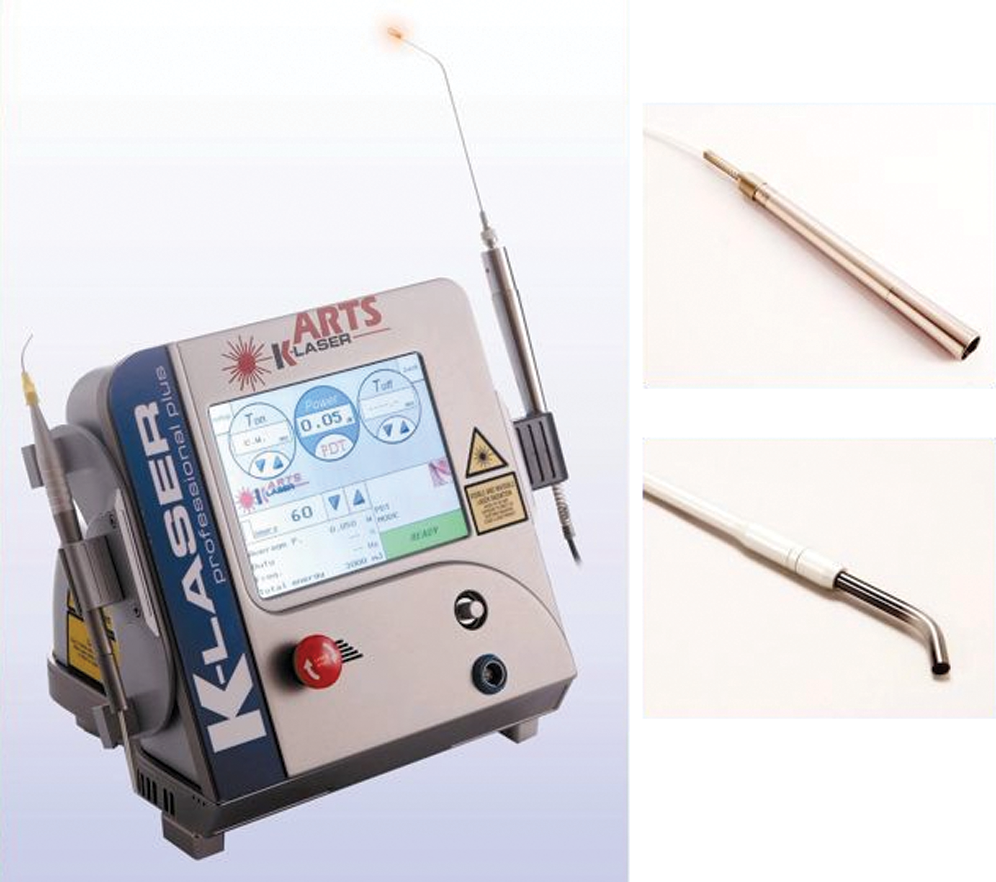
The diode laser used in the treatment of persistent idiopathic facial pain.
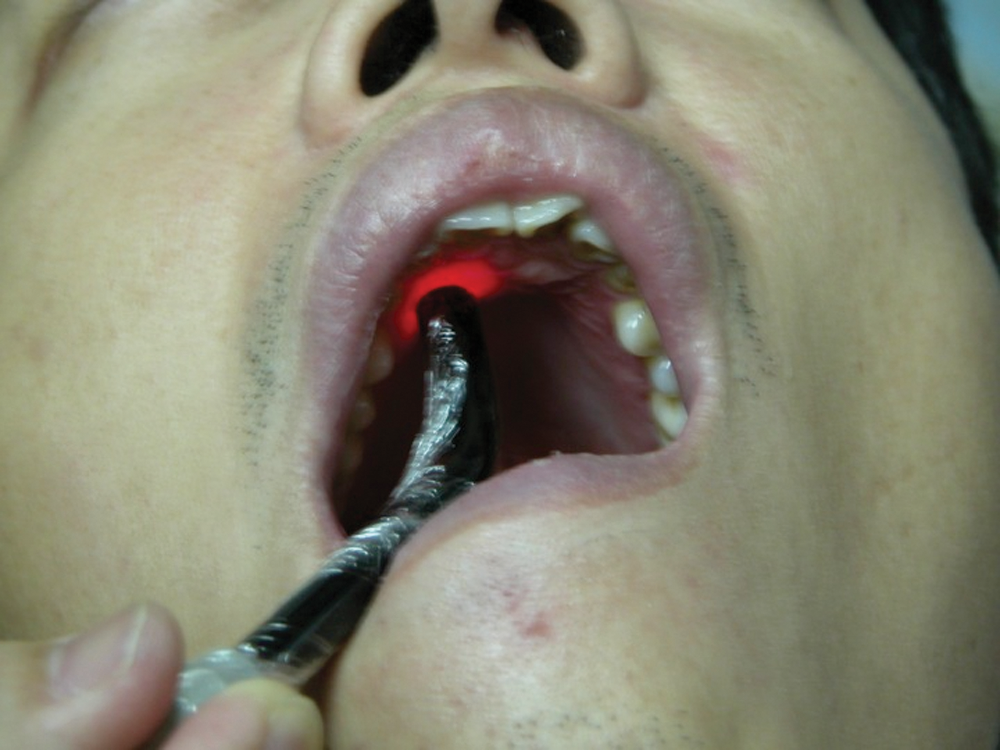
The pain-involving area was directly irradiated by diode laser.
Results
A total of 16 patients with a diagnosis of PIFP were recruited, 4 males and 12 females. The pain-involving areas are listed in Table 1. The mean age was 46.8 years, ranging from 30 to 72 years. Average treatment course was 4.3 visits (ranging 1 to 10 visits).
Average pain score before treatment was 7.4 (ranging from 3.5 to 10.0), more toward the right end of the VAS. The average pain score after laser treatment was reduced to 4.1 (ranging from 2.0 to 8.4), shifting toward the left end of the VAS. When analyzing the percent reduction in the pain score among every patient, the average percent pain reduction from laser treatment was 43.87% (ranging from 5.6% to 74%). Although still present, the pain intensity after treatment was much lower and more tolerable by the patients. No discomfort or side effect was reported during and after laser treatments. All patients were followed up once a month to once every 3 months for up to 12 months, and none reported any change in the pain and/or burning level after termination of laser therapy.
Discussion
A large survey on the prevalence of chronic pain disorders was conducted in 19 German hospitals, on >30,000 patients with chronic orofacial pain. 3 The authors found that the prevalence of chronic orofacial pain, including atypical facial pain, is 5% in German university dental practices. The term “atypical facial pain” was first introduced by Frazier and Russell in 1924 and has been renamed “persistent idiopathic facial pain” (PIFP). The pathophysiology of PIFP is unknown, although Didier et al suggested that a neuromuscular component of the craniomandibular system may play a role in the pathogenesis of chronic idiopathic facial pain. 4 For patients in whom no clear causative factor emerges during the evaluation, the treatment is challenging, and traditionally involves psychological counseling and pharmacological therapy. Anti-convulsants are the most commonly used medications, including topiramate and gabapentine. 5 Unfortunately, medical treatment of PIFP is usually less satisfactory than that for other facial pain syndromes.
Depression, anxiety, and other forms of psychological distress are frequently observed in PIFP patients, which complicates the diagnostic procedure as well as the treatment. 6,7 In a single experimental study of 21 PIFP patients, those who received progressive relaxation training increased salivary immunoglobulin A secretion, which indirectly improved the pain level. 8 On the other hand, another study compared the psychiatric profile of 14 patients with unilateral PIFP and 16 age-matched control subjects, which did not show significant differences. 9 Therefore, to successfully treat PIFP patients, a multidisciplinary approach should be considered, including counseling. 7
Other measurements have been reported useful for the treatment of PIFP. The effectiveness of using hypnosis to treat PIFP was studied, but only limited effects were achieved on highly susceptible patients. 10 Transcutaneous nerve stimulation (TEN) was reported to have a positive result in relieving atypical facial pain in 45% of studied subjects. 11 More aggressively, Gamma Knife® surgery for idiopathic trigeminal neuralgia was studied in 76 patients, with favorable outcome. 12 Posterior fossa exploration provided surgeons an option to perform either nondestructive (microvascular decompression) or destructive (partial sensory rhizotomy) procedures in 62 cases of idiopathic trigeminal neuralgia, with a better pain-free outcome. 13 –15
Low-level energy laser therapy has been shown to be effective in treating various types of acute and chronic orofacial pain, including neck, back, and myofacial pain, 16 –19 degenerative osteoarthritis, 20 –23 and headache, 24 and burning mouth syndrome. 25,26 The mechanism of analgesic effect is mainly by increasing endorphins, 27 blocking the depolarization of C fiber, 28,29 and increasing the threshold for action potential. 29,30 In our series, before the treatment, more than half of the recruited patients received a shamed laser emission and none of the patients reported any change in the pain level. It is also very interesting to note that the average pain scales before laser treatment for burning mouth syndrome and PIFP were 6.7 and 7.4, respectively. 25 It may be therefore interpreted that the pain experienced by PIFP patients was more “excruciating” than that experienced by burning mouth syndrome patients.
In summary, low-level energy diode laser is an effective approach to treating PIFP patients. Further studies, including long-term follow-up and increased patient numbers, will be conducted to confirm the therapeutic mechanisms of the diode laser.
Footnotes
Author Disclosure Statement
No conflicting financial interests exist.