




Abstract
Introduction
With a reliable chemical bonding of resin cements to restorative materials, fewer dental tissues would be removed, more tooth structures would be preserved, and more durable restorations with short clinical crowns would be performed. 14 One of the limitations of the clinical use of zirconia is that it is not properly luted with resin cements. 15 Conventional adhesive cementation procedures (hydrofluoric acid etching and silanization of the ceramics) are thought not to be efficient for zirconia because of the absence of silicon dioxide and glass phase. 16 –18 Therefore, several surface conditioning methods such as sandblasting or tribochemical silica coating have been suggested for zirconia in order to obtain high bond strength. 18
Aluminum oxide (Al2O3) sandblasting has the potential for enhancing surface energy, surface area, and wettability for the proper adhesive procedure. 19 Although sandblasting was found as an effective surface treatment method for zirconia prior to adhesive cementation, 19 –25 it may cause adverse effects on mechanical properties of zirconia such as flexural strength and reliability. 26 –28
In addition to current surface conditioning methods, another new treatment protocol to modify zirconia surface and develop roughness is laser etching. 15 Lasers have become popular in dentistry and been proposed for different dental applications. Neodymium:yttrium–aluminum-garnet (Nd:YAG) laser is efficiently used in reducing tooth sensitivity, 29 removing caries, 30 bleaching, 31 and roughening high-strength ceramic surfaces prior to adhesive cementation. 32,33 Erbium:yttrium-aluminum-garnet (Er:YAG) laser has similar dental applications including removing caries, preparing cavities, and modifying ceramic surfaces. 34 The Er:YAG laser has the ability to remove particles by a process called “ablation”, including micro-explosions and vaporization. 35 Another laser used in dentistry is the carbon dioxide (CO2) laser, and it was found that CO2 laser etching increased the osseointegration of zirconia implants 36 and feldspathic porcelain surface. 37 It is properly used for surface treatment of ceramics because of its wavelength, which is almost totally absorbed in ceramic substances. 37
In the existing literature, there are many studies that investigated the bond strength of laser-irradiated zirconia ceramic to resin cement. 14,15,35,38 –40 However, some controversial results regarding the effects of lasers on surface roughness or the bond strength of zirconia ceramics also exist in the literature. Therefore, the aim of this study was to evaluate and compare the effect of different lasers and conventional surface treatments (sandblasting) on shear bond strength (SBS) of zirconia ceramic to resin cement. The null hypothesis was that SBS between zirconia and dentin obtained by sandblasting is similar that obtained by different types of laser irradiations.
Methods
One hundred and twenty human maxillary third molar teeth with ∼9 mm mesiodistal length free of caries, cracks, fractures, and restoration were selected. The teeth were cleaned of surface debris and stored in 0.1% thymol solution for <6 months. Then, they were sectioned 3 mm below the occlusal surfaces with a slow-speed diamond saw sectioning machine (Isomet, Buehler Ltd., Lake Bluff, IL). They were embedded in a metal ring and positioned in the center of the ring with the buccal cementoenamel junction 3 mm above the top of the metal mounting ring. Then, the ring was filled with autopolymerizing acrylic resin (Meliodent, Bayer Dental Ltd., Newbury, UK). One hundred and twenty dentin specimens were obtained in this manner and stored in distilled water at 37°C.
One hundred and twenty commercially available zirconia core materials (Zirkonzahn, Zirkonzahn GmbH, Bruneck, Italy) were selected for this study. Disc-shaped specimens were fabricated (6 mm in diameter and 4 mm in thickness) by an authorized dental laboratory according to the manufacturer's recommendations. The bonding surfaces of zirconia specimens were polished consecutively with 600-, 800-, and 1200-grit silicon carbide papers (English Abrasives, London, England) under water cooling on a polishing machine (Phoenix Beta Grinder/Polisher, Buehler, Germany) to obtain standardized surface roughness. Then, the specimens were randomly assigned to six groups of equal size, (n=20), according to the surface treatments applied (Fig. 1).
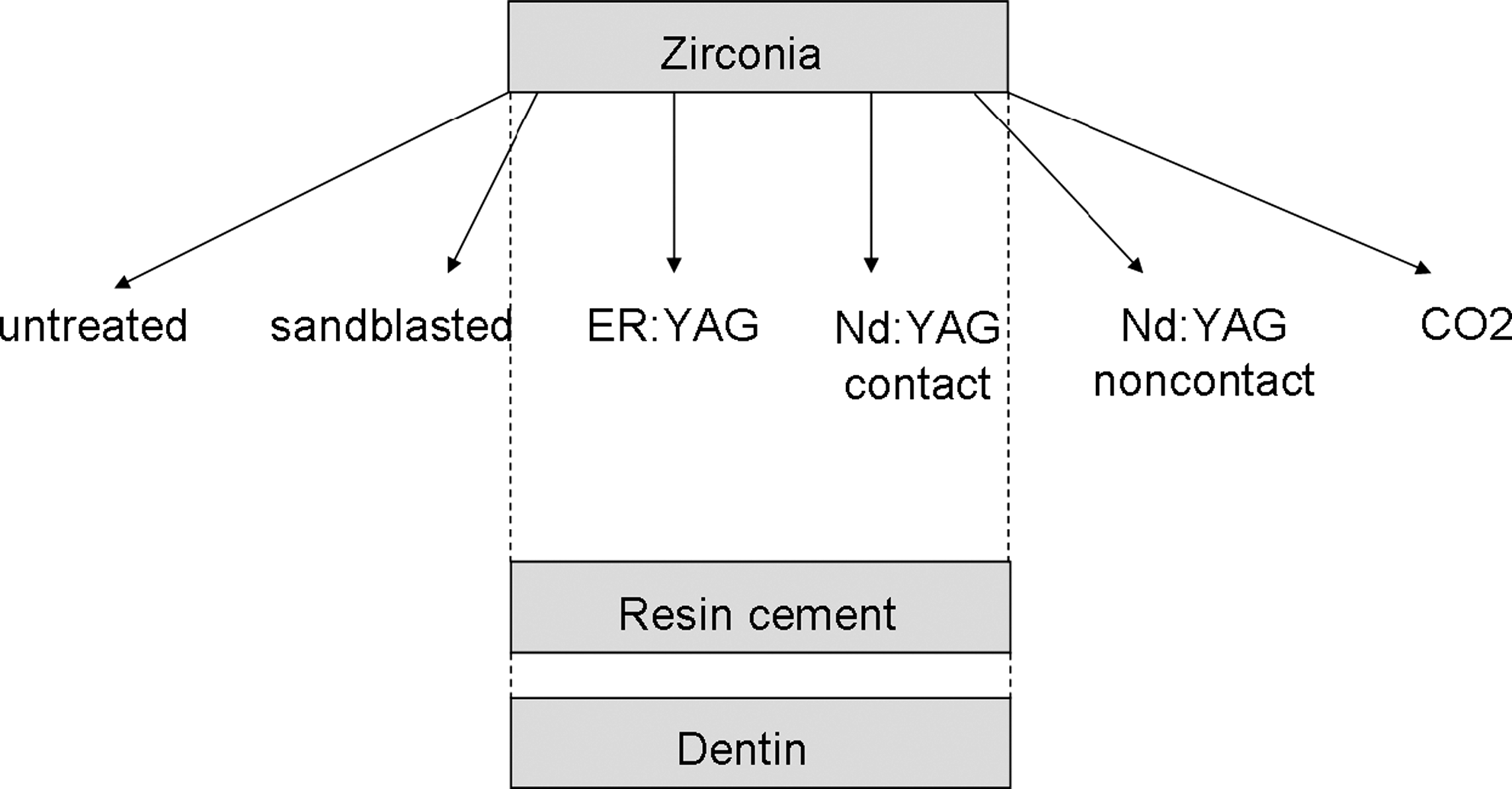
The diagram of the method.
Group 1, untreated (control): No treatment was applied to the zirconia surfaces and this group was determined to be a control group.
Group 2, sandblasted: Bonding surfaces of zirconia specimens were sandblasted (Ney, Blastmate II, Yucaipa, CA) with 120 μm aluminum oxide (Al2O3) for 10 sec. The air pressure for sandblasting was maintained at two bars. Specimens were mounted in a special holder at a distance of 10 mm between the surface of the specimen and the blasting tip. Then, the specimens were rinsed under running water and then dried with oil-free compressed air to remove the remnants.
Group 3, Er:YAG laser irradiated: Bonding surfaces of zirconia specimens were irradiated by Er:YAG laser (Smart 2940D Plus, Deka Laser, Florence, Italy) with a wavelength of 2.94 μm. Laser energy was delivered in pulse mode by a 4-mm diameter titanium articulated arm transmission system with a repetition rate of 10 Hz, energy of 150 mJ, output power of 1.5 W, energy density of 119.42 J/cm2 and pulse duration of 700 μs for 20 sec. The distance of application was 10 mm. Moreover, ceramic surface was cooled with the water spray at a rate of 5 mL/min during irradiation.
Group 4, Nd:YAG laser irradiated with contact, no distance: Bonding surfaces of zirconia specimens were irradiated by Nd:YAG laser (Smarty A10, Deka Laser, Florence, Italy). Laser energy was delivered in pulse mode with a 300 mm in diameter laser optical fiber and a wavelength of 1,064 μm for 30 sec. The laser parameters used were 80 mJ (pulse energy), 10 Hz (repetition rate), 0.8 W (output power), 300 μs (pulse duration), and 113.23 J/cm2 (energy density). Air cooling was used during laser irradiating of the specimens.
Group 5, Nd:YAG laser irradiated with the distance of 1 mm: Bonding surfaces of zirconia specimens were irradiated by Nd:YAG laser (Smarty A10). A 300 mm in diameter laser optical fiber was aligned perpendicular to the ceramic surface at 1 mm distance, and scanned the whole ceramic area for 20 sec. Laser energy was delivered in pulse mode with a repetition rate of 20 Hz, energy of 200 mJ, output power of 4 W, pulse duration of 300 μs and energy density of 283.08 J/cm2. Air cooling was used during laser irradiating of the specimens.
Group 6, CO2 laser irradiated with contact, no distance: Bonding surfaces of zirconia specimens were irradiated by CO2 laser (Smarty US-20 D, Deka Laser, Florence, Italy) with a 10.60 μm wavelength in continuous mode. R14 contact tip with a 4 mm diameter was used for laser irradiating of the specimens. The laser beam was delivered with a pulse duration of 160 ms and energy density of 159.22 J/cm2 at power outputs of 4 W for 50 sec. Air cooling was used during laser irradiating of the specimens.
Following the surface treatments, zirconia disc-shaped specimens were cemented onto the dentin specimens with dual-cured resin cement (Variolink, Ivoclar Vivadent, Schaan, Liechtenstein), according to manufacturer recommendations. The zirconia discs were positioned and stabilized on the dentin surface with finger pressure, and excess cement was removed using a microbrush. The specimens were then stored in distilled water at 37°C for 24 h before SBS test.
SBS test
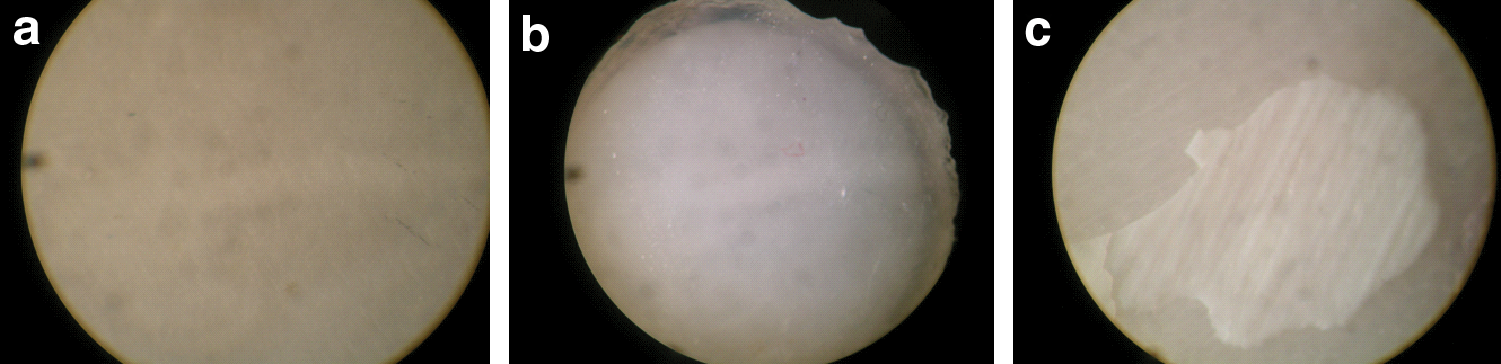
The specimens were attached to a custom jig of a universal testing machine (Lloyd LF Plus, Ametek Inc, Lloyd Instruments, Leicester, UK), and subjected to a shear force at a crosshead speed of 1 mm/min until failure occurred. The SBS values were calculated from this measurement and expressed in MPa. In addition, the fractured specimens were examined under a stereomicroscope (SMZ 800, Nikon, Tokyo, Japan) at 40x magnification to evaluate the fracture pattern. Failure modes were classified into one of three categories: adhesive failure if debonding occurred between resin cement and dentin or zirconia ceramic and resin cement interface; mixed failure if it exhibited partially adhesive, partially cohesive failure in resin cement; or cohesive failure in resin cement (Fig. 2). All observations were conducted by one person. The mean values and standard deviations of the specimens were statistically evaluated by one-way ANOVA and post-hoc Tukey-Kramer multiple comparisons tests (α=0.05).
Results
One-way ANOVA revealed significant differences among the different surface treatment groups (F=23.829 and p<0.001). Table 1 summarizes the mean values and standard deviations of SBS for all groups. The highest mean SBS was recorded for Group 4 (Nd:YAG laser irradiation with contact), and followed by Group 3 (Er:YAG laser irradiation). In addition, Tukey's Honestly Significant Difference test showed that no significant difference was found between Groups 3 and 4 (p=0.956). Analysis of the data also revealed that there were no significant differences when Nd:YAG laser irradiation groups were compared (p=0.935). Furthermore, there were no significant differences between the control group and Group 2 (p=0.891); however, differences between the control group and other groups were statistically significant (p<0.05).
n=20 and groups with same superscripted letters not significantly different (p>0.05).
Modes of failure are presented in Table 2. The analysis of failure after the SBS test revealed that the adhesive failure mode was predominantly observed in Groups 2, 3, 5, and 6. Contrarily, 45% mixed failure in Group 1 and 50% mixed failure in Group 4 were seen.
Discussion
The results obtained in the present study clearly demonstrate that, contrary to results with CO2 laser-irradiated zirconia, Er:YAG and Nd:YAG laser-irradiated zirconia exhibited higher bond strength than sandblasted zirconia. Therefore, the hypothesis that SBS between zinconia and dentin obtained by sandblasting is similar to that obtained by different types of laser-irradiation was rejected.
Different methods have been proposed to achieve reliable bond strength between zirconia and resin cement. The increase of surface roughness is necessary to obtain reliable bond strength of zirconia and resin. 20 Sandblasting and mechanical grinding are able to create microcracks within the zirconia material, causing undesirable changes of mechanical properties. 41,42 Therefore, an alternative treatment method, laser etching, was developed to provide roughness on zirconia surfaces. 15
The bond strength of resin cements to zirconia ceramics had been evaluated in previous studies. 35,40,42 –44 In the present study, the effect of different surface treatment methods on the SBS of resin cement to zirconia was investigated, and the surface treatments resulted in significantly different bond strength. The highest SBS value was obtained in the Nd:YAG irradiated group. Akin et al. 40 evaluated the effect of Er:YAG laser on the SBS of zirconia to resin cements, and found that roughening the zirconia surface with Er:YAG laser increased the SBS values (3.2 MPa) compared to untreated surfaces (2.8 MPa). This result is in agreement with the present study. Furthermore, Paranhos et al. 15 examined the untreated, sandblasted, and laser etched (Nd:YAG and CO2) zirconia surfaces and reported that Nd:YAG laser significantly affected the SBS (14 MPa) compared to untreated (4.65 MPa), sandblasted (8.79 MPa), and CO2 irradiated (7.92 MPa) groups. The lower SBS results obtained with CO2 laser was explained by the micrographs, in which a smooth and nonretentive surface was observed. The findings of the present study are in agreement with Paranhos et al., 15 showing higher SBS values in the Nd:YAG laser treatments (4.24 and 4.56 MPa) when compared with untreated (3 MPa), sandblasted (3.45 MPa), and CO2 irradiated (1.4 MPa) groups.
Contrarily, in a study by Cavalcanti et al., 35 it was stated that Er:YAG laser irradiation (200 mJ, 10 Hz, 5 sec) did not increase the bond strength (15.8 MPa) as well as the sandblasting (22.3 MPa). In addition, it caused lower bond strength than untreated specimens (17 MPa). Similarly, Foxton et al. 14 found that Er:YAG laser (200 mJ, 10 Hz, 5 sec) decreased the SBS (13.3 MPa) compared to untreated (20.6 MPa) and sandblasted surfaces (19 MPa). In contrast to these results, it was found that Er:YAG laser irradiation (150 mJ, 10 Hz, 20 sec) achieved higher bond strength (4.27 MPa) than sandblasted (3.45 MPa) and untreated specimens (3.09 MPa) in our study. This may be because of the longer irradiation time (20 sec) in this study. Moreover, as expected, in the present study, sandblasted zirconia ceramics had higher mean SBS than did untreated zirconia ceramics; however, the differences were not statistically significant. This result is in accordance with Ural et al. 45 Difference in the size of particles and the application time may be effective in this result.
Contrary to results with the present study, Akyıl et al. 43 also investigated the effect of lasers on the SBS of zirconia to resin cements and advocated that contrary to results with Nd:YAG laser, both Er:YAG and CO2 laser irradiation can increase the bond strength. In addition, they reported that the air abrasion surface treatment group showed the highest bond strength.
On failure after SBS testing, different failure types were observed among the groups and there was a correlation between SBS and failure types. Group 4 (Nd:YAG laser), which had the highest SBS, presented 50% mixed failures, whereas adhesive failures were predominantly observed in Group 6 (CO2 laser) (95%).
In the present study, the specimens had two adhesive interfaces to simulate clinical situation, that is, between zirconia and resin, and between resin and dentin. In this way, the performance of tooth–resin–zirconia complex was investigated. During laser irradiation, local temperature changes may damage the mechanical properties of zirconia because of the transformation toughening phenomenon of the material. 39 In addition, high laser power settings may deteriorate the zirconia surfaces. 46 Therefore, lower power settings such as 80, 150, and 200 mJ were selected.
In this study, the SBS test was preferred because it is easy to perform and fast to produce results. 47 All the specimens were stored in distilled water at 37°C for 24 h before testing, which is classified as a standard for short-term storage in ISO/TR 11405. One of the limitations of this study was that the effects of thermocycling and long-term storage on SBS were not evaluated. Although these storage types are important to simulate clinical conditions, the results of this study may be beneficial for the comparison of the effects of different surface treatment methods. The final evaluation of surface modification techniques should be determined using long-term clinical studies.
Conclusion
Within the limitations of this study, the following conclusions were drawn: 1. CO2 laser irradiation of the zirconia showed lower bond strength than did untreated, sandblasted, Er:YAG, and Nd:YAG laser treatments. 2. Er:YAG and Nd:YAG laser treatment demonstrated higher bond strength than untreated, sandblasted, and CO2 laser irradiated zirconia.
Footnotes
Acknowledgments
The authors gratefully acknowledge Assistant Professor Sertaç Peker from Istanbul, Turkey, for his kindly contributing the laser application.
Author Disclosure Statement
No conflicting financial interests exist.