




Abstract
Introduction
In this study, we report the clinical effectiveness and tolerability of a low-energy double-pass 1450-nm diode laser on facial acne scars in Asian patients.
Patients and Methods
Twenty-four Japanese patients (17 females, 7 males) with atrophic acne scars on the face participated in this study, which was conducted from August 2008 to December 2010. The average age was 27.1 years (range, 15–44 years). The mean duration of the acne scars prior to receiving laser therapy was 4.8 years (range, 1–9 years). The aims of the study were explained to the patients, who then gave informed consent. The study protocol was approved by the institutional ethical committee.
A low-energy double-pass 1450-nm diode laser (Smoothbeam™, Candela Corp.) was used for all treatments. Each patient received five treatments at 4-week intervals. Follow-up observation was performed 3 months after the last evaluation. Topical therapies for acne vulgaris were permitted during the follow-up period. The following treatment variables were used: spot size, 6 mm; fluence, 12 J/cm2; pulse duration, 210 ms; dynamic cooling device spray duration, 33 ms; and repetition rate, 1 Hz. Each treatment was administered on both cheeks of the face. The acne scars were treated with a single non-overlapping pass over the affected areas and the surrounding skin. Lidocaine-containing tape (Penles™, Nittodenko, Japan) was used for topical anesthesia. The patients were classified into three types of acne scars: 11 rolling, boxcar, and icepick (Fig. 1).
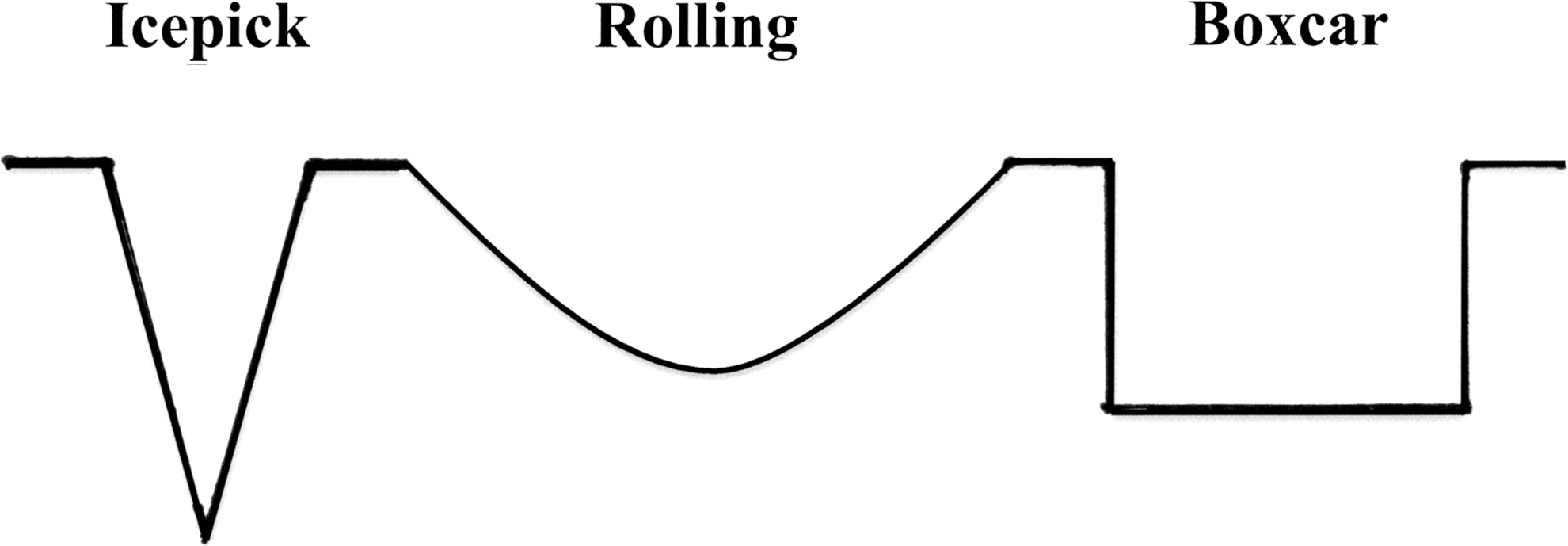
Acne scar subtypes proposed by C.I. Jacob (partially modified). 11 (Reprinted from J. Am. Acad. Dermatol., vol. 45, Jacob, C.I., Dover, J.S., and Kaminer, M.S. Acne scarring: a classification system and review of treatment options. Pages 109–117, 2001, with permission from Elsevier.)
Evaluation of skin lesions and photographing of the affected areas were performed before treatment, at the time of each treatment, and 4 weeks after the final treatment. The same investigator took photographs of each patient. Final evaluation of the efficacy was made by the investigators using a combination of observations and photographs. Photographs were assessed by two blinded investigators who did not know the patients. The physicians' overall assessments of the extent of improvement/worsening graded were based on the following categories: worsened, no change, slight improvement (1–29%), moderate (30–69%), and marked (70–100%). Subjects were asked to evaluate the degree of satisfaction from the treatments based on the following categories: not satisfied, slightly satisfied, satisfied, or very satisfied. Patients also noted any adverse events.
Results
All patients completed the five sessions with only slight procedural pain. Results of the physicians' overall assessments are summarized in Table 1. The 1450-nm diode laser achieved moderate-to-marked improvement in 75.0% of the total population, with 29.2% of patients having moderate improvement and 45.8% having marked improvement. A slight improvement was seen in 12.5% of the subjects. No patients showed worsened scars, whereas 12.5% had no change. Satisfaction for 79.2% of patients ranged from satisfied to very satisfied (Table 2). The representative cases with a marked response are shown in Figs. 2 –4. Vesicle formation was seen in one case, following no hyperpigmentation. Transient hyperpigmentation was seen in another case and disappeared within 2 months.

A 33 year-old woman
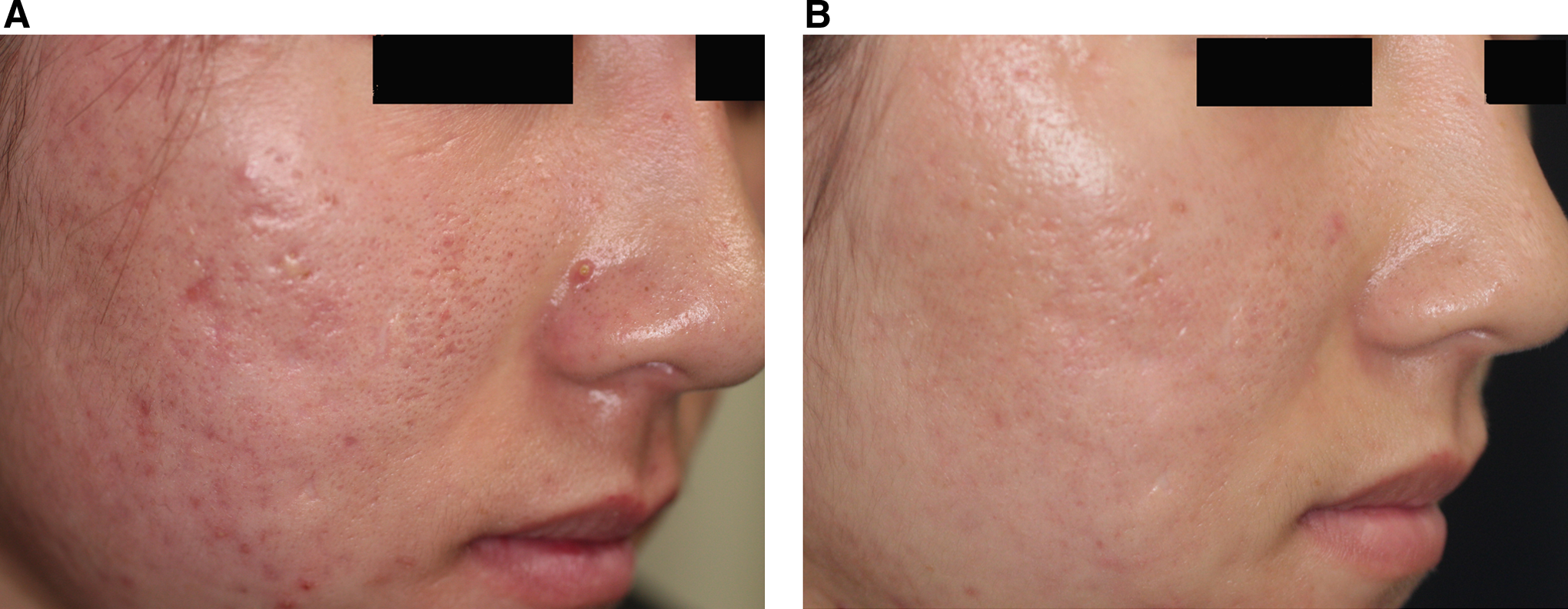
A 21 year-old woman
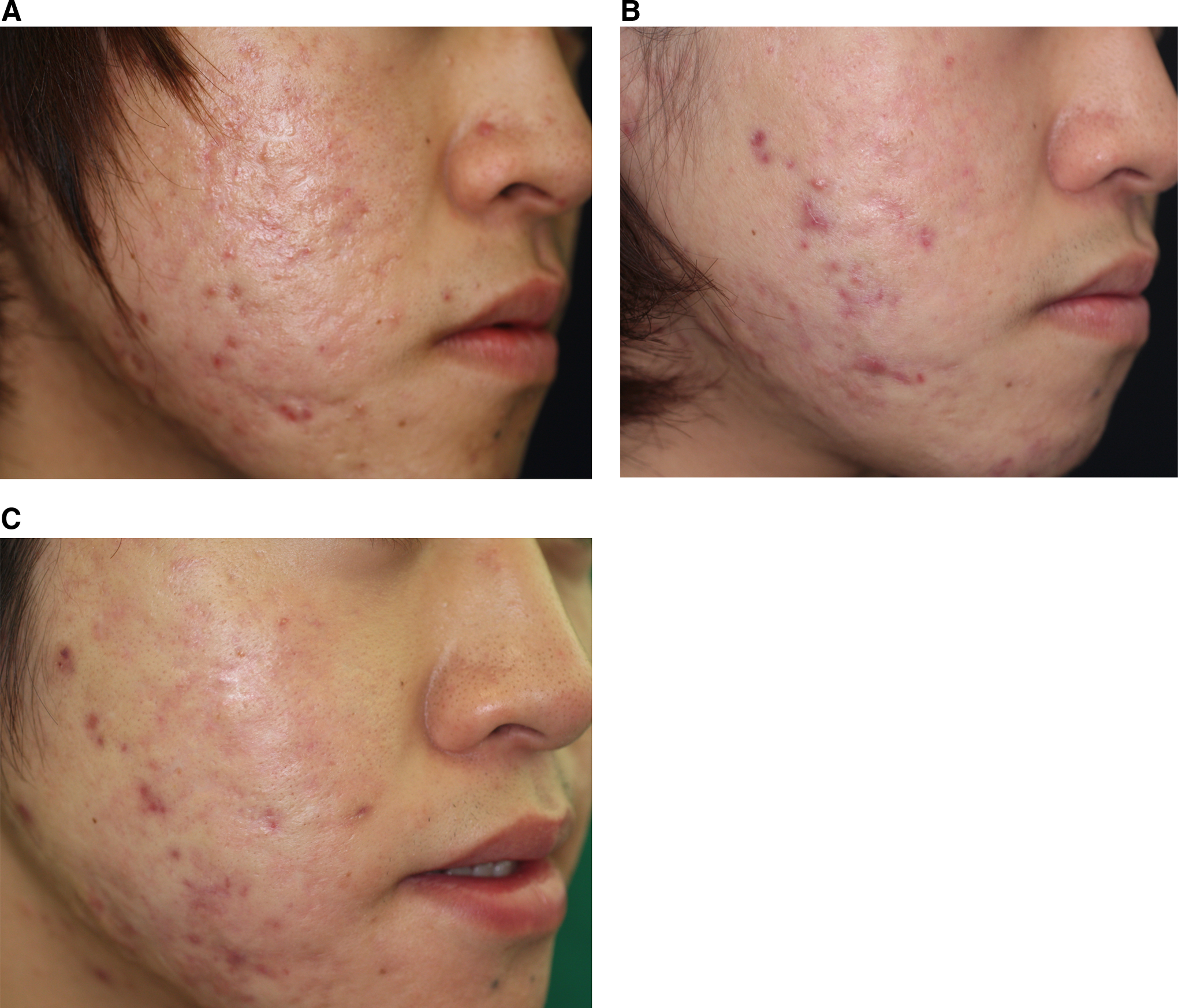
A 19 year-old man before
According to the classification of acne scars, 37.5% of patients had rolling+boxcar types, 37.5% had boxcar types, 16.7% had rolling types, and 8.3% had rolling+icepick types. In the group with rolling+boxcar scars, 88.9% had >30% improvement (marked and moderate). In the boxcar scar group, 66.6% of patients showed >30% improvement (marked and moderate) in acne scars (Table 3). Fourteen cases with moderate and marked improvements were evaluated 3 months after the last observation. Moderate- to-marked improvements were noted at the 3-month follow-up visit by 92.9% of patients (13 of 14 patients) (Fig. 4C).
Discussion
Our study used only one irradiation protocol for the low-energy double-pass 1450-nm diode laser. The physicians' overall assessment in this study demonstrated clinical effectiveness on facial acne scars. Moreover, data for patient satisfaction showed a similar tendency toward improvement after laser therapy. No serious adverse events were seen for this treatment, indicating good tolerability. Therefore, treatment with the 1450-nm diode laser may be an appropriate modality for facial acne scars. Further studies on energy dose and treatment frequency are necessary to achieve maximal improvement for acne scars.
The 1450-nm laser has received Food and Drug Administration approval for the treatment of acne, atrophic acne scars, and fine wrinkles. 3 This laser is clinically effective for atrophic acne scars as well as acne vulgaris. 9 The light at 1450-nm in the infrared spectrum and corresponds to the peak of the absorption spectrum of water, which indicates that the target chromophore resides in collagen and sebaceous glands of the mid-dermis. Histopathological examination has revealed that this laser causes thermal damage to the collagen in the dermis. 9, 12 We hypothesize that the 1450-nm diode laser may remodel collagen and form new collagen, leading to an improvement of acne scar tissue. In our patient population, a total of 75% of patients had either boxcar or rolling+boxcar scars (37.5% for each type). Moreover, the percentage of patients having >30% improvement was larger for the rolling+boxcar type (88.9%) than for the boxcar type (66.7%). The number of subjects with >70% improvement was also larger for the rolling+boxcar type (77.8%) than for the boxcar type (33.3%). Carniol et al. reported that greater improvement after 1450-nm diode laser therapy was seen for rolling rather than boxcar scars. 13 These results imply that this modality could be more effective for rolling+boxcar type scars than for boxcar type scars. Rolling type scars with mild edges may be responsible for the formation of new collagen as opposed to boxcar scars, which have sharp edges. However, as the number of subjects in our study was small, additional subjects are needed to clarify differences in the effectiveness for acne scar types.
The length of remission following acne scar therapy is a great concern. Approximately 90% of the subjects observed in our study maintained improvements up to 3 months, suggesting an increase in the patients' QOL. These improvements may have been caused by collagen formation and subsequent architectural alteration in the dermis after this therapy. The 1450-nm diode laser may produce longer remission for acne scars, similar to that seen in acne vulgaris. 14 Further studies with longer follow-up periods are currently underway. Moreover, additional irradiation may enhance the remission and should be investigated.
Some studies with nonablative lasers have reported postinflammatory hyperpigmentation (PIH). The incidences of PIH after the nonablative 1450-nm diode laser treatments were 18% in skin types I–III, 15 20% in skin type V, 9 and 39% in skin types IV and V. 10 PIH is a frequent complication of laser therapy in darker skin types. 16 Our previous study 7 had no cases with PIH, and the current study had only one case with PIH. This result may have been caused by the relatively low pulse energy (12 J/cm2) and lesser cooling parameter (33 ms) used. Another Asian group reported low incidence (3.8%) of PIH under similar conditions (8 J/cm2 and 25 ms, respectively). 17 However, physicians should be aware that the 1450-nm diode laser has the potential to produce unwanted PIH if the pulse energy and cooling parameter are increased.
Conclusions
In summary, this study demonstrated that the 1450-nm diode therapy was effective and well tolerated for treatment of facial acne scars. Most patients maintained the improvements for up to 3 months. Although further study with more subjects is necessary, this laser may be an appropriate nonablative modality in the treatment of acne scars.
Footnotes
Author Disclosure Statement
No competing financial interests exist.