




Abstract
Introduction
The recycling process is basically defined as removing adhesive from the bracket completely to provide the possibility of bracket reuse, without damaging the bracket backing or distorting the slot dimensions. Recycling of metal brackets can be performed by specialized companies or in the dental office (chair side). 1 Both chemical and thermal methods may be used for industrial bracket recycling. However, a significant decrease in bond strength has been demonstrated in most studies using industrial recycling. 2 –5 Furthermore, commercial bracket recycling is time consuming and demands special appliances and materials, and is therefore impractical to perform at the dental office. 6 Today, although industrial methods of bracket recycling are not commonly used by most practitioners, reconditioning of one or more accidentally dislodged brackets to be reused in the same patient, is still popular.
Several in-office methods for reconditioning of metal brackets are available. The use of silicon carbide stone operated in a slow-speed handpiece is a common and easy-to-perform procedure for composite removal, but a significant reduction in bond strength has been reported in most studies. 1,2,6 –8 Aluminum oxide air-abrasion technique has also been used for reconditioning of orthodontic brackets, potentially increasing micromechanical retention on the base, and thus improving the bond strength. 9,10 However, the difference in bond strength between sandblasted rebonded and new brackets was not statistically significant in most studies. 1,6,7,11 –13 Erbium family lasers have been used effectively for composite removal. 14 –17 Erbium, chromium: yttrium-scandium-gallium-garnet (Er,Cr:YSGG) laser has also been used successfully for surface treatment of dental composites, with similar effects to that of the air-abrasion technique. 18 A recent study found that Er,Cr:YSGG laser can promote the use of recycled brackets by providing shear bond strength (SBS) values comparable to sandblasted attachments, and not significantly different from the mean initial bond strength. 19
There are few studies evaluating the efficiency of Er,Cr:YSGG laser as a method for recycling of orthodontic brackets. In addition, the quantitative amount of adhesive remained on the bracket base after recycling has not been determined in previous studies. Therefore, this study was undertaken to (1) compare the ability of several recycling methods including Er,Cr:YSGG laser in removing adhesive from the bracket base, (2) evaluate the SBS values of the recycled brackets, and (3) correlate changes in percentage of remaining adhesive on the base with changes in SBS.
Materials and Methods
Seventy-five stainless steel upper first premolar brackets (twin bracket, 0.018-inch slot, Dentaurum, Ispringen, Germany) were used in this study. To prepare brackets for the recycling process, 60 brackets were first bonded on the buccal surface of an unetched and slightly wet
20,21
premolar tooth with Transbond XT adhesive (3M Unitek, Monrovia, CA). Excess adhesive was removed with a dental explorer and the bracket was light-cured for 40 sec from occlusal, gingival, mesial and distal sides. Curing was performed with a Bluephase C8 (Ivoclar Vivadent, Schaan, Liechtenstein) light-emitting diode (LED) delivering a light intensity of 650 mW/cm2. Subsequently, the brackets were easily detached from the tooth with a pair of tweezers. The debonded brackets were divided into 4 groups of 15 each, and the composite was removed from the bracket bases using different reconditioning methods as follows: 1. Sandblasting with aluminum oxide particles: The brackets in this group were cleaned with 50-μm aluminum oxide powder using an intraoral sandblasting unit (Kolo Multi Functional Micro blaster, Sun Ring Dental Medical Instrument. Co, Japan). Sandblasting was performed under 55 ψ pressure and the tip of the device was held at 10 mm distance from the bracket base. 2. Silicon carbide stone: In this group, the remaining adhesive on the base of the bracket was cleaned with a silicon carbide stone operated in a low speed-handpiece at 25,000 rpm. 3. and 4. Er,Cr:YSGG laser (Waterlase, Biolase Technology, Irvine, CA): The brackets in these groups were cleaned with Er,Cr:YSGG laser (wavelength 2780 nm, pulse duration 140 μs, pulse repetition rate 20 Hz, 55% water, 65% air) at power of 3.5 W (3) and 4 W (4). The laser beam was directed manually and perpendicular to the bracket base area at a distance of 1 mm.
Before sandblasting and laser application, the buccal surfaces of the brackets were pressed on a layer of dental wax, so that the bracket base was easily managed during the reconditioning process. The brackets in each experimental group were cleaned until the adhesive resin was totally removed from the base and no longer visible to the naked eyes. After recycling, the brackets were rinsed with water and dried with an air spray. The base of each bracket was then photographed using a stereomicroscope (Blue Light Industry, Waltham, MA) at 42.5×and 85×magnifications. The quantitative amount of remaining adhesive on the base of each bracket was calculated relative to the total base area of the bracket (%) using a microstructure image processing software (Nahamin Pardazan Asia Co, Iran). The damage done to the mesh structure was also examined in the microscopic images.
SBS testing
Seventy-five freshly extracted human premolar teeth were selected and stored in distilled water during the period of the experiment. The teeth were intact and without any caries or hypoplasia on the buccal surface. The sample was divided into 5 groups of 15 teeth each, based on the treatment conditions of the bracket bases: (Group 1) grinding with a silicon carbide stone, (Group 2) sandblasting with 50-μm aluminum oxide powder, (Group 3) reconditioning with Er,Cr:YSGG laser at 3.5 W power, (Group 4) reconditioning with Er,Cr:YSGG laser at 4 W power, and (Group 5) no treatment (control).
Before bonding, the buccal surfaces of the teeth were cleaned with non-fluoridated pumice slurry and rubber prophylactic cups for 5 sec. Then the enamel was etched with 37% orthophosphoric acid gel for 30 sec, rinsed thoroughly for 15 sec, and dried for another 15 sec with an oil-free air spray. Transbond XT primer (3M Unitek) was later applied on the enamel surface and the bracket was bonded at the center of the clinical crown and parallel to the long axis of the tooth with Transbond XT adhesive. The excess adhesive was removed from the periphery of the base with a dental explorer and each bracket was cured for 40 sec from all four sides of the bracket, as described previously.
The bonded teeth were immersed in distilled water at 37°C for 24 h and then mounted in chemically cured acrylic resin so that the buccal surface of the tooth was parallel to the direction of the debonding force. SBS test was performed on a Zwick testing machine (model Z250, Zwick GmbH & Co, Ulm, Germany) with a crosshead speed of 0.5 mm/min. The force required to fracture the bracket from the tooth was recorded in newtons (N) and then converted into megapascals (MPa) by dividing the measured force by the bracket base area. After debonding, the teeth were examined under 10×magnification to score the amount of adhesive remained on the enamel surface according to the adhesive remnant index (ARI) of Artun and Bergland:
22
0: no adhesive remained on the tooth, indicating that bond failure occurred purely at the enamel–adhesive interface.
12
1: <50% of the adhesive remained on the tooth, implying that bond failure occurred predominantly at the enamel–adhesive interface.
12
2: >50% of the adhesive remained on the tooth, indicating that bond failure occurred predominantly at the bracket–adhesive interface.
12
3: all adhesive remained on the tooth with a distinct impression of the bracket base, indicating that bond failure occurred purely at the bracket–adhesive interface.
12
Statistical analysis
After the normality of the data was confirmed by the Kolmogorov–Smirnov test and the homogeneity of variances confirmed through Levene's test, one way analysis of variance (ANOVA) was used to delineate significant differences in the percentage of remaining adhesive on the brackets after being recycled, and the SBS values of the study groups. Pairwise comparisons between the groups were made by the Duncan test, and the difference in ARI scores was assessed by the χ2 test. The Pearson correlation test was used to identify any significant correlation between the percentage of remaining adhesive on the base and the SBS. Statistical calculations were performed by SPSS (Statistical Package for Social Sciences, Version 11.5, Chicago, IL) software, and a p-value <0.05 was considered significant.
Results
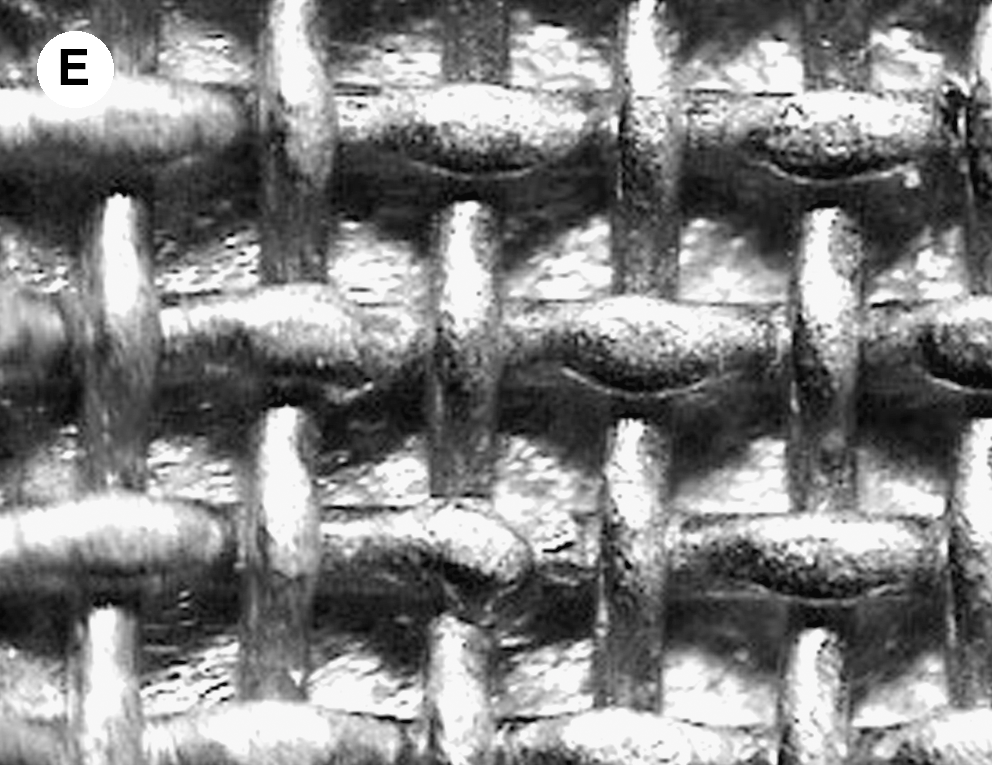
Representative photographs taken from bases of reconditioned brackets at different magnifications are demonstrated in Fig. 1. In group 1 (reconditioning with silicon carbide stone), substantial fragments of adhesive resin remained, filling most of the undercuts in the bracket base (Fig. 1A). Furthermore, the mesh structure was ground in some areas (Fig. 1A), and some distortion was also evident at the periphery of the base. Bracket reconditioning with aluminum oxide air-abrasion technique (Fig. 1B) or Er,Cr:YSGG laser (Fig. 1C and D) resulted in a limited area of remaining adhesive on the base and caused minimal damage to the mesh structure. The surface area of the foil mesh was noticeably roughened in brackets prepared by air-abrasion technique and to some extent in Er,Cr:YSGG laser groups, showing apparent increase in the retentive areas of the bonding pad (Fig. 1B–D). New brackets (Fig. 1E) had a multi-stranded mesh structure with retentive areas between the strands.
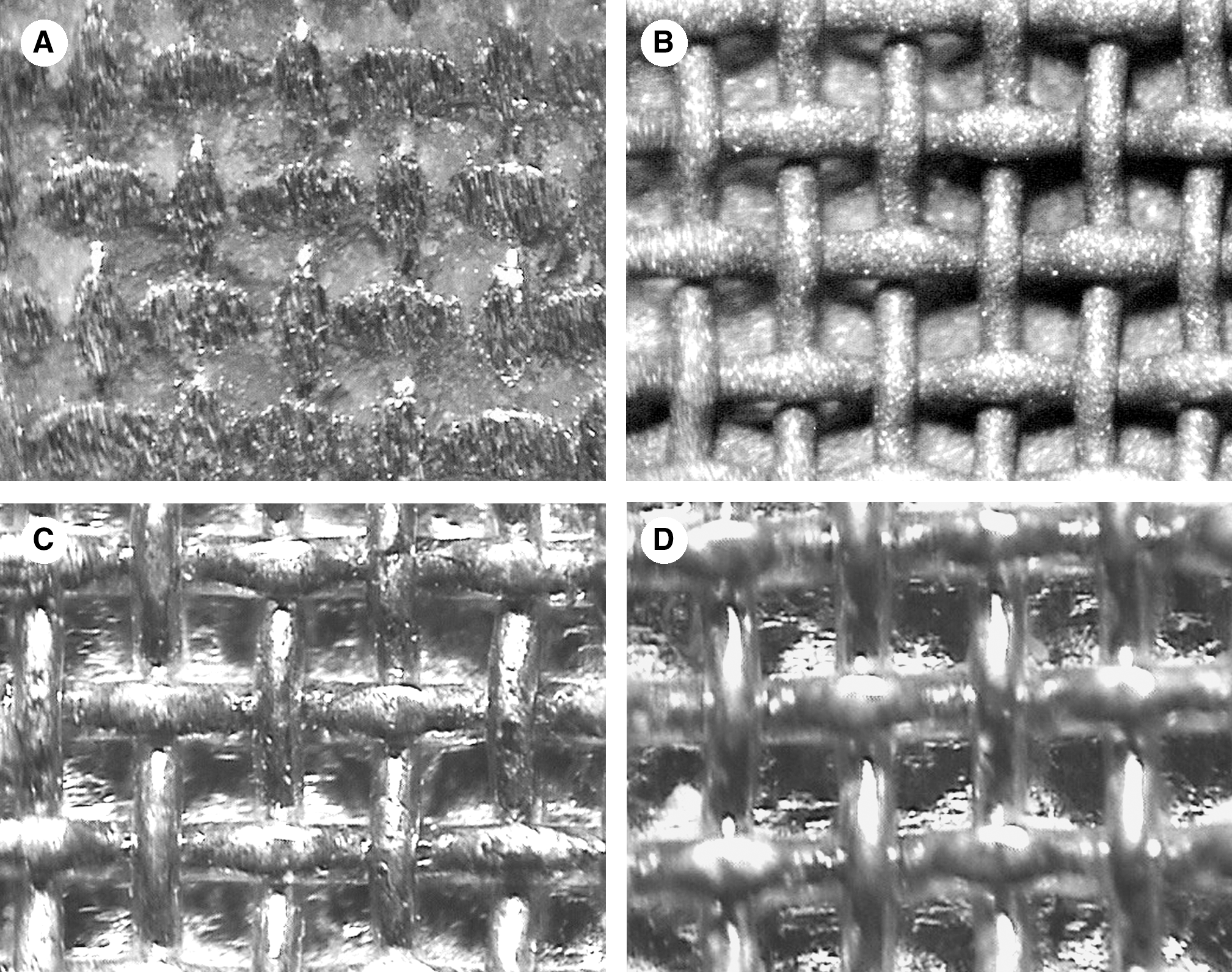
Representative images taken with stereomicroscope at 85×from the foil mesh of brackets reconditioned with
The descriptive data regarding the percentage of remaining adhesive on the base and the SBS values of the study groups are presented in Table 1. ANOVA revealed significant between-group differences in both the percentage of remaining adhesive on the base (p<0.0001) and the bond strength (p<0.0001). Duncan test (Table 1) revealed that the brackets cleaned with aluminum oxide sandblasting had the lowest, whereas those prepared by silicon carbide grinding had the highest percentage of remaining adhesive on the base after reconditioning. Multiple comparison with the Duncan test (Table 1) also revealed that the brackets cleaned with silicon carbide stone had the lowest SBS, whereas those reconditioned with aluminum oxide blasting or Er,Cr:YSGG laser (both 3.5 and 4 W groups) had the highest SBSs, showing no statistical difference with each other.
Duncan post-hoc comparison test; different letters indicate significant differences between the groups.
There was a significant correlation between changes in percentage of remaining adhesive on the base after recycling with changes in SBS (Pearson r=−0.41, p<0.0001).
ARI
The results of the ARI scores are shown in Table 2. The χ2 test indicated a significant difference in the distribution of ARI scores among the groups (p<0.0001). Bond failure at the enamel–adhesive interface was more frequently observed in brackets prepared by aluminum oxide blasting and both groups of Er,Cr:YSGG laser prepared specimens. In groups 1 (grinding with silicon carbide stone) and 5 (new brackets), most failures occurred at the bracket–adhesive interface, leaving a substantial amount of adhesive on the tooth surface.
Discussion
In the present study, the effectiveness of Er,Cr:YSGG laser in reconditioning of orthodontic brackets was compared with some other methods. Unlike most previous studies, 1,4,9,13,19 the amount of adhesive on the bases of all brackets were made similar before the reconditioning process to give a more precise comparison among the groups. To determine the percentage of remaining adhesive on the base, stereomicroscopic images were used through image processing software. In most of the previous studies, 1,2,6,9,13 scanning electron microscope (SEM) had been used for this purpose, but, it is not possible to determine the quantitative amount of remaining adhesive under SEM. As was expected, the use of silicon carbide stone for reconditioning of orthodontic brackets caused severe damage to the mesh structure. In brackets prepared by aluminum oxide blasting and both groups of Er,Cr:YSGG laser reconditioned brackets, the bonding pad was micro-roughened and some microscopic impressions were observed on the mesh surface, potentially increasing the retention area for bonding of composite to the bracket base.
The findings in the present study imply that aluminum oxide blasting could eliminate almost all adhesive remaining on the bases of brackets. The small percentage of remaining adhesive in the 3.5 W (4.9 %) and 4 W (5.9 %) laser groups also indicated the efficiency of Er,Cr:YSGG laser in removing adhesive from the bracket base. However, silicon carbide stone grinding was not efficient in cleaning orthodontic attachments, leaving ∼30% of adhesive on the bracket base. Similarly, Basudan and Al-Emran 6 observed nearly continuous resin coverage above the level of the wire mesh after being reconditioned by a green stone.
The SBS values of orthodontic brackets were variable from 6.9 MPa in brackets cleaned with silicon carbide stone to 14.5 MPa in those prepared by 4 W Er,Cr:YSGG laser. Grinding the remaining composite by a silicon carbide stone produced significantly lower bond strength than other groups. This can be attributed to the decrease in retentive areas of the base caused by incomplete adhesive removal, as well as damaging the mesh structure. Similar findings have been reported in several studies. 1,2,6 Tavares et al 1 found that the SBS values of brackets recycled with silicon carbide stone was significantly lower than those of new brackets. Basudan and Al-Emran 6 reported that bracket reconditioning with a green stone left a composite surface devoid of undercuts, resulting in significantly lower bond strength than other groups. In the present study, bracket reconditioning with aluminum oxide blasting or Er,Cr:YSGG laser provided significantly higher bond strength than the control group, indicating the effectiveness of these methods in adhesive removal from the base. The improved retention may also be related to the creation of additional micro-retention areas in the mesh that would in turn increase the available area for adhesive bonding, as observed in microscopic images. The results of this study corroborate the findings of Millett et al. 10 who reported that sandblasting of the bracket base significantly improved the mean survival time of brackets bonded with a glass ionomer cement, relative to the un-sandblasted sample. The findings of this study, however, are in contrast with some previous studies that found comparable 1,6,7,11,13 or statistically lower 23 bond strength values in air-abraded recycled brackets as compared to the new ones.
Recycling with Er,Cr:YSGG laser is a simple technique that is based on the ability of laser in selective removal of adhesive from the bracket base. The bond strengths of brackets recycled with Er,Cr:YSGG laser at 3.5 W (13.1 MPa) and 4 W (14.5 MPa) were considerably higher than other groups, although the difference with brackets cleaned with aluminum oxide blasting was not statistically significant. Ishida et al 19 also found no significant difference in SBS values of rebonded brackets treated by Er,Cr:YSGG laser and those prepared with sandblasting, or with a combination of Er,Cr:YSGG laser and sandblasting.
A significantly reverse correlation was found between changes in percentage of remaining adhesive on the mesh after recycling, with changes in SBS. This implies that as the remaining adhesive increases on the bracket base, the bond strength will decrease. However, the relatively low correlation coefficient indicates that the relationship is not strong. Therefore, it is generally expected that the SBS decreases as the percentage of remaining adhesive on the base increases, but small variations in adhesive remnants on the base have no detrimental effects on SBS.
The distribution of ARI scores in the present study showed a significant difference among the study groups. ARI is commonly used as a method of determining the bond fracture interface. 24 The frequency of bond failure at the bracket–adhesive interface was higher in the silicon carbide ground and new brackets, indicating that this interface is the weakest in the system. In brackets prepared with aluminum oxide blasting or Er,Cr:YSGG laser, a higher frequency of bond failure at the enamel–adhesive interface was observed. This corroborates the findings of Nalbantgil et al 25 that ARI is significantly dependent upon the SBS, with higher SBS values causing more cases of enamel–adhesive failure.
The SBS value required for clinical use in orthodontics is not well determined. Certainly, the bond between the bracket base and the enamel surface should be strong enough to resist stress and occlusal forces during the treatment, while the brackets could be detached easily and without damaging the enamel surface at the time of appliance removal. Reynolds 26 proposed the bond strength of 7.8 MPa as being required for clinical purposes in orthodontics. On the other hand, the mean linear tensile strength of enamel has been demonstrated to be 14.51 MPa, 27 and enamel fracture during bracket removal has been reported to occur with bond strengths as low as 13.7 MPa. 28 With these in mind, the findings of the present study imply that the bond strength of brackets recycled with silicon carbide stone may be lower than what is required clinically, whereas the use of aluminum oxide blasting or Er,Cr:YSGG laser could provide bond strengths that are sufficient and sometimes higher than the safety threshold for clinical use. Taking the risk of enamel damage into account, the use of Er,Cr:YSGG laser at 3.5 W could be considered safer than at 4 W.
Both sandblasting and Er,Cr:YSGG laser can be considered viable options for reconditioning of orthodontic attachments in the dental office. These methods may also be used whenever extra retention is required, for example when the orthodontist prefers to use glass ionomer cement instead of resin composite, when bonding to mottled or hypoplastic enamel is planned, or when brackets should be bonded on the primary teeth. However, a previous study found that micro-etching new brackets for 9 sec caused distortion of mesh structure, 10 a time-limiting factor that should be kept in mind when using this method of reconditioning. 13 The high cost of lasers may also be a great barrier for their common use in orthodontics. But, erbium lasers are multipurpose and bracket reconditioning can be considered as another useful application of lasers in dentistry. Further research should focus on the clinical efficiency of laser-recycled orthodontic brackets and the possible effects of this method on bracket corrosion and enamel staining.
Conclusions
The percentage of remaining adhesive was lowest in brackets cleaned with aluminum oxide blasting and highest in those prepared by silicon carbide stone. Bracket reconditioning with Er,Cr:YSGG laser also left a low percentage of remaining adhesive on the base.
Despite its ease, the use of silicon carbide stone could not be considered a suitable option for bracket reconditioning, because of the damage caused to the multi-stranded structure of the mesh and the lowest SBS achieved.
The bond strengths of brackets recycled with aluminum oxide blasting or Er,Cr:YSGG laser (3.5 and 4 W) were significantly higher than those for the new brackets, indicating the efficiency of these methods in removing adhesive remnants from bracket bases and the possible increase in micromechanical retention of the mesh.
Changes in adhesive remnants on the bases of reconditioned brackets negatively correlated with changes in SBS.
Footnotes
Acknowledgments
The authors thank the Research Chancellor of Mashhad University of Medical Sciences for financial support of this research. The results presented in this work have been taken from a student's thesis (No # 2451).
Author Disclosure Statement
No competing financial interests exist.