




Abstract
Introduction
Lasers have some advantages, such as absence of discomfort and vibration, less trauma to adjacent tissue, and decreased chance of contamination. 1,3 However, root resection takes longer and produces rougher surfaces compared with burs. 3 Additionally, most lasers cause thermal damages such as carbonization or cracking on hard tissue. 2 Bone necrosis occurrs when the temperature is ≥47°C; therefore, 47°C for 1 min is the threshold level for bone survival. 6 The use of a cooling system is important to reduce thermal effects in both laser and standard dental bur drilling of hard tissue. 7,8 Armengol et al. 8 reported that Nd:YAP laser induced significantly higher temperature increases during cavity preparation compared with Er:YAG laser or high-speed dental handpiece. However, this increase for a few seconds could not be implied as causing irreversible tissue damage. 8 A scanning electron microscopy study by Paghdiwala 1 showed no structural damage to the exposed root surface in the presence of a constant water flow during the Er:YAG laser exposure. Komori et al. 2 performed root resection using Er:YAG, Ho:YAG, CO2 laser, and mechanical drills and found that Er:YAG laser had the potential to perform root resection with extremely low thermal damage when used with sufficient water flow. 2
For laser application, the required amount of pulse energy depends predominantly upon the size and specific heat capacity of the volume. As heat transport causes a loss of energy from the heated volume to the surrounding tissue, the same amount of energy delivered by a longer laser pulse will yield a lower temperature, but a shorter laser pulse will lead to a larger heat-affected volume. Therefore, as pulse duration significantly influences heat distribution in the tooth, it plays an important role in ablation efficiency and quality. 9 Therefore, the aim of this in vitro study was to evaluate the generated temperature of the Er:YAG laser, with three different pulse durations for apicectomy compared with tungsten bur and surgical saw.
Materials and Methods
Sixty single-rooted extracted human teeth were selected for this study. All teeth were cleaned and stored in 0.9% sodium chloride until they were ready for resection. The teeth were randomly divided into five groups of 12 samples each. Teeth in each group were resected by three cutting methods: tungsten bur, surgical saw, and Er:YAG laser irradiation with three different pulse durations.
The cut was performed at a 3 mm distance from the apex of the tooth and perpendicular to the long axis from the labial to the lingual. The Er:YAG laser (Fotona AT, FidelisIII, Ljubljana, Slovenia) with a wavelength of 2.94 μm was used at 20 Hz, 300 mJ per pulse. The applicator used was a contact handpiece (type R14). Laser irradiation was performed alternately with three different pulse durations of 50 μs (a super short pulse [SSP]), 100 μs (a very short pulse [VSP]), and 300 μs (a short pulse [SP]) with a chisel-shaped sapphire tip, and bathed in an adjustable air-water spray. The tip had a diameter of 1.5 mm–0.5×1.5 mm at the distal end, and a length of 12.0 mm. The mechanical handpiece was used with a tungsten bur (Komet Dental, Croydon, U.K.) with water cooling, and the surgical saw (NSK Europe GmbH, Eschborn, Germany) also was used with sufficient water flow.
Teflon-insulated, type K thermocouples (model 5SRTC-TT-KI-36, Omega Engineering, Manchester, U.K.) were used to measure temperature changes during the apicectomy process. Thermocouples were read by a Four Channel, Handheld Data Logger Thermometer (model HH147, Omega Engineering, Manchester, U.K.) which allowed for constant, real-time temperature readings. Temperature measurements were made during the apicectomy procedure for all teeth of each group.
Two thermocouples were inserted at 1 and 3 mm away from the cutting site of each tooth (Fig. 1). The apicectomy procedure began when the room temperature was 20°C, as measured by another thermocouple. The total time required for apicectomy, from the beginning to the end of the resection, was recorded for each root.
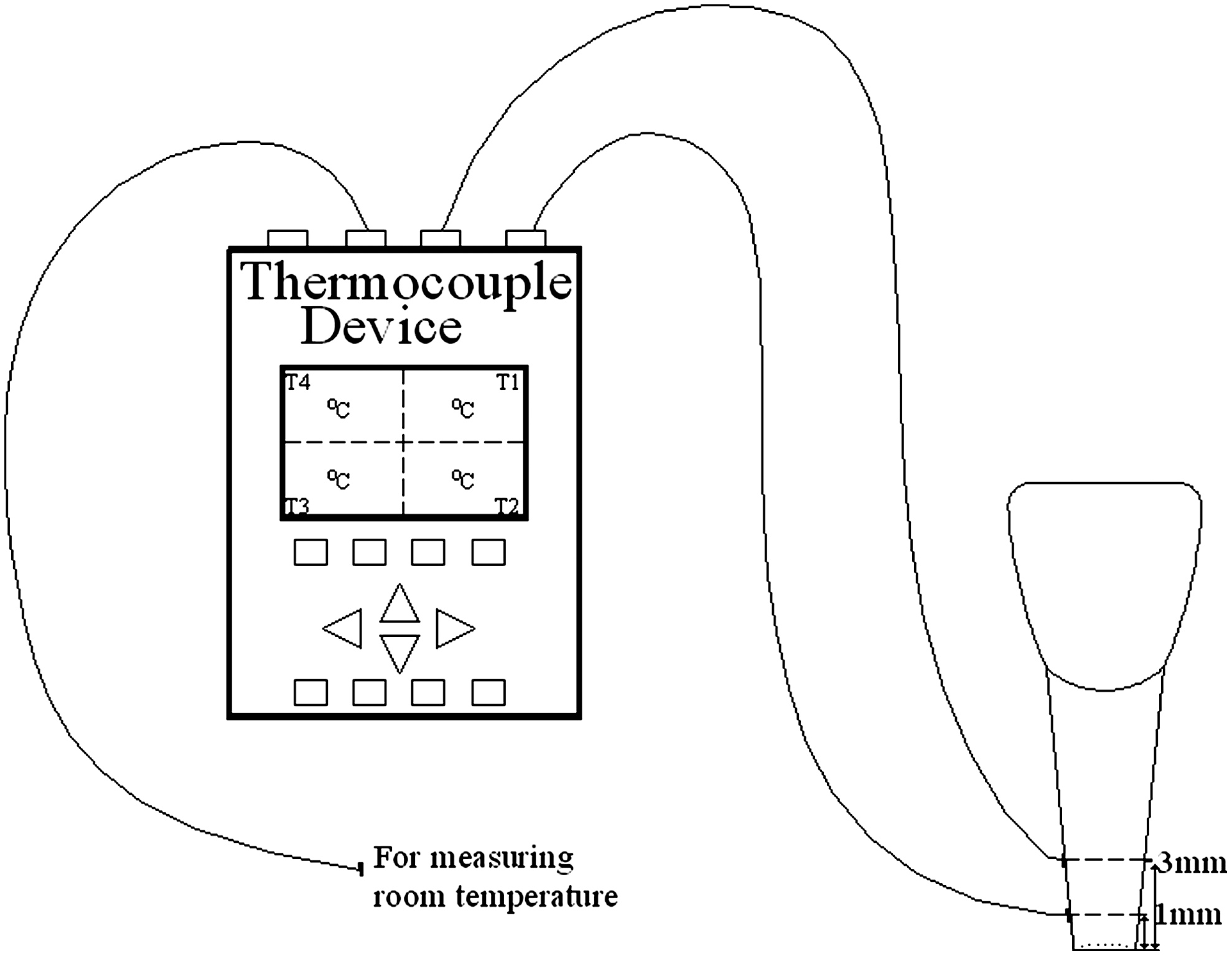
Schematic illustration of the reference points on the tooth of the thermocouple device.
Temperature values were recorded and stored in a personal computer, and data were analyzed using the General Linear models (GLM) procedure of the SPSS statistical software program (SPSS, 15.0 for Windows, Chicago, IL) using the following model: a completely randomized design (CRD); Ŷi=μ +αi+eij where, Ŷi, observation value (temperature, time); μ, means of values; αI:,the effect of techniques (the tungsten bur, surgical saw and Er:YAG laser with three different pulse durations); eij, residual error. Means were separated by using Tukey multiple comparison. The α level was set a priori at 0.05.
Results
Table 1 shows the mean values of temperature changes at 1 and 3 mm away to the cutting site of teeth for five different groups. Although there was no statistically significant difference among groups at 1 mm (p>0.05), there was statistically significant difference among groups at 3 mm away (p<0.05). The surgical saw showed the highest mean temperature, whereas the laser irradiation with pulse duration 50 μs produced the least mean temperature.
Different superscript letters in each column represent significant differences (p<0.05).
Table 2 shows the total time required for apicectomy for each group. There was statistically significant difference among groups (p<0.05). Using surgical saw and mechanical bur required less time to complete apicectomy, whereas laser irradiation required a longer time. Laser irradiation with pulse duration 300 μs required the longest time to complete the apicectomy procedure.
Different superscript letters in each column represent significant differences (p<0.05).
Discussion
This study aimed to determine and compare the temperature changes at resected root surfaces using Er:YAG laser with three different pulse durations, tungsten bur, and surgical saw. In many studies, the temperature variations in different parts of the tooth using different methods are studied. As there are no known studies comparing the temperature variation using Er:YAG laser with three different pulse durations for the apicectomy process, direct comparisons with the current study are not possible.
In the present study, the apical 3 mm of each root were resected perpendicular to the root long axis similar to in previous studies. 3,10 –13 Apicectomies were generally performed at 90 degrees and at 3 mm from the apical end because such angle and distance result in less microleakage than when apical resection is beveled. 11,13,14
Numerous techniques and instruments have been evaluated to find the ideal approach in endodontic surgery. 15 The bur has been one of the most employed methods. Camargo Villela Berbert et al. 10 comparing different burs, found that the carbide burs produced smoother and more regular root-end surfaces than the plain fissure. However, Nedderman et al. 16 found better results with a plain fissure bur. Camargo Villela Berbert et al. 10 evaluated the differences in root-end resection using a laser, ultrasound, and high-speed bur and found that the bur performed apicectomies faster, with better surface finishing. In the present study, when compared with the low-speed tungsten bur and surgical saw, apicectomy took longer using laser irradiation, similar to in previous studies. 3 –5 For laser application, laser irradiation with pulse duration 300 μs took the longest time, whereas laser with pulse duration 50 μs required the shortest time to complete the apicectomy procedure.
Most laser irradiation, and also the use of a dental handpiece, may generate heat that may affect the surrounding tissues of the root; therefore, a safety threshold temperature level should be maintained to avoid tissue injury. 17 The threshold temperature rise of 7°C on root surface was commonly considered to be the highest temperature limit biologically acceptable to avoid periodontal damage. 17,18 The severity of hard and soft tissue damage is determined by the quantity of heat generated and the time that it persists in the region. 6,19 Water spray cooling is essential to reduce temperature effects in both laser and standard dental bur drilling of hard tissue. 17 The presence of water flow during resection of a tooth produced a marked reduction in charring of the cut surfaces. 1 Theodoro et al. 20 compared the effects of Er:YAG and diode laser irradiation on the root surface and showed that the temperature decreased when the Er:YAG laser irradiation was combined with water cooling. In the present study, all apicectomy processes were made under sufficient water flow.
CO2 laser application showed that even low laser energy in endodontic therapy might damage the external root cementum surfaces because of high temperature rises. 21 Nammour et al. 17 evaluated the external temperature using the KTP-Nd:YAG laser irradiation in root canals and showed that it might be considered harmless for periodontal tissues. Komori et al. 2 compared three different laser and mechanical drill procedures for root resection and reported that Er:YAG laser irradiation produced the least thermal damage of the three laser types. CO2 laser irradiation produced the most severe thermal damage and the degree of thermal damage produced by Ho:YAG laser irradiation was less than that of CO2 laser. 2 Armengol et al., 8 comparing temperature increases during dentin ablation performed with an Er:YAG laser, Nd:YAP laser, or a high-speed handpiece, showed that the temperature response to the Er:YAG laser and the handpiece seemed to be similar, although the temperature response to the Nd:YAP laser was too great. 8 Therefore, the Er:YAG laser could replace the handpiece for safe removal of dental hard tissue, and the use of water spray was essential. 20 In the present study, because of the positive results in previous studies, the Er:YAG laser irradiation was used for apicectomy. Results showed that the thermal increase during apicectomy using three different pulse durations could not be said to cause irreversible tissue damage.
The time required to cut through the same amount of dentine decreases proportionally with the greater energy that the laser delivers. 4 Grgurevic et al. 4 evaluated the efficacy of the VSP Er:YAG laser for apicectomy with different pulse width/energy/frequency combinations, and found that shortening the pulse duration increased the performance by ∼10%, but that very short pulses by themselves were not enough to make a major change. Super short pulses are ideal for precise ablation of hard tissues; very long pulses are for soft tissue procedures. 22 In the present study, the laser irradiation with pulse duration 50 μs induced the lowest mean temperature. At high energies and low pulse durations, the speed of ablation is faster than the rate of diffusion of heat into the tissue. With decreasing energies and/or longer pulse durations, thermal effects become more pronounced. 22
Conclusions
In conclusion, the laser irradiation with pulse duration 50μs seems to have the lowest temperature rise and the shortest time required for apicectomy of the three pulse durations. However, Er:YAG laser for apicectomy in all pulse durations could be used safely for resection in endodontics in the presence of sufficient water.
Footnotes
Author Disclosure Statement
No conflicting financial interests exist.