




Abstract
Introduction
Case Reports
Case 1
A 38-year-old female patient who was self-conscious about the appearance of her teeth and with a chief complaint of “desire to improve esthetics,” presented to our clinic (Fig. 1).
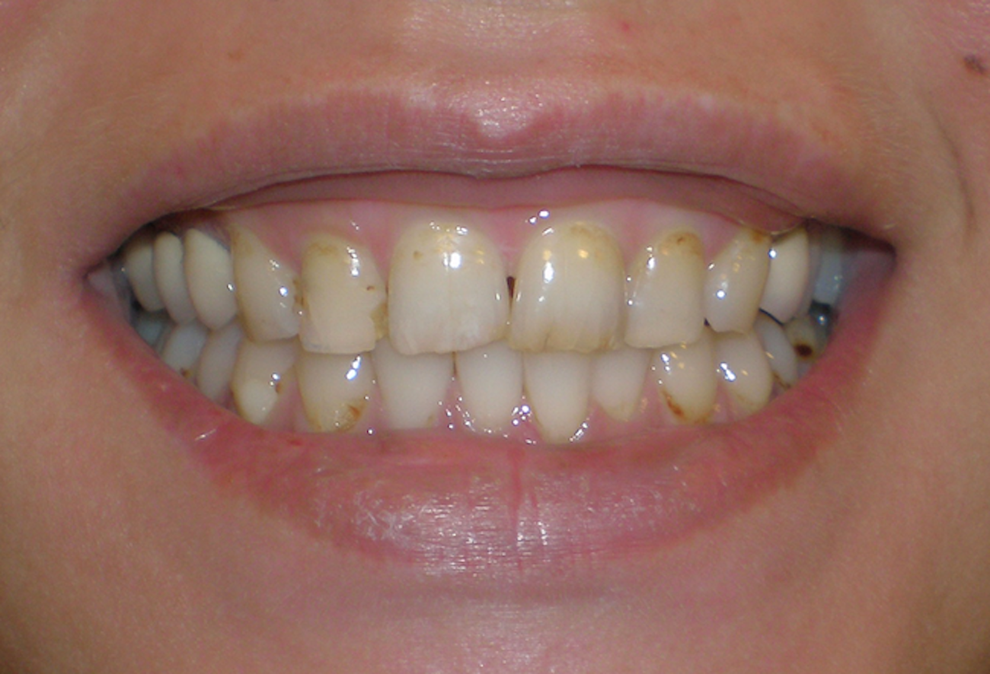
Initial view of the patient.
A treatment plan was developed with the aims of improving the patient's appearance with porcelain laminate veneers between the teeth numbered 13 and 23.The patient was informed of the diagnosis and treatment plan, which she accepted. Restorative procedures were completed by laminate veneer applications (pressable ceramic, IPS Empress Esthetic, Ivoclar, Vivadent, Liechtenstein). Three months after the completion of the laminate veneers, the patient returned to our clinic with the right central incisor's laminate veneer fractured. She indicated that she had been chewing an olive seed accidentally. The laminate veneer was removed with Er:YAG laser (Versawave®, Hoya Con Bio, Fremont, CA, 20 Hz, 320 mJ, under water irrigation, for 9 sec) and the chisel-type tip was selected (1.2×0.4 mm, rectangular shape) according to the procedure that was described by Oztoprak et al. (Fig. 2). Impressions were taken after removing the laminate. The new restoration was fabricated and cemented as previously performed (luting cement: Variolink Veneer, Ivoclar Vivadent, Liechtenstein) (Fig. 3). Occlusion and articulation were carefully checked. The patient was satisfied with the aesthetics and function of the restoration. The patient was recalled at 6-month intervals for the reinforcement of oral hygiene and function of the restoration. The laminate veneer restorations have been functioning satisfactorily for 3 years.
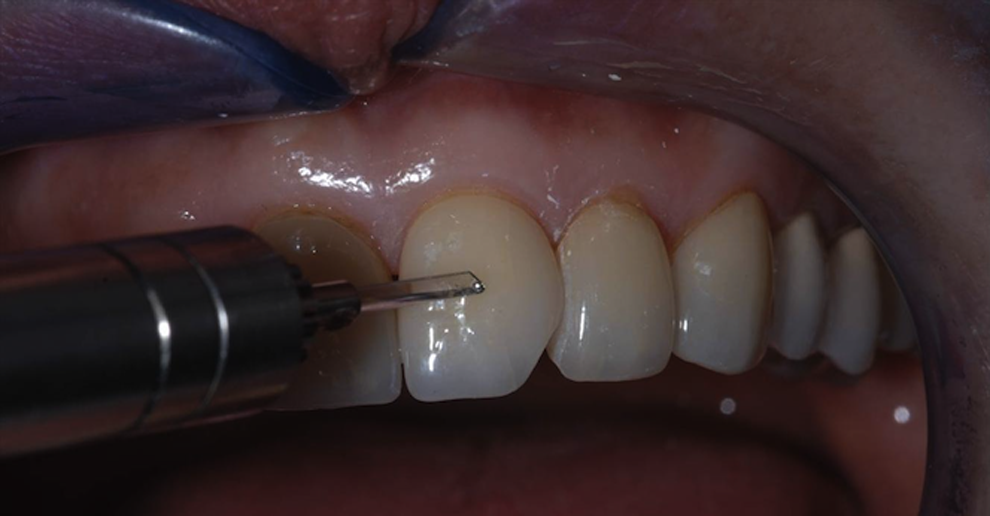
Removal of fractured laminate with Er:YAG laser.
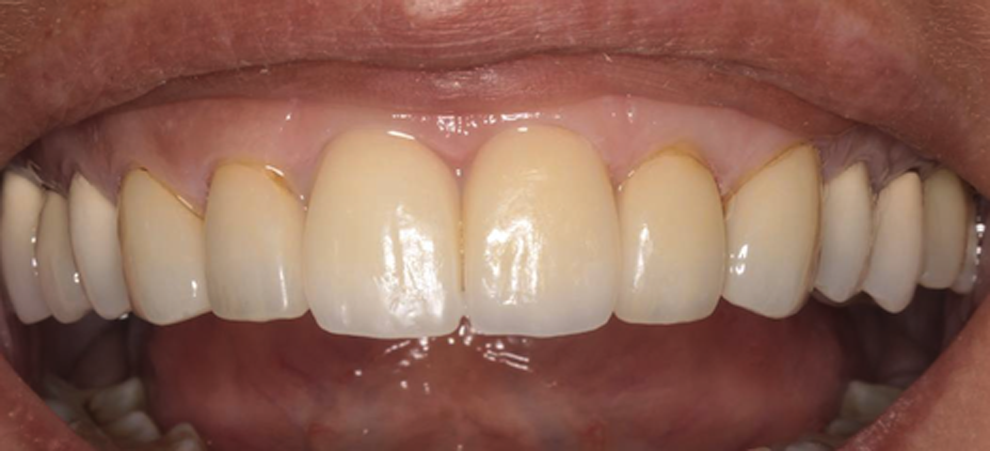
Reconstruction of fractured laminate veneer.
Case 2
A 66-year-old male patient presented to our clinic with aesthetic concerns. The patient's complaint basically concentrated on the shortness of the clinical crowns (Fig. 4).
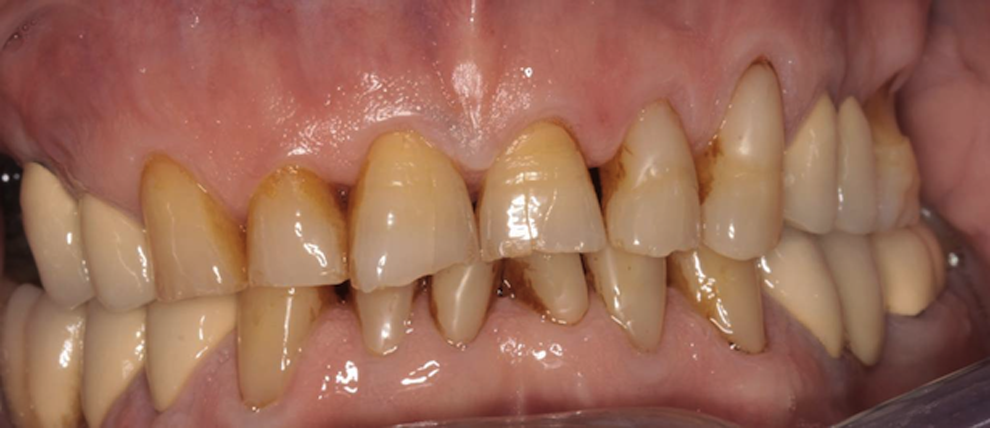
Intra-oral initial view of the patient.
He was not aware that he had a bruxism problem. Laminate veneers were prepared and cemented (pressable ceramic; IPS Empress Esthetic, luting cement; Variolink Veneer, Ivoclar Vivadent, Liechtenstein) on the condition that he would use a stabilization splint while asleep. However, the patient did not stay motivated and he quit using the splint. One month after quiting, the two laminate veneers were fractured (Fig. 5). The laminate veneers were removed with an Er:YAG laser as described previously, and the new restoration was fabricated and cemented (Fig. 6). The laminate veneer restorations have been functioning satisfactorily for 12 months.

Fractured laminate veneers.
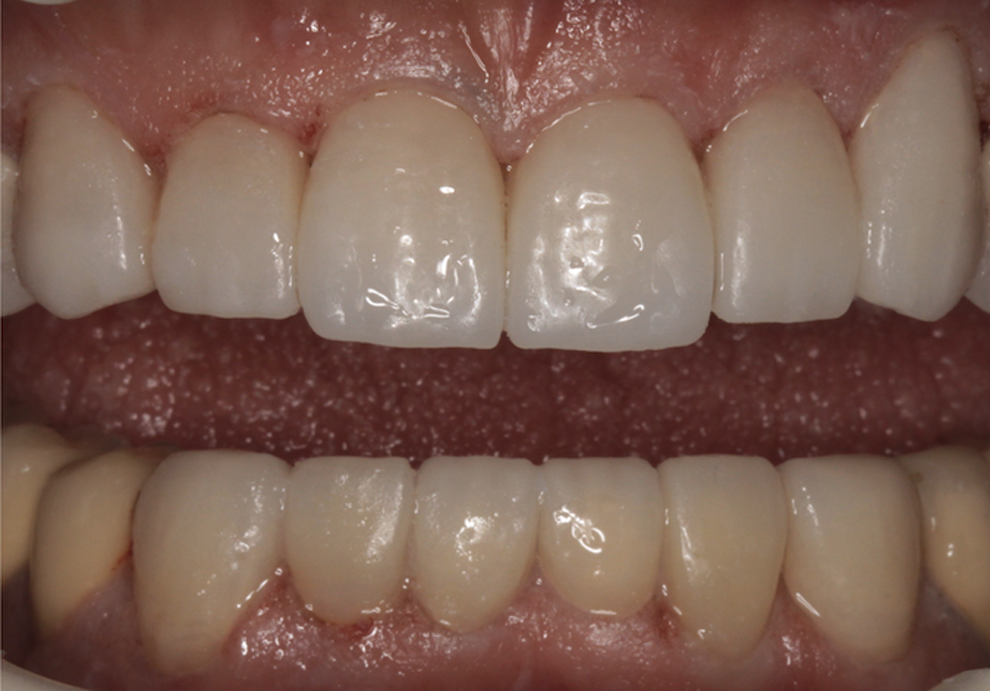
Reconstruction of new laminate veneers.
Discussion
The most conservative and common method for maintaining the aesthetic of the patient is using porcelain laminate veneers. 4,5 It is the one of the minimally invasive methods. 4 –6
There are a few ways to remove laminate veneers that are time consuming and need a high shearing force to debond. This is also a painful experience for the patient. 2 To the best of our knowledge, this is the only case report that shows the positive effect of laser application on debonding procedure for porcelain laminate veneers.
There are reports in the literature of many lasers having been tested for this purpose. Among these laser systems Er:YAG laser has gained attention because of its multiple advantages. The Er:YAG laser is well absorbed by all biological tissues and hard substances containing water. 7,8 The Er:YAG laser has a wavelength of 2940 nm, which coincides with the main absorption band of water. Because of its good absorption of water and OH groups in hydroxyapatite, this laser is useful in the removal of dental hard tissues. In the case of removal of dental hard tissue, the laser's energy is selectively absorbed by water molecules, which causes the evaporation of water. This results in an increase of the internal pressure within the tissue, causing an explosive expansion that produces alterations in the morphological characteristics of the enamel. 9,10 In cases of debonding, the Er:YAG laser light can be selectively absorbed by resin containing a readily vaporizable constituent such as water molecules or residual monomer. 11
Debonding mechanisms that cause the adhesive resin to degrade by laser energy was explained by Tocchio et al. 12 as thermal softening, thermal ablation, or photoablation. The Er:YAG laser debonding protocol with the scanning method used in the present study did not produce any explosive blowoffs that suggest photoablation or thermal ablation. Therefore, we preferred to remove the laminate veneers with a scanning method.
Various clinical studies have revealed that the survival rate for bonded porcelain laminate veneer restorations is >90% over 10 years of clinical service. 13 –15 In those studies, the failures reported were either cohesive ceramic fractures (the majority) or failures of the adhesive between the cement and the tooth surface. 13,14
According to Oztoprak et al., 3 9 sec of lasing appears to have the most favorable effect on debonding of porcelain laminate veneers without the intrapulpal temperature increasing. Therefore, we specifically paid attention not to exceed 9 sec during the irradiation of the fractured laminates.
Conclusions
These case reports have described the removal of restoration of the anterior teeth with fractured porcelain laminates with Er:YAG laser. The removal of porcelain laminates with Er:YAG laser could be a suitable alternative for fracture cases in routine clinical use.
Footnotes
Author Disclosure Statement
No competing financial interests exist.