




Abstract
Introduction
The Er:YAG laser is an effective device to prepare the cavity with ablation of the dental hard tissues that contain water and hydroxyapatite. One of the most important advantages of this laser system is the instantaneous evaporation of hard tissue during irradiation. The Er:YAG laser also incorporates water cooling, and thereby ablates the surrounding tissue with minimal thermal side effects. Additionally, the application of the Er:YAG laser was limited to rigid delivery systems in the noncontact mode. 3 –6
Dentin structures of primary teeth have some chemical and morphological differences compared with permanent teeth. Especially, primary teeth have fewer and smaller diameter dentinal tubules at a distance of 0.4–0.5 mm from the pulpal surface and the peritubular dentin is 2–5 times thicker than in permanent teeth. 7,8 Moreover, the concentrations of calcium and phosphorous in both the peritubular and intertubular dentin of primary teeth are lower than in permanent teeth. 9 Primary dentin also is softer because its degree of mineralization is lower than that in permanent dentin. 10 More importantly, dentists should consider atraumatic treatment approaches because of children's dental anxiety and fears. For these reasons, successful treatment of primary teeth requires serious attention and critical decisions.
According to Zach and Cohen, 11 a temperature rise of 5.5°C in the pulp is the greatest that the pulp can recover from. Some studies 6,12 have shown that the Er:YAG laser produced low thermal side effects in permanent teeth. Contente et al. 13 investigated temperature rise during Er:YAG cavity preparation of primary enamel. Although the increasing of temperature was directly related with the pulse repetition rate, there was no relation with energy density. Many studies emphasized that Er:YAG also has some thermal effects on the pulp. 14 –16 Another study showed morphological changes in dentin during Er:YAG laser irradiation. For example, laser irradiation without water cooling was sufficient to prompt melting, recrystallization of dentin crystals, melted dentin, and organic matrix vaporization. On the contrary, laser irradiation with water cooling cleaned ablated surfaces and exposed dentinal tubules. Therefore, water cooling is considerable for reducing the thermal effect of the Er:YAG laser. 17
Importantly, dental pulp may be damaged following the decrease of remaining dentin thicknesses during cavity preparation of primary teeth. Although minimally invasive cavity preparation may be performed with Er:YAG laser irradiation, this application can cause temperature rise. Recently, manufacturers of lasers distribute new-generation laser systems in which the pulse repetition rate is increased and the energy pulse is decreased in order to obtain cavities similar to cavities prepared by high-speed handpieces. In light of these new developments, the present study investigated the effects of the Er:YAG laser's different pulse repetition rates on temperature rise under various primary dentin thicknesses.
Materıals and Methods
Study design
In the present study, 90 primary mandibular second molars that were freshly extracted without caries and restorations, were used. Sex distribution was 60% male and 40% female. Additionally, the ages ranged from 11 to 12 years. Informed consent was obtained from the patients and their families before the study, and the study was approved by the Local Ethics Committee on Human Research of Cumhuriyet University (January 12, 2012). After having been cleaned of residues, the freshly extracted primary teeth were kept at +4°C in a 0.9% saline solution until the study began.
Preparation of dentin discs
At the beginning of the study, primary mandibular second molars were embedded in Teflon molds with epoxy resin. Then the teeth were sectioned perpendicular to the long axis with a water-cooled saw to produce discs of dentin (Isomet, Buehler Ltd., Lake Bluff, IL). Dentin discs of 1.5 and 2 mm thicknesses were sectioned from the dentin–enamel border up to the pulp chamber. Furthermore, dentin discs of 0.5 and 1 mm thicknesses were sectioned nearest to the roof of the pulp chamber. Diameters of dentin discs were standardized to 8 mm. Ten specimens were obtained for each dentin thickness and then included in the study.
Temperature test apparatus
The new apparatus was developed to standardize temperature measurements. It is composed of two-part Teflon mold cylinders constructed from polytetrafluoroethylene. On the upper part of the movable Teflon mold cylinder there was a central aperture (6 mm in diameter, 5 mm distance). The bottom part of the movable apparatus included spaces in which the dentin discs were placed. Four different movable Teflon mold cylinders were prepared for each dentin discs thickness (8 mm in diameter; 0.5, 1, 1.5, and 2 mm deep, respectively). A hole (1 mm in diameter) was drilled through the center of another Teflon mold cylinder to provide entrance for thermocouple wire (Fıg. 1.). Dentin disc was placed and fixed between two Teflon molds compatible with this disc. Through the central orifice of the Teflon mold cylinder, a thermocouple wire was fixed to beneath the center of the dentin discs. The laser irradiation was applied from the upper side of the apparatus.
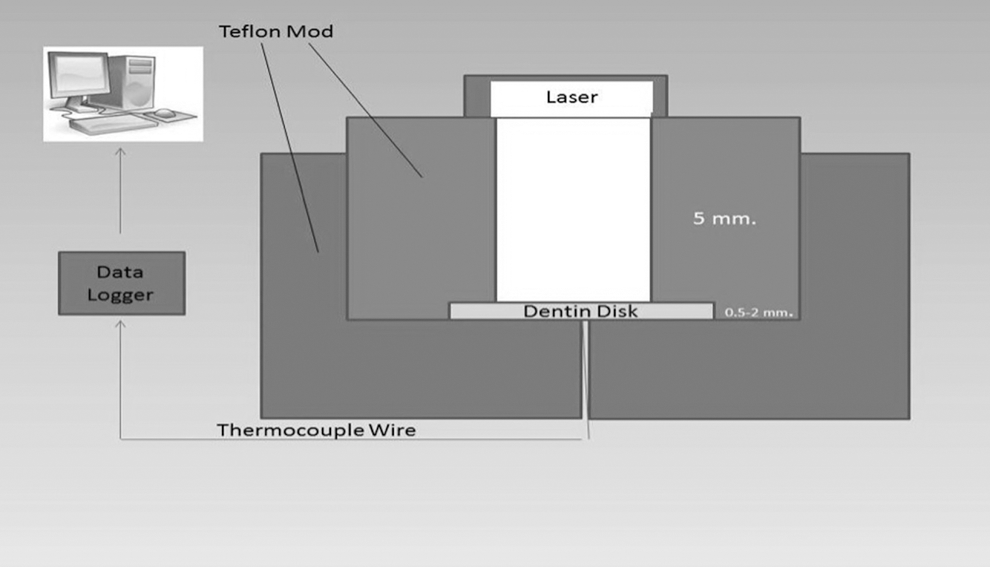
Apparatus for measuring temperature changes.
Laser irradiation
The dentin discs were irradiated with an Er:YAG laser device (Smart 2940D, DEKA M.E.L.A. SRL, Calenzano, Italy) emitting pulsed infrared radiation at a wavelength of 2940 nm. Er:YAG laser beam is delivered through an articulated arm. At the end of the articulated arm on the Smart 2940D system, there was a handpiece that was used in the noncontact (window) tip. Laser irradiation was applied perpendicularly in focus ∼5 mm from the window of the handpiece to a single point resulting in a 0.7854 mm2 circular beam spot on a 6 mm diameter dentin area for 30 sec irradiation. The power densities ranged from 127.3 to 254.7 W/cm2; the pulsation frequencies ranged from 10 to 20 Hz, with an energy density of 12.7 J/cm2 and pulse duration of 230 μs. All dentin discs were irradiated in a sweeping fashion with a water flow of 5 mL/min in accordance with the device manufacturer's recommendations.
Temperature measurement
Thermal emission during laser irradiation was measured by a type L thermocouple (Fe-Const. Elimko Co., Turkey) connected to data logger (E-680, Elimko Co., Turkey). The E-680 series of universal data loggers/scanners has important advantages such as 32 channel digital data recording and enhanced distortion of the calibration caused by external factors. These new generation microcontroller-based industrial instruments are compatible with IEC 668 standards. Data were collected and stored in a centrally located PC using software (Data Logger, version 5.1, Elimko Co., Turkey). The ambient temperature and relative humidity were measured (20±0.1°C, 50–60% humidity) by Digital Hygro Thermometer (ATM 9226, Novasina, Switzerland). During the measurements, the initial temperature was recorded after temperature stabilization and the temperature peak was registered. The initial temperature was deducted from the final one to obtain the temperature variation. All measurements were performed by another researcher.
Statistical analysis
The temperature variation data were analyzed using an SPSS statistical software program (version 14.0, SPSS Inc., Chicago, IL). A two-way ANOVA was applied to compare temperature rises among the different thicknesses of primary dentin. Where significant differences were present, a Tukey post-hoc test was applied to examine pairwise differences at a significance level of 0.05.
Results
The means of temperature rises, observed with the specimens of each primary dentin thickness, are presented in Table 1. The peak values, registered during laser irradiation of all specimens, were lower than the previously reported critical value of 5.5°C. The two-way ANOVA revealed significant temperature rise differences among the specimens tested (F=153.75) (p=0.000). As a result of the present study, whereas the lowest temperature rise (0.44±0.09°C) was measured from a 10 Hz (127.3 W/cm2) pulse repetition rate at a dentin thickness of 2 mm, the highest temperature rise (3.86±0.43°C) was measured from a 20 Hz (254.7 W/cm2) pulse repetition rate at a 0.5 mm dentin thickness. These results showed an exactly inverse proportional relationship between dentin disc thicknesses and temperature rises. Statistically significant differences were found among the three different parameters of the Er:YAG laser (p<0.05). Additionally, statistically significant differences were found among the dentin thicknesses. These differences are presented in Table 1.
By two way ANOVA: F=153.75 P=0.000, p<0.05.
The comparisons among different dentin thicknesses are shown in horizontal rows.
The comparisons among different laser watts are shown in vertical columns, respectively. Values with same superscript letter are statistically different at p<0.05 by Tukey's test.
PRR, pulse repetition rate; n=10 specimens per experimental condition; standard deviations are shown in parentheses.
Discussion
The present study investigated the effects of the Er:YAG laser's different pulse repetition rates on temperature rise under various primary dentin thicknesses. We especially aimed to gain a better understanding about the responsibility of dentin thicknesses on pulpal damage during laser irradiation. Er:YAG laser irradiation was affected by various remarkable factors that play an important role in temperature changes. Some of these factors include pulse repetition rate, energy density, power density, water cooling, and the type of the Er:YAG laser. 14,15,18 –20 Er:YAG laser irradiation with water cooling is one of the crucial factors. This factor was evaluated in a study that emphasized the importance of Er:YAG laser irradiation with or without water cooling. Consequently, the temperature changes were ranged from 0.03 to 2.5°C following the the Er:YAG laser irradiation with water cooling. Furthermore, irradiation of the Er:YAG laser without water cooling caused dark lesions, suggesting carbonization of the tissue. 21 Another study explored the effect on the temperature changes of using or not using postirradiation water spray after Er:YAG laser irradiation. The addition of water spray for 1 or 2 sec caused lower intrapulpal temperature rises than no application of postirradiation water spray, which possibly leads to thermal damage of the dental pulp tissue. 22 In light of the results obtained from the abovementioned studies, 21,22 we used the Er:YAG laser with water cooling.
Zach and Cohen 11 reported 5.5°C to be the threshold temperature rise that permitted the pulp to recover from thermal damage. In another study, Keller and Hibst 6 investigated the efficacy of appropriate Er:YAG laser parameters on pulp damage. They found that pulp did not lose its vitality after Er:YAG laser irradiation for 3.3 min. Castilho et al. 12 evaluated the temperature changes in pulp chambers of deciduous molars during cavity preparation with an Er:YAG laser for 30 and 60 sec. As a result, the highest temperature rise (4.01°C) was observed from 60 sec of Er:YAG laser irradiation. In present study, we evaluated the temperature changes that occurred under the four different dentin thicknesses (0.5, 1, 1.5, and 2 mm) of primary teeth during the application of various Er:YAG laser pulse repetition rates. We used three frequencies (10, 15, and 20 Hz) and a standardized energy density (12.7 J/cm2). The laser irradiation was applied without contact (a distance of 5 mm) and in focused mode for 30 sec. Consequently, whereas the lowest temperature rise of 0.44°C was measured from a 10 Hz pulse repetition rate at a dentin thickness of 2 mm, the highest temperature rise of 3.86°C was measured from a 20 Hz pulse repetition rate at the 0.5 mm dentin thickness (Table 1). The peak values, measured during laser irradiation of all specimens, were lower than the critical value of 5.5°C mentioned in previous studies. 6,11,12
Promklay et al. 23 investigated the response to Er:YAG irradiation of primary human dental pulp cells lying on a thin dentin disc. Different parameters of the Er:YAG laser were used to ablate the non-cell surface of the dentin disc for 10 sec with water cooling. The low-energy Er:YAG laser did not cause harmfull effect to pulp cells of dentin, whereas the high-energy Er:YAG laser (500 mJ) led to partial damage to the cells. After considering the result of the study, 23 we standardized lower pulse energy at 100 mJ (12.7 J/cm2) for all parameters of the Er:YAG laser.
Krmek et al. 24 examined the temperature changes in the pulp chamber of the human molar during cavity preparation with the Er:YAG laser. The dentin was irradiated with different pulse repetition rates and pulse energy levels for 7 sec. Although the highest temperature rise was achieved with 3.4 W of power output (10 Hz/340 mJ), the lowest was found with 1 W of power output (5 Hz/200 mJ). In a different study, Contente et al. 13 investigated in vitro thermal events that occurred during Er:YAG laser cavity preparation of primary enamel at different energies and pulse repetition rates. The temperature rises that were above the critical value (5.5°C), were observed from the parameters of 2.5 W (10 Hz/250 mJ) 8.97°C, and 3.25 W (15 Hz/250mJ) 8.95°C with a water flow of 1.5 mL/min under 2 mm of dentin thickness. Conversely, we reached lower temperatures than the critical value (5.5°C) because we chose lower power density (2 W) and higher water flow rates (5 mL/min) than Contente et al. 13 and Krmek et al. 24 chose.
Brandāo et al. 25 explained the ināuence of the Er:YAG laser pulse repetition rate on the thermal effects occurring during laser ablation on standardized 2 mm thicknesses of sound and demineralized primary dentin. They used three frequencies (4, 6, and 10 Hz) and standardized pulse energy (250 mJ). The laser irradiation was applied without contact (a distance of 12 mm) and in focused mode for 15 sec. The maximum temperature rise was obtained from 10 Hz in sound and demineralized dentin. The temperature rise did not reach 1.0°C.
Raucci-Neto et al. 26 explored the effects of the Er:YAG laser pulse repetition rate (4, 6, and 10 Hz) on standardized 2 mm thicknesses of sound and carious human dentin. Other parameters of the study included a standardized pulse energy (200 mJ), no contact (a distance of 12 mm), and focused mode for 20 sec. Pulse repetition rates were found directly proportional to temperature rises. The highest temperature rise was shown in a 10 Hz repetition rate. Additionally, under sound and carious dentin, temperature rises were observed as 2.08°C and 2.38°C, respectively.
Although in the present study we used higher repetition rates and lower energy density than in the abovementioned studies, 25,26 temperature rises in the current study were similar to the rises in other studies 25,26 under a 2 mm dentin thickness. Additionally, the relation between pulse repetition rates and temperature rises were evaluated under different dentin thicknesses. As a result, the pulse repetition rate was directly proportional to temperature rises that were lower than the critical threshold value under all dentin thicknesses. In addition to that, the temperature values were measured directly and considered as the temperature changes during in situ application of the Er:YAG laser on surfaces of teeth in vitro, because of the absence of blood circulation and heat conduction.
In pediatric dentistry, we think that the Er:YAG laser is a reliable tool, because it has a low effect on the pulpa of child patients when it is used within suitable parameters in cavity preparation of primary teeth. More comprehensive in vitro studies are needed to arrive at definite results.
Conclusions
On the essential theme of this study, it is concluded that high pulse repetition rate and low energy density of the Er:YAG laser may be recommended with a high water flow rate and without the threshold critical temperature under primary dentin.
Footnotes
Author Disclosure Statement
No competing financial interests exist.