




Abstract
Introduction
For decades, people have relied on time-tested antibiotics to overcome bacterial infections. With MRSA infection, common antibiotics, such as penicillin, are virtually ineffectual, as the bacterium has developed a repertoire of evasive mechanisms to resist the drug. This observation prompted the development of synthetic antibiotics, such as methicillin. However, at present, <5% of staphylococci strains remain susceptible to penicillin, and it is estimated that 40–50% of S. aureus isolates are now resistant to methicillin, a problem that continues to worsen with uncontrolled use of antibiotics. 11,12 Recently developed antibiotics, such as vancomycin, which were once effective in treating MRSA, are now being resisted by the bacterium. As MRSA infection continues to defy antibiotic therapy, the situation calls for alternative measures to stem outbreaks and the tide of antibiotic resistance.
Phototherapy and photodynamic therapy (PDT) appear to be viable alternatives to antibiotic treatment; particularly in cases of topical infection with MRSA. More than 100 years ago, it was observed that certain microorganisms were killed in vitro when exposed to a combination of harmless dyes and visible light. 13 Since then, PDT has been studied extensively and shown to be beneficial in treating ophthalmological and dermatological disorders, as well as cancer and other diseases. Although there have been significant improvements in developing targeted photosensitizers and matching specific wavelengths of light with each photosensitizer and disease, serious side effects have been reported. 14
We showed in previous studies that 405 or 470 nm blue light, emitted by commonly available light-emitting diodes (LEDs), photo-destroys MRSA without the need for photosensitizers. 15,16 Our data showed that as much as 94% of a standard 5×10⁶ colony-forming units (CFU)/mL culture can be eradicated in vitro with a single dose of either wavelength. This finding, which is supported by reports from other laboratories showing that blue light in the range of 400–420 nm kills MRSA, 17 suggests that blue light phototherapy may be a viable alternative to antibiotic treatment of MRSA infections. Furthermore, light, in the range of 400–470 nm wavelength, has been shown to kill other types of bacteria, including Propionibacterium acnes, Pseudomonas aeruginosa, Porphyromonas gingivalis and Helicobacter pylori. 18 –23
To advance our line of work, we tested the effect of 405 and 470 nm light on MRSA cultured at various densities. As one shot irradiation of a standard 5×10⁶ CFU/mL culture eradicated almost 94% of the colonies, we were interested in elucidating the potential effect of bacterial density on the photo-eradicating effect of blue light. The present study addresses three basic research questions. (1) Does bacterial density affect MRSA eradication by blue light? (2) Do 405 and 470 nm light have the same effect on MRSA cultures of different densities? This question arose because we showed in previous studies that both wavelengths have commensurate effect on the standard culture. (3) Is the effect of blue light limited by beam penetration?
Materials and Methods
Bacterial culture
US300 CA-MRSA strain was obtained from American Type Culture Collection (ATCC® BAA-1680), Manassas, VA). The strain was identified by standard identification procedures, including Gram's staining, hemolytic patterns seen on blood agar, catalase and coagulase production, and polymerase chain reaction (PCR). As detailed in our previous reports, 15 bacteria cultures were separately diluted to cell counts of 3×10⁶, 5×10⁶, 7×10⁶, 8×10⁶, and 12×106 CFU/mL, in 0.9% normal saline, to mimic mild, regular, and heavy MRSA infections. Then bacteria were volumetrically streaked onto round 5.0 cm2 Petri dishes with tryptic soy agar (TSA) before being irradiated with 405 or 470 nm light. Irradiated cultures were then incubated at 35°C for 24 h. Control non-irradiated bacteria cultures were similarly incubated for comparison.
Photo-irradiation
A Dynatron Solaris® 708 device (Dynatronics Corp., Salt Lake City, UT) fitted with a 405 or 470 nm light probe was used to irradiate the bacteria. The 5.0 cm2 applicator, with its cluster of 36 LEDs, emits blue light with a spectral width of 390–420 nm, 405 nm peak emission (Fig. 1), and has a rating of 500 mW average power and 100 mWcm–2 irradiance. The power emitted by this probe at a distance of 0.3–0.5 cm from the culture Petri dishes was 180 mW, with a total of 99 mW absorbed within the culture. The second 5.0 cm2 applicator, interchangeable with the 405 nm probe, has a cluster of 32 LEDs emitting 470 nm light with a spectral width of 455–485 nm (Fig. 1), and has a rating of 150 mW average power and 30 mWcm2 irradiance. Similarly, we verified that the power emitted at a distance of 0.3–0.5 cm from the culture was 25 mW, with 18 mW absorbed within the culture. By design, each applicator is cooled with a built-in fan, to minimize thermal radiation by the applicator. In preliminary studies, we confirmed that neither applicator generated any measurable temperature rise within the range of fluences used in this study.

Spectral width of the 405 nm and the 470 nm light-emitting diode (LED) light sources.
To ensure even irradiation of each plate, we used 5.0 cm2 Petri dishes, which were the same size as the surface area of the applicator. Each applicator was clamped at a distance of 1–2 mm perpendicularly above each open plate. As doses were selected, the treatment time was automatically computed by the Solaris® device; thus ensuring dose precision. For example, to attain a fluence of 3 J/cm2 with either probe, the device computed 30 sec (0.5 min) of irradiation, and the device automatically shut off beam emission after 30 sec had elapsed.
Research design
We conducted three series of experiments as follows. In the first series, we irradiated 3×10⁶ and 5×10⁶ CFU/mL of the bacteria at 0, 1, 3, 45, 50, 55, or 60 J/cm2, before incubation. These fluences were selected based on our previous experiments with photo-eradication of MRSA with blue light. 15,16 This series of experiments confirmed our previous finding that the higher fluences were necessary to observe appreciable bacterial eradication. Consequently, in this series, we used only 0, 45, 50, 55, or 60 J/cm2 fluence to irradiate a denser amount of bacteria, 7×10⁶ CFU/mL, before incubation. As 100% bacterial eradication was not achieved at any fluence in this series, and, in particular, because the photo-eradicating effect of 45, 50, 55, or 60 J/cm2 fluence on the 7×10⁶ CFU/mL culture was significantly limited, in a second series of experiments, we used higher fluences, 110 and 220 J/cm2, to irradiate denser cultures.
Prompted by the observation that the photo-eradicating effect of blue light seemed to be limited by the capacity of light to penetrate denser layers of bacteria, we conducted a third series of experiments. In this series, we irradiated a denser 8×10⁶ and 12×106 CFU/mL CA-MRSA culture with 110 and 220 J/cm2, respectively; but with 50% of each fluence, that is, 55 and 110 J/cm2, respectively, applied perpendicularly from above the culture plate as previously described, and the other 50% from directly below the culture plate.
In each series of experiments, irradiation of each bacterial culture at each fluence was repeated three times in separate Petri dishes with separate bacterial cultures, to foster accuracy, and bacterial colonies were counted and compared following 24 h incubation.
Quantification of bacterial colonies and data analysis
Standardized digital images of the bacterial colonies were taken, scanned into the computer, and quantified with Sigma Scan® Pro 5 software (Systat Software, Inc., Point Richmond, CA). The colony counts were thus automatically computed and subjected to statistical analysis. Descriptive data were generated, then repeated measures analysis of variance (RM-ANOVA) was performed with SPSS Version 18 statistical software (SPSS Inc., Chicago, IL) to test the null hypotheses: (1) irradiation of MRSA colonies with 405 and 470 nm blue light were not density dependent, and (2) the difference in wavelength between 405 and 470 nm beams does not affect the bactericidal effect produced in various densities of MRSA. Greenhouse Geisser statistical adjustments were made as necessary to account for violations of sphericity of data.
Results
Regardless of bacterial density, irradiation with either wavelength produced a statistically significant (p<0.001) dose-dependent reduction in the number of bacterial colonies when compared with controls. The effect was non-linear (Figs. 2 –4).
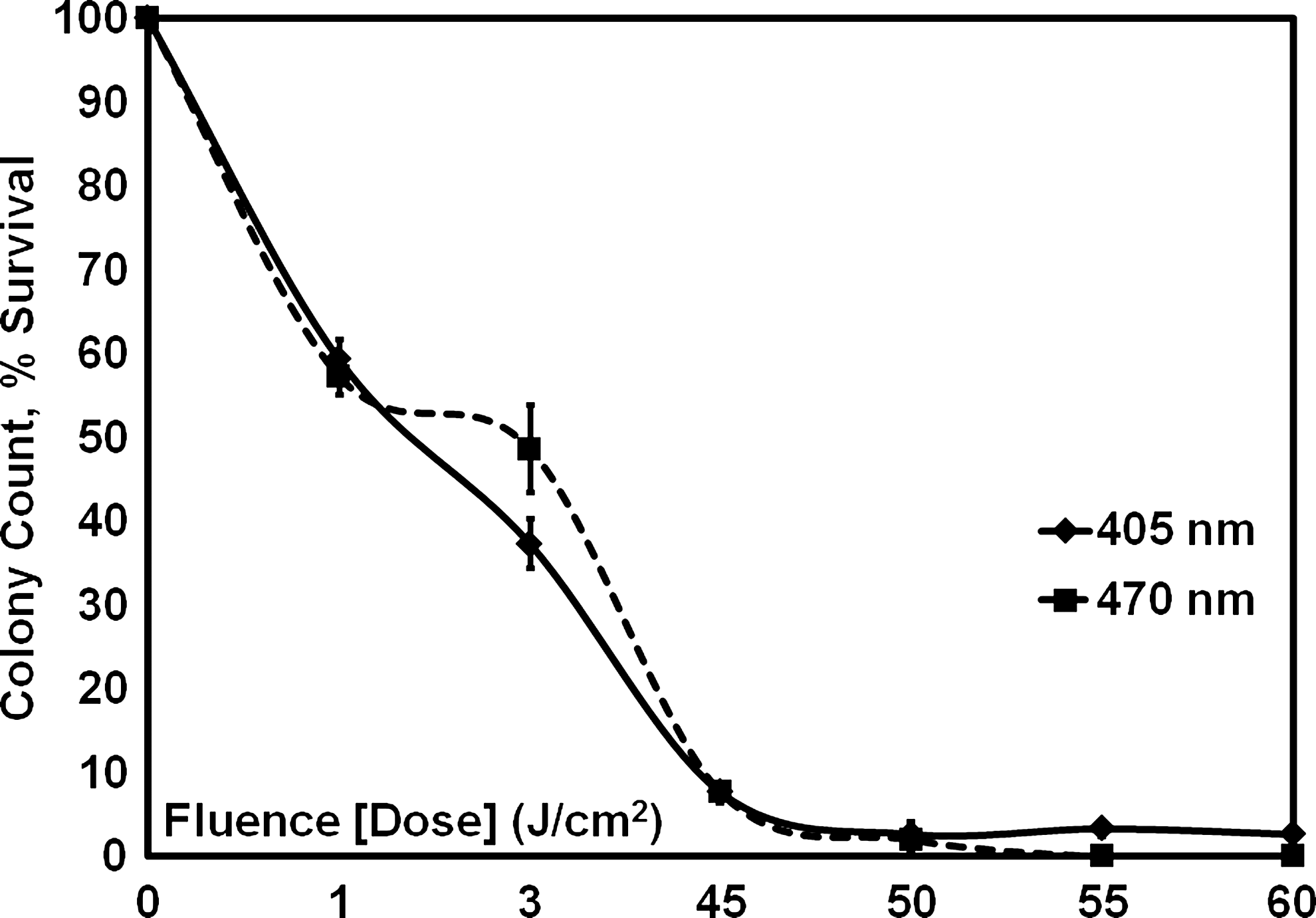
Effect of 405 and 470 nm light on 3×10⁶ colony-forming units (CFU)/mL US300 methicillin-resistant Staphylococcus aureus
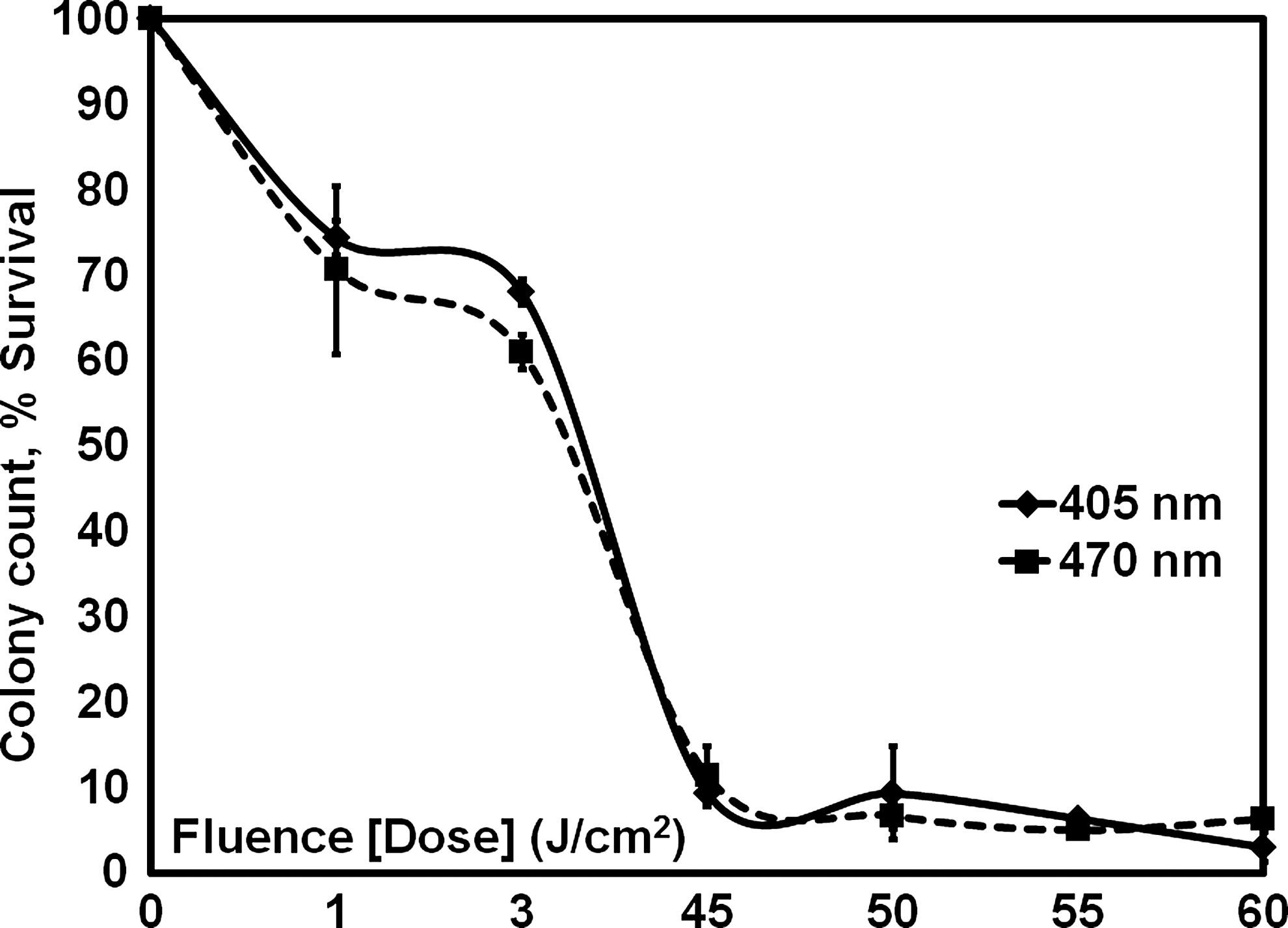
Effect of 405 and 470 nm light on 5×10⁶ colony-forming units (CFU)/mL US300 methicillin-resistant Staphylococcus aureus

Effect of 405 and 470 nm Light on 7×10⁶ colony-forming units (CFU)/mL US300 methicillin-resistant Staphylococcus aureus
Bactericidal effect of 405 and 470 nm blue light on 3×10⁶ CFU/mL of MRSA
In this series of experiments, each treated bacterial culture had significantly fewer bacterial colonies than non-irradiated cultures, regardless of the wavelength used {RM-ANOVA [F(6,24)=545.476, p<0.001,
Bactericidal effect of 405 and 470 nm blue light on 5×10⁶ CFU/mL of MRSA
Consistent with our previous reports,
15,16
irradiation of 5×10⁶ CFU/mL culture with either 405 or 470 nm light resulted in significant bacterial eradication at each fluence when compared with controls (0 fluence) [RM-ANOVA: F(6,24)=456.827, p<0.001,
Compared with the 3×10⁶ CFU/mL culture, a lesser proportion of bacterial colonies were killed in the denser 5×10⁶ CFU/mL culture, and at no fluence was 100% bacterial clearance achieved in this series. However, the maximum amount of bacterial colonies cleared, 94% of 5×10⁶ CFU/mL, which amounts to 4.7×10⁶ CFU/mL, is higher than the 3×10⁶ CFU/mL (100%) cleared in the sparser 3×10⁶ CFU/mL culture. There were no statistically significant differences in bacteria clearance between 405 and 470 nm wavelengths at each fluence.
Bactericidal effect of 405 and 470 nm blue light on 7×10⁶ CFU/mL of MRSA
A maximum of 78% and 74% of bacteria were killed in plates inoculated with 7×10⁶ CFU/mL, using 405 nm light at 55 and 60 J/cm2 fluences, respectively. At the same respective fluences, maximum bacteria clearance was 68% and 67% when cultures were irradiated with 470 nm light (Fig. 4). In general, the higher the fluence, the more bacterial colonies were eradicated. A lesser proportion of bacterial colonies were eradicated in this high density culture than in the 3×10⁶ or the 5×10⁶ CFU/mL culture; however, the maximum amount of bacteria colonies cleared, 78% of 7×10⁶ CFU/mL, which amounts to 5.46×10⁶ CFU/mL, was higher than the 3×10⁶ CFU/mL cleared in the sparser 3×10⁶ CFU/mL culture, as well as the 4.7×10⁶ CFU/mL cleared in the 5×10⁶ CFU/mL culture.
Comparison of the bactericidal effect of 405 and 470 nm light on MRSA density at specific fluences
Irradiation of the 3×10⁶ or the 5×10⁶ CFU/mL culture did not reveal significant differences in the bacteria eradication capacity of either wavelength. However, as shown in Table 1 and Fig. 4, in the denser 7×10⁶ CFU/mL culture, 405 nm light cleared more bacteria at each fluence than 470 nm light (p<0.05).
The results represent mean difference±SEM (n=3). The p values were obtained following repeated measures ANOVA followed by least significant difference (LSD) post-hoc tests. *Signifies significant difference, p<0.05.
a, wavelength 405 nm; b, wavelength 470 nm.
MRSA, methicillin-resistant Staphylococcus aureus; CFU, colony-forming units.
There were no statistically significant differences in the bactericidal effect of 405 nm light on the 3×10⁶ and 5×10⁶ CFU/mL cultures at any of the fluences tested. However, the bactericidal effect of 470 nm light on both cultures differed significantly (p<0.05); (Tables 2 and 3). Moreover, each wavelength had statistically differing bactericidal effect on the 5×10⁶ CFU/mL culture compared with the 7×10⁶ CFU/mL culture.
Density pairs are: 3×10⁶ and 5×10⁶ CFU/mL; 3×10⁶ and 7×10⁶ CFU/mL; 5×10⁶, and 7×10⁶ CFU/mL. The results represent mean difference±SEM (n=3) and are based on repeated measures ANOVA with LSD post-hoc tests.
Signifies significant difference, p<0.05.
MRSA, methicillin-resistant Staphylococcus aureus; CFU, colony-forming units; LSD, least significant difference.
Density pairs are: 3×10⁶ and 5×10⁶ CFU/mL; 3×10⁶ and 7×10⁶ CFU/mL; 5×10⁶, and 7×10⁶ CFU/mL. The results represent mean difference±SEM (n=3) and are based on repeated measures ANOVA with LSD post hoc tests.
Signifies significant difference, p<0.05.
MRSA, methicillin-resistant Staphylococcus aureus; CFU, colony-forming units; LSD, least significant difference.
Effect of 470 nm irradiation from the top, bottom, or top and bottom of the culture plate
As 100% bacterial clearance was achieved with one shot irradiation of the sparse 3×10⁶ CFU/mL MRSA culture but not with the denser 5×10⁶ and 7×10⁶ CFU/mL cultures, we tested the null hypothesis that bacterial clearance is not limited by beam penetration. To achieve this, we irradiated denser colonies of 8×10⁶ and 12×106 CFU/mL cultures of the bacteria with 470 nm light applied directly, either from the top of the plate, the bottom of the plate, or from both directions at fluences of 110 and 220 J/cm2; that is, respectively twice and quadruple the 55 J/cm2 that did not completely clear the bacteria but gave maximum bacterial eradication at each bacterial density in the previous series of experiments. As is shown in Figs. 5 and 6, a significantly larger amount of bacterial colonies were eradicated when the culture plates were irradiated from top and bottom at the same sum total fluence compared with irradiation from the top or bottom (p<0.001), indicating that photo-eradication of bacteria with blue light is not just limited by bacterial density but by the ability of the light to penetrate the entire layers of bacteria. At each fluence, there were no statistically significant differences in bacteria eradication when irradiation from the top of the plates was compared with irradiation from the bottom of the plates (p>0.05).

Representative plates of 8×10⁶ colony-forming units (CFU)/mL US300 Staphylococcus aureus (MRSA) irradiated with 220 J/cm2 470 nm light.
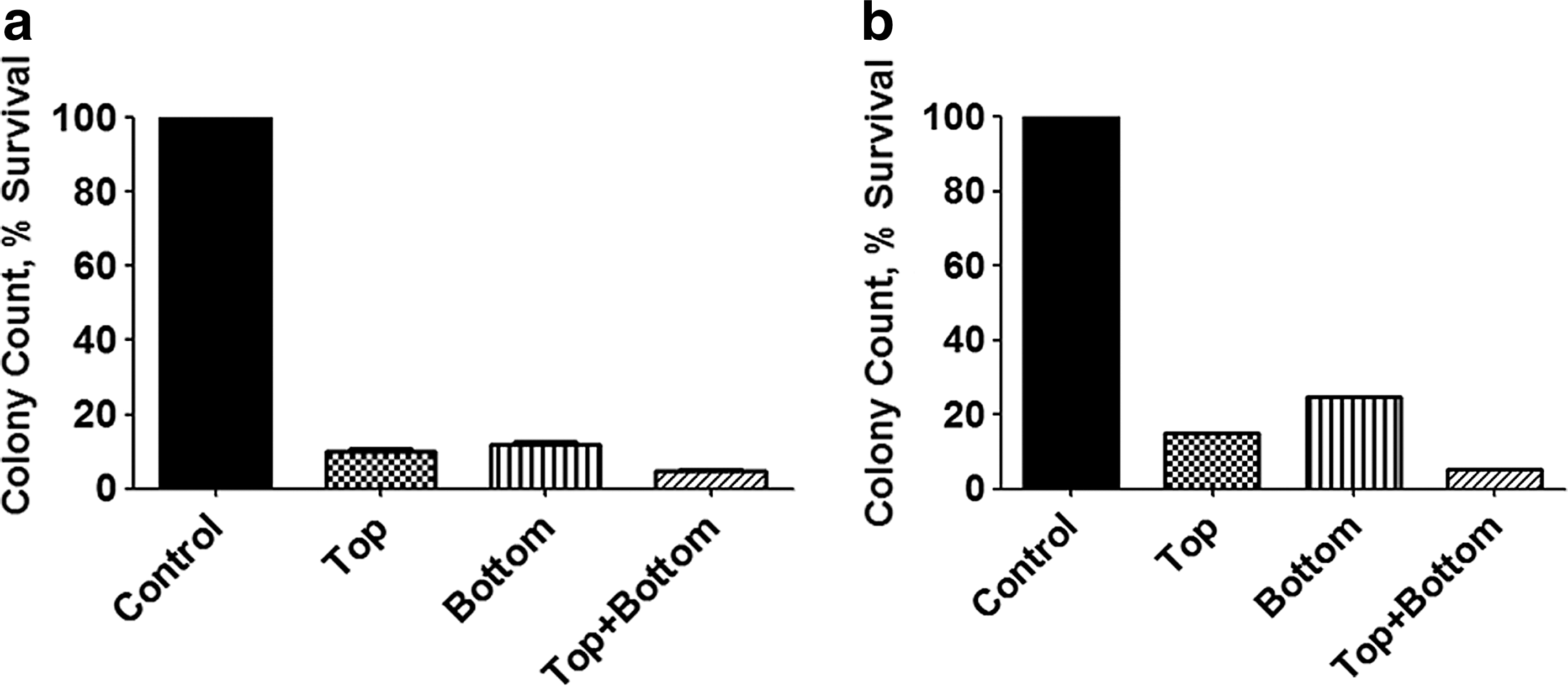
The effect of mode of 470 nm irradiation on US300 methicillin-resistant Staphylococcus aureus MRSA:
Discussion
Overall, our results show that 100% bacterial clearance is possible with one shot irradiation of MRSA, but only in a sparse culture of 3×10⁶ CFU/mL, not in a standard 5×10⁶ CFU/mL culture or a denser culture of colonies. Furthermore, the maximum proportion of colonies eradicated in the standard culture with 405 nm light, 96%, is comparable to previous reports, 15 in which one shot irradiation with the same wavelength of light killed 92.1% of this strain of bacteria. Similarly, whereas 94% of the bacteria was cleared with 470 nm light in this study, Enwemeka et al. reported 90.4% clearance using the same wavelength. 16
Our findings uphold the null hypothesis that bacterial density does not limit the bactericidal effect of 405 and 470 nm light on MRSA. Even though a maximum of 78% of the bacteria in the denser 7×10⁶ CFU/mL culture were eradicated compared with 94% for the standard 5x10⁶ CFU/mL culture, the estimated total number of colonies cleared from the 7×10⁶ CFU/mL culture was higher; 5.46×10⁶ CFU/mL compared with 4.7×10⁶ CFU/mL. The same is true when the estimated amount of bacteria cleared in the 7×10⁶ CFU/mL culture or the 5×10⁶ CFU/mL culture is compared with amount of bacteria (100%) cleared in the sparser 3×10⁶ CFU/mL culture. Therefore, more bacteria were killed as culture density increased. And as detailed subsequently, this result is not caused by greater beam penetration in the denser culture than in the sparser culture; rather, it seems related to clearance of more bacteria from the culture medium when colonies are dense, compact, and present a larger surface area of exposure to the beam.
With the 3×10⁶ and the 5×10⁶ CFU/mL cultures, the bactericidal effect of both wavelengths were similar; but in the denser 7×10⁶ CFU/mL culture, 405 nm light cleared more bacteria at each fluence than 470 nm light. This result is consistent with the observation of Maclean et al., who investigated high-intensity narrow-spectrum light and wavelength sensitivity of S. aureus. 24 They found that photo-inactivation of S. aureus occurred upon exposure to blue light of wavelengths between 400 and 420 nm, with maximum inactivation occurring at 405±5 nm. The peak emission of our 405 nm applicator falls within this reported maximum photo-inactivation spectra. Furthermore, given the 390–420 nm spectral width of our 405 nm LED device, it is possible that the trace of ultraviolet (UV) emitted by the applicator also accounts for its superior bactericidal effect in the denser culture.
As bacterial density increased, a correspondingly lower proportion of bacterial colonies were cleared. However, the bacteria-killing capacity of both wavelengths was never diminished. This observation, combined with our finding that more bacteria were killed when bacteria were irradiated from top and bottom than when irradiated from the top or the bottom of each plate at the same sum total fluence, clearly show that beam penetration was the primary factor limiting bacterial eradication; not necessarily bacterial density. Our findings suggest that layers of bacteria closer to the source of light were readily killed by both wavelengths. Colonies farther from the light source seemed less susceptible to photo-eradication because being farther from the light source, they were exposed to less intense light or no light at all, because of poor beam penetration and diminished irradiance. This implies that clearance of MRSA above concentrations observed in clinical settings would require a protocol that adequately accounts for limited beam penetration.
Conclusions
Within the confines of our experimental protocols, our findings warrant the conclusions that: (1) 100% bacterial clearance is possible with one shot irradiation of US300 MRSA in a sparse culture—the type that mimics mild infection, not in a standard clinical culture of 5×10⁶ CFU/mL or a denser culture of colonies; (2) bacterial density limits beam penetration, but not the bactericidal effect of 405 or 470 nm light on MRSA; (3) both 405 and 470 nm wavelengths have similar bactericidal effects on standard or sparser bacterial cultures; however, in a denser culture, such as 7×10⁶ CFU/mL, 405 nm light clears more bacteria at each fluence than 470 nm light; and (4) beam penetration is a major factor limiting bacterial eradication in dense MRSA cultures.
Footnotes
Acknowledgment
Funding for this research was provided by the College of Health Sciences, University of Wisconsin-Milwaukee.
Author Disclosure Statement
No competing financial interests exist.