




Abstract
Introduction
Fiber-reinforced posts are produced using fibers, such as carbon, quartz, or glass, embedded in a matrix of epoxy or methacrylate resin. 4,5 The fibers are oriented parallel to the post-longitudinal axis, and their diameter ranges between 6 and 15 μm. The fiber density, that is, number of fibers per mm2 of post cross-sectional surface, varies between 25 and 35, depending upon the post type. Therefore, fibers occupy 30–50% of the area in a transverse section of the post. 6 The adhesion between quartz or glass fibers and the resin matrix is enhanced by silanization of the fibers prior to embedding. A strong interfacial bond enables load transfer from the matrix to the fibers, and such a bond is essential for effective reinforcement. 7
The clinical success of a post-core restoration depends upon the formation of a strong bond between the resin composite and the residual dentin, as well as the quality of the post-core interface. Intimate contact must exist between the post surface and core materials, regardless of their composition. 8,9 Surface treatment with different surface conditioning techniques is a common method for improving adhesion between posts and composite resin cores. 10 For surface pretreatment of fiber posts, both chemical and micromechanical treatment protocols have been applied. 11 Currently, coating of posts with a silane primer and/or adhesive resin, potentially combined with acid pre-etching of the post surface, is frequently preferred as a chemical post-surface pretreatment. In particular, the application of silane on post surfaces has been widely investigated; however, these investigations have often revealed contradictory results. 12 The most common micromechanical post-surface pretreatment is sandblasting, which is intended to remove the top layer of resin and render the glass fibers suitable for chemical interaction. After sandblasting, an increase in surface roughness is inevitable; therefore, sandblasting has been applied to increase surface area and energy. 13 The Co-Jet system (3M ESPE, St Paul, MN) for intraoral use is a modification of the Rocatec system introduced in 1989 for laboratory use. It utilizes aluminum oxide particles modified by silica. As a result, the surface area/roughness is increased, and a silicate layer is also welded onto the post surface in a process referred to as “tribo-chemical coating.” The formed surface can then be silane-treated through combined micromechanical and chemical bonding mechanisms. 11
Lasers have become popular in dentistry since the development of the ruby laser by Maiman in 1960. 14 Recently, among the various laser types, the erbium:yttrium-aluminum-garnet (Er:YAG) laser has become preferred for use in dental applications. Er:YAG laser energy is emitted at a wavelength of 2.94 μm, strongly absorbed by water. and well absorbed by hydroxyapatite. 15 Lasers have been shown to provide a relatively safe and easy means for altering the surface of materials, and they change the wettability characteristics of ceramics and metals for improved adhesion and bonding. 16 It has also been indicated that laser use could constitute an alternative treatment to other surface pretreatment techniques for enhancing bond strength. 17
The longitudinal success of restorative or prosthetic rehabilitations of endodontically treated teeth depends upon the quality of the restoration as a result of the success of bonding between fiber-reinforced posts and resin cement and/or composite resin cores. Although several studies have focused on the possibility of improving adhesion at the fiber post–composite interface through various treatments of the post surface, 18 –20 less information is available on fiber-reinforced post surface treatments using lasers.
Therefore, the purpose of this in vitro study was to investigate the effects of the Co-Jet system and Er:YAG laser irradiation, under different power settings, on the pushout bond strengths of fiber-reinforced posts and composite resin cores. The null hypothesis was that Er:YAG laser treatment would affect bond strength in a manner comparable to that of the Co-Jet sandblasting method.
Materials and Methods
Sample preparation
Twenty-five translucent glass fiber posts (Cytec Blanco Glasfiber, Hehnenkrat, Germany) were used in this study (diameter of 2.2 mm). The glass fiber posts were composed of glass fibers (60%) surrounded by an epoxy resin matrix (40%). The fiber posts were randomly divided into five groups, and different surface treatments were applied to each group as follows: Group 1: no treatment Group 2: Co-Jet (3M ESPE) sandblasting: the posts were sandblasted by silicate-coated alumina particles with a diameter of 30 μm at a pressure of 2.3 bar (2.3×10⁵ Pa) and from a distance of 10 mm for 5 sec; the latter tribochemical coating was completed by the application of a layer of ESPESil (3M ESPE). A disposable brush was used to apply the silicatized surface and allow the volatile solution to dry for 5 min Group 3: 150 mJ, 10 Hz, 1.5 W Er:YAG laser irradiation for 60 sec, 100 μs duration Group 4: 300 mJ, 10 Hz, 3 W Er:YAG laser irradiation for 60 sec, 100 μs duration and Group 5: 450 mJ, 10 Hz, 4.5 W Er:YAG laser irradiation for 60 sec, 100 μs duration.
The post surfaces were treated using an Er:YAG laser (Doctor Smile Erbium and Diode laser, Lambda Scientifica S.r.l, Vicenza, Italy) working at 2940 nm. The optical tip, which had a diameter of 400 μm, was used at an incidence angle of 45o under water cooling, 1 mm distant from the post surface.
After surface treatment, the fiber posts were built up to a composite resin core. The Cytec Blanco fiber posts have double tapers at the middle and apical parts of their design. The parallel sections of the posts were used for the core foundation to simplify calculation of the surface area. Only the upper cylindrical portions of the Cytec Blanco posts (∼5 mm long), with a larger diameter of 2.2 mm, were used. Each post was positioned perpendicularly on a Teflon mold and maintained at the coronal portion. The cylindrical part of the Teflon mold was placed around the post, and an incremental technique was applied to build up the core following the bond application of post surfaces. (Fig. 1). Each 2-mm increment of the core composite (Clearfil DC Core Automix) was cured using a light-curing unit (Elipar FreeLight LED II, 3M ESPE Dental Products, St. Paul, MN) per the instructions of the manufacturers. The main compositions of the posts, silane, and composite resin cores are listed in Table 1.
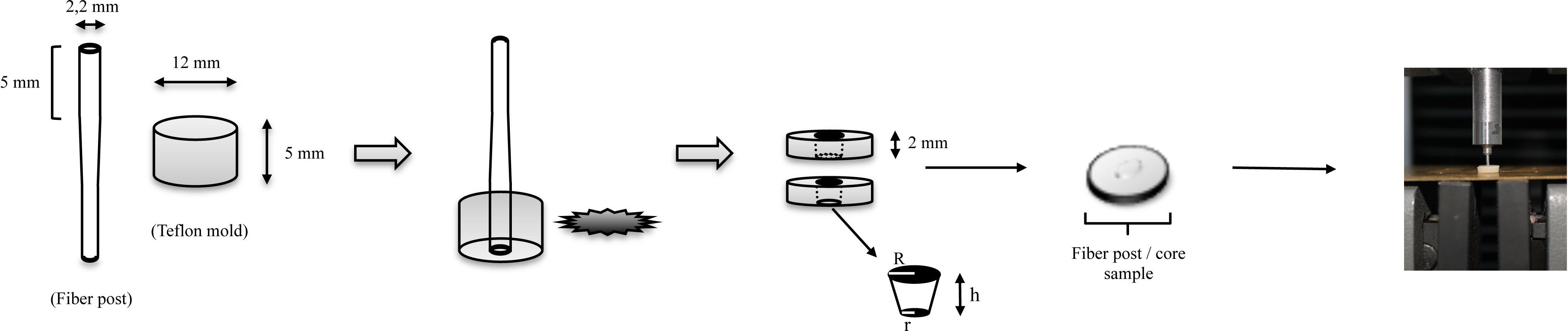
Schematic representation of specimen preparation.
After 24 h of storage in distilled water, each specimen was mounted on the holding device of a low-speed saw (Isomet, Buehler, Lake Bluff, IL) and cut perpendicular to the long axis of the post with a saw. Two discs (thickness of 2 mm) were obtained from each post-core sample, and each group therefore consisted of a 10-disc sample. The exact thickness of each disc was checked with a digital micrometer. For artificial aging, the specimens were stored in water (37°C) for 24 h and subjected to thermal cycling (5000 cycles, 5–55°C, 30 sec dwell time).
Push-out bond strength test
Next, each specimen was subjected to a pushout bond strength test using a universal materials tester (5848 MicroTester, Instron, Norwood, MA). The test was performed at a cross-head speed of 0.5 mm/min, with the load applied in the apical-coronal direction until the post was dislodged. The maximum load at failure was recorded in Newtons (N) and was converted to MPa by dividing the applied load by A, the bonded area. Because of the tapered post shape, the bonded area was calculated using the following formula:
with r and R representing, respectively, the smallest and largest diameters of the cross-sectioned tapered post, and h representing the thickness of the section.
After testing, the mode of failure was also determined for all of the specimens using a stereomicroscope.
SEM analysis
One specimen from each group was examined using SEM (JSM-5600, JEOL; Tokyo, Japan) to study the characteristics of the post surfaces after different treatments. Each specimen was sputter-coated with gold-palladium (Polaron Sc500 Sputter Coater, VG Microtech Inc., E. Sussex, United Kingdom) and examined under SEM at 3000× magnification.
Statistical analysis
One way analysis of variance (ANOVA) and Tukey's honest significant difference (HSD) test for post-hoc comparisons were used to determine statistically significant differences in the pushout bond strength data (MPa) (p<0.05), using specific software (IBM SPSS Statistics, version 20.0 for Mac).
Results
The mean pushout bond strength is presented in Table 2 for all of the tested groups. In general, ANOVA revealed no differences among the groups, except for the Er:YAG 450 mJ group (p<0.05). Er:YAG laser irradiation affected bond strength values, depending upon the power setting. In the Er:YAG 150 and 300 mJ groups, there were small differences relative to the untreated control group (p>0.05). Among the other tested groups, the highest bond strength was observed for the Er:YAG laser at 450 mJ (23,879 MPa). In the Co-Jet group, a higher value was observed than in the control group (19,184 MPa); however, ANOVA did not reveal any significant differences. In the analysis of failure, all of the specimens failed adhesively at the post-cement interface.
Means belonging to the same statistical group are not significantly different, p<0.05.
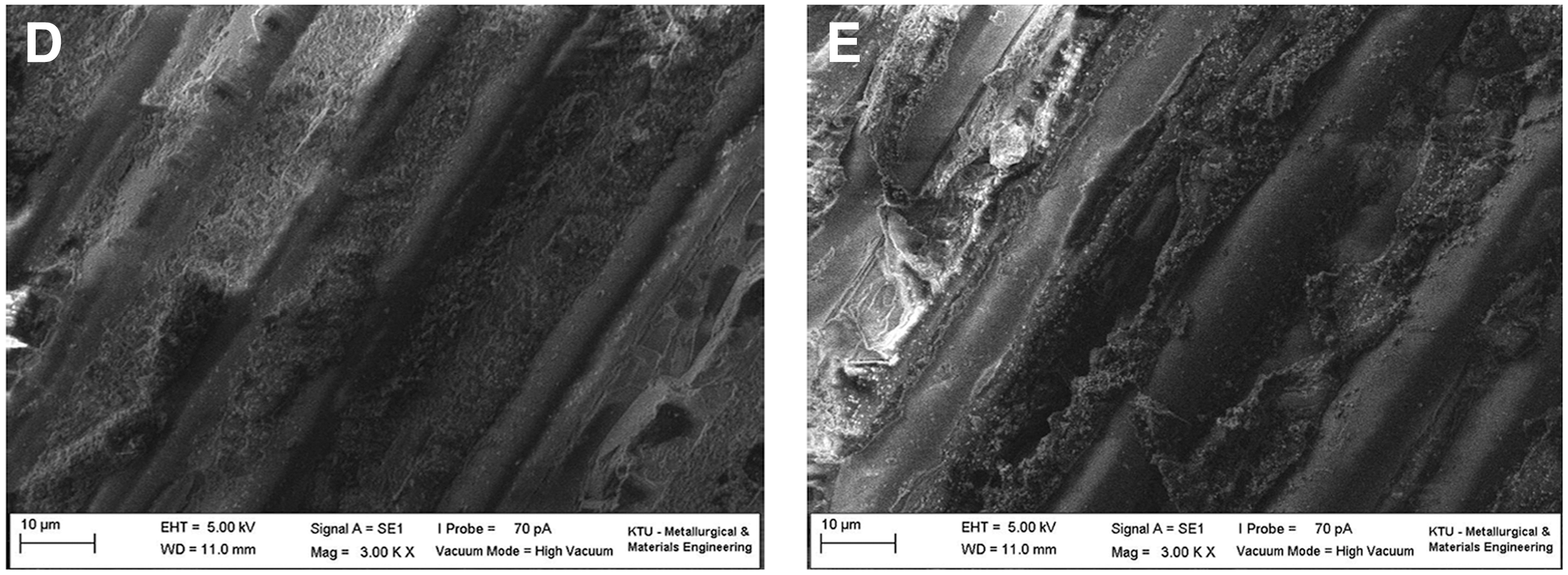
SEM evaluation revealed surface dissolution of the epoxy resin matrix of the fiber posts treated with the Er:YAG laser at 450 mJ. Partial removal of the epoxy resin matrix of the fiber post created “retention spaces” among the fibers, thus providing micromechanical retention and infiltration of core materials (Fig. 2E). In addition, Er:YAG 150 mJ and Er:YAG 300 mJ laser irradiation did not produce significant changes in the fiber post surfaces (Fig. 2C and D). After Co-Jet sandblasting, the surface topography of fiber posts appeared to be significantly more microretentive (Fig. 2B). No cracked or damaged fibers were observed in any of the groups. These observations and the pushout bond strength results were in agreement.
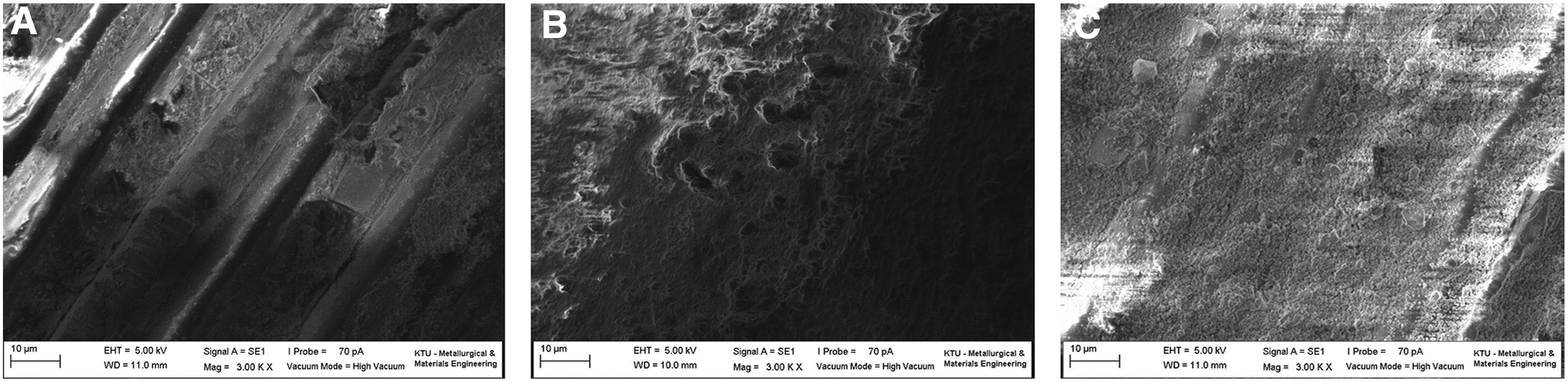
Scanning electron microscope images of the fiber post surfaces after different treatments at a magnification of 3000×.
Discussion
The longitudinal success of restorative or prosthetic rehabilitations of endodontically treated teeth depends upon the quality of the restoration, its clinical adaptation, and the health of the supporting tissue. 21 Fiber posts have been proposed for restoring excessive loss of tooth structure, in combination with adhesive materials. In retrospective clinical studies, few failures have been reported. 22,23 The fracture modes reported in earlier studies were adhesive in nature, with failure of the bond between the composite resin and the fiber post surface. 24,25 Therefore, the challenge has been to form an interpenetrating network between the luting composite resin or its adhesive and glass fibers. 26 To enhance the bonding of resin to fiber-reinforced posts, some surface treatments for posts have been investigated, such as tribochemical coating followed by silanization (Co-Jet system). The ability of the Co-Jet system to improve the bonding of composite resin to other materials has been confirmed in other studies. 27,28 Use of the Co-Jet system resulted in higher pushout bond strengths relative to the corresponding control groups and to Er:YAG laser application at 150 and 300 mJ. Additionally, the tribochemical coating of post surfaces, followed by silanization after the Co-Jet procedure, was confirmed by SEM. 25,27 Sandblasting removes the superficial layer of resin and exposes the glass fibers, which can then be accessed by the subsequently applied silane primer. SEM clearly revealed increased microretentive surface topography after Co-Jet sandblasting of glass fiber posts. A similar finding was reported in a previous study, 12 in which silica coating by Co-Jet was demonstrated to improve the bond strength of composite resin cement to fiber-reinforced posts. Zicari et al. 12 reported that epoxy resin-based fiber posts had lower bond strengths than fiber posts that were embedded in methacrylate resins. The present study showed that Co-Jet sandblasting improved pushout bond strength less effectively. Methacrylate-based composite cements were barely chemically reactive with highly polymerized epoxy polymers. 29 Sahafi et al. 30 evaluated the efficacy of blasting the surface of fiber posts with silicon oxide (Co-Jet system). Although satisfactory bond strengths were obtained, the treatment was considered to be too aggressive for the fiber posts. These results may have been influenced by application time, alumina particle size, and pressure. 30 In agreement with the present results, Bitter et al. 26 reported a limited influence of Co-Jet treatment on the bond strength between fiber posts and resinous cements. More promising results were recently achieved in another study by Balbosh and Kern, 31 who used epoxy resin-based fiber posts that were abraded by airborne 50 μm alumina particles at 2.5 bar pressure for 5 sec and at a distance of 30 mm; in contrast, 30 μm particles at a pressure of 2.3 bar and a distance of 10 mm for 5 sec were used in the current study.
To enhance the bond strength of dental materials to metal surfaces, Murray et al. 32 indicated that laser treatment may be a suitable alternative to other surface treatment techniques, such as airborne particle abrasion. The current study focused on evaluating the effects of different surface treatment procedures, including an Er:YAG laser under three different power settings (150, 300, and 450 mJ; 10 Hz for 100 μs), on the bond strengths of fiber posts to composite resin cores. Among the various laser types, the use of an Er:YAG laser on the surfaces of dental materials is highly recommended. 33 The clinical use of Er:YAG lasers on dental substrates has been well described in the literature; they act on tissues by thermomechanical ablation and vaporize the water content, which causes expansion followed by microexplosions that eject both organic and inorganic tissue particles and provide a surface with open dentinal tubules and no smear layer. 34,35 However, with regard to restorative materials, Burnett et al. 36 found that indirect composite surface treatment with the Er:YAG laser (λ=2.94 μm) at 200 mJ and 10 Hz enhanced single-bond tensile-bond strength relative to air abrasion and fluoridic acid. Tundemir et al. 37 evaluated the influence on pushout bond strength of surface treatment of quartz fiber posts with airborne-particle abrasion and 150 mJ Er:YAG laser irritation, and found that 10 Hz 150 mJ irradiation with the Er:YAG laser and airborne-particle abrasion did not significantly affect bond strength values, consistent with the current study. Only a few studies have evaluated the laser treatment of fiber-reinforced post surfaces. Kurt et al. 38 investigated the effects of different surface treatments of methacrylate-based glass fiber-reinforced posts utilizing an Er:YAG laser under different power settings (300, 400, and 500 mJ at 2 Hz) on the pushout bond strength to composite resin cores. Kurt et al. claimed that Er:YAG laser application significantly decreased the bond strength of fiber posts to composite resin cores relative to the untreated control group. However, the low bond strength observed at higher Er:YAG power settings was the result of heat damage to the surface. In contrast, the SEM images of Kurt et al. are similar to those of the present study. 38 Kurt et al. concluded that microgaps and microretentive surfaces on the SEM images were associated with lower bond strength. Monticelli et al. 10 used the term “retention spaces” for microgaps that were created among fibers after partial removal of the epoxy resin matrix of the fiber posts and that provided higher pushout bond strength values than those in the present study. In the present study, Er:YAG laser treatment of fiber post surfaces significantly enhanced the bond strength values, as did sandblasting; therefore, the null hypothesis of this in vitro study was supported. In this study, the thermal cycling method was performed as an artificial aging procedure, because bond strength can be affected by chemical, thermal, and mechanical factors in the mouth. As in previous reports, short-term thermal cycling was performed, which simulated a duration of ∼7 months. 39
The current study was limited to one type of fiber-reinforced post and composite resin core buildup material. The extent of the superficial changes on the fiber-reinforced post surfaces depended upon both the energy density of the laser irradiation and the type of irradiated fiber post. Therefore, to achieve better clinical performance from Er:YAG lasers for the superficial treatment of dental fiber-reinforced posts, further studies are required to test other laser parameters and materials and to confirm the results of the present study. These findings allow a better understanding of the effects of laser surface treatment on the bonding of core buildup materials to fiber posts.
Conclusions
Within the limitations of this in vitro study, it can be concluded that Er:YAG laser irritation at a 450 mJ power setting can enhance the bond strength of composite resin cores to fiber-reinforced posts relative to different power settings and to the Co-Jet (3M ESPE) sandblasting method.
Footnotes
Acknowledgment
The authors thank Gülsa Dental for obtaining the Kuraray products used in this study.
Author Disclosure Statement
No conflicting financial interests exist.