




Abstract
Introduction
R
Low-level laser therapy (LLLT), a simple, innovative approach, was recently shown to improve visual acuity in patients with age-related macular degeneration or amblyopia. 4,5 On the basis of these findings, we describe the effects of LLLT in a patient with late-stage RP.
Patients and Methods
A 55-year-old male patient was treated using LLLT as previously reported. 4 Visual acuity was assessed using Snellen projection optotypes. Visual fields were determined by kinetic Goldmann perimetry. Electroretinography was performed using the Retiport System (Roland Consult, Germany).
LLLT was performed in compliance with the Declaration of Helsinki after the patient had given his informed consent. LLLT employed a continuous wave laser diode (780 nm) operated with 292 Hz pulse wave modulation at a 50% duty cycle. Average power output was 10 mW, determined by use of a laser meter (LC-M2E-800-100U, Laser Components GmbH, Germany) Laser diode, electronic power control, and collimating optics were housed in a hand piece that produced a beam of an estimated 3 mm2 spot size (Bimed GbR, Germany). The patient was asked to maximally look left, right, up, and down while the eyelids were manually kept open and the complete conjunctival area of the eyeball was irradiated. The beam was guided by hand with a scanning movement at a 1 cm distance from the eyeball. Irradiation treatment was performed for 40 sec (0.4 J laser energy delivered at a power density of 0.333 W/cm2) and was repeated two times per week for 2 weeks (1.6 J total energy).
Results
At first presentation, the patient had complained about progressive reading difficulties, and night blindness (nyctalopia). His family medical history was unknown. The initial ophthalmological examination revealed blue-yellow dyschromatopsy and a visual acuity of 20/50 in each eye (uncorrected; no improvement using optical correction). B-waves were absent in the electroretinogram. Visual fields were reduced to very narrow central residuals of 5 degrees (Fig. 1 A,B). Fundoscopy revealed a typical pattern of retinal pigmentations and narrow retinal blood vessels.
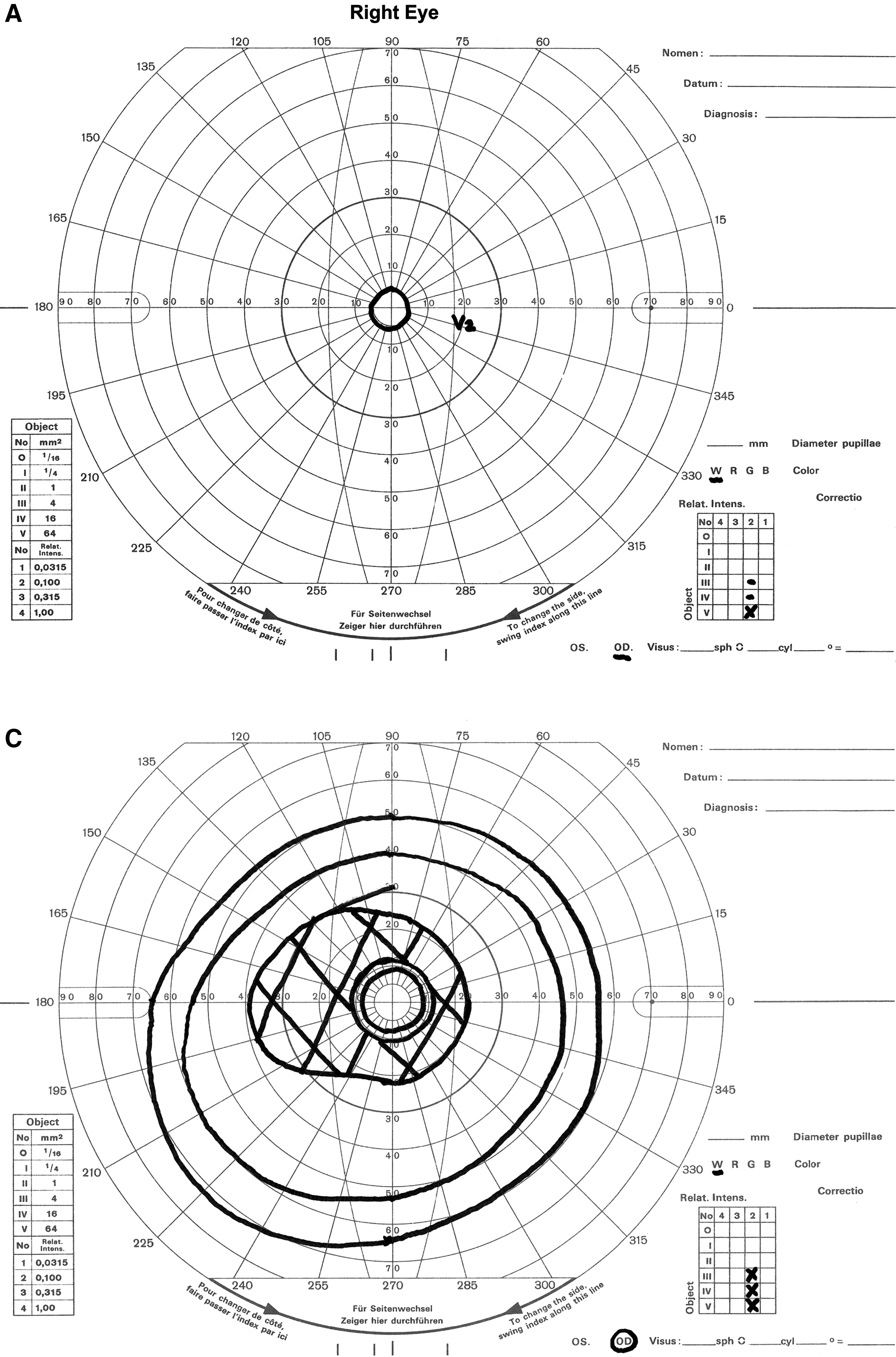
Visual fields in a patient with retinitis pigmentosa before (panels
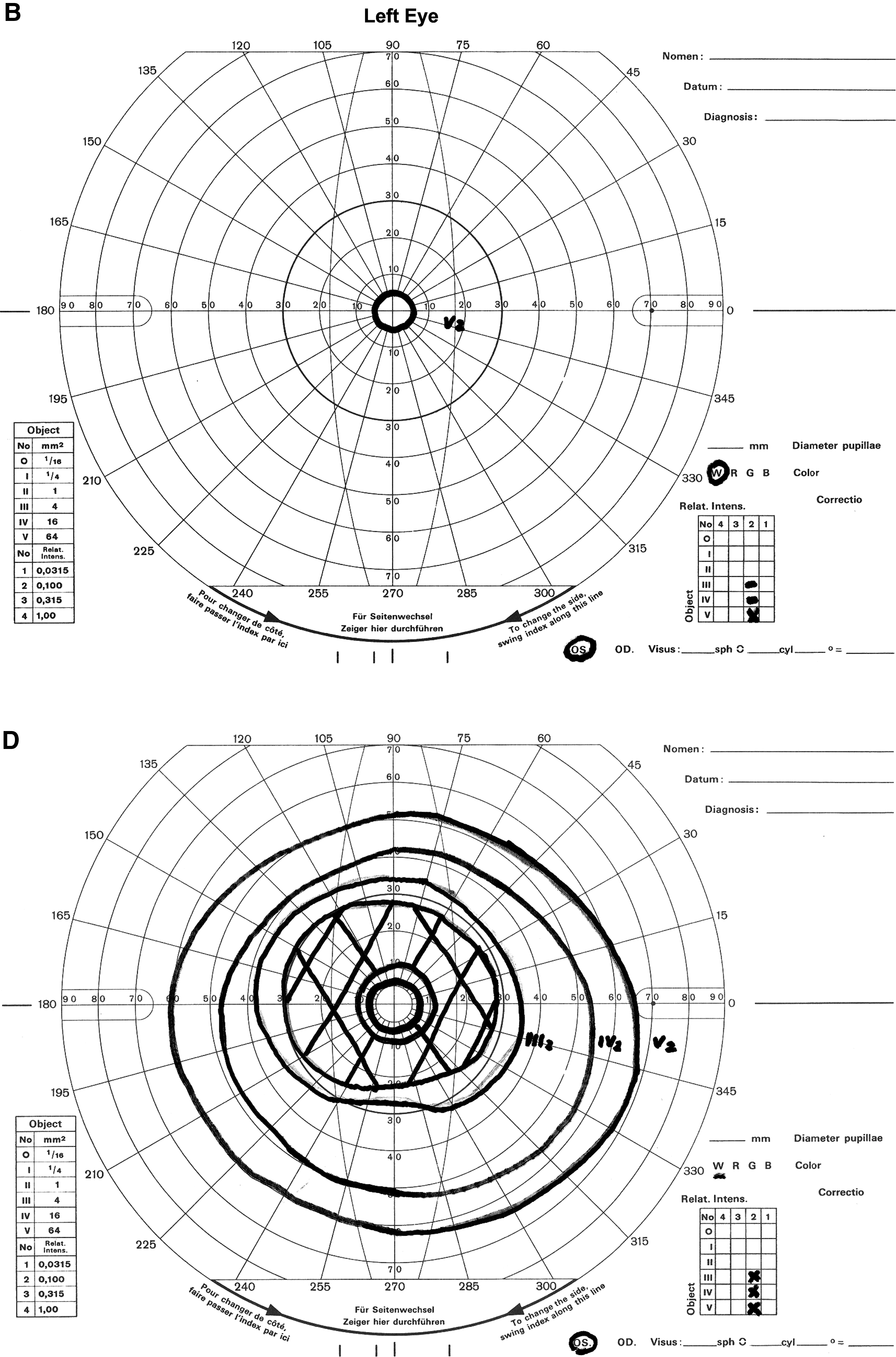
During the first 2 weeks (four treatments) visual acuity increased from 20/50 at baseline to 20/20. Visual fields regained normal outer perimeters but kept a residual absolute mid-peripheral circular scotoma (hatched areas in Fig. 1 C,D). Five years after discontinuation of any therapy, the patient returned showing a relapse to the original condition: visual acuity and fields were reduced to 20/50 and 5 degrees, respectively. LLLT was repeated with another four treatments, restoring the initial success described previously. During the subsequent 2 years, 17 additional treatments were performed on an “as needed” basis to maintain this success. No adverse side effects were noted.
Discussion
It seems conceivable that the improvement in vision and visual fields observed in the present case are the result of a regenerative process leading to restored cell function. This process may include the rescue of a considerable population of receptor cells that had been nonfunctional because they entered a–still reversible–path to apoptotic cell death. In addition, LLLT may even have promoted axonic, synaptic, and dendritic neoformation as well as qualitative and quantitative improvement of intercellular connectivity. The basis of the positive effects of LLLT remains highly speculative in this single case. We already noticed an improvement in vision from LLLT in a previous study of another degenerative eye disorder, age-related macular degeneration. 4 This experience prompted us to employ LLLT for RP in a similar fashion. Notably, treatment modalities were not further adapted or optimized for RP. Moreover, we emphasize that it is not justified to herald LLLT as a therapeutic option for RP on the basis of the individual success described here. On the contrary, this case report first requires independent confirmation.
The surprising improvements in visual acuity and fields restored the orientation ability and autonomous mobility of the patient. It remains unknown whether the visual fields could have been further improved by a more systematic therapy. In any case, the patient argued that he could see enough, and decided that no further treatments were necessary.
An earlier therapy, before visual fields deteriorated to 5 degrees, may have been advantageous. Progressive loss of visual acuity may have been avoided or delayed. Future studies should examine patients with early-stage RP, and consider more treatment modalities, to determine the best treatment outcome with respect to normalization and long-term stability of visual fields and acuity. Moreover, this case suggests the need for continuous individual follow-up to slow down the progression of the disease.
Conclusions
In conclusion, LLLT improved and maintained vision in a single patient with RP, and may have contributed to delaying impending blindness. LLLT is simple, and without adverse effects. The results are promising, but require independent confirmation before one may claim a benefit for patients with RP.
Footnotes
Author Disclosure Statement
No competing financial interests exist.