




Abstract
Nevertheless, we stated that, given existing data, it was not possible to prove the role of EZ water in photobiomodulation. 2 A re-evaluation of published experimental and clinical data now lends further support to our initial proposal, 2 which is in accord with the seminal contributions of Pollack 1 and others to the study of water and exclusion phenomena. For an in-depth yet thoroughly accessible review on EZ water, we highly recommend the work of Pollack. 1
Using a 90 MHz hydrogen-1 nuclear magnetic resonance (H-NMR) spectrometer, we found that an infrared pulsed laser device (IPLD) (904 nm pulsed at 3 MHz) induced significant short-term molecular changes in burned rat soft tissue. 3 After 48 h, there was a statistically significant difference in 1/T2 values in irradiated specimens versus non-irradiated specimens and the control group. In particular, 1/T2 results indicated greater structuring of water in irradiated burned tissues. 3
This is consistent with clinical data from an MRI microdensitometry study of patients with advanced neoplasias treated with the same IPLD. 4 Figure 1 shows the image of a cheek metastasis from a patient with recurrent malignant papillary meningioma. Red tones relate to high water content caused by photo-induced cellular death. Blue shades correspond to active tumor areas. The wide divide partially separating the tumor is in agreement with a described loss of cellular adhesion caused by the microscopic effects of anoikis. 5
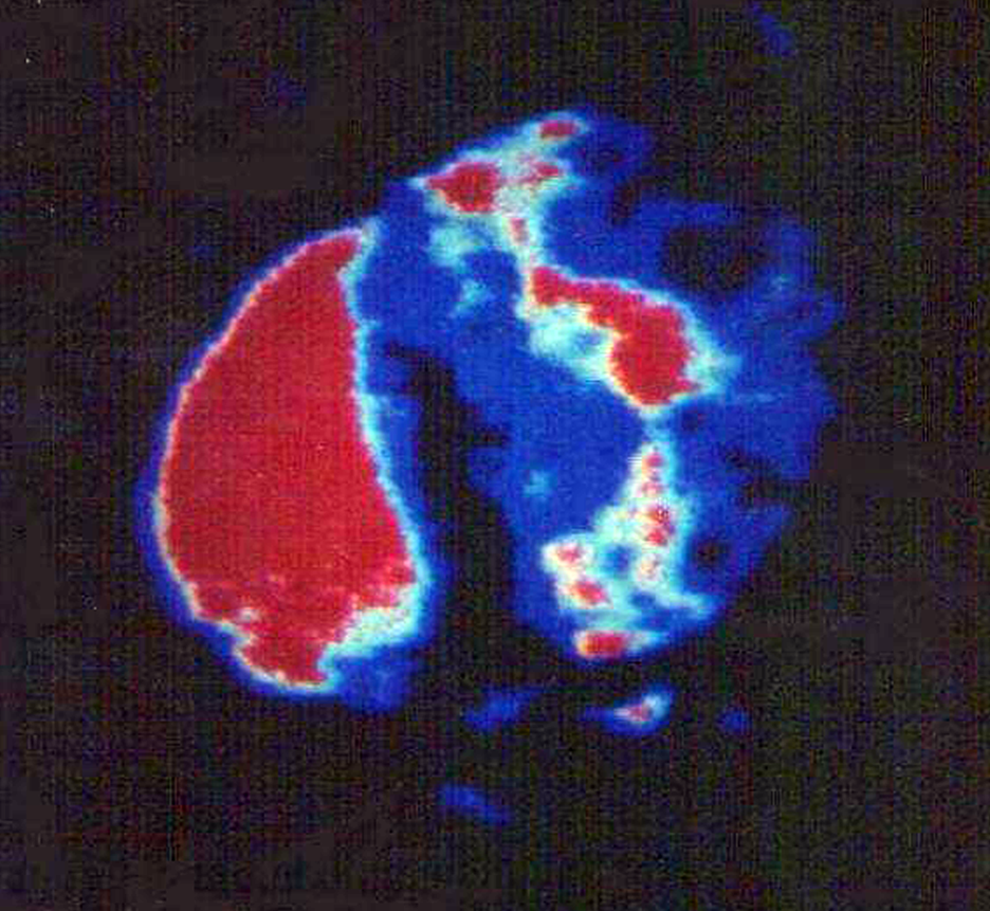
Raw microdensitometry of T2-weighted magnetic resonance (MR) image of cheek metastasis from a patient with recurrent malignant papillary meningioma after infrared pulsed laser device (IPLD) treatment. 5 (Copyright retained by authors.)
Remarkably, the light blue color around the red tones strongly suggests areas of highly ordered water, possibly proving a photobiomodulation effect over EZ water. This fits well with the behavior of the corresponding published curve obtained from an algorithm for tumor characterization by analysis of transversal relaxation rates, 5 which showed an increase in structured water associated with biopolymers and macromolecules. This may be contrasted with an experimental model comprising triangular specimens of Nafion in water examined by using infrared absorption. 1
Cited experimental and clinical results together,, which to the best of our knowledge are the first of their kind, suggest a more-ordered post-irradiation water structure in a manner consistent with increased EZ ordering. As previously argued, this is important because such effect could modulate cell signaling and power extensive complex networks that lie behind the structure and functioning of metabolic control levels. 2 Research must now ascertain how, in the presence of injury-induced redox potentials, external electromagnetic energy (light) may substitute and/or complement metabolic energy pathways and activate signaling pathways through EZ water.
Footnotes
Acknowledgment
This study was supported by Fundalas, Foundation for Interdisciplinary Research and Development.
Author Disclosure Statement
No competing financial interests exist.