




Abstract
Introduction
B
During recent years, there has been an increasing interest in laser application in bracket recycling. In 2009, Kulandaivelu 9 and Almeida, 10 respectively reported that the Er:YAG laser can remove adhesive from the dislodged bracket base completely, and that a good result was obtained, which prompted us to evaluate whether a laser could be used to facilitate bracket refurbishing.
In the preliminary experiment by this research group, it was found that KrF excimer laser with a wavelength of 248 nm could thoroughly remove the residual adhesive on the bracket base. The advantage of using KrF excimer laser was not only high efficiency and no mechanical contact damage, but also, because UV KrF excimer laser thermal effect was significantly less than that of the infrared Er:YAG laser, it did not need water cooling spray. The purpose of this study was to compare the processing effect of the KrF excimer laser versus traditional methods of grinding, flaming, and sandblasting. Rebonded after being refurbished by one of four methods, the shear bond strength of two kinds of metal brackets with different base designs were investigated, and the morphological analysis of the recycled bracket base also was performed. The null hypothesis of this study was that the processing effect of KrF excimer laser on metal bracket was better than that of traditional methods.
Materials and Methods
A total of 150 premolar teeth extracted for orthodontic reasons were collected from Beijing Stomatological Hospital, which was approved by Ethics Committee (NO. 2011-04). Periodontal tissue remnants were removed cleanly, and the teeth were stored in 0.9% NaCl, at 4° for up to 6 months until use. 11 All teeth were checked under 10× magnification, and any carious, damaged, obviously cracked, hypoplasic, or tetracycline-stained teeth or those with dental fluorosis were rejected. Two kinds of metal brackets with different bases were chosen to represent types commonly used in clinical practice: the Victory Series™ bracket (3M Unitek, USA) with a mono-layered foil-mesh base and the Mini Sprint® bracket (FORESTADENT, Germany) with a raised base for retention. Ninety of each kind of maxillary premolar brackets were selected, of which there were 15 brackets used for the two control groups respectively.
Sample preparation and group design
Before bracket bonding, the buccal enamel of the teeth was cleaned using nonfluoridated pumice powder and rubber prophylactic cups for 20 sec, rinsed and dried with air spray, then etched with a 35% gel of phosphoric acid (Heraeus Kulzer, Germany) for 30 sec. Seventy-five of each type of bracket were bonded respectively to these teeth using Transbond XT adhesive (3M Unitek, USA) according to the manufacturer's instructions. All brackets were released by bracket remover after 24 h, and residual resin was removed from the teeth using a green stone operated on a straight handpiece. 12 The teeth were polished with silicon ions. A total of 150 tooth surfaces were acquired for rebonding, randomly divided into 10 groups of 15 teeth each. The teeth were rebonded again with simulation of clinical practice. Five groups were randomly formed, among them one group using Victory new brackets and four groups using the rebonded Victory brackets, allocated as follows.
1. Victory new bracket group (V-New): bonded new brackets, as a control group
2. Victory bracket grind group (V-Grind): bonded recycled brackets processed by grinding, with the adhesive on the bracket base removed using a green stone in a straight handpiece, taking care not to damage the metal mesh, followed by rinsing under high-pressure water vapor and blow drying
3. Victory bracket flame group (V-Flame): bonded recycled brackets processed by flaming, achieved by heating the bracket base to red on an alcohol burner and burning off the adhesive, then rinsing of the mesh under high-pressure water vapor and blow drying after ultrasonic cleaning for 5 min 7
4. Victory bracket blast group (V-Blast): bonded recycled brackets processed by sandblasting using a MacroCab Danville Engineering sandblasting machine (MacroCab, USA) with 50 μm aluminum oxide abrasive powder (Hager & Werken, Germany), maintaining a 5 mm distance between the bracket base and handpiece head and sandblasting until the adhesive was not visible to the naked eye
5. Victory bracket laser group (V-Laser): bonded recycled brackets processed by lasering with a KrF excimer laser at a wavelength of 248 nm, energy density at 1.3J/cm2 and repetition rate at 2 Hz with the bracket base held perpendicular to the laser until complete adhesive removal, which required ∼50–200 impulses 13
The other five tooth groups were rebonded with Mini Sprint brackets following the same design and procedures as the above groups.
6. Mini Sprint new bracket group (MS-New)
7. Mini Sprint bracket grind group (MS-Grind)
8. Mini Sprint bracket flame group (MS-Flame)
9. Mini Sprint bracket blast group (MS-Blast)
10. Mini Sprint bracket laser group (MS-Laser)
Each rebonded tooth surface was cleaned with alcohol cotton and rinsed with oil-free high-pressure water vapor, and then the enamel was processed with a 35% gel of phosphoric acid for 30 sec, rinsed, and blow dried. Bonding was performed using Transbond XT adhesive according to the manufacturer's instructions, and any excess adhesive was removed with a probe to guarantee equivalent bonding areas. Light (Beyond, USA) was then applied for 10 sec on each proximal side of the bracket to cure the adhesive. All bonding procedures were performed by the same researcher.
Shear bond strength testing
The samples were fixed in 24 well culture plates and then stored in a water bath for 24 h at 37°C. Shear bond strength testing was performed on a BOSE 3330 Electroforce test machine (USA). The cutting blade was placed between the bracket's wing and the base, parallel to the base and perpendicular to the slot of the bracket. 14 Debonding was accomplished with a bar speed of 1 mm/min until the bracket dislodged, and the computer recorded the maximum force automatically.
Analysis of the adhesive remnant index (ARI)
The amount of adhesive residue on each tooth surface was observed under stereomicroscope at ×10 magnification after bond strength testing. Enamel surfaces were scored according to the ARI, as follows: score 0, no adhesive left on the tooth; score 1, ≤50% of the adhesive left on the tooth; score 2, >50% of the adhesive left on the tooth; and score 3, all adhesive left on the tooth, with a distinct impression of the bracket base. 15,16
Morphology of recycled bracket bases and residual component analysis
Three brackets were randomly selected from each of the groups. The morphology of the bracket bases before and after processing was observed under scanning electron microscopy (SEM) at ×200 for Victory brackets and ×100 for Mini Sprint brackets (ShimadzuSS550, Japan). CLSM (Olympus OLS3100, Japan) was used to observe the three-dimensional changes in the bracket base. Component analysis of residues on the bracket base was conducted using Raman spectroscopy (Horiba Jobin Yvon T64000, France). The information collected by spectroscopy was processed by OriginPro 8 software to produce a Raman spectrogram. The components can be evaluated based on the occurrence of the Raman characteristic displacement peak compared with the Raman spectra database.
Statistical analyses
The grind, flame, blast, and laser groups were the experimental groups, and the new bracket group served as the control. All statistical analyses were conducted by means of statistical package for social sciences (SPSS17.0 for Windows). The data of shear bond strengths showed normal distribution by Kolmogorov–Smirnov test, and an analysis of variance (ANOVA) was conducted. Further comparisons for each kind of bracket were made between the experimental groups and the control group using the least significant difference (LSD) test. The ARI scores for both kinds of brackets were analyzed using the Kruskal–Wallis test. All the significance levels were set at p<0.05.
Results
The results showed that the shear bond strength of the recycled Victory brackets processed by grinding, flaming, or blasting was lower than that of the new brackets (p<0.05); however, the laser group did not differ from the controls (p=0.7), indicating that laser processing performed better than other methods for brackets with a foil-mesh base. The shear bond strength of the recycled Mini Sprint brackets processed by grinding or flaming was lower than that of new brackets (p<0.05), but the blast and laser groups did not differ from controls, indicating that blast and laser processing was better for brackets with a raised base (Table 1).
These groups had significant difference from V-new group (p<0.05).
These groups had significant difference from MS-new group (p<0.05).
ARI scores did not differ between experiment and control groups (p>0.05). However, the ARI scores of the groups processed by grinding or flaming were higher for both kinds of brackets, suggesting more adhesive left on the tooth surface and a lower relative bond strength between the adhesive and bracket (Table 2).
SEM and CLSM showed that both kinds of bracket bases processed by grinding had a rough plane. Some residual adhesive was detectable on the bottom of the foil-mesh of the Victory bracket and between the raised edges of the Mini Sprint bracket processed by flaming. The sandblasting method removed the adhesive completely but left the foil-mesh thin and shallow and blunted the margin of the raised base.
The KrF excimer laser, however, thoroughly removed the adhesive from both kinds of bracket base. The depth of the metal mesh and the diameter of the metal wire changed little, and the edges of the raised base remained relatively distinct (Figs. 1 –4).
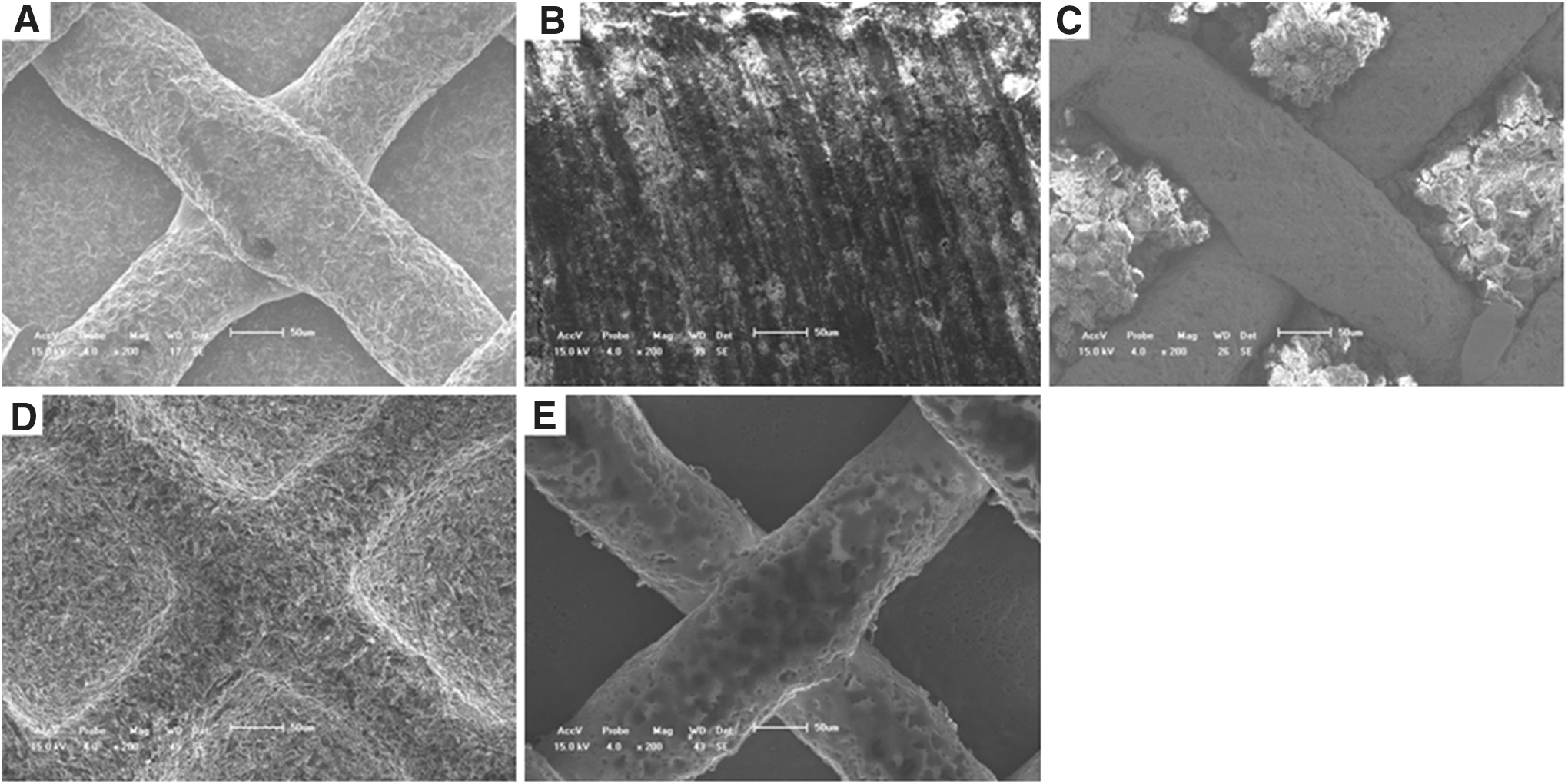
Scanning electron microscopic (SEM) photographs at 200× magnification of the Victory™ bracket base.

Scanning electron microscopic (SEM) photographs at 100× magnification of the Mini Sprint® bracket base.
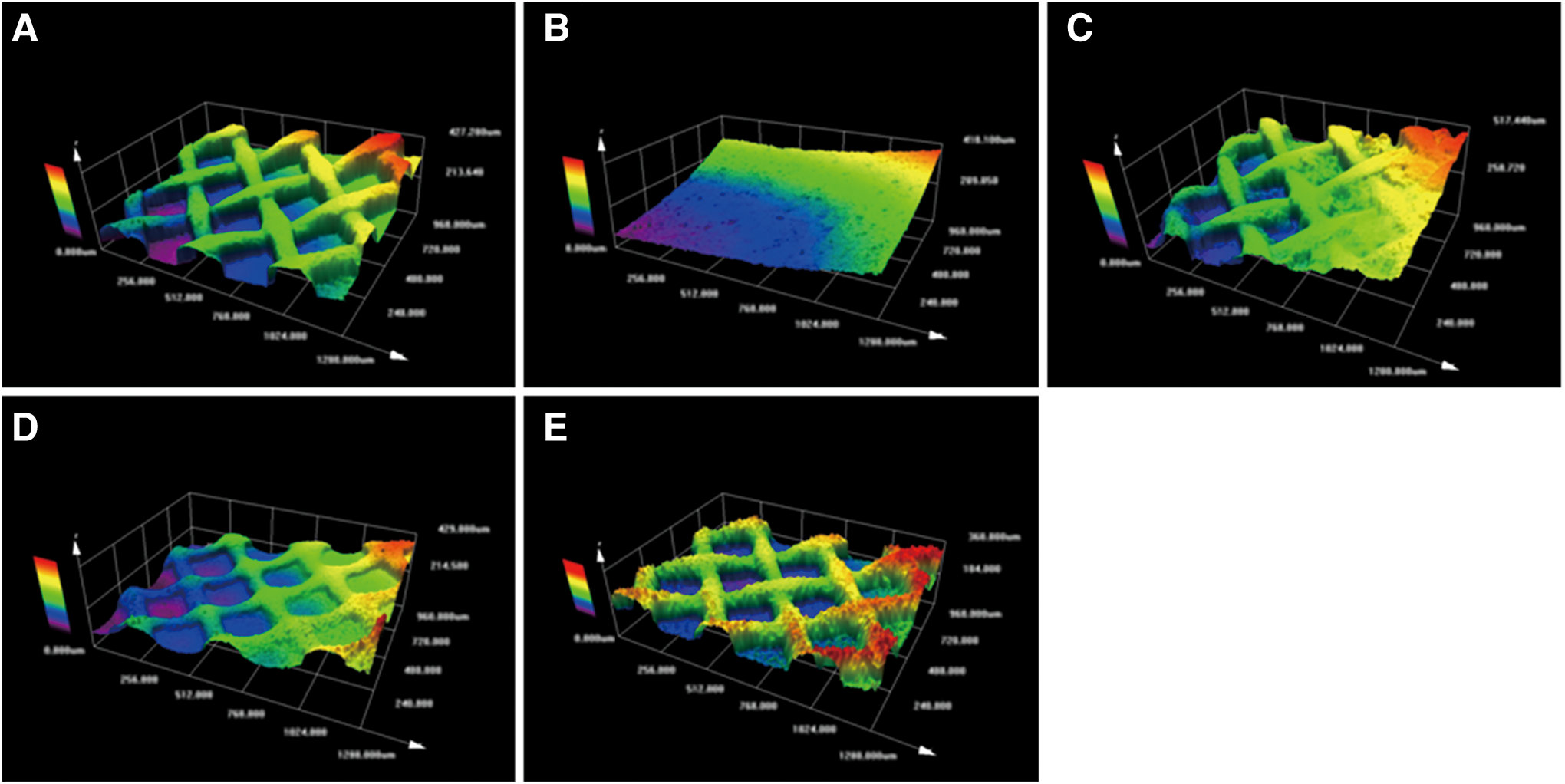
Three-dimensional reconstruction by CLSM of the Victory™ bracket base.

Three-dimensional reconstruction by CLSM of the Mini Sprint® bracket base.
On the Raman spectrograms (Fig. 5) of both kinds of brackets processed by blasting or lasering, no Raman peak appeared, indicating that there was no adhesive on the base. For both types of brackets processed by flaming, carbide remained on the base according to the Raman peak on the spectrogram, representing the ash of the adhesive. The brackets processed by grinding had a macromolecular compound on the base. These results of the Raman analysis were consistent with those of the SEM and CLSM.
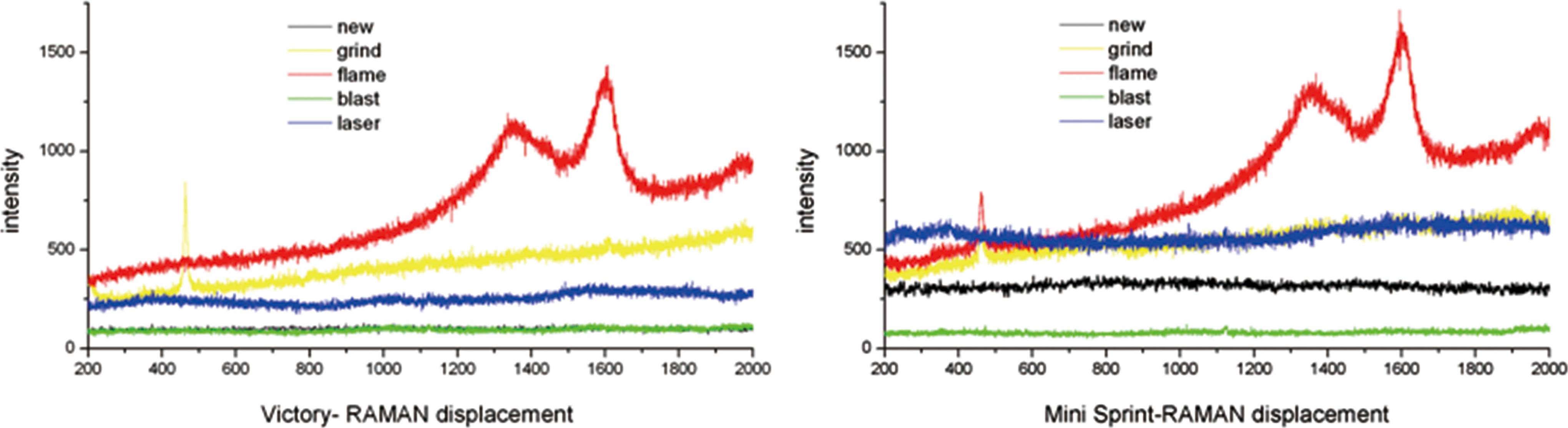
Raman spectrogram results.
Discussion
The operation of grinding is the simplest method, one that some orthodontists turn to use. However, the studies of Regan et al., 1 Tavares et al., 2 Basudan et al., 5 and Aksu et al. 17 showed that the shear bond strength of a dislodged bracket processed by the grinding method is significantly lower than that of a new bracket. The current study showed that although the surface resulting from grinding is rather rough, the mechanical fitting force produced by the roughened surface is far below that of the solid-bit structure. Furthermore, a chemical combination between the old and the new adhesives cannot achieve self-curing strength of the adhesive. The fracture surface mostly occurred between the old and the new adhesive surfaces when the bracket re-dislodged.
Flaming to remove adhesive from the bracket base is a very old method. Most reports indicate that the shear bond strength will significantly decrease when a bracket processed by flaming is rebonded. 3,9 The current study confirms this outcome. Although we had difficulty finding residue without visual aid on bracket bases in the flaming group, SEM and CLSM showed some residue on the bottom of the foil-mesh of the Victory bracket and between the raised edges of the Mini Sprint bracket. The Raman spectrogram results suggested that this residue was carbide, or ash from the adhesive. There was a gray imprint on the residual adhesive surfaces of the teeth when the rebonded brackets were re-dislodged, and this ash residue appeared to cause a significant decrease in shear bond strength when rebonded. In addition, because of the high temperature, it would release more ions than the new bracket did, the color of the bracket following processing by flaming was not aesthetically desirable and its corrosion strength also decreased. 18
The sandblasting method was originally used to improve the new bracket bond strength, 19 and later was used as a step in processing a dislodged bracket and enamel to be bonded. 14,20,21 Sonis et al., 22 Grabouski et al., 23 Tavares et al., 2 and Aksu et al. 17 found that the shear bond strength of rebonded brackets refurbished by sandblasting did not differ from that of new brackets; however, Chung et al. concluded that sandblasting decreases bond strength significantly compared with new brackets. 24 In the present study, sandblasting could clear residual adhesive from the bracket base, but the foil-mesh Victory bracket showed a drop in bond strength compared with new brackets, even as the raised retention Mini Sprint® bracket did not differ from controls. A possible explanation is that the bracket base processed by sandblasting is rougher than before, so that the mesh on the bracket base suffers damage, the metal wire becomes thinner, and the depth decreases. The retention of the mesh pattern bracket comes from the mechanical interaction between the adhesive and the metal mesh, so that the depth of the mesh and the diameter of the metal wire will directly influence the bond strength; these factors could explain the decreased bond strength in the Victory brackets processed by sandblasting. The retention of the Mini Sprint bracket, conversely, relies on the differently oriented trapezoidal protrusions, with sandblasting making the base rougher and the margin of the protrusions blunt, but not significantly reducing protrusion height. This outcome would be expected to balance the increased roughness of the bracket base against the blunt margin of the protrusion, mildly increasing the shear bond strength. However, whether the retention of a bracket processed more than once would decrease still needs further study.
In recent years, researchers have focused on laser reconditioned dislodged brackets. In 2009, Kulandaivelu reported that the Er:YAG laser was better than sandblasting for processing adhesive on a dislodged bracket. 9 In 2011, Ishida et al. came to the conclusion that Er,Cr:YSGG laser could promote the use of recycled orthodontic brackets. 25 In 2012, Ahrari et al. found that Er,Cr:YSGG laser was efficient in removing adhesive from bracket bases, and resulted in significantly higher bond strength than for new brackets. 26 In 2013, Yassaei et al. reported that processing with Er:YAG laser was better for dislodged brackets than processing with CO2 laser. 27 The wavelength of Er:YAG is 2.94 μm and the wavelength of Er,Cr:YSGG is 2.796 μm. In this study, we tried to utilize the KrF excimer laser because its wavelength is 248 nm, just within the germicidally effective UV wavelength range (280–200 nm). Our hope was that the laser could clear the adhesive from the bracket base and also play a disinfectant role at the same time. The sterilization end-point will be evaluated separately and was not included in this study. The current results show that the KrF excimer laser could remove the adhesive of the bracket effectively. The shear rebond strength did not differ statistically from that of new brackets, whether the foil-mesh Victory bracket or the raised retention Mini Sprint bracket. The depth of the metal grid and the diameter of the metal wire showed almost no changes in the Victory bracket. The pointedness of the raised base was relatively distinct, and no significant damage could be seen.
Therefore, the findings of this study required the acceptance of the null hypothesis. The processing effect of KrF excimer laser on metal bracket was better than that of traditional methods. For feasibility, grinding and flaming are very simple and easy to perform methods with inferior effects. Sandblasting and KrF excimer laser need a specific machine. Sandblasting is suitable for brackets with a raised base for retention. KrF excimer laser is a superior bracket refurbishing method and requires safety protection because of its UV wavelength range. This study only compared KrF excimer laser with traditional debonded bracket processing methods of grinding, flaming, and sandblasting. In the future, its comparison with other lasers, such as Er:YAG, Er,Cr:YSGG, and CO2 laser should be explored.
Conclusions
The grinding and flaming method could significantly reduce the shear bond strength of a refurbished bracket and, therefore, cannot be recommended for use. Sandblasting could damage a metal base, making it unsuitable for processing a bracket with a foil-mesh base; however, it can be used for brackets with a raised base for retention. The KrF excimer laser can remove adhesive on a bracket base effectively, causing little damage to the bracket; therefore, it is a superior bracket refurbishing method worth further study.
Footnotes
Author Disclosure Statement
No competing financial interests exist.