




Abstract
Introduction
B
Interim restorations are used to protect the prepared tooth structure and the pulp from thermal, mechanical, and microbial noxae. They are also required to maintain the existing position of the prepared teeth and gingiva, ensure masticatory function and phonetics, and restore or preserve aesthetic quality until the permanent restoration is inserted. 11 Furthermore, TCMs can be used during orthodontic treatment in teeth that require prosthetic treatment to prevent final restoration damages. 12 Two major groups of TCMs are available for interim restorations: methacrylate resins and composite-based materials. 13 These two major groups can be divided into eight subgroups according to the content material: poly (ethylmethacrylate) (PEMA), poly (methylmethacrylate) (PMMA), epimin resin, bis-acrylic resin, thermoset acrylic resin, urethane dimethacrylate (UDMA)-based light-curing resin, cellulose acetate, and polycarbonate (used in prefabricated crowns). 14 –16
Regarding the contents of the crown material, many alternative methods are available for surface preparation prior to orthodontic bonding, such as the diamond bur, sandblasting, acid etching, 17 and Er:YAG laser systems 18 for the porcelain surface, as well as sandblasting with aluminum oxide particles, the diamond bur, and hydrofluoric acid etching for temporary crowns. 19
The wavelength (2.94 μm) of the rays emitted by Er:YAG lasers consisting of Erbium (Er+3) ions and a yttrium-aluminum-garnet (YAG) crystal is very strongly absorbed by water and hydroxyapatite components. This laser system has a wide range of applications in dentistry such as soft tissue surgery, 20,21 ablation of hard tissue 22 (tooth, bone, and dental calculus), and surface roughening. 23 –25 Numerous studies have investigated whether the Er:YAG laser is useful for etching dental surfaces. Shiu et al. 26 concluded that SBS values were higher in the acid etch and sandblasting groups than in the Er:YAG laser group. However, Kirmali et al. 9 showed that Er:YAG laser application increased the SBS values. Similarly, Lee et al. 23 reported that Er:YAG laser application can be used as an alternative method to conventional acid etching for roughening the bonding surface.
Although many studies assumed that Er:YAG laser irradiation could be used as a new method for roughening various dental surfaces such as enamel and dentin, 27,28 amalgam, 29 and porcelain, 30,31 no studies have evaluated the efficiency of the Er:YAG laser on TCMs. Therefore, the aim of the present study was to evaluate SBS between different types of TCMs and orthodontic brackets, and to investigate the effects of surface roughening methods on the SBS of orthodontic brackets. It was hypothesized that surface modifications would not significantly affect the bond strength between temporary crowns and orthodontic brackets, regardless of the chemical nature or type of TCMs.
Materials and Methods
Five different TCMs (Dentalon Plus, Heraeus Kulzer GmbH, Hanau, Germany; Bosworth Trim II, The Harry J. Bosworth Company, Skokie, IL; Structure Premium, Voco GmbH, Cuxhaven, Germany; Protempt 4, 3M ESPE, Neuss, Germany; and Revotek LC, GC, Corp, Tokyo, Japan) were used in the present study. The details regarding the selected TCMs, such as the manufacturers, compositions, and descriptions, are listed in Table 1. All specimens were prepared in the form of the upper right central incisor. The upper right central incisor was prepared on the model and an impression was taken (Zhermack Zetaplus, Badia Polesine, Italy). The TCMs were made on the plaster models obtained from the impression. Subsequently, the specimens were randomly assigned to three subgroups (n=20), according to the surface treatments applied.
Acid etching: The buccal surfaces of the TCMs were etched with 37% phosphoric acid gel (3M Unitek; Monrovia, CA) for 20 sec, rinsed with a water spray for 15 sec, and dried with a moisture- and oil-free air spray until a dull, frosty appearance was obtained on the crown surface.
Sandblasting: The buccal surfaces of the TCMs were sandblasted (Ney, Blastmate II, Yucaipa, CA) with 50 μm Al2O3 particles at four bars of pressure for 3 sec. The specimens were perpendicularly mounted in a special holder in order to maintain a distance of 4 mm between the surface of the specimen and the blasting tip. In addition, the specimens were rinsed under running water and then dried for 10 sec with oil-free compressed air to remove the remnants.
Laser irradiation: The buccal surfaces of the specimens were uniformly irradiated for 20 sec with an Er:YAG laser (Light Walker, Fotona, Ljubljana, Slovenia) at power settings of 3 W, 10 Hz, 300 mJ. The beam spot size was 0.63 mm2, the energy density was 47.62 J/cm2, and the power density was 476.2 W/cm2. The laser was applied with sliding on the surface, a noncontact handpiece parallel to the occlusal surface that was positioned 8 mm from the buccal surface of the teeth.
One specimen from each different surface treatment modality was used for visual observation of the differences in enamel surfaces by scanning electron microscopy (SEM) (JSM 6390 LV, Jeol Ltd, Tokyo, Japan) at 1500×magnification.
For all groups, a thin layer of Transbond XT (3M ESPE, USA) light-cured adhesive primer was applied to the crown surface. We used 300 upper right central metal brackets (Master series; American Orthodontics, Sheboygan, WI) in this study. The bracket, with Transbond XT paste on its base, was placed to the center of the middle third of the buccal surface. A sharp scaler was used to remove resin remnants around the brackets. A light-emitting diode (LED) light cure device (Demi, Kerr Corp, Orange, USA) was used for 20 sec to polymerize the composite beneath the brackets.
All teeth were stocked in distilled water at 37°C for 24 h and thermocycled (GM, Gokceler Mechanical, Sivas, Turkey) for 500 cycles (5°–55°C), with a dwell time of 30 sec. A universal testing machine (AGS-X; Shimadzu, Tokyo, Japan) at a constant crosshead speed of 1 mm/min was used to record the SBS of the brackets bonded onto the different-conditioned enamel surfaces, until failure occurred. The buccal surfaces of all teeth embedded in self-curing acrylic were oriented with the testing machine such that tensile force was applied to the bracket in parallel to the long axis of the teeth. The SBS values of all brackets were recorded in megapascals (MPa).
SPSS version 11.5 for Windows (SPSS Inc., Chicago, IL) was used for all statistical analyses. One way ANOVA and Tukey's honest significant difference (HSD) multiple comparison tests were used for independent samples to compare quantitative measurements (p<0.05).
Results
The mean values and standard deviations of the SBS values for all groups are summarized in Table 2. The highest SBS values were observed in group V, followed by groups D and P, regardless of the surface treatment. The lowest bond strength was observed in group B. The data analysis revealed a significant difference in SBS values between group V and all other groups (p<0.05).
Statistical significance between all groups and group D acid etch.
Statistical significance between all groups and group D sandblast.
Statistical significance between all groups and group D laser.
Statistical significance between all groups and group B acid etch.
Statistical significance between all groups and group B sandblast.
Statistical significance between all groups and group B laser.
Statistical significance between all groups and group V acid etch.
Statistical significance between all groups and group V sandblast.
Statistical significance between all groups and group V laser.
Statistical significance between all groups and group P acid etch.
Statistical significance between all groups and group P sandblast.
SBS, shear bond strength.
Furthermore, the laser-irradiated specimens exhibited higher SBS values compared with those of the sandblasting and acid etch specimens. A significant difference in SBS values was found between the laser-irradiated group V and all other groups (p<0.005).
SEM micrographs of the representative specimens of the investigated pretreatment procedures are presented in Fig. 1A–D. Different degrees of surface roughness were obtained in all groups. The surfaces of acid-etched specimens were flatter than those of the sandblasted specimens. Nevertheless, we found that the morphology of the Er:YAG laser- treated specimens appeared to show a greater increase in roughness than the acid-etched and sandblasted specimens. In all groups, Er:YAG laser-irradiated specimens showed distinctive irregularities.
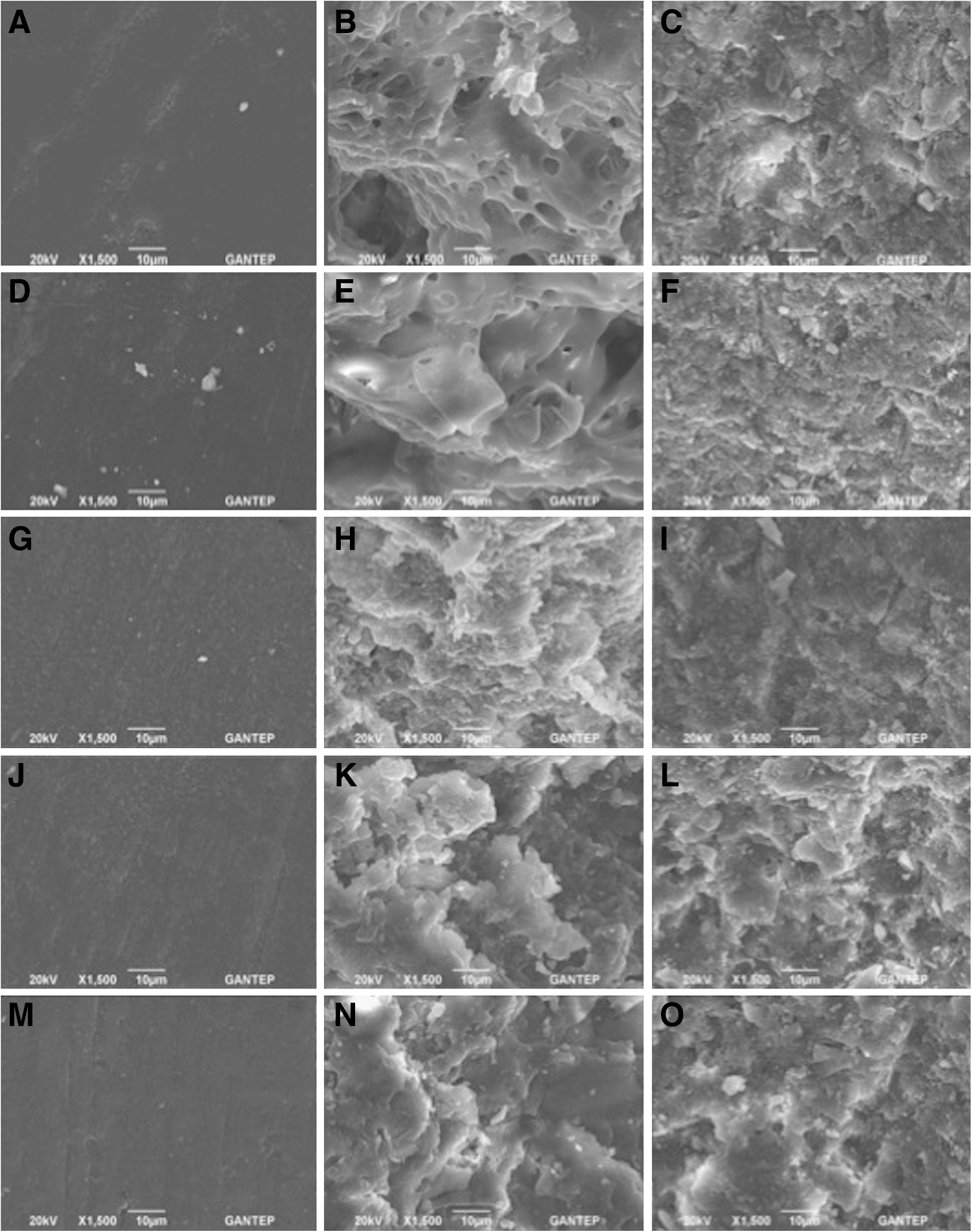
Scanning electronic microscopic (SEM) images of group D specimens (original magnification, 1500×).
Discussion
The results obtained in the present study clearly demonstrate that surface treatments with an Er:YAG laser significantly improved the SBS values between the temporary crowns and orthodontic brackets. Although the highest SBS values were observed in group V specimens, which were composite-based materials, group D specimens (methacrylate-based resin) exhibited higher SBS values than those of group R specimens (composite-based resin). Therefore, the null hypothesis, which stated that surface modifications would not significantly affect the bond strength between temporary crowns and orthodontic brackets regardless of the chemical nature or type of TCMs, was rejected.
In the literature, limited studies were performed on bond strength between orthodontic bracket and TCM after surface treatments. However, same materials, which were used in the present study, were investigated by the researchers and many studies have reported results that both support and contradict the results of the present study. 26,32 –41 Gundogdu et al. 34 investigated the effects of different surface pretreatments (36% phosphoric acid etching, sandblasting with 50 μm Al2O3 particles, and Er:YAG laser irradiation at 10 Hz 150 mJ) on the bond strength of PMMA denture base material. They reported that sandblasting and Er:YAG laser irradiation are ineffective for improving the bond strength of PMMA resin. Nevertheless, etching with phosphoric acid was found to have improved the bond strength of PMMA resin. Therefore, in the present study, the bonding surface of TCMs was altered with phosphoric acid etching.
Al Jabbari et al. 35 researched the bond strength between orthodontic brackets and different TCMs after surface modifications, including grinding with silica carbide paper, polishing with pumice, and sandblasting with 50 μm Al2O3 particles. Contrary to the results of the present study, it was presented that sandblasting had a beneficial effect on SBS of the TCMs. Similar results to those of Al Jabbari et al. 35 were reported by Blakey and Mah, 19 Bahrani and Khaledi, 36 and Usumez et al. 37 In agreement with the present study, Jacobsen et al. 38 and Akin et al. 25 exhibited that roughening the PMMA surface by sandblasting with 50 μm Al2O3 particles does not have a positive effect on the bond. Sandblasting with 50 μm Al2O3 particles was used in the present study, because of these conflicting results in the literature.
On the other hand, in the literature, there were limited studies about surface modification of PMMA or UDMA resins by using laser irradiation. Laser parameters of 10 Hz, 3W, and 300 mJ were used in the present study because they appeared to be the best parameters for roughening PMMA resins compared with 1W and 100 mJ, 2W and 200 mJ, and 4W and 400 mJ. 39 Recently, consistent with the present study, it was demonstrated that altering the PMMA surface by Er:YAG laser significantly increased the bond strengths of PMMA denture base resin. 25,39 Conversely, Usumez et al. 37 reported that laser treatment of PMMA denture base resin increases the surface roughness and bond strength. However, the increase in bond strength was not statistically significant. Furthermore, it was exhibited that laser irradiation on the bonding surface of UDMA resin effectively increased tensile bond strength between the soft lining material and UDMA resin, 40 whereas laser irradiation of the adhesive surface was found to be ineffective in improving bond strength of denture teeth to UDMA resin. 41
Shiu et al. 26 reported that the SBS values of the surface roughening method in which only sandblasting was used were higher than those in which sandblasting plus Er:YAG laser irradiation and only a laser were used. On the other hand, in accordance with the results of the present study, Dilber et al. 33 showed that roughening with sandblasting plus Er:YAG laser irradiation is more effective than sandblasting. In the present study, the sandblasted and acid-etched specimens revealed partially smooth areas in the SEM images when compared with the laser-irradiated specimens. These areas showed reduced surface roughness, which may have been responsible for decreasing the SBS values of the sandblasting and acid applications. Nevertheless, Er:YAG laser application resulted in irregularities and many small pits on the surface of the TCMs. Therefore, adhesive materials can penetrate into the irregularities or pits produced by the Er:YAG laser and increase the strength of the bond.
The main component of both Structure Premium and Protempt 4 is bisphenol A glycerolate dimethacrylate (Bis-GMA), and many studies have evaluated the SBS of Bis-GMA resin or the effect of its addition to another resin. 42,43 In the literature, a consensus has not been reached regarding the effect of Bis-GMA on the SBS. Chen et al. 42 reported that the Bis-GMA resin did not significantly affect the bond strength of the zirconia primer, while Kallio et al. 43 found that the SBS values of the composite of the Bis-GMA/triethylene glycol dimethacrylate (TEGDMA) substrate were significantly higher than those of other substrates. According to the results of the present study, the addition of Bis-GMA resin increased the bond strength of orthodontic brackets.
Rambhia et al. 10 demonstrated that the SBS values of orthodontic brackets to TCMs ranged from 2.81 to 9.65 MPa. Further, these authors found that the SBS of Protemp ranged from 8.33 to 9.65 MPa, which is significantly higher than the results of the present study (3.68 MPa). The bonded specimens were stored in distilled water for 24 h prior to the SBS test in the study by Rambhia et al., 10 whereas the bonded specimens were maintained in a thermocycling machine for 500 cycles in the present study. This likely explains why the values in the present study were lower than those of Rambhia et al. On the other hand, according to literature, several studies reported that the SBS value must be at least 5 MPa, 44 whereas others suggested that it should range from 6.5 to 10 MPa. 45 In the present study, the SBS value of group V was >5 MPa, regardless of the surface treatment. In addition, the laser-irradiated specimens of group P exhibited SBS values that were >5 MPa. Others were not presented sufficient SBS values to withstanding orthodontic force.
Conclusions
Within the limitations of this study, it was concluded that the type of surface treatment, especially Er:YAG laser irradiation, has a significant influence on the bond strength between TCMs and orthodontic brackets. Furthermore, all group V specimens and only laser-irradiated group P specimens presented SBS values>5 MPa, which is a clinically acceptable value.
Footnotes
Author Disclosure Statement
No competing financial interests exist.