




Abstract
Introduction
M
Osteoporosis, a systemic and metabolic disease of the skeletal system, is characterized by the deterioration of bone microarchitecture. 2 The majority of the female population develops postmenopausal osteoporosis after 50 years of age. 3 A patient with this condition may experience problems such as low peak bone mass and reduced new bone formation. 4
Rapid maxillary expansion (RME) and surgically assisted RME are widely used and well-established treatment options in orthodontics and maxillofacial surgery. 5 These treatments are similar to distraction osteogenesis, a model of controlled trauma or fracture that induces osteogenesis at bone edges as they are mechanically distracted gradually over small distances with a considerable cumulative amount of bone formation. 6 For successful treatment, inducing new bone formation within the expanded area, and reducing the currently observed relapse tendency of 20–25%, must stabilize the expanded tissue. 7
Low-level laser therapy (LLLT) has been used to accelerate the regeneration of bone tissue. 8 Previous studies showed that LLLT accelerates bone regeneration in the midpalatal suture after RME in rats. 9 Considering that osteoblasts are responsible for bone formation, LLLT may exert a stimulatory effect on osteoblastic activity when such treatment is applied to bone tissue. 10 Although there are many studies, which researched acceleration of bone regeneration in the midpalatal suture after LLLT, the application of LLLT to the midpalatal suture after RME were never researched on ovariectomized rats. To address the aforementioned issues, this study evaluated the effects of LLLT on bone regeneration in the expanded premaxillary suture in an ovariectomized rat model.
Materials and Methods
For the experiment, 32 12-week-old female Wistar albino rats were used. The rats were separately housed in plastic cages under artificial lighting from fluorescence lamps at a 12:12 h light-dark cycle. The temperature of the cages was set at 5°C, and food and water were provided ad libitum. The Animal Ethics Committee of the Gaziantep University approved of this study, which was conducted in accordance with the guidelines for the use of laboratory animals.
All of the animals were anesthetized by intraperitoneal administration of xylazine and ketamine, and then subjected to ovariectomy. Ovariectomy was preceded by a 3 cm long midline dorsal skin incision, approximately halfway between the middle of the back and the base of the tail, according to the method described by Lasota et al. 11 The animals were monitored for infection.
Three months after ovariectomy, all the animals were re-anesthetized by intraperitoneal administration of xylazine and ketamine. Subsequently, expansion appliances that consisted of helical springs fabricated from 0.30-mm stainless steel wires were affixed to the maxillary incisors of all the animals for the expansion of premaxillary sutures. The springs were placed on a grid and activated using pliers. The initial expansion force was measured with a gauge (Cortex Tension Gauge, Haag Streit AG, Switzerland) and adjusted to 30 g. A stainless steel disk was used to prepare a groove at the level of the gingival papilla on the distal sides of the incisor teeth to ensure retention. Then, a 0.23-mm stainless steel ligature wire was used to fix the spring. Seven days after the expansion period, retainers were installed in the rats and maintained for 10 days (total 17 days). The animals were monitored for infection or appliance failure throughout the study.
The rats were randomly divided into two groups (n=16 rats each): the laser group (LG) and the control group (CG). In the first group, LLLT was administered 4 days after expansion began. In the second group, all the procedures were implemented in the same manner as the first group, except for laser therapy. All the rats in both groups were euthanized on either the 7th day (n=8) [end of expansion period; Laser Group 1 (LG1) and Control Group 1 (CG1)] or the 17th day (n=8) [end of retention period; Laser Group 1 (LG1) and Control Group 2 (CG2)] for histological assessment.
For the laser group, the premaxillary sutures of the animals were irradiated daily with a Ga-Al-As diode laser (model: Fotona XD-2 diode laser, Fotona, Ljubljana, Slovenia) from the 1st to the 4th days. A diode laser device with a continuous wavelength of 808 nm was used, and laser therapy was administered with a 320 μm fiber handpiece operated in a sliding motion. The rats were exposed to laser energy at 250 mW (0.25 W) for 20 sec (0.25 W×20 sec=5 J) daily at once. The premaxillary region (∼1 cm2 area) of the laser group was intraorally exposed to 5 J (5 J/cm2) of low-level laser irradiation 1 cm from the target tissue (Fig. 1). No treatment was performed for the controls.
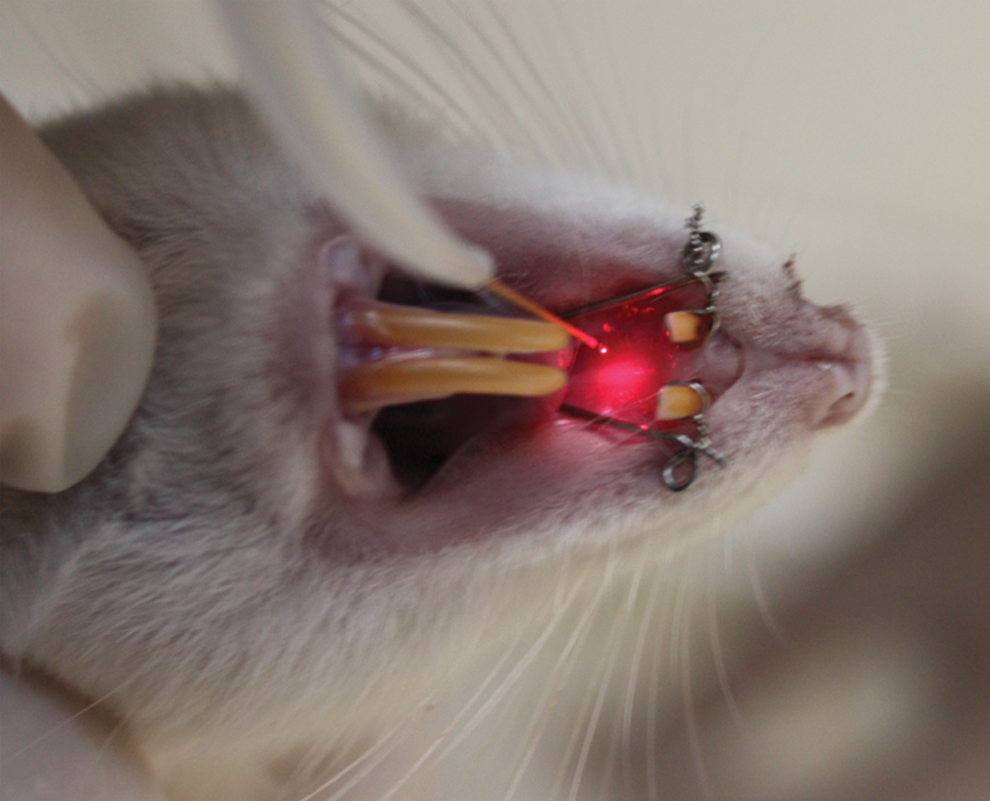
Administration of laser therapy with a 320 μm fiber handpiece operated in sliding motion.
When complications, such as infection, rapid decrease in body weight, or appliance failure, were encountered, the animals were excluded from the study.
All of the rats were euthanized after the experiment with an overdose of intraperitoneal anesthetic solutions. Afterwards, the heads of the rats were removed for histological evaluation. Then, the springs were removed and the specimens were decalcified with aqueous 10% formic acid solution, after which they were dehydrated and embedded in paraffin. The maxillary incisor served as the primary guide for orienting the sections. The section was cut perpendicular to the sagittal plane and was determined by two points, one at the alveolar crest and the other 4 mm apically. This plane passes through the center of the incisor crown at its gingival portion. The paraffin blocks were sliced into 5 μm thick sections and prepared for hematoxylin and eosin staining before optical microscopic examination. Measurement for bone histomorphometry was performed, centering on the premaxillary suture and 175–250 μm (sections, 35–50) below the surface of the osseous palate facing the oral cavity. This procedure was adopted because bone formation in the surface area was sometimes irregular and unsuitable for quantitative measurement.
Two examiners blinded to the identity of the sections performed histomorphometric evaluation, and the average of the counts was obtained. Three histological sections from each animal were analyzed. The study and control groups were compared to establish the number of osteoclasts, osteoblasts, and capillaries, as well as the intensity of inflammatory cells and new bone formation. The sections were rated as mild (+: 0–25 cells), moderate (++: 25–50 cells), strong (+++: 50–75 cells), or very strong (++ ++: +75 cells) for the osteoblastic cells. 5
Statistical analysis
All the data were analyzed with commercially available software (SPSS 14.0). The differences in the number of osteoclasts and osteoblasts among the four groups were evaluated using the Kruskal–Wallis test, and pairwise comparisons were made using the Mann–Whitney U test. The difference was considered statistically significant at a p value of <0.05.
Results
The animals did not show obvious signs of systemic illness throughout the study. Deep mucosal infection, dehiscence, or other adverse effects were not encountered in any of the animals. The midpalatal suture was successfully expanded by the activated helical spring. Because of appliance failure, one rat in the LG2 group, one rat in the CG1 group, and 1 rat in the CG2 group were excluded from the study. Additionally, two rats in the LG1 group and one rat in the LG2 group died.
Histomorphometric findings
Number of osteoblasts
Histological findings indicated that the LG1 group showed a significantly higher number of osteoblasts than did the CG1 group (p=0.028). The CG1 group had the lowest number of osteoblastic cells (Table 1). No statistically significant differences were found among the other groups.
p<0.05 compare with CG1.
p<0.05 compare with LG1.
p<0.05 compare with LG2.
CG, control group; LG, laser group.
Number of osteoclasts
All the four groups had osteoclasts. Table 1 presents the number of osteoclasts in the groups. The CG1 and CG2 groups showed a significantly higher number of osteoclasts than did the LG1 and LG2 groups, respectively (p=0.005), (p=0.032). The LG1 group had the lowest number of osteoclastic cells (Table 1).
Number of capillaries
The LG2 group showed a capillary increase similar to that of the other groups, without statistically significant differences (Table 1).
Histological analysis
On the 7th day, although thin trabecular bone with numerously osteoblasts was observed only in LG1, connective tissue was seen in both LG1 and CG1 (Figs. 2a,b and 3a,b). These characteristics indicate a more advanced healing process in the laser group (LG1). On the other hand, inflammation was more easily detected in the CG1 group than in the LG1 group.

(

On the 17th day, both the LG2 and CG2 groups showed increased connective tissue and irregular bone formation (Figs. 4a,b and 5a,b). However, inflammation was more intense in the CG2 group.The LG2 group presented better ossification than did the other groups.


Discussion
Various experimental studies have been conducted to shorten the period for fracture healing or distraction osteogenesis protocols. 12 To stimulate bone healing, certain materials (e.g., autologous marrow cells, demineralized bone matrix, vitamin D analog, and cultured periosteal cells) were transplanted into the lengthened area. 12,13 To stimulate callus formation, some mechanical procedures 14 were performed; electrical stimulation. 15 , electromagnetic stimulation, and LLLT 8,10 were applied to the healing region. 16 Despite the progress made with these methods, however, they have not been applied to ovariectomized rats, which is a model for postmenopausal osteoporosis.
Resorption by osteoclasts and apposition by osteoblasts continuously occur in healthy bone, and these processes are balanced in a normal adult skeleton. Conversely, bone loss occurs because resorption exceeds formation in osteoporotic patients. Although men also develop osteoporosis, this condition is particularly common among women who have reached menopause. The increased risk at menopause indicates that the ovaries no longer produce estrogen, a key factor in maintaining bone strength in women after menopause.
Some animal models were created for stimulation of osteoporosis. Animal models provide uniform experimental materials and allow for extensive testing of potential therapies for osteoporosis. 17 Rats are currently the principal laboratory animals used to investigate this process, because they are inexpensive to maintain and widely available, and they rapidly grow, but have relatively short life spans. 18 In this study, we subjected all the rats to ovariectomy to generate an accepted model of postmenopausal osteoporosis; this approach was preferred, because the pathological processes found in this model are similar to those found in humans. 19
Osteoporosis is a clinically and epidemiologically relevant disease because of consequent fractures. Osteoporotic fracture carries considerable economic and social costs in many countries, as well as increased morbidity and mortality. Although the healing of a fracture in osteoporotic bone passes through normal stages, it is also prolonged. 20 Osteoporosis increases the risk of fracture and represents a problem in the osteofixation of fractures in fracture treatment. 21 Hsieh et al. 22 pointed out that estrogen deficiency negatively affects alveolar bone turnover following tooth extraction. Walsh et al. 23 also suggested that ovariectomy impaired fracture healing. Wang et al. 24 reported that osteoporosis influencesd the middle and late periods of fracture healing in a rat osteoporotic model.
Because the healing process is prolonged in osteoporotic patients, 20 several studies have been performed to stimulate bone healing in ovariectomized rats. 2,25 –27 Sener et al. 2 investigated the effect of zoledronic acid on mandibular fracture healing in an osteoporotic model. The authors reported no significant difference between the experimental groups. Benghuzzi et al. 26 suggest that estrogen administered in a sustained fashion reverses the decline in bone strength and re-establishes bone quality in ovariectomized rats to that which is similar to ovary-intact controls. Shuid et al. 25 studied an osteoporotic rat model to investigate the effect of calcium supplements on fracture healing. They suggest that calcium supplements improve fracture healing of osteoporotic bone, but fail to improve strength. In another study, Nozaka et al. 27 indicated that the administration of human parathyroid hormone enhances bone formation and union at the site of cancellous bone osteotomy in normal and ovariectomized rats. Although various studies have been devoted to the stimulation of bone healing in osteoporotic rat models, none of these methods have been applied to sutural regions during maxillary expansion procedures.
RME is characterized by midpalatal suture opening. As a patient becomes older, the period of treatment also lengthens. Another controversial point is the stability of maxillary expansion. 28 Studies confirm that 8–9 months of stabilization with an expander appliance is necessary to guarantee the complete ossification of the midpalatal suture. 29 Saito and Shimizu 9 evaluated the effect of LLLT on bone regeneration in the midpalatal suture in rats. They suggested LLLT to be an effective approach to accelerating bone regeneration, especially during initial stages of bone formation. Da Silva et al. 10 also reported the in vivo stimulatory effects on bone formation observed in the midpalatal suture after RME following LLLT; these effects were caused by an increase in the proliferation and expression of osteoblastic activity. We also found that LLLT stimulates bone regeneration in the midpalatal suture after RME, even in ovariectomized rats.
Some researchers conducted different studies to evaluate the effect of LLLT on bone healing in ovariectomized rat models. 30 –32 Garcia et al. 30 histologically analyzed the effect of LLLT combined with bisphosphonate on bone healing in surgically created defects in rat calvaria. The authors concluded that LLLT may or may not be associated with bisphosphonate treatment, which effectively stimulates bone formation in the calvaria of ovariectomized rats. To evaluate the osteogenic potential of recombinant human bone morphogenetic protein-2 (rhBMP-2) and LLLT, Siéssere et al. 31 created bone defects in the parietal bone of an experimental animal model. The authors concluded that pure rhBMP-2 and a single dose of laser application stimulated new bone formation. Pires-Oliveira et al. 32 determined the action of AsGA laser irradiation on bone repair in the tibia of osteopenic rats. Low-level 904 nm laser accelerated the repair of osteopenic fractures, especially in the initial phase of bone regeneration. In this study, we found that bone regeneration in the suture and accelerated healing in the LG groups were better than those in the controls in the ovariectomized rat model.
Conclusions
On the basis of our methodology and results, we conclude that low-level laser associated with RME influences the bone regeneration process in sutures, thereby accelerating healing even in ovariectomized rats. However, no evidence was derived as to whether laser therapy effectively prevents relapse via RME procedures in ovariectomized rats. Because LLLT decreased osteoclastic activity in the ovariectomized rats, osteoporosis prevention necessitates further investigations to clarify the effect of LLLT on postmenopausal patients.
Footnotes
Acknowledgment
This study was supported by the Gaziantep University Scientific Research Projects Governing Unit (Project No: DHF.10.02).
Author Disclosure Statement
No competing financial interests exist.