




Abstract
Introduction
P
Positive effects of photoexposure may be seen as a mixture of stimulation and inhibition of cellular pathways, and it is preferable to use the term “photobiomodulation” to reflect the overall net benefit to the organism through such effects. In general, PBM may be interpreted through a general increase of metabolic rate and cell division, reflecting the utilization of incident photonic energy transfer. Possible parameters that may affect PBM may include laser wavelength, spatial coherence of the irradiation, and energy dose over time (power density effects). 2 Recently, in order to simplify the irradiation procedures and to allow a more homogenous irradiation, Vallone et al. 3 used a flat-top handpiece that allows an even distribution of irradiation of a 32 cm2 area with the same power density when employing a 980 nm diode laser.
The use of protozoa has been proposed as subjects in non-animal biotests in standardized laboratory procedures, to assuage a public opinion that is increasingly sensitive to bioethical matters and to meet the requests of both the Interagency Coordinating Committee on the Validation of Alternative Methods (ICCVAM) and the European Centre for the Validation of Alternative Methods (ECVAM) for compliance with the 3Rs strategy (Reduce, Reuse, Recycle). 4 Among such protozoa, Paramecium sp. is a popular choice because of their fundamental features. 5 Paramecium primaurelia is a unicellular eukaryote organism living in fresh water. Paramecium is a most common ciliate that multiplies very quickly by transverse binary fission; like many ciliates, P. primaurelia shows a metagenetic life cycle with asexual and sexual reproductive processes. Asexual reproductive process occurs during favorable conditions of food, and results in genetically identical progeny (clones). Sexual reproductive process, termed “conjugation,” is the temporary pairing of two individuals of the same species, but from two different mating types for the exchange of micronuclear material. This process does not generate clones, and occurs during starvation conditions. The starvation stimulus can induce the autogamy process too. Autogamy is a type of nuclear reorganization occurring in P. primaurelia, which resembles conjugation but occurs inside the single individual. 6,7
The aim of this investigation was to identify a laboratory assay to test the effect of an infrared (IR) diode laser light (808 nm) on cell fission rate. A laboratory test was performed, using the protozoa P. primaurelia. An advantage of using protozoa in laboratory studies is that their short cell cycles allow the analysis of the effects of environmental perturbations on a conspicuous number of cells, genetically homogeneous populations (clones), and successive generations in a short time. In addition, the absence of a cellular sheath in the vegetative state allows the protozoa to respond to the stimulus more rapidly than bacteria and yeasts. Furthermore they can be cultured in the laboratory under conditions very similar to those in nature, making their response more reliable than that of animal cell cultures cultured in artificial conditions. 4,8,9
This study involved the assessment of changes in both Paramecium's cell fission (mitosis) rate and the pH and temperature of Paramecium's culture medium, associated with applied photonic irradiation by means of a 808 nm wavelength diode laser with a flat top handpiece.
Materials and Methods
P. primaurelia and culturing methods
Cell cultures of P. primaurelia were grown at a temperature of 24°C in tubes with infusion of lettuce inoculated by Enterobacter aerogenes as food. The lettuce infusion medium was obtained by drying green leaves from organic farming lettuce for 1 h at 180°C. Thirty grams of dried leaves were boiled for 15 min in 1 L of distilled water. The obtained concentrated infusion was filtered and fractionated into tubes (10 mL per tube). The tubes were closed, properly autoclaved at 120°C for 20 min and subsequently stored at 4°C. A concentrated infusion was diluted in 500 mL of distilled water, balanced to pH 7.1 and autoclaved (120°C, 20 min) into 50 mL tubes.
Paramecium experimental samples and irradiation with 808 nm IR diode laser
P. primaurelia cells within an environment that would support favorable asexual reproductive process were transferred onto a depression slide. The cells were starved until signs of autogamy were noted; this process would determine a nuclear reorganization that would allow the age of the Paramecium cells to be measurably determined. The autogamy was detected by 4′,6-diamidino-2-phenylindole (DAPI), a fluorescent stain that highlights (in blue) the intact macronucleus (Fig. 1B, C) of the cells undergoing asexual reproductive process and the fragmented macronucleus (Fig. 1E, F) of the cells in an autogamous reproductive process. The cell culture was considered to be in the autogamy phase when 100% of 30 cellular samples showed the typical fragmented macronucleus. The autogamous cells were isolated by a glass micropipette in a depression slide and fed.
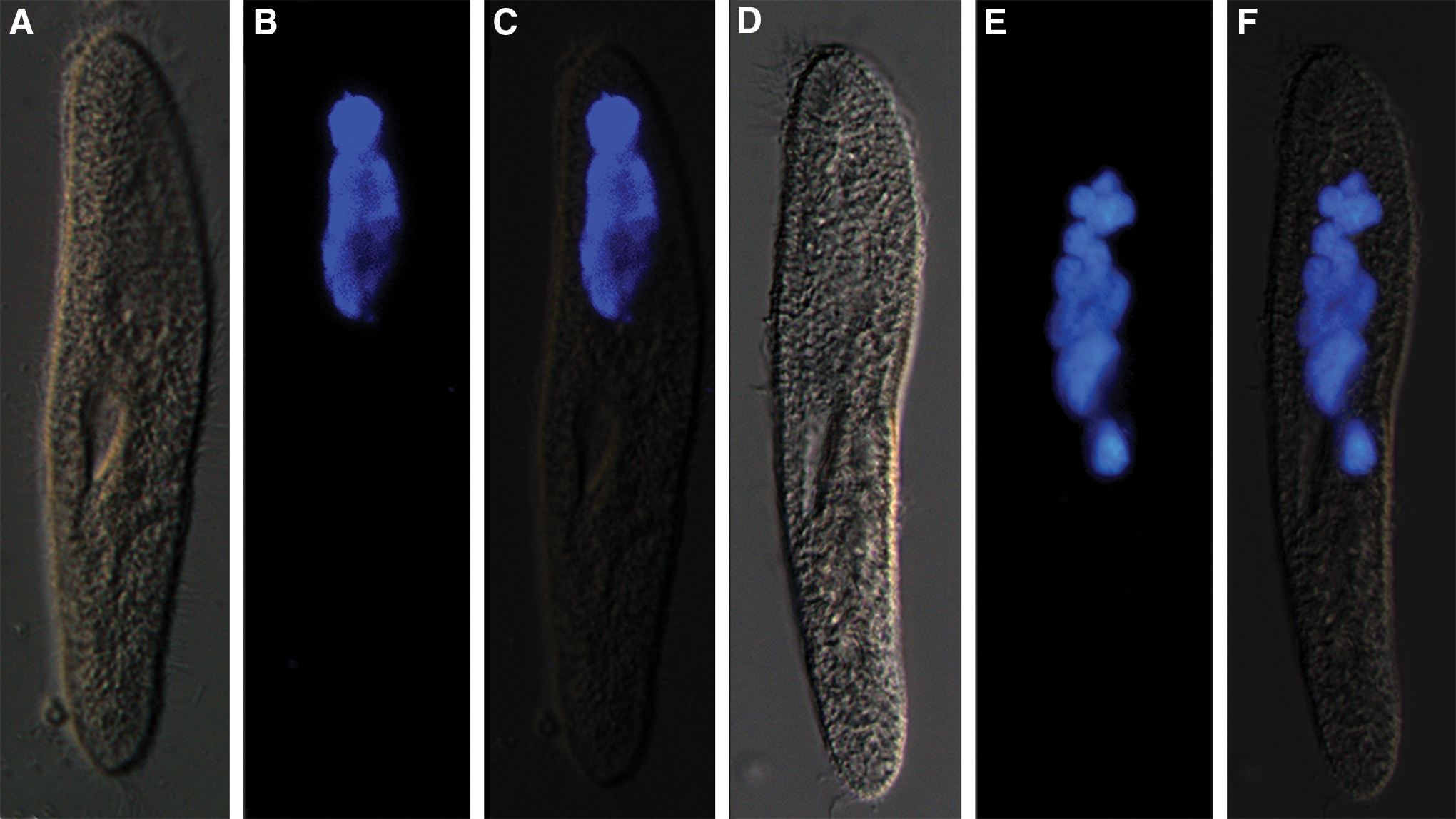
Paramecium primaurelia cells during asexual (
Ten days after the autogamy phase, the cells in division were isolated in two depression slides (control and exposed sample). Smith-Sonneborn and Klass 10 stated that Paramecium cells deriving from the autogamy phase have a constant fission rate from 10 up to 30 days from that sexual process. Thirty cells (exposed samples) were transferred by a glass micropipette into 30 Eppendorf tubes (one cell for tube), wrapped with aluminum foil to avoid light transmission and to allow light scattering. The Eppendorf tubes, containing 1 mL of sterile infusion of lettuce, were then irradiated from above, at the temperature of 24°C for 50 sec by a 808 nm diode laser (Wiser, Doctor Smile, Vicenza, Italy). The output power of the laser was checked by a power meter (Coheren-Ca, USA) and laser operating parameters were: the use of a flat top handpiece, 1 cm of spot diameter, 1 W in continuous wave (CW), 50 sec irradiation time, and 64 J/cm2 of fluence. The handpiece was kept in contact with the Eppendorf tube during laser irradiation. Thirty cells (control sample) were transferred into 30 Eppendorf tubes with 1 mL sterile infusion of lettuce, at a temperature of 27°C, for 50 sec. The 27°C temperature was chosen because preliminary observations suggested that laser irradiation with operating parameters as described would result in a temperature rise of the infusion medium of 3°C.
After the treatment, the cells were transferred onto 30 depression slides (one cell per slide), fed, and incubated in a moist chamber at a temperature of 24°C. The cells were monitored every 30 min, and the time between two cellular divisions was measured and recorded. After the cellular division, one of the two control daughter cells and one of the two exposed daughter cells were isolated into a Eppendorf tube and nonirradiated or irradiated as described. The cells were exposed, monitored, and isolated for 10 consecutive fission cycles. This division number is optimal, as it allows for the effect on a significant number of successive generations to be observed in a short time, and is very far from the P. primaurelia lifespan (340 fission cycles), 11 therefore excluding the influence of aging on the results.
Irradiation of lettuce infusion medium with 808 nm IR diode laser
The possible effect of the 808 nm IR diode laser light on both the temperature and pH of the lettuce infusion was evaluated by measuring these parameters, before and after the exposure to the laser using an HI 2211 pH / ORP Meter (Hanna Instruments, Carrollton, TX).
Statistical analysis
The statistical analysis was performed using a two way ANOVA followed by the Student–Newman–Keuls multicomparison test to discriminate statistically significant results (software SPSS version 13.0 for Windows)
Results
Effect of 808 nm IR diode laser on fission rate
Figure 2 shows the data relevant to the effects of the irradiation of 808 nm IR diode laser on Paramecium cells' fission rate. The exposed cells have, during the 10 cellular divisions, observed a fission rate rhythm faster than that of the control cells, showing a time that passes between one binary fission and another that is significantly (p<0.05) shorter than in unexposed cells.

Effect of 808 nm infrared diode laser light biostimulation on Paramecium primaurelia fission rate. The vertical (x) axis indicates the time (in hours) between one binary fission and another. The y axis indicates progressive cell fission rate. The values that are significantly (p<0.05) different from their controls are indicated by an asterisk (*).
Effect of 808 nm IR diode laser on lettuce infusion
Figure 3 shows the data relevant to the effects of the irradiation of 808 nm IR diode laser on the pH and temperature of Paramecium's lettuce infusion medium. The lettuce infusions exposed to the laser have a pH value not significantly different (p>0.05) from that of the unexposed infusions (control). Instead, the laser affects the infusion temperature that increases significantly (p<0.05) by ∼3°C.

Effect of 808 nm infrared diode laser light biostimulation on Paramecium's lettuce infusion medium. The values that are significantly (p<0.05) different from their controls are indicated by an asterisk (*).
Discussion
The history of using light and color for health and healing (heliotherapy) can be traced back thousands of years in human history. The nineteenth century saw a resurgence of this concept, with the use of colored light sources for the promotion of wound healing and pain reduction. Niels Finsen (Denmark) developed the first artificial light source for the purpose of treating lupus vulgaris. He received the Nobel Prize in Physiology or Medicine in 1903. The latter half of the 20th century witnessed a rediscovery of the science by researchers such as Gurwitsch (Russia), Mester (Hungary), Karu (Russia), Fröhlich and Popp (both from Germany). In 1967, Endre Mester 12 experimented with the effects of lasers on skin cancer and saw that while applying laser photonic energy (ruby 694 nm) to the backs of shaven mice, the shaved hair grew back more quickly on the treated group than on the untreated group. During a period of 40 years, >2000 formal research articles have been published in the area of IR laser radiation, and what has become known as PBM. 1
The first law of photobiology states that for low power visible light to have any effect on a living biological system, the photons must be absorbed by molecular photoceptors or chromophores. 13 An example of such chromophores is cytochrome c oxidase (Cox), found in cell mitochondria. 2 Laser wavelength and photonic energy are inversely proportional. The absorption of incident energy and consequent intersystem crossing and transfer by a chromophore is critical, in that excess energy may result in inhibition or otherwise deleterious effects. As such, it has been proposed that a wavelength range from visible red to near IR (600–1200 nm), an “optical window,” would offer optimal beneficial effects. 14,15 The choice of a diode laser wavelength in delivering PBM effects has been well documented. 16 –21 Additionally, investigation has been conducted into the possible influence of spatial coherence and irradiation dose on PBM. Low-level photonic irradiation may be achieved with either a laser or a light-emitting diode (LED). Fundamental differences are found in the exact value of the emission wavelength (LED emission will have a bandwidth of 10–50 nm) and coherence of the beam waves. Laser emission waves are in phase, whereas LED emission is incoherent and disorganized. However, in both cases, the claims to superiority may be equivocal, with outcomes cited that, although beneficial, may not be statistically significant in their difference. 22 –26 Certainly, dose-related response to visible and near IR photonic energy in terms of PBM effects is both crucial and well documented. 15 –20,25 –29
In this investigation, P. primaurelia cells were exposed to the 808 nm IR diode laser light. The protozoa are considered excellent laboratory models over a long period of time. 30 Because of their nature as eukaryotic single cells/organisms, the protozoa exhibit a relatively simple organization and a high degree of specialization. As organisms, like the metazoan, they respond directly to environmental stimuli; as single cells, which expose their receptors directly to the surrounding environment, they are more sensitive to environmental modifications than the metazoan cells, which have developed complex apparatuses and structures that respond to environmental stimuli according to their diverse functions. 4 Furthermore, because a of common ancestor with the metazoan, the experimental response of the protozoa can be correlated with those of the more developed organisms. 31 It is important to emphasize how in protozoa, the identification of molecules responsible for neurotransmission in metazoan, 9,32 –36 as well as the genomal sequencing of several protozoa, 37 –39 has demonstrated that they can represent excellent bioassay in field studies on human health, 40 such as the effects of pesticides, 31 and extremely low frequency electromagnetic fields 41 –44 The characteristics listed make the protozoa excellent biological assay tools, combining the reliability of in vivo results with the practicality of in vitro ones, and representing a fast and cheap standardized model alternative to the more expensive mammalian cellular cultures. 5,31
Results show a precocious fission rate for all cells observed during the 10 binary fissions examined, and confers well with a preliminary study on Paramecium sp. exposed to 904 nm IR laser light. 45 A precocious fission rate is a shortening of the length of time that passes between one binary fission and another. This time lapse, as measured in the present study, was an average of 6.7 h±0.5 for the cells exposed to 808 nm IR diode laser light, compared with 8.9 h±0.6 for the control cells. It is known that the entry into mitosis of eukaryote cells might be coupled somehow to the availability of metabolic energy. 46 Therefore, the effect on Paramecium can be attributed to an action of the laser light on cellular metabolism with a positive intensifying type effect. This can occur as described for lymphocytes that increase the intracellular adenosine triphosphate (ATP) level after irradiation by IR laser light of 904 nm wavelength. 47 Finally, the exposure of the lettuce infusion to the laser indicates that the precocious fission rate observed in Paramecium is not the result of both the pH and the temperature change. During the 50 sec of exposure, the pH of the infusion is not altered by the laser, and its temperature increases by ∼2.96°C (±0.30), from 24.03°C (±0.20) up to 27°C (±0.10), the same temperature to which the control group was exposed.
Conclusions
Our results lead to the conclusion that: 1. The 808 nm IR diode laser light at the irradiation parameters used in our work results in a precocious fission rate in P. primaurelia cells, probably through an increase in metabolic activity that is secondary to an energy transfer. 2. P. primaurelia shows a response to the 808 nm IR diode laser light biostimulation similar to that of mammalian cellular cultures, highlighting its excellence as a non-animal bioassay, and combining the reliability of the results with fast and cheap experimental tests. 3. The use of a flat top handpiece compared with a defocused conventional handpiece with a Gaussian profile will enable irradiation of a target surface with a homogenous energy density. This would enable the application to be repeatable and not operator sensitive, with higher fluences and without a dangerous thermal increase.
Footnotes
Author Disclosure Statement
No competing financial interests exist.