




Abstract
Introduction
I
Failures of zirconia posts, however, predominantly result from loss of retention at the post/cement interface. Unlike conventional ceramics, zirconia has a highly crystalline glass-free structure, characterizing zirconia as acid-resistant material. 8 –12 Moreover, conventional surface pretreatment procedures, including acid etching and silanation, were ineffective to establish a reliable and predictable bond between zirconia and resin cement. 4 Therefore, efforts by many manufacturers and researchers have been performed to modify the surface energy characteristics of a zirconia post for promoting the resin-ceramic bonding. Airborne-particle abrasion, 9,10,13 –16 tribochemical silica coating, 17 hydrofluoric acid, 18 metal or alloy primer, 12,18 and piranha solution 9 have been used. Recently, solid or gas state lasers have become increasingly popular in dentistry because of the positive reports of roughening the ceramic surface with Nd:YAG or Er:YAG lasers. 4,10,15,16
In the existing literature, there are little data regarding the effect of lasers on the zirconia posts. Hence, investigation of the microtensile bond strength (μTBS) between zirconia posts and resin cement was undertaken with different surface treatments, including sandblasting, silica coating, Nd:YAG and Er:YAG laser treatments. It was hypothesized that surface treatments significantly affected the bond strength between the zirconia posts and resin cement.
Materials and Methods
Table 1 presents materials and their compositions used in this study. Twenty-five zirconia posts (CosmoPost, Ivoclar Vivadent AG, Schaan, Liechtenstein) with a diameter of 1.4 mm were randomly divided into five groups of five posts each to be processed using different conditioning methods: control (C), airborne-particle abrasion (AA), silica coating (SC), Nd:YAG laser irradiation (N), and Er:YAG laser irradiation (E).
ZrO2, zirconium dioxide; Bis-GMA, bisphenol glycidyl methacrylate; TEGDMA, triethyleneglycol dimethacrylate; UDMA, urethane dimethacrylate; Al2O3, aluminium oxide.
Zirconia posts were subjected to a surface roughness profilometer (Mitutoyo surftest SJ-401; Mitutoyo Corporation, Kanagawa, Japan) to evaluate roughness values (Ra) of the specimens after surface treatments. Therefore, Ra values were measured before surface treatments. A measurement was performed with a 5 μm radius diamond stylus at a length of 0.8 mm and a speed of 1 mm/sec. In this way, three readings were performed for each specimen and average Ra values were calculated for all specimens.
Surface treatments
Group C: untreated (control)
Post surfaces received no surface treatment.
Group AA: airborne-particle abrasion
Aluminum oxide (Al2O3) particles (110 μm) (Ney, Blastmate II, Yucaipa, CA) were applied on the surface of the specimens at 2 bars for 10 sec. Application distance of 10 mm was adjusted by using a special holder. Remnants were removed from the specimens by using running tap water and oil-free compressed air for 10 sec.
Group SC: silica-coating
Silica-modified Al2O3 particles (30 μm) (CoJet Sand) were sprayed on the surface of the specimens with an intraoral airborne-particle abrasion device (Co-Jet, 3M ESPE, St Paul, MN) at 2 bars for 10 sec. In order to adjust application distance of 10 mm, a special holder was used.
Group N: Nd:YAG laser irradiation
Nd:YAG laser (Smarty A10, Deka Laser, Florence, Italy) was applied on the specimens in free-running pulse mode with air cooling for 20 sec. Laser optical fiber with a diameter of 300 mm was contacted on the surface during application. Laser energy was delivered with an output power of 1 W, 100 mJ pulse energy, 10 Hz repetition rate, and 300 μs pulse duration. Therefore, energy density was 141.54 J/cm2.
Group E: Er:YAG laser irradiation
An Er:YAG laser (Smart 2940D Plus, Deka Laser, Firenze, Italy) irradiation with the parameters of 1.5 W, 150 mJ, 10 Hz, and 700 μs was delivered on the specimens. Laser irradiation was performed in free-running pulse mode by a 4 mm diameter titanium articulated arm transmission system. In addition, a special holder was used in order to fix an application distance of 10 mm. Laser irradiation was applied for 20 sec with a water cooling device and 119.42 J/cm2 of energy density was used.
Procedures following treatments
Following surface treatments, surface roughness of the posts were measured as described before. Furthermore, representative post specimens were photographed with a scanning electron microscope (SEM) (JSM-5200, JEOL, Tokyo, Japan) at 1000×magnification. After coding, prior to keeping in a desiccator containing phosphorous pentoxide during 24 h, the specimens were fixed on brass carriers individually and a gold thickness of 200 Å sputtering (Fisons Instruments, Polaron SC502, Uckfield, England) was then performed on them. SEM was operated in the secondary electron (SE) mode under 20 kV accelerating voltage in vacuum (3x10⁻⁴ Pa) and 80 μA beam current.
Microtensile testing
Ten transparent plastic matrixes (42 mm×10 mm×1.4 mm) were used for preparing microtensile test specimens. Prior to application of a dual-cured resin composite (Variolink N, Ivoclar Vivadent AG, Schaan, Liechtenstein) on the posts, adhesive procedures were followed according to the manufacturer's instructions. They were light cured for 10 sec via a halogen light curing unit (Hilux 550; Hilux, Ankara, Turkey). In order to ensure optimal polymerization of the resin material, additional 40 sec irradiations were performed from each side of the plastic matrixes (Fig. 1A). After removing cemented posts from the plastic matrixes, they were serially sectioned perpendicular to the long axis using a slow-speed diamond saw (Isomet Low Speed Saw, Buehler Ltd., Lake Bluff, IL) under running water. in order to obtain rectangular sticks with 1 mm thickness (Fig. 1B). Six slabs were obtained from each stick for a μTBS test (n=24).
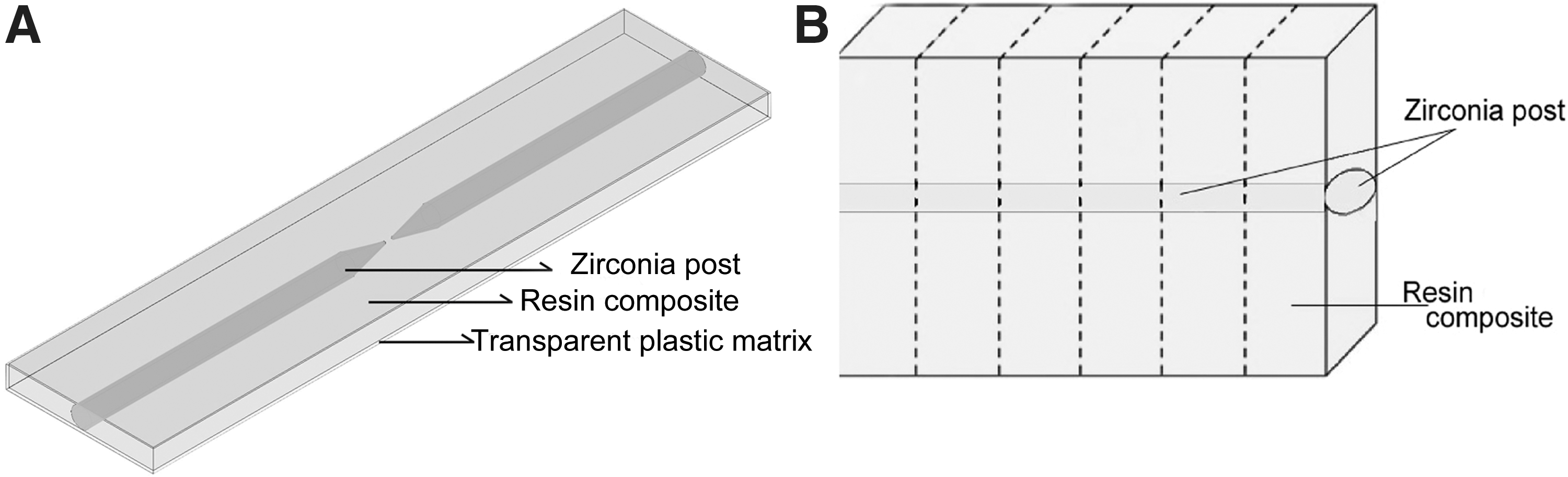
Specimen preparation for microtensile bond strength testing.
A universal testing machine (Lloyd LF Plus; Ametek Inc., Lloyd Instruments, Leicester, UK) at a crosshead speed of 0.5 mm/min was used for the μTBS test. Each sticks were subjected to a custom jig using a cyanoacrylate adhesive (Model Repair II Pink, Dentsply-Sankin, Otawara, Japan) and loaded in tension until failure occurred. The cross-sectional area of the fractured sticks at the site of failure was measured with a digital caliper (Altas 905; Gedore-Altas, Istanbul, Turkey) to the nearest 0.01 mm. Bond strength values (N) were calculated from this measurement and expressed in MPa. The data were analyzed using a one way ANOVA test. In addition, post-hoc Tukey comparison tests were performed at a 0.05 significance level.
Failure analysis
Fractured specimens were analyzed by same researcher using a stereomicroscope (SMZ 800, Nikon, Tokyo, Japan) at 40×magnification in order to evaluate fracture patterns, which were classified as either adhesive (total separation at the interface between resin and post), cohesive (within the post or the composite), or mixed (partially adhesive and partially cohesive in the same interface).
Results
The mean values and standard deviations of μTBS and surface roughness for all groups are demonstrated in Table 2. Analysis of data revealed that all surface treatment groups demonstrated significant higher μTBS values than the group (F=29.485 and p<0.001). The highest mean force value was observed in group SC, followed by group E. Furthermore, similar bond strength results were detected between group SC and group E (p=0.669), group AA and group N (p=0.687), and group N and group E (p=0.052).
For bond strength: values with small letters indicate no statistically significant difference (p>0.05).
For surface roughness: values with capital letters indicate no statistically significant difference (p>0.05).
On the other hand, one way ANOVA revealed that the highest mean roughness value was observed in group N, and significant difference was found between group N and all other groups (F=18.775 and p<0.001). When surface treatment methods (except group N), were compared, none of them resulted in significant improvement in roughness values of the post (p<0.05).
According to fracture analysis, all groups of specimens predominantly presented adhesive failures (Fig. 2). Furthermore, the highest cohesive failure mode (17%) was seen in group SC and group E specimens. Similarly, the highest mixed failure mode (13%) was detected in group SC specimens.

Failure type distributions of groups for each specimen.
Figure 3A–E shows the representative specimens of the investigated pretreatment procedures. SEM images revealed that untreated post surface and Er:YAG laser treated surface are similar, whereas Nd:YAG laser irradiated post surface exhibited some irregularities. However, group AA and group SC specimens demonstrated different surface morphology from those of groups C, N, and E. Canals or fibrillar structures on the surface of the specimens of group AA and group SC were not observed.
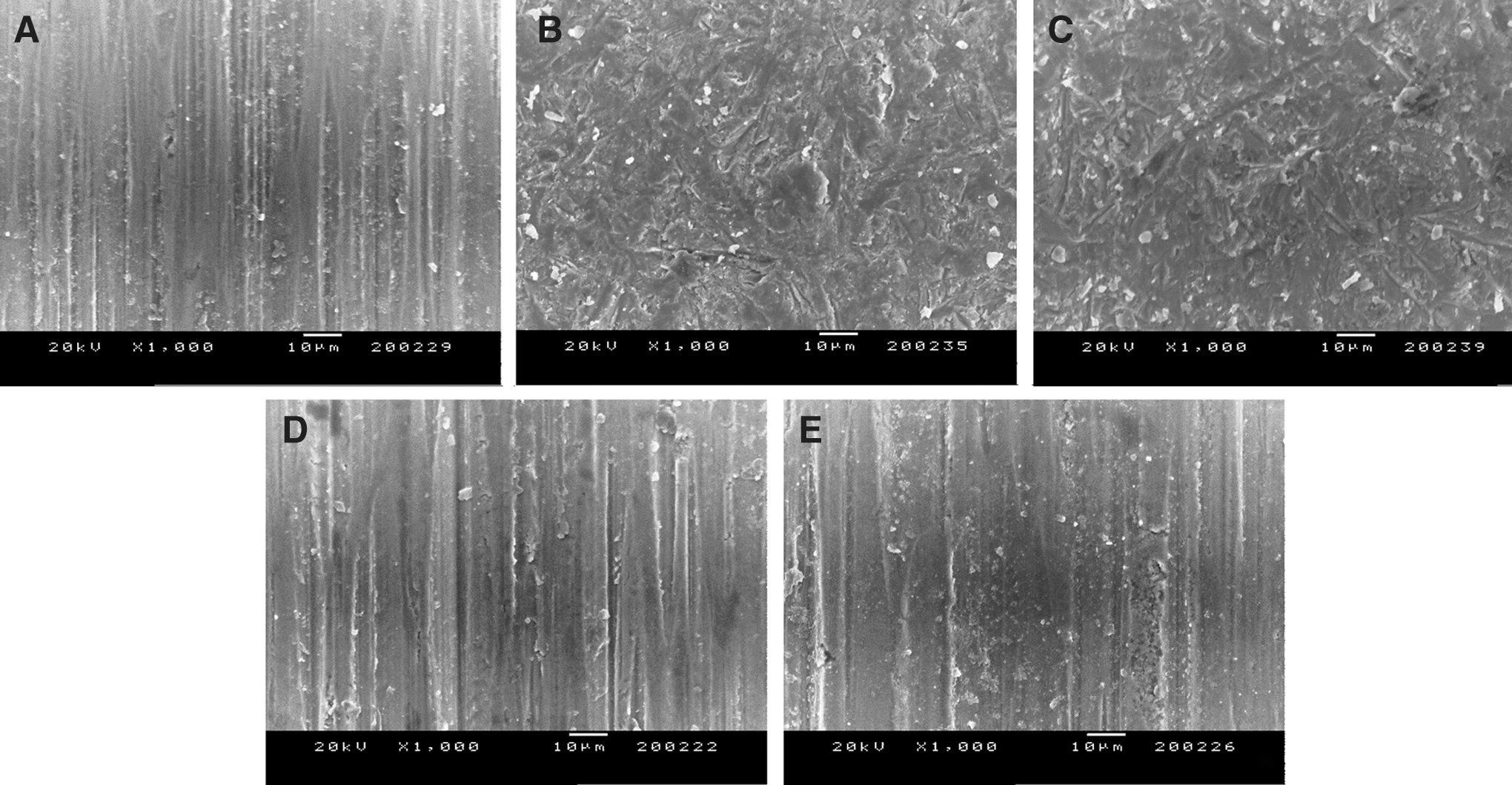
Representative scanning electron micrographs (SEM) of the zirconia fiber posts (original magnification: 1000×).
Discussion
Based on the results, the hypothesis that surface treatments significantly affect the bond strength between the zirconia posts and resin cement was accepted. Furthermore, silica-coated post specimens demonstrated the highest bond strength value, whereas they exhibited the lowest roughness value. Contrary to the results of μTBS, roughness values for surface treatment groups were similar to those of the control group, except group N.
According to Shin et al., 11 airborne abrasion with Al2O3 particles and tribochemical silica coating enhanced the shear bond strength of zirconia to resin cement. However, increase in bond strength after silica coating was found not to be statistically significant. Consistent with the present study, Blatz et al. 14 reported that air-particle abrasion was an effective method for improving shear bond strengths of self-adhesive resin cements to zirconia. Inokoshi et al. 19 presented that chemical surface treatment with Monobond Plus (Ivoclar Vivadent) of a silica-coated zirconia surface improved the μTBS of zirconia to resin cement. In the present study, despite that improvement in roughness for silica-coated specimens was not detected, the highest bond strength values were seen. This can be explained because silica coating is based on combining chemical and micromechanical retention. Spraying silica particles on the post surface with blasting pressure, which produces high spot heat, causes a silicate welding layer onto the surface. This process is called “tribochemical coating,” and it is followed by silanization of the pretreated post surface. 20
Researchers have tried to create roughness on the zirconia surface with an alternative treatment method, laser etching, 21 because microcracks within the zirconia material created by mechanical grinding and sandblasting result in undesirable changes of mechanical properties. 12,22 Consistent with the results of the present study, according to Usumez et al., 10 when compared with control and airborne-particle abrasion, Nd:YAG laser irradiation of the zirconia surface exhibited significantly higher bond strength values. Similar results were seen in the study by Akin et al., 16 who demonstrated that bond strength values between zirconia and resin cement in surfaces treated with Nd:YAG laser and Er:YAG laser, were significantly higher than in control and sandblasted ones. Furthermore, it was stated that Er:YAG laser application is an effective method for either increasing bond strength or decreasing microleakage. 4 Akyil et al. 23 detected the highest bond strength values in air-abraded specimens, and recorded improvement in bond strength values for Er:YAG and CO2 laser-irradiated specimens. Contrary to the results of the present study, the finding that Er:YAG laser irradiation did not improve the bond strength as well as the sandblasting was detected by Cavalcanti et al. 24
There are a few studies on laser pretreatments of post surfaces in the existing literature. 25,26 In agreement with the findings of the present study, Akin et al. 25 and Sipahi et al. 20 reported that surface treatments with Er:YAG laser were found to be effective methods for improving the bonding of fiber posts to resin cement. Contrarily, Tuncdemir et al. 26 reported that Er:YAG laser irradiation did not affect bonding of the quartz fiber post. This could have been the result of the application parameters of laser irradiation.
In the literature, many different experimental setups for laser irradiation, which can affect the results of the studies, have been used. These are energy, output power, pulse duration, and distance of application. Cavalcanti et al. 24 demonstrated that roughening the zirconia surface by Er:YAG laser at 10 Hz, 200 mJ, and 5 sec did not improve the bond strength. Similarly, Foxton et al. 27 reported that Er:YAG laser-irradiated (10 Hz, 200 mJ, 5 sec) zirconia specimens exhibited lower bond strength values than untreated ones. Contrarily, Akin et al. 4 were able to improve bonding of zirconia specimens by Er:YAG laser irradiation at 10 Hz, 150 mJ, and 20 sec. Similarly, according to Paranhos et al., 21 Nd:YAG laser significantly affected the bond strength of zirconia specimens compared with untreated, sandblasted, and CO2 irradiated groups. In addition, it was detected that both Nd:YAG and Er:YAG laser irradiated specimens (10 Hz, 150 mJ, 20 sec) exhibited higher bond strength values than untreated and sandblasted specimens. 16 Hence, the laser parameters used in this study were based on the previous studies. 4,16
When evaluating SEM images, it could be seen that surface treatments resulted in gentle damage. The roughness of the posts measured similarly to the control posts, except for those with Nd:YAG laser treatment. There were only some scratch-like traces, and shallow pits can be seen in Nd:YAG laser treated post surfaces. Despite that the lowest roughness values were seen in group SC, it exhibited the highest bonding to resin cement. A similar result was seen in the studies of Akin et al. 25 and Sipahi et al. 20 On the other hand, although the fracture type for all tested groups was predominantly adhesive, a correlation was detected between bond strength values and fracture types. An increase in bond strength resulted in an increase in cohesive or mixed fracture types.
Guess et al. 28 reported that surface treatments damaged the structure of zirconia and weakened it by causing microcracks. Hence, future studies should focus on determining the effects of this surface damage on zirconia. Moreover, simulation of in vivo conditions by using aging procedures including cyclic loading and thermocycling was not performed in the present study. The results of this study are important for evaluating the effects of various surface pretreatment methods, and these preliminary results can lead future investigation. On the other hand, laser irradiation were meticulously performed on the specimens for 20 sec by the same operator. In addition, a special holder was used for Er:YAG laser application. However, a formatted scan template was not applied on the specimens to ensure even distribution of exposure, and this was another limitation of the present study.
Conclusions
Within the limitations of this in vitro study, the following conclusions were drawn.
1. All surface treatments were found to be effective methods to achieve a durable bond between zirconia posts to resin cement.
2. Lasers could be used as an alternative pretreatment method for improving bonding between resin cement and zirconia post material.
Footnotes
Acknowledgments
This investigation was supported by the Cumhuriyet University Scientific Research Project.
Author Disclosure Statement
No competing financial interests exist.