




Abstract
Introduction
Y
Although the long-term performance of zirconia material is associated with enhancing mechanical properties, the clinical success of prosthetic restorations strongly depends upon the cementation and veneering procedure. Obtaining adhesion between a luting agent and veneering material to zirconia ceramic may require various heat and surface pretreatments. 6,7 In addition, laboratory or chairside procedures may create surface defects on the zirconia materials. 2,8
Sandblasting is a procedure commonly used to clean the surface of ceramic materials and to increase microretentive structures for the bonding process. It is a sensitive operation in which a small amount of surface material is removed and heat increase and stress on the surface do not reach high levels. 9,10 Some studies suggested sandblasting to obtain a sufficient bonding area between zirconia and resin cement (Table 1). 8,11 –13 Kosmac et al. 14 and Sato et al. 15 have reported that sandblasting increased the flexural strength of zirconia ceramic.
Laser technology in dentistry has already been of interest and reported in several studies. 16 –19 There is voluminous information concerning the effect of Erbium: Yttrium Aluminum Garnet (Er:YAG) laser irradiation on tooth structure, 16,20 and in recent years, this laser has become widely used as a surface treatment for zirconia ceramic (Table 1). 4,21 –25
Despite improved mechanical properties, acceptable marginal adaptation, and biocompatibility, the opacity of zirconia material is an obvious aesthetic disadvantage. Because of the optical opacity of zirconia, the zirconia framework is often veneered with veneering porcelain to obtain a natural appearance. The veneering process requires a successive firing procedure at least once, but usually twice to five times. 15,26 Because an increase in temperature has an adverse effect on t-m transformation in frameworks, 27 it may reduce strength by weakening the compressive layer emerging within the surface (Table 1). 26,28,29
The purpose of this in vitro study was to examine the influence of surface and heat treatments on the mechanical properties, and evaluate the phase transformation of two zirconia ceramics. The null hypothesis was that surface and heat treatments do not affect the mechanical properties of a zirconia core.
Material and Methods
Preparation of specimens
Two types of Y-TZP ceramic materials were evaluated in the present study: Zirkonzahn (Z) (Zirkonzahn GmbH, Bruneck, Italy), which is a 4.95% Y2O3 TZP material, and DC-Zircon (DC) (DC-Zirkon, Precident DCS Dental AG, Allschwill, Switzerland), which is a 5% Y2O3 TZP material.
Forty disk-shaped specimens (15 mm in diameter and 1.2 mm in thickness) in accordance with international standards (ISO 6872) 30 for each material were randomly divided into four groups of 10. Z specimens were milled from partially sintered blocks. The specimens were prepared in a 25% higher volume to compensate for shrinkage during sintering. Then, the specimens were sintered at 20°–1500°C temperature using a rise time of 3 h, and kept at 1500°C for 2 h. For DC specimens, fully sintered zirconium oxide blocks were milled according to the manufacturer's instructions.
Surface and heat treatment
The treatment groups were as follows.
Group 1: Control, no treatment.
Group 2: Sandblasting. Zirconia specimens' surfaces were sandblasted for 30 sec with a 110 μm particle size Al2O3 (RocatecTMPre, 3M ESPE, St. Paul, MN) at a pressure of 2.5 bars. An apparatus to keep the specimens and the tip of the sandblasting device in a fixed position during the process was prepared to provide standardization to the process at the 30 mm distance.
Group 3: Laser irradiation. The Er: YAG laser (Smart 2940 D, Deka Corp., Florence, Italy) with a wavelength of 2940 nm, frequency of 10 Hz, and 230 μsec pulse length at a power output of 2 W was applied to the zirconia ceramics' marked surfaces. The energy density was 129.98 J/cm2. The whole surfaces of the specimens were coated with graphite powder prior to laser irradiation (Table 2). Graphite powder prevents the reflection of laser light from the surface of the material. 31,32 The straight-type sapphire tip (1 mm) of the laser device was used at a distance of 1 mm above the zirconia surface. For standardization of the distance between the surface of the specimen and the laser tip, a mechanism was prepared (Fig. 1). The whole surfaces of the ceramics were irradiated for 15 sec. During the process, fine air and water cooling were used.
Group 4: Heat treatment. The specimens were heated five times (liner, shoulder, dentin 1, dentin 2, glaze) in a porcelain furnace (Vivadent Programat P500, Ivoclar Vivadent AG, Germany). This firing process was applied according to the instructions of a manufacturer of veneering porcelain of the zirconia framework without veneering (Table 3).
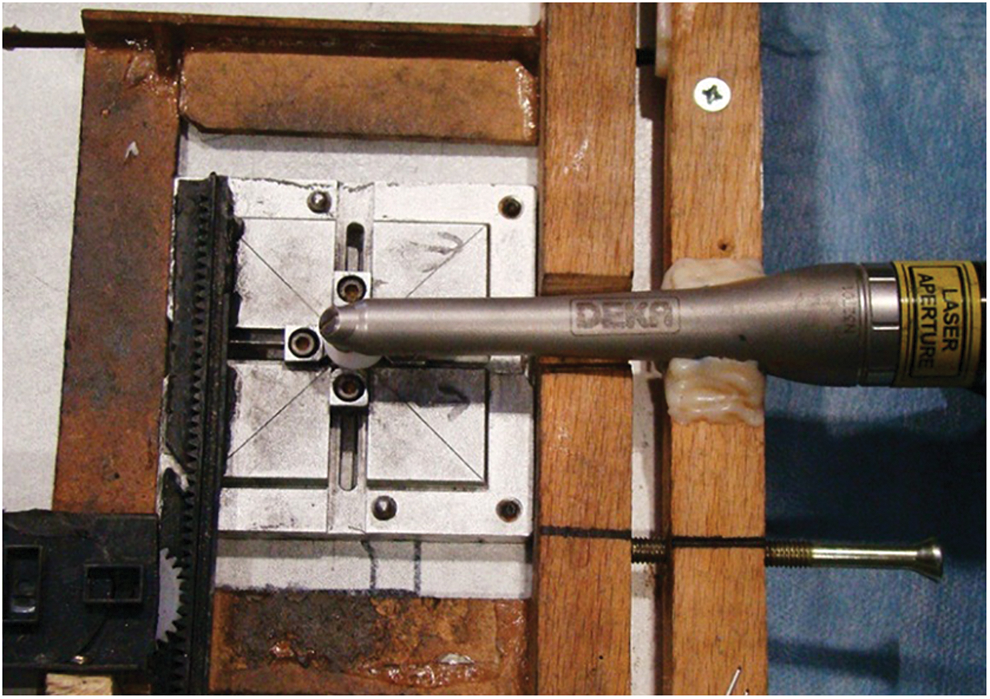
A mechanism for standardization of the distance between the surface of the specimen and the laser tip.
Z, Zirkonzahn; P, preheating temperature; D, drying time; t, raise of temperature; F, final temperature; H, holding time; DC, DC-Zirkon;
After the surface and heat treatment, specimens were cleaned in an ultrasonic bath with distilled water (Euronda; Erosonic Energy, Italy).
Surface roughness measurements
A profilometer device (MarSurf PS1, Mahr, Esslingen, Germany) was used to evaluate the surface roughness of treated surfaces of the specimens. Measurements were made from three different points on the marked surface of every specimen, to determine the surface roughness of each specimen; the mean values were calculated.
Scanning electron microscope (SEM) examination
Zirconia specimens were sputter coated (Ion Sputter JFC-1100, JOEL, Tokyo, Japan) with gold, and evaluated using an SEM (Jeol JSM-6400, UK) at magnifications of 500× and 1000×.
X-ray diffraction analysis
X-ray diffraction analysis was applied to determine the constitution of the crystalline phase at the surface of the specimens, and to indicate the effect of surface and heat treatments on the crystalline structure of the zirconia surface. A crystal structure analysis of the specimens was made with an X-ray diffractometer (X-ray diffractometer Rigaqu-Geirflex, Japan) using monochromatic CuK-α radiation. Scanning was performed on the marked surface of the specimens at a 0.01 degree step range between the intervals of 20 and 34 2θ degrees, where θ is the angle of reflection.
The relative amount of the monoclinic phase of zirconia (XM) was calculated according to the Garvie and Nicholson
3
method using the following equation:
2,8
where I is the intensity detected by the detector at angular position 2θ degrees from the diffraction, T is the tetragonal peak, and M111- and M111 are the two major monoclinic peaks.
Biaxial flexural strength
The biaxial flexural strength test (piston on the three ball) was achieved according to ISO 6872-7430 standards using a universal mechanical testing machine (Model 3382, Instron Engineering Corp., Canton, MA). To support the specimens, three stainless steel spherical balls that were 3.2 mm in diameter were placed on a circle that was 10 mm in diameter. Spherical balls were positioned at an angle of 120 degrees in relation to the center of the circle. The specimen was placed on the spherical balls in such a position that its center would be on the same axis as the piston (Fig. 2). The load was applied to the treated surface of the specimens with the machine through a flat punch, with a cylindrical compression tip that was 1.4 mm in diameter at a 0.15 mm/min crosshead speed, until failure. The failure stress was calculated with the following equations.
30
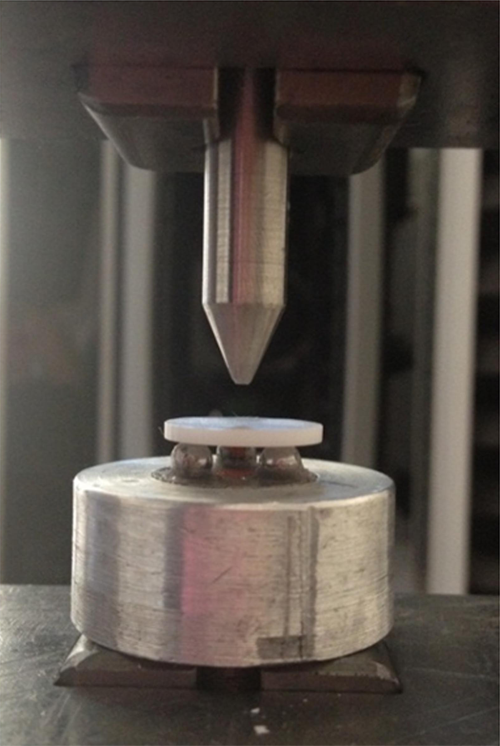
Piston on 3 ball biaxial flexural test.
where S is the maximum center tensile stress (MPa) (the flexural strength at fracture) and P is the total load causing fracture (N)
and
where
Statistical analyses
The means of surface roughness, relative amounts of monoclinic phase, and biaxial flexural strength were evaluated using the Kruskal–Wallis test with Bonferroni correction. The Mann–Whitney U test was used for comparisons between materials.
Results
Surface roughness test
The effect of surface and heat treatments on surface roughness was evaluated for each material. There was no significant difference between control and treated groups for the Z and DC materials (p > 0.05), whereas sandblasting groups displayed higher surface roughness values than other treated groups. Having compared the surface roughness values of the two materials in the control and sandblasting groups, Z material exhibited higher surface roughness values than DC materials (p < 0.05). Although the DC material exhibited higher surface roughness values for Er:YAG laser and fired specimens than did the Z material, no significant differences were found between them (p > 0.05) (Table 4).
Different superscript letters indicate significant differences (p < 0.05). Boldface indicates values 0.05 and under.
The SEM images showed morphologic differences in the zirconia surface after treatments. Sandblasting created a rougher surface than that of the control groups for Z and DC materials (Figs. 3B and 4B). Er:YAG laser groups generated smooth areas similar to those of the control groups. However, rare pits formed by the laser optical fiber tip could be seen (Figs. 3C and 4C). In some specimens, Er:YAG laser irradiation caused the appearance of crack formations (Fig. 5A, B).

Scanning electron microscopic (SEM) images of Zirkonzahn (Z) material surface.

Scanning electron microscopic (SEM) images of DC-Zirkon (DC) material surface.
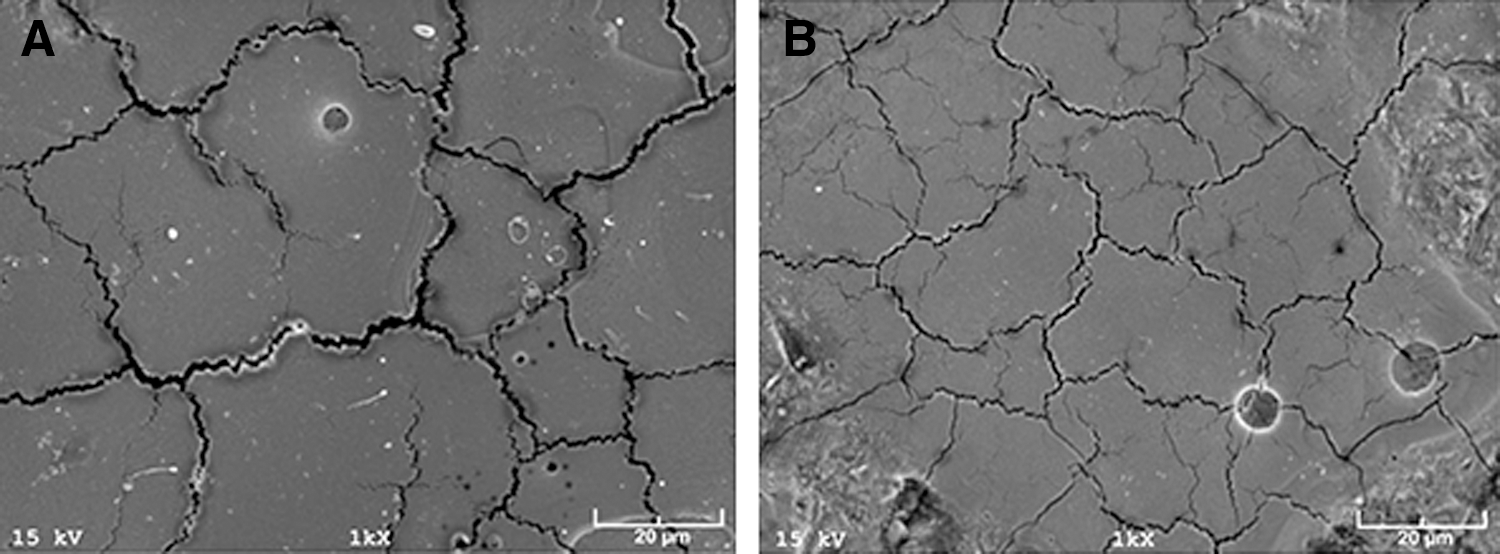
Scanning electron microscopic (SEM) images of the zirconia surface after Erbium: Yttrium Aluminum Garnet (Er:YAG) laser treatment.
X-ray diffraction analysis
Figures 6 and 7 represent the X-ray diffractometry (XRD) pattern of control, sandblasting, Er: YAG laser, and heat-treated groups for the DC and Z material. After sandblasting, the peak of monoclinic ZrO2 increased, and it decreased after heat treatments. The highest relative amount of the monoclinic phase was observed with the sandblasted DC specimen (19.08 ± 0.9%), and the lowest relative amount of the monoclinic phase was observed with Z specimens for heat treatments (0.46 ± 0.06%). The spectrogram of Er:YAG laser treatment was similar to that of the control group (Figs. 6C and 7C).
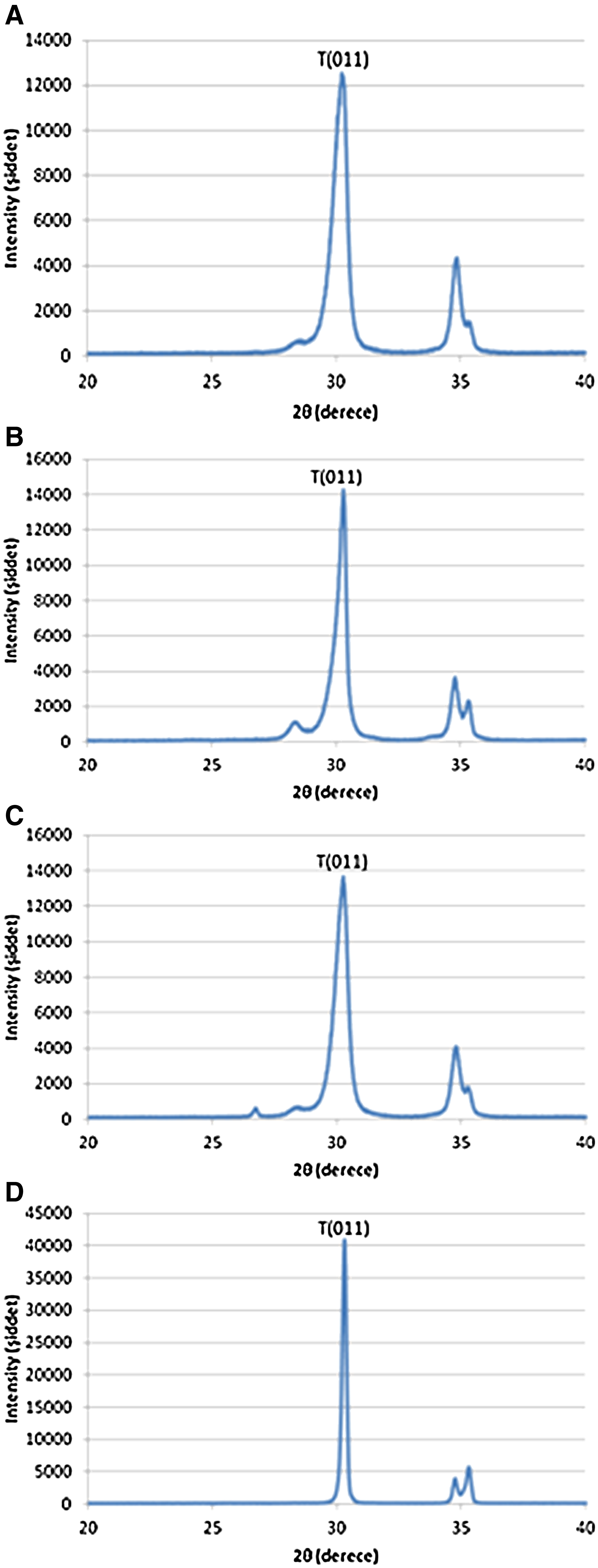
X-ray diffractometry (XRD) pattern of Zirkonzahn (Z) specimen surface.
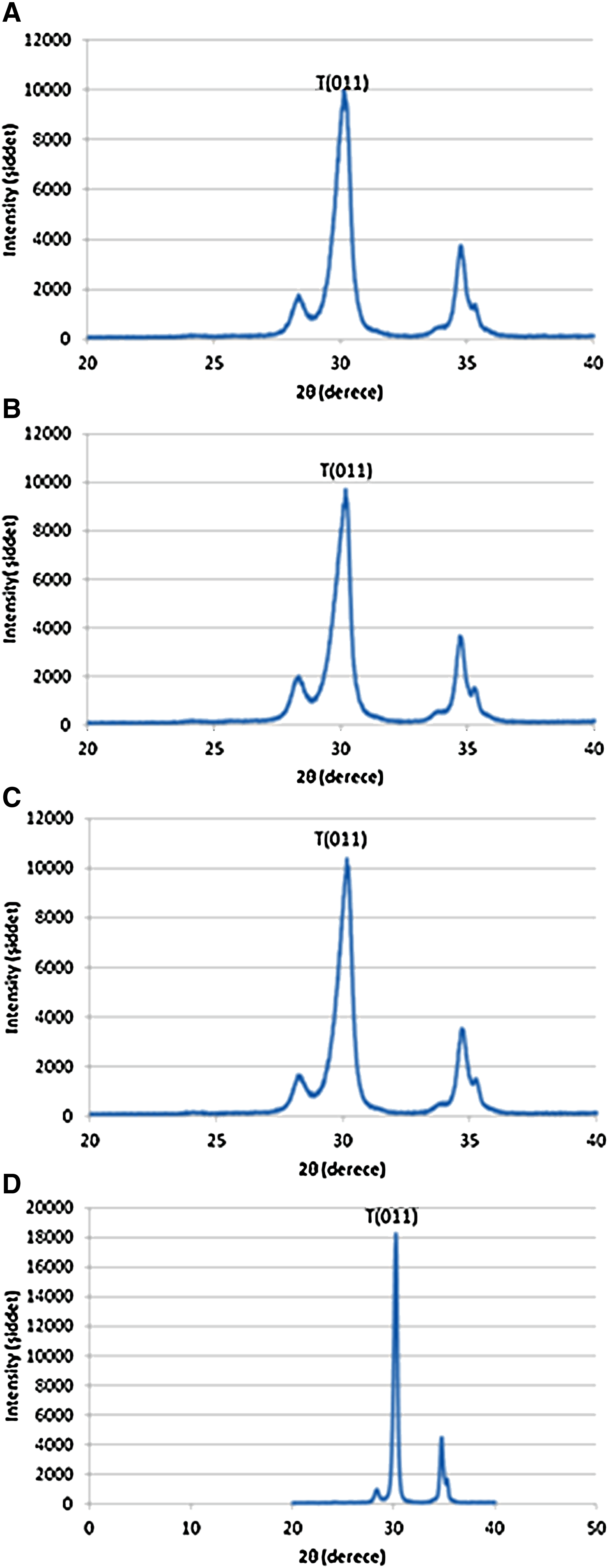
X-ray diffractometry (XRD) pattern of DC-Zirkon (DC) specimen surface. (
The amount of monoclinic zirconia content of materials was significantly decreased by the firing process (p < 0.05). Sandblasted groups included a higher monoclinic content of zirconia than did the control group, but it was not statistically significant (p > 0.05). When surface and heat treatments were examined separately for materials, the values of the relative monoclinic phase content of DC specimens were statistically higher than for the Z specimens (p < 0.05) (Table 5).
Different superscript letters indicate significant differences (p < 0.05). Boldface indicates values 0.05 and under.
Biaxial flexural strength test
The DC material exhibited higher biaxial flexural strength than the Z material (p < 0.05). For both materials, heat treatment groups showed significantly lower biaxial flexural strength values than those of the other groups (p < 0.05). Although sandblasting and Er:YAG laser groups exhibited higher values than those of the control groups, no significant differences were found between them (p > 0.05) (Table 5).
Discussion
In accordance with the results of this study, the null hypothesis—that surface and heat treatments do not affect the mechanical properties of zirconia cores—was rejected.
Zirconia ceramics are treated through a sequence of stages from the manufacturing period. Surface and heat treatments may lead to undesirable changes in the mechanical properties of zirconia ceramics such as phase changes and small cracks. 14,33,34 The results of the present study showed that surface and heat treatments exhibit a commutative effect on the mechanical properties of zirconia ceramic.
Sandblasting has been reported to be a precondition for improving surface roughness to create a micromechanical bonding area for resin cement or veneering porcelain. 9,14,35
The sandblasting process is frequently based on the deposition of particles ranging between 30 and 250 μm on the material's surface under pressure. 8,9,13,14,36 Wang et al. 37 reported that sandblasting with 50 μm Al2O3 particles increased the strength of zirconia ceramic, but they also reported that abrasion with 120 μm Al2O3 particles weakened the zirconia. However, Karakoca and Yılmaz 9 remarked that the abrasion of zirconia material with small particles may not be effective in providing a micromechanical bonding area; they used 110 μm Al2O3 particles for abrasion of the zirconia ceramic. In addition, the other study showed that the sandblasting deposition duration had an effect on the mechanical properties of zirconia. 8 The researchers compared 50 and 110 μm Al2O3 particles for 5, 15, and 30 sec, and they reported that 30 sec of sandblasting for all depositions increased the monoclinic phase and surface roughness compared with other durations. The present study also showed that 110 μm particles sandblasted with Al2O3 after 30 sec increased the monoclinic phase for both materials. In the present study, the sandblasting process was applied with a specifically designed device for standardizing the parameters. However, some studies 10,14,15,37 stated that the specimens were sandblasted freehand in an uncontrolled style.
Lasers have been used in dentistry since 1995. 16 –18,24,25,31 The actual impact of the laser energy is provided by the conversion of light energy into heat. The pigmentation of the surface and the amount of water that material contains affects the energy to be absorbed. 25,31 Stübinger et al. 38 reported that 1, 3, 5, and 10 W Er:YAG laser energy was not able to cause an adequate roughness of the zirconia ceramic surface because of the no-water content composition and its reflectance. Cavalcanti et al. 24 remarked that laser irradiation had minimal or no effect on the uncoated surface of zirconia. Therefore, in the present study, the absorption of Er:YAG laser energy was provided by coating the whole surface of specimens with graphite powder.
Er:YAG laser energy intensities were compared in many study to determine the reliable intensity for zirconia ceramic. 4,21 –24,31,32,38,39 Cavalcanti et al. 24 remarked that 200 mJ intensity of Er:YAG laser energy was more reliable for zirconia ceramic among 400 and 600 mJ intensities. Akın et al. 39 remarked that 150 mJ Er: YAG energy for 20 sec increased the roughness of zirconia. Subaşı et al. 22 suggested that 400 mJ Er: YAG laser energy altered the surface properties of zirconia ceramic. However, Akyıl et al. 32 reported that 400 and 600 mJ Er:YAG laser energy caused some deep cracks in the zirconia surface and extreme loss of mass. The different results of these studies may be because of their varied laser application times or the usage of graphite powder, or not.
Based on previous studies, 4,21,24,32 200 mJ Er:YAG laser energy intensity was defined for the present study. Nevertheless, 200 mJ energy intensity caused some cracks on the surface of zirconia, which were seen with SEM examination in the present study. The laser's frequency could have an impact on the heat increase on the treated surface. An increasing pulse number may cause further damage to the surface by increasing the energy density on the surface. 24 The application period in the present study was longer (15 sec) than in the previously mentioned study, which may be the reason for cracks in the surface of Y-TZP.
In the present study, the surface roughnesses of two materials were increased after sandblasting. Although different surface topography was observed between the sandblasting and laser groups, there were no significant differences between them. Sandblasting caused a rougher surface with irregularities, although no obvious, discernible defect was found on the surface. However, Er:YAG laser groups generated smooth areas similar to those of control groups. Subaşı et al. 22 also demonstrated that the sandblasting method provided rougher surfaces than Er:YAG laser irradiation and silica coating, which is in agreement with the present study. Unlike Subaşı et al., in the present study, microcracks were observed in SEM micrographs of the Er:YAG laser-treated specimens.
Zirconia frameworks have to be veneered with feldspathic porcelain. This veneering process requires multiple heat treatments. The effects of the firing process on the mechanical properties of zirconia ceramics were examined in some studies. It was reported that flexural strength and relative monoclinic phase values decreased after heat treatment. 27,29,40
In the present study, veneering firing procedures were applied for zirconia specimens without using veneering porcelain. Sundh et al. 40 reported that, regardless of whether or not ceramic was applied on frameworks, it had the same impact on phase transformation, and it was determined that the relative monoclinic phase amount decreased with heat treatments in both conditions. This is the reason why the application of ceramic was not required in the present study.
Swain et al. 41 reported that heat treatments on zirconia specimens caused an adverse effect on tetragonal to monoclinic phase transformation. They detected a negligible amount of the monoclinic phase after heat treatments. Conformably, in the present study, the lowest amount of the monoclinic phase was found after heat treatments. However, Denry et al. 27 reported that a heat treatment after a mechanical surface treatment reduced the size of the flaw, reducing the stress at the crack tip, which is related to an increase in the fracture strength. This result is different from our finding because, in the present study, the heat treatment was applied to untreated specimens, not after sandblasting.
Chintapalli et al. 42 remarked that sandblasting causes phase transformation, regardless of the sandblasting conditions. Kosmac et al. 14 reported that sandblasting with 110 μm Al2O3 particles caused microcracks in the surface of the specimen, but they did not exceed the compressive surface layer.
In the present study, sandblasting showed a greater amount of monoclinic phase than other groups. However, heat treatments showed the lowest content of the monoclinic phase. Liu et al. 43 reported no crystallographic changes of zirconia after laser irradiation. This result was similar to that of the present study, which reported that the relative amount of the monoclinic phase of Er:YAG laser treatments was similar to control groups of zirconia frameworks.
Strength, a mechanical property determining the success of fragile dental ceramics, is defined as the highest stress recorded at the moment when the material breaks. 35 In the present study, DC material (fully sintered Y-TZP blocks) showed higher flexural strength than Z material (partially sintered Y-TZP blocks) in all treated groups. Zirconia ceramic prepared from fully sintered blocks indicated higher flexural strength values than the other Y-TZP ceramics, as reported in the literature. 30,44 –46 The higher flexural strength values of fully sintered Y-TZP blocks may be explained by the fact that they have less porous structure in their volume than partially sintered blocks. Also, they had different sintering temperatures and construction techniques.
The present study showed that sandblasting caused an increase in the mean flexural strength values. Kosmac et al. 14 and Guazzato et al. 28 also reported that flexural strength values increased with 110 μM Al2O3 particles compared with control groups. Qeblawi et al. 47 remarked that sandblasting with 50 μm Al2O3 particles increased the flexural strength of zirconia ceramic. However, Karakoca et al. 9 defended that 50 μm Al2O3 may not be effective for micromechanical retention. In contrast to previous studies, Garcia Fonseca et al. 2 reported a decrease in flexural strength after 250 μm Al2O3 particle sandblasting. They also reported that sandblasting with large Al2O3 particles decreased the strength of zirconia ceramic because the phase transformation that arises from severe alumina abrasion was not able to neutralize the propagation of cracks.
Laser irradiation, which is another surface treatment, indicated flexural strength values similar to those of control groups in both materials. This may be explained by the preservation of the monoclinic phase amount in the structure by minimizing the heat increase as a result of using a laser with a water cooling process. According to the appearance of cracks on the surface of specimens in SEM analyses, 200 mJ Er:YAG laser irradiation may not be considered a reliable process. The lowest flexural strength values for both materials were reported in heat treatment groups. The transformation of tetragonal crystals into monoclinic crystals with larger volumes is considered to be the most significant mechanism strengthening zirconia frameworks. The activation of the reverse phase transformation with the firing process was seen as an exploratory reason for the decrease in flexural strength. Nakamura et al. 26 reported that the biaxial flexural strength of zirconia showed an inclination to decrease after heat treatments. Moreover, Oilo et al. 29 and Guazzato et al. 28 reported a significant reduction in strength after the first firing. The flexural strength of both zirconia decreased with a decrease in monoclinic zirconia and increased with an increase in monoclinic zirconia. This indicated that phase transformation, which was stimulated by stress, affected the mechanical properties of zirconia.
Limitations
There are some limitations to the present study. A heat treatment was not applied after surface treatments; therefore, this study does not reflect clinical situations. Grain size and sintering temperature criteria were not evaluated; however, they may affect the mechanical properties of the zirconia material. In addition, the thermal aging of the tested materials was not evaluated.
Conclusions
Within the limitations of this study, the materials that were used showed different surface roughnesses. Sandblasting showed the highest surface roughness values. However, there were no significant differences in surface roughness between treated specimens and controls.
SEM analyses showed that Er:YAG laser irradiation resulted in smooth areas surrounded by cracks on surfaces. However, sandblasting changed the surface morphology with the formation of microretentive grooves.
Monoclinic zirconia content and the biaxial strength of zirconia increased with sandblasting, but decreased with heat treatments.
Footnotes
Acknowledgments
The present study was supported by Scientific Research Project Unit from Karadeniz Technical University (project number: 1060). The authors gratefully acknowledge Fatih Mehmet Korkmaz as project coordinator.
Author Disclosure Statement
No competing financial interests exist.