




Abstract
Introduction
S
The patients typically experience pain in the anterolateral shoulder to the acromion, often radiating to the midlateral portion of the humerus, which worsens with shoulder elevation or during rest at night. The elevation of arm is painful between 60 and 120 degrees, which is called “the painful arc.” 6,7
Neer and Hawkins subacromial impingement tests were found to be positive on physical examination. 3,8 The definitive diagnosis is established by subacromial injection test. 1,9 Many factors are implicated in the development of subacromial impingement syndrome, including acromion morphology, weak rotator cuff, abnormal kinetic patterns of scapular muscles, capsular abnormalities, weak posture, repeated loading during elevation of the arm above 90 degrees, and overuse. 10 Vascular, degenerative, traumatic, and mechanical factors, which complement each other, play a role in etiopathogenesis and physiopathology of this condition. 11
Neer classified subacromial impingement syndrome in three stages. Stage 1 is characterized by edema and hemorrhage observed in the rotator cuff in the early period. This stage is reversible. Stage 2 is characterized by fibrosis and tendinitis. Stage 3 is characterized by bone changes and partial or full thickness tendon ruptures. 3
The treatment involves the use of nonsteroidal anti-inflammatory drugs (NSAIDs), steroid injections to the subacromial region, and a conservative method including hot-cold packs, exercise, and various physical therapy methods. The goal of conservative therapy is to decrease the inflammatory response and restore the range of joint motion, improve shoulder functions, and provide pain relief. 12 Physical therapy agents such as high- and low-energy extracorporeal shock wave therapy (ESWT), ultrasound (US), electrical stimulation, acupuncture, microwave diathermy, pulsed electromagnetic fields, and low-intensity laser therapy (LILT) are used in SAIS lesions. However, contradictory results exist concerning the efficacy of these applications, and therapeutic options for the physicians in physical therapy and rehabilitation are limited. 13 –15
Low-intensity laser therapy has been used for a long time on shoulder lesions. There are various studies regarding the use of low-intensity laser therapy in the treatment of subacromial impingement syndrome. 16 –20
High-intensity laser therapy (HILT) has recently been a preferred choice among the physical therapy modalities. 21 –23 HILT, which uses high-intensity laser radiation leading to slow light absorption by chromophores in small amounts, has been introduced into practice. This absorption is achieved not with concentrated light, but with diffuse light in all directions (the scattering phenomenon), causing an increase in the mitochondrial oxidative reaction and adenosine triphosphate, RNA, or DNA production (photochemistry effects) and resulting in the phenomenon of tissue stimulation (photobiology effects). The analgesic effect of HILT relies on different mechanisms of action, such as slowing down the transmission of pain stimulus and increasing the production of morphine-mimetic substances. 24
The number of studies regarding the efficacy of HILT in the treatment of shoulder lesions is very limited. 21 –23 In the present study, we aim to demonstrate the short-term effectiveness of HILT on SAIS.
Materials and Methods
The present study was a retrospective case series that included a total of 42 patients (25 females and 17 males), who were admitted to the outpatient clinics of the Bolu Physical Therapy and Rehabilitation Hospital between January 2014 and June 2014 and who were diagnosed with stage 1 or 2 subacromial impingement syndrome and were receiving HILT.
Patients with a restricted passive range of motion in the shoulder, severe cervical spondylosis, radicular arm pain, inflammatory rheumatoid disorders, acromioclavicular or glenohumeral osteoarthritis, calcium deposition, diabetes mellitus, thyroid disease, ischemic heart disease, or a cardiac pacemaker, and those with previous history of neurological disorders were excluded. Patients who had received physical therapy and rehabilitation, who had been injected steroids within the 6 months preceding the study, and those who underwent shoulder surgery, were also excluded. A total of 57 (31 female, 26 male) patients were screened and 15 patients were excluded from the study after investigation of the study selection criteria.
Patients who attended our clinic with shoulder pain, and who had painful arc signs during shoulder abduction in the physical examination, and those who tested positive for Neer's impingement sign and the Hawkins test, were administered a subacromial injection of 4 mL lidocaine plus 4 mL 0.9% NaCl via the posterior approach. Patients who reported complete or partial pain relief within 15 min after subacromial injection were diagnosed to have subacromial impingement syndrome. An experienced radiologist evaluated the magnetic resonance images in order to determine disease stage and establish a radiological diagnosis.
Patients diagnosed as stage 1–2 SAIS were primarily advised to avoid excessive physical activity and to elevate the arm above the shoulder level. Codman's pendulum exercises and NSAIDS were recommended. Patients with sustained complaints in the control evaluation after 4 weeks were admitted to a HILT program. Written informed consent from patients was taken before the treatment.
An Nd:YAG laser device, using 1064 nm wavelength (BTL-6000 High Intensity Laser 12 W), was used in the present study. The device produces a maximum of 12 W power and has three different treatment modes. Analgesic and biostimulant modes were used in the present study.
1. Analgesic. This is called the pulsed mode. It is often not perceived by the patient. It uses a standard frequency of 25 Hz. The higher the power, the higher the depth of penetration by the laser beams. In analgesic mode, a power of 8 W, a dose of 12 J/cm2, and a total maximal energy of 300 J were applied for 2.5 min. The beams were delivered to the subacromial space, forming a circle outside-to-inside.
2. Biostimulation. This is called continuous wave mode. In biostimulation mode, a power of 7 W, a dose of 100 J/cm2, and a total maximal energy of 2500 J were applied for 5 min and 57 sec. The beams were applied to the subacromial space in a longitudinal direction.
In the present study, patients received nine sessions of HILT, three times per week on alternate days for 3 weeks. The first three therapy sessions were analgesic and the last six sessions were in biostimulation mode on the most painful area of the shoulder. During the application to patients with stage 1 and 2 SAIS, a distance holder of 3 cm was used. A space of 2.5–3 cm was kept between the skin and distance holder, which was then applied from a distance of 5.5–6 cm to 25 cm2 of the subacromial region by the same physiotherapist (Fig. 1). The device has the property of 30 degree beam divergence and the direct area on the skin's surface is 3.14 cm2 with power density 3.2 W/cm2 in analgesic mode and 2.8 W/cm2 in biostimulation mode.
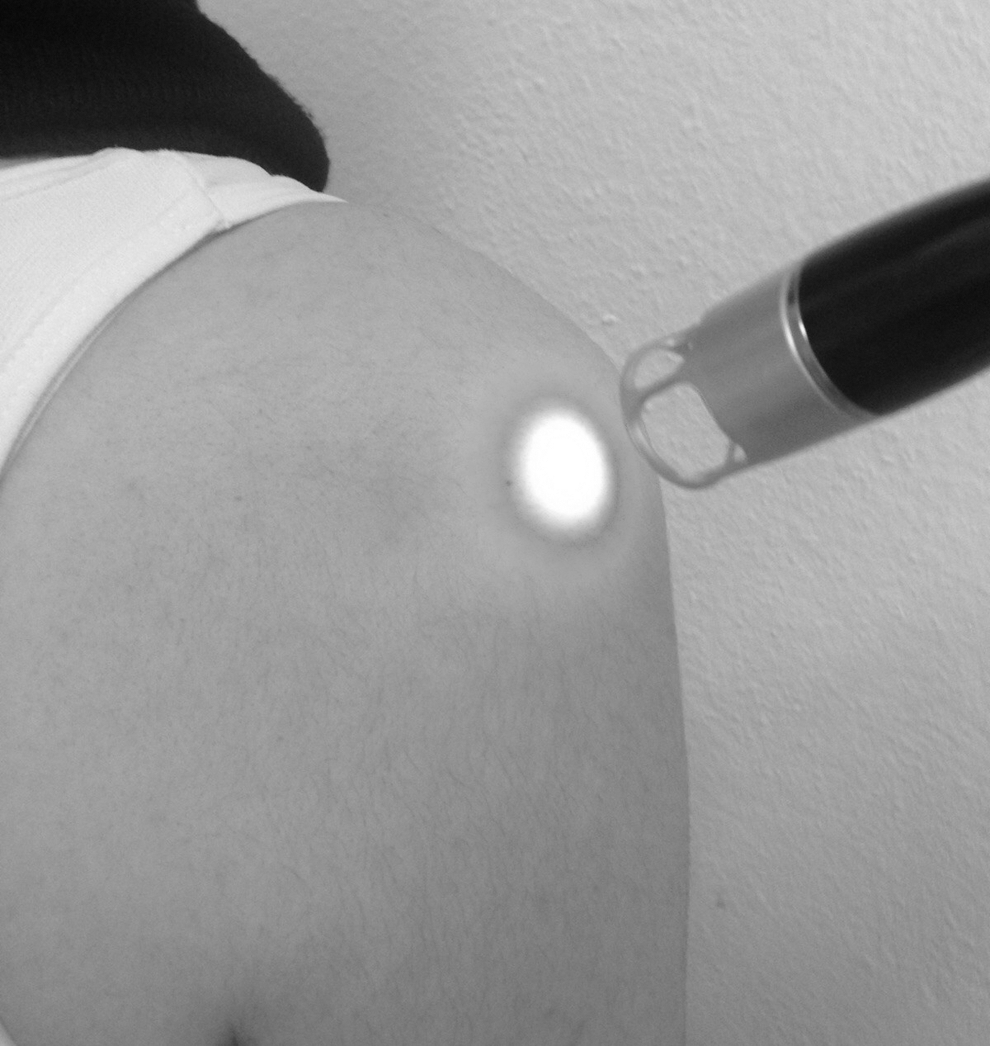
Holding the probe during high-intensity laser therapy (HILT) application.
The recommendations given during the first visit and admission of the patients taken to HILT were re-explained. It was recommended that the patients should avoid excessive physical activity, to elevate the arm above the shoulder level, and to perform Codman's pendulum exercises. However, regular NSAID use was changed to the oral intake of etodolac 300 mg when required.
The functional status was evaluated using the Shoulder Pain and Disability Index (SPADI). This is a self-administered shoulder-specific questionnaire including two subscales: pain and disability. The pain subscale consists of five questions and the disability subscale consists of eight. The patients were asked to answer each question using a 0–100 mm visual analog scale (VAS). The possible score of SPADI ranged from 0 to 100. Higher scores indicate a high level of disability. 25,26 The Turkish version of SPADI, as validated by Bumin et al., 27 was found to be reliable.
The patients were evaluated using the University of California Los Angeles (UCLA) shoulder rating scale, which indicates their pain, function, patient satisfaction, strength of forward flexion, and active forward flexion according to the following point system: 34–35 points is considered excellent performance, whereas 29–33 points is considered good performance, and <29 points is considered poor performance.
28
UCLA shoulder rating scale does not have validity and reliability tests. However, Roddey et al.
29
compared the pain and function subscales of the UCLA Shoulder Scale and Simple Shoulder Testi (SST) with SPADI. Nevertheless, because the UCLA scale depends on single-item scales, it was impossible to put it under the same psychometric scrutiny as the SPADI and the SST. In scoring the UCLA, the scores of the first question evaluating the pain, in relation to the frequency of analgesic intake, are determined before and after the treatment. Scoring varies from 1 to 10 points, and the higher scores indicate a decrease in the pain intensity and analgesic intake: Present always and unbearable; strong medication frequently (1 point) Present always but bearable; strong medication occasionally (2 points) None or little at rest, present during light activities; salicylates used frequently (4 points) Present during heavy or particular activities only; salicylates used occasionally (6 points) Occasional and slight (8 points) None (10 points)
Data were analyzed using the statistical package for social sciences (SPSS) for Windows 11.5 software. The Shapiro–Wilk test was used to analyze whether the discontinuous numerical variables were normally distributed. Descriptive statistical data were expressed as the mean ± standard deviation or median (minimum-maximum) for discontinuous numerical variables. Nominal variables were expressed as the number of cases and percentage values. The Wilcoxon signed rank test was used to evaluate the statistical significance of the differences between the pretreatment and post-treatment SPADI pain, SPADI disability, SPADI total, and UCLA scores. A p value <0.05 was accepted as statistically significant.
Results
Of 42 study patients, 17 were males (40.5%) and 25 were females (59.5%). The mean age was 56.62 ± 11.2 years (minimum 38 years; maximum 81 years. The median duration of complaints of the cases was 12 months. The demographic properties of the cases are illustrated in Table 1.
Median scores for post-treatment SPADI pain, SPADI disability, SPADI total, and UCLA decreased significantly when compared with the pretreatment values (p < 0.001, Table 2). The pretreatment value of the median UCLA pain score was 4 (minimum 1; maximum 6), and the post-treatment value was determined to be 6 (minimum 2; maximum 10). The higher post-treatment UCLA pain score was significant statistically (p < 0.001).
Wilcoxon sign test.
SPADI, Shoulder Pain and Disability Index; UCLA, University of California Los Angeles.
Discussion
The present study evaluated the short-term effectiveness of nine sessions of HILT, three times per week on alternate days for 3 weeks; the first three sessions of therapy in analgesic mode and the last six sessions of therapy in biostimulation mode, for patients with stage 1 and 2 SAIS. The study found a decrease in pain, an improvement in disability, a decrease in the need for NSAIDs, increased independence in daily activities, and patient satisfaction.
The treatment strategies of SAIS, other than a surgical approach, in the acute phase, include: relative rest, NSAIDs for 1 or 2 weeks, steroid injection within the first 8 weeks, low-intensity and high-frequency exercise at the pain threshold, and maintaining the efficacy of high-energy ESWT in the subacromial calcium deposits. Rehabilitation has been recommended in the chronic cases. 15,30
High- and low-energy ESWT, US, electrical stimulation, acupuncture, microwave diathermy, pulsed electromagnetic fields, and LILT are physical therapy agents that have been previously tested on SAIS lesions. However, contradictory results exist concerning the efficacies of these applications, and treatment options for physical therapy and rehabilitation physicians continue to remain fairly limited. 13 –15
Previous researchers have conducted numerous studies to evaluate the efficacy of LILT. Some authors 16 –18 have suggested that LILT used without other physical therapy modalities might be helpful in the management of SAIS, whereas other researchers did not identify similar efficacies. 19,31 In a meta-analysis by Enwemeka et al., 32 laser phototherapy was reported to be a highly effective means of therapy in the armamentarium to promote tissue repair and provide pain relief. Despite the current controversy, LILT appears to be more beneficial than a placebo when applied as a single intervention in patients with SAIS.
HILT is the other physical therapy agent recently experienced in clinical use. Alayat et al. 33 compared HILT efficacy with that of LILT in the treatment of Bell's palsy, and HILT was found to be more efficient. Its efficacy compared with ultrasound was evaluated in two different studies on back pain; it was found to be efficient in treating the pain and disability in one study; however, no difference was detected in the other. 34,35 In another study, HILT was determined to be more effective in treating the pain in knee osteoarthritis when compared with LILT. 36
A limited number of studies exist in the literature related to the use of HILT in shoulder lesions. US and HILT were compared with SAIS treatment in a study by Santamato et al., 21 in which the subjects with SAIS, who received HILT for 2 weeks, had a significantly greater decrease in the level of pain and more improvement in articular movement, functionality, and muscle strength of the affected shoulder, compared with patients who had received US therapy. Ebid and El-Sodany 22 assessed the long-term effect of pulsed HILT in the treatment of the postmastectomy pain syndrome. After 12 weeks of follow-up, the shoulders' range of motion, visual analogue scale, and quality of life results showed a significant improvement in the laser group compared with that of the placebo group. Kim et al. 23 evaluated the clinical efficacy of HILT in patients with frozen shoulder, and the HILT group had significant pain relief at 3 and 8 weeks, but not at the 12th week, the final follow-up time point. As in the three other studies related to the efficacy of HILT in shoulder lesions, we have also indicated that HILT is effective for the management of short-term pain. No study is yet available related to efficacy existing after the 12th week, and further studies are required that investigate the long-term efficacy.
The limitations of our study include the absence of a control group. In the previous three studies, the efficacy of HILT was compared with that of the placebo that was administered in two studies, and with that of US in one other study. We could not access a study in the literature that compared HILT efficacy with a sham laser group. Studies including sham laser control groups are needed. However, the study was conducted retrospectively and we had no opportunity to form a control group. Another weakness of our study is that it was conducted on a limited number of patients. Studies covering larger series are needed.
In addition, it is possible that the continuation of the Codman's pendulum exercise by our patients and the intake of NSAIDs might have affected the study results. However, patients whose complaints continued or increased despite conservative treatment in the 4-week period before the beginning of HILT, the application of these conservative treatments were included into the study. The reason why we changed NSAID use from “daily” to “when required” was to demonstrate the decrease in the need for NSAIDs when assessing pain. Previous studies on the use of NSAIDs determined that they were effective in reducing pain within the first 1 or 2 weeks. 37,38 In the study by Devereaux at al. 39 , the improvements in pain and function observed with an NSAID or Precut Kinesiology Tape (PCT) as adjuvant treatments were no greater than with the rehabilitation exercise alone. In the study by England et al., 18 the authors compared NSAIDs (naproxen sodium 550 mg two times a day for 2 weeks) with laser therapy for shoulder tendinitis. Significantly less pain was reported for laser versus NSAIDs at a 2-week follow-up. In addition, drug therapy failed to show any significant improvements over placebo for active flexion, extension, and abduction. Subjective benefit was evident for drug treatment for movement and function. In the light of these data we can say that NSAIDs shall be effective for the first 2-week period; however, it does not have any additional benefits as an adjuvant treatment. There are a limited number of studies on the effectiveness of stretching and strengthening exercises. 40 –43 We did not identify any studies in the literature regarding the effectiveness of isolated Codman's Pendulum exercises in SAIS. For these reasons, we believe that the effect of NSAID use and exercises on the study results were minimal. However, the absence of a control group receiving NSAIDs and performing exercises prevented us from fully demonstrating the effectiveness of isolated HILT.
Conclusions
In the present study, HILT was shown to be effective in the short term for decreasing pain and improving disability in patients with stage 1 and 2 SAIS. However, perhaps clinicians would be more willing to use HILT if the effectiveness of this therapy were investigated, and favorable results obtained, in future studies.
Footnotes
Author Disclosure Statement
No competing financial interests exist.