




Abstract

I
Myers and Myers, using an Nd:YAG laser, 6 showed the removal of caries in 1985. In 1986, Melcer published on the possibility of using CO2 laser for the same objective, 7 and in 1999, McNally demonstrated that the diode laser could remove caries. 8
In 1970, there was usage of the laser beam to allow dental metal welding in vitro. 9 We had to wait until 2010 to see the possibility of intraoral metal laser welding. 10
The possibility pf replacing a dental drill with an Er:YAG laser beam 11 gave an important boost to manufacturers to offer many efficient apparatuses for dental practitioners. The number of dental laser applications increased with time, 12 and, therefore, the interest of the dental practitioner increased significantly.
In the early 1990s, the postgraduate education program for dental laser applications started in Europe at the University of Brussels. However, because of its importance and the interest of practitioners to laser therapy, universities in many countries received several priority demands from dental practitioners to deliver a postgraduate education in laser dentistry. For this reason, several universities worldwide started to respond to these demands of dentists and, therefore, started to offer different methods to follow the postgraduate education programs.
Worldwide, the total number of universities offering postgraduate programs for laser dentistry is ∼31 (Fig. 1). The distribution is different from one continent to the other. The number of universities in the Americas is five, mainly in Brazil. In Asia, there are 11 universities offering this type of education program (3 universities in Japan; 2 universities in Thailand; 3 universities in Iran; 1 university in India, and 1 university in Turkey). In Australia, only one university exists. The Middle East and Africa contain four universities offering different education programs (one university in Lebanon; one university in Dubai, and one university each in the United Arab Emirates and in Egypt). Regarding the European continent, there are 10 universities offering an education program in laser dentistry (3 universities in Italy, 1 university in Slovenia, 2 universities in Germany, 1 university in Spain, 1 university in France, 1 university in Romania, and 1 university in Belgium).
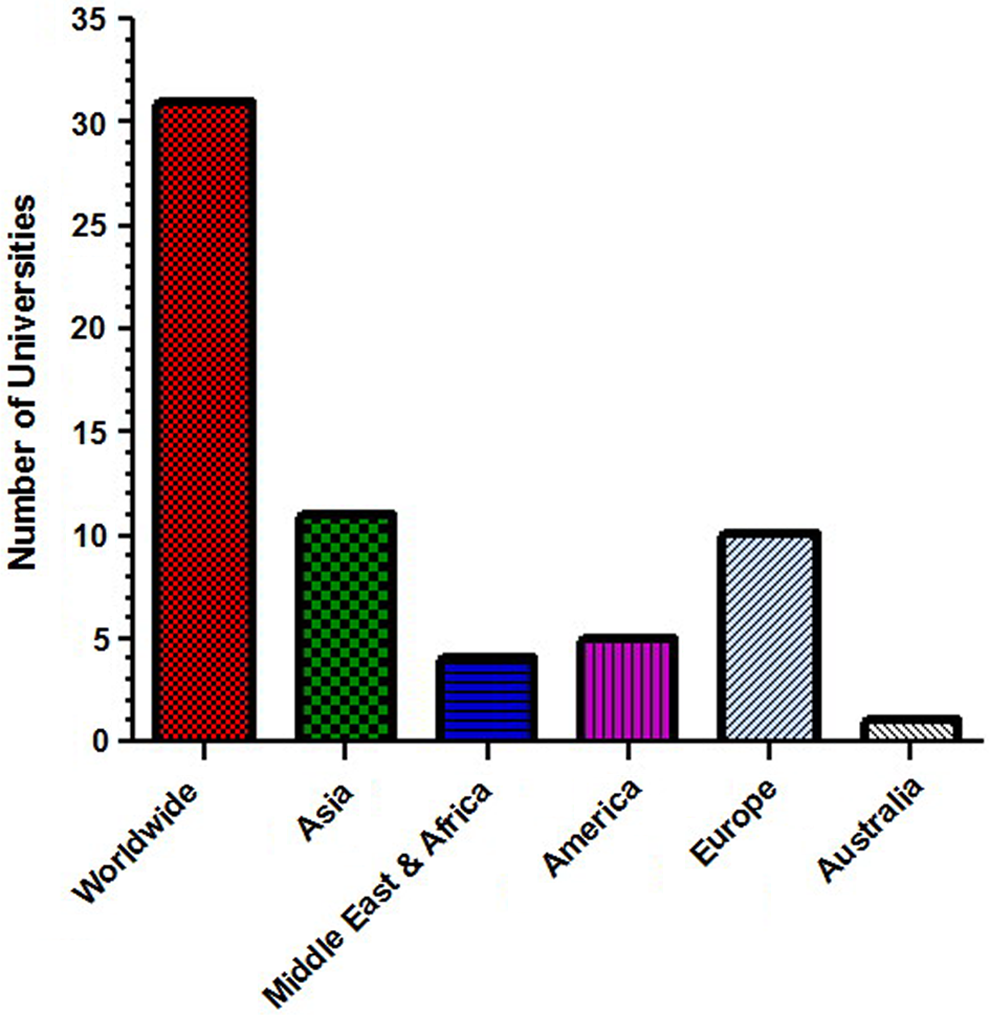
Distribution of different universities offering postgraduate education programs in laser dentistry. Worldwide = 31 universities; Americas = 5 universities; Asia = 11 universities; Australia = 1 university; Europe = 10 universities; Middle East and Africa = 4 universities.
Further, between 2006 and 2008, seven European universities decided to join their efforts in the European Master Degree in Oral Laser Applications (EMDOLA) group, to increase the quality of the education program in laser dentistry. They are offering a coherent, updated European joint study program with the objective of sharing, increasing, collating, and extending competencies in the field of oral laser applications. EMDOLA partners deliver one similar program for education under the auspices of the European commission of the European Union. The universities involved in the EMDOLA program are Liege University (Belgium), Aachen University (Germany), Barcelona University (Spain), Parma University (Italy), Roma La Sapienza University (Italy), Nice University (France), and Timisoara University (Romania).
In conclusion, the application of the laser beam increases the quality of some treatments in many fields of dentistry. 13 The coming years and reported research will give evidence of its benefit.