




Abstract
Introduction
O
Diagnosis of onychomycosis mainly relies on clinical features, KOH examination, and mycotic culture of the sample. 3 However, in equivocal cases, dermatoscopy may be a useful tool to the clinical assessment of fungal nail infections. Recently, specific dermatoscopic patterns suggestive of onychomycosis have been identified, including chromonychia, onycholysis, opacity, longitudinal striae, and jagged proximal edge with spikes. 3,4 Current treatments available for onychomycosis include oral (terbinafine and itraconazole) and topical antifungal agents (ciclopirox and amorolfine), photodynamic therapy, surgical approaches such as mechanical, chemical, or surgical nail avulsion, as well as the use of several laser devices. 5 Among the latter, the use of long-pulsed 1064-nm Nd:YAG laser (neodymium-doped yttrium aluminum garnet) for the treatment of onychomycosis has demonstrated promising results. Indeed, because of its longer wavelength, long-pulsed 1064-nm Nd: YAG laser is able to more deeply penetrate tissue and efficiently target fungal overgrowth in the nail plate. 6 In the largest study using a long-pulsed 1064-nm Nd: YAG laser for the treatment of onychomycosis, Kozarev et al. treated a total of 194 infected nails in 72 patients with 4-mm spot size, 30–40 J/cm2 energy fluence, and 35 msec pulse duration in the presence of cold air cooling. Patients received four treatments with 1-week interval and they were, thereafter, followed up for a period of 12–30 months. Their results showed a completely clear nail plate in 93.5% of patients. 7 In general, laser systems in the near infrared spectrum (780–3000 nm wavelength) carry out their effect by direct heating of the target tissues. 8 Moreover, by using pulsed light rays instead of continuous beam, they can deliver a “selective photothermolysis,” causing an immediate elevation in temperature into the defined target area. Sufficient intervals between pulses can allow tissue relaxation and cooling, avoiding severe collateral damage to the surrounding structures. 9
The use of lasers to treat nail diseases has been approved in the United States by the Food and Drug Administration (FDA). Wide literature has been produced to assess the effectiveness of these devices, but, because of the opposing results emerging from current studies, more data are still needed on the long-lasting efficacy and safety of this procedure.
Patients and Methods
This study aims to observe the effect of long-pulsed 1064-nm Nd: YAG laser on mycotic nail in terms of clinical cure using both clinical and dermoscopic pictures, before and after each treatment. Diagnosis was established in each patient on the basis of clinical findings, dermoscopic images, and mycological cultures. A long-pulsed 1064-nm Nd: YAG laser (DEKA M.E.L.A. Srl, Calenzano, Florence, Italy) was used and set to 4 mm spot size, 30 J/cm2 fluence, 5 msec pulse duration, and 1 Hz repetition rate with epidermal cooling. Patients were treated at intervals of 1 week for a total of four sessions. In one session, three passages across each nail plate were performed with 1-min pause between each passage. Clinical and dermoscopic images were captured in all cases before each treatment and 2 months after the fourth session. A special lens for dermoscopy (DermLite Foto; 3Gen LLC, San Juan Capistrano, CA) connected to a digital camera (Canon PowerShot A360) was used for dermoscopic images.
Results
Twenty patients enrolled for the study (16 females and 4 males aged from 21 to 72; median: 42 years). Fourteen patients (70%; 12F; 3M) obtained excellent results with an important reduction of chromonychia, onycholysis, opacity, longitudinal striae, and jagged proximal edge (Figs. 1 and 2).
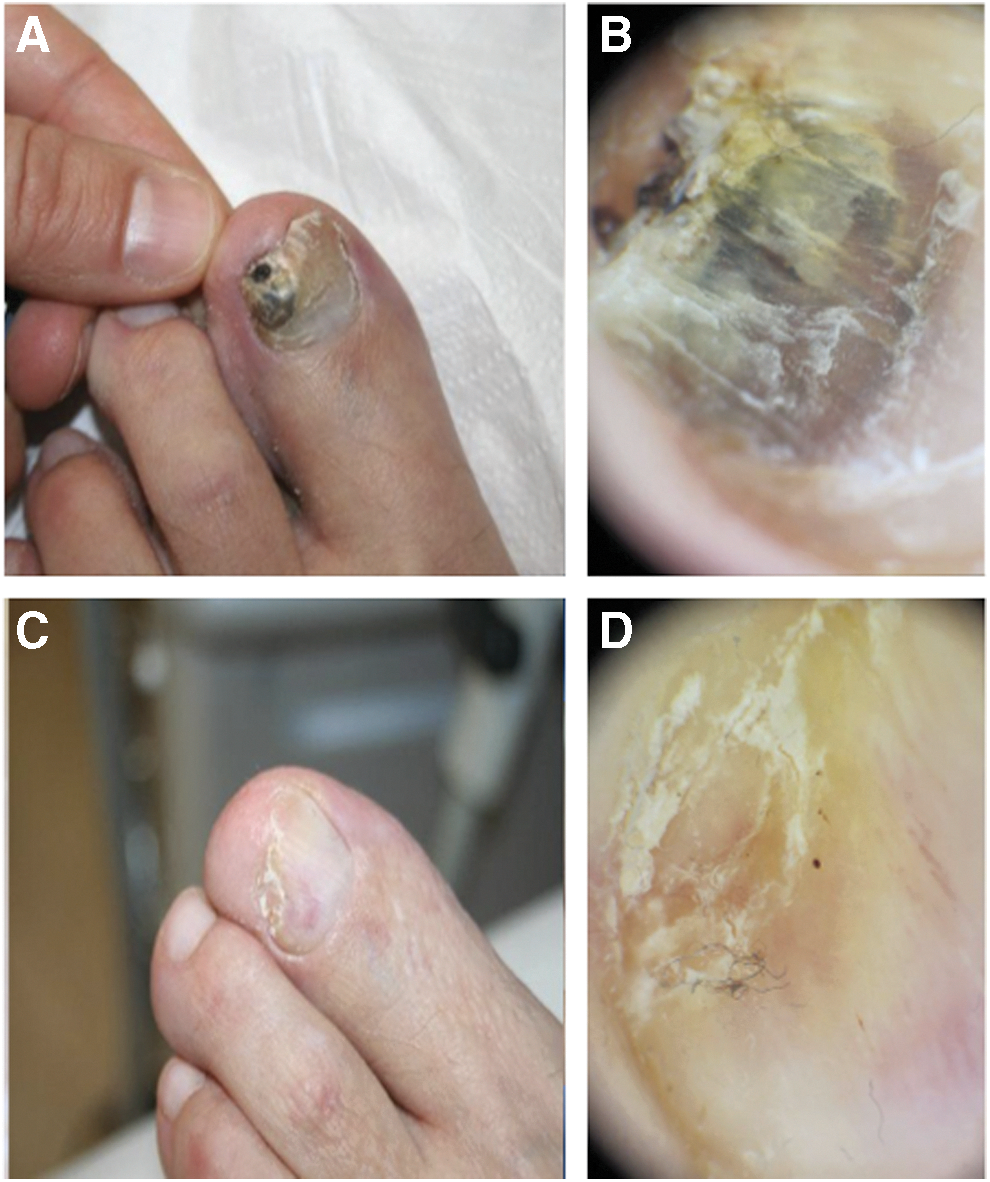
Clinical images and dermatoscopic features of onychomycosis treated with long-pulsed 1064-nm Nd:YAG laser.
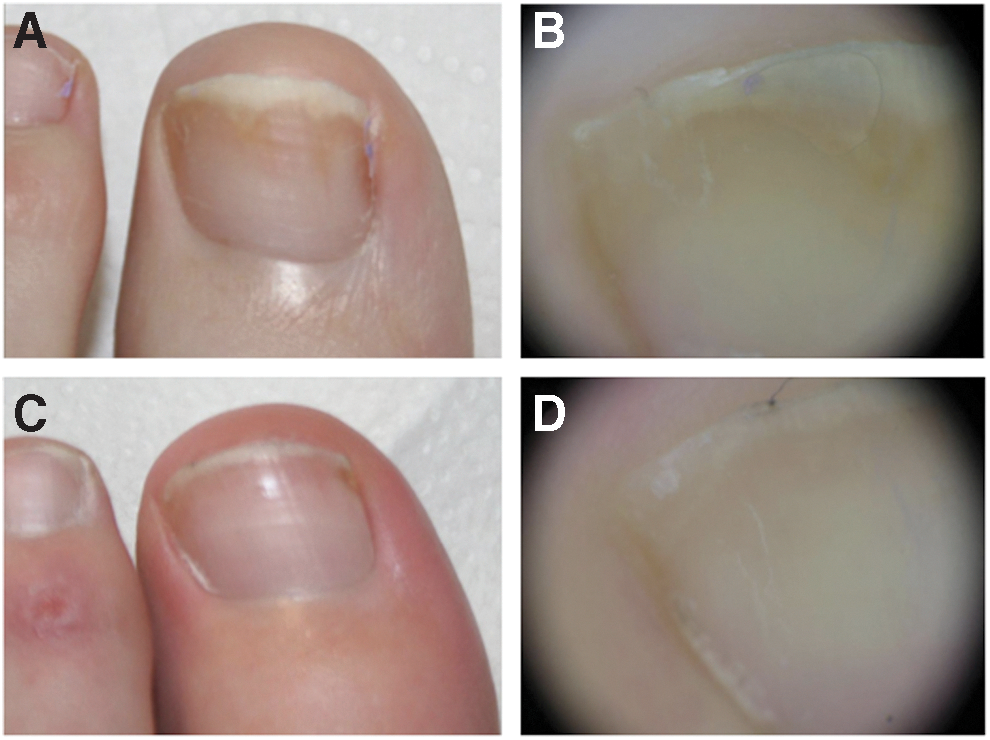
Clinical and dermatoscopic features of onychomycosis treated with long-pulsed 1064-nm Nd:YAG laser.
The results were already visible after the second session, especially in those patients who had mild mycotic involvement. All patients who claimed pain before treatment because of onychomycosis declared its complete disappearance after one or two treatments. Good results were obtained in four patients (20%; 4F). Fair-to-good reduction of chromonychia, onycholysis, opacity, longitudinal striae, and jagged proximal edge was achieved (Fig. 3). Two patients (10%; 1M and 1F) did not obtain results after treatments (Fig. 4). Interestingly, we noticed better results in severe cases in the 2-month follow-up visit. Although some patients reported mild pain and burning during the laser treatment, all patients underwent all three passages.
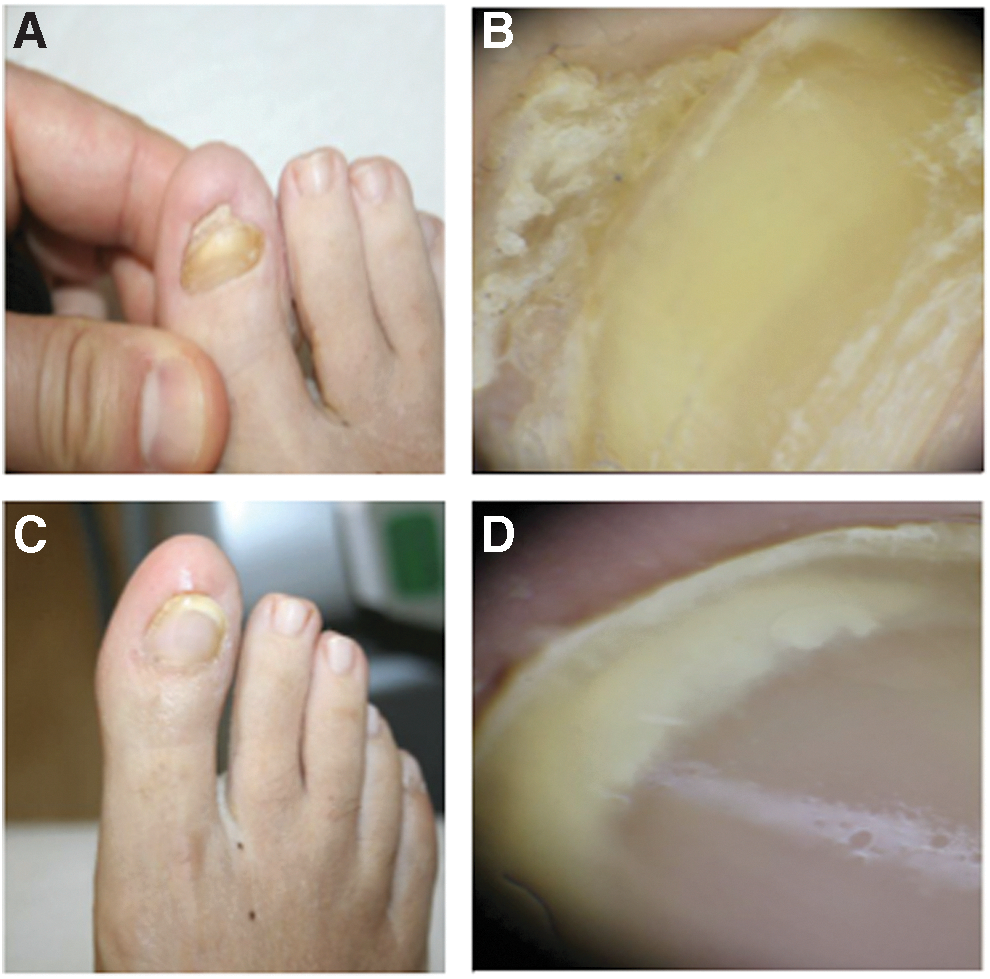
Clinical and dermatoscopic features of onychomycosis treated with long-pulsed 1064-nm Nd:YAG laser:
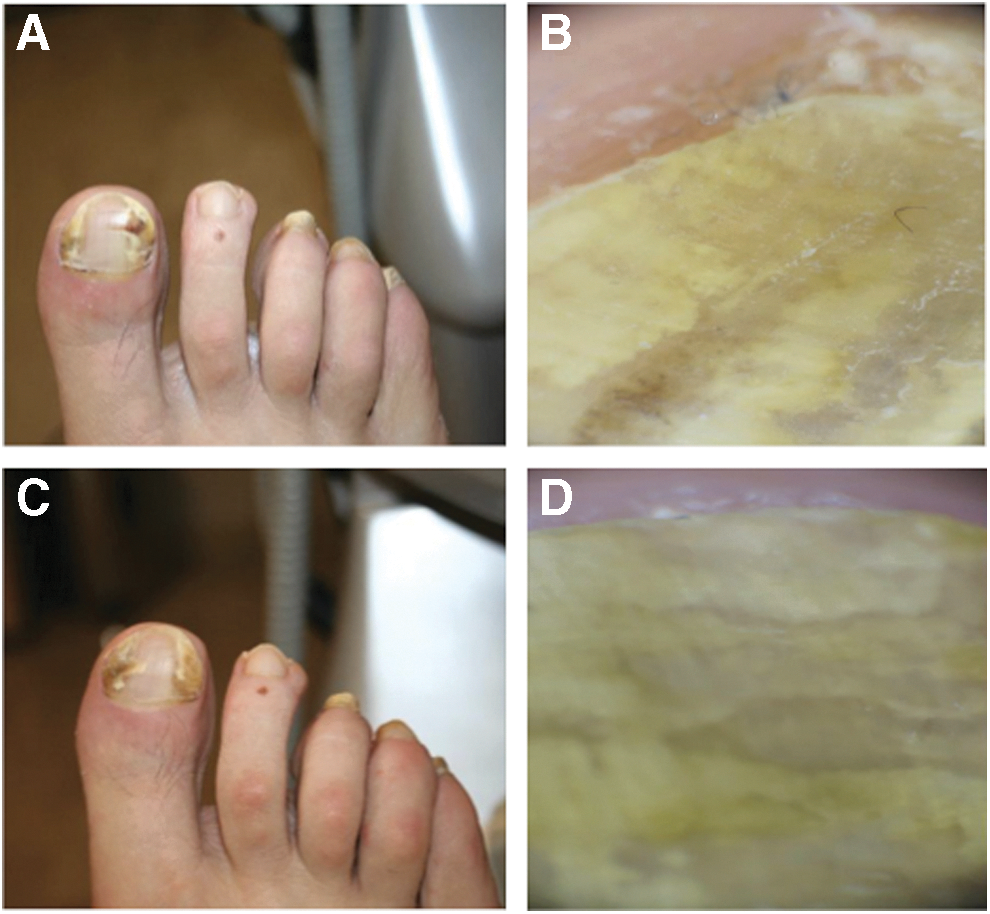
Clinical and dermatoscopic features of onychomycosis treated with long-pulsed 1064-nm Nd:YAG laser:
Conclusions
Laser therapy for onychomycosis is a new frontier of treatment, because of its fewer side effects. The number of professional lasers approved by the U.S. Food and Drug Administration is continually increasing, most of which are the long-pulsed Nd:YAG 1064-nm lasers. 10 Many studies show that the laser treatment of onychomycosis is safe and effective. 6 However, new studies 11 stated that the use of Nd:YAG 1064-nm laser is not a long-lasting treatment for onychomycosis. 12 For this reason, further study of the Nd:YAG 1064 method to treat onychomycosis is still needed to assess the efficacy of the Nd:YAG 1064-nm laser therapy as a valid treatment for this frequent pathology.
Pivot studies on laser effects on onychomycosis show, in the laboratory, eradication of the common dermatophyte T. rubrum. 13 The direct thermal killing effect on fungal mycelia was ensured, treatment temperatures exceeding 50° centigrade. 14
Wide literature has been reviewed to assess the effectiveness of these devices 15 and our experience confirms the possible key role that long-pulsed 1064-nm Nd:YAG laser might represent on treatment of onychomycosis.
The promising results identify long-pulsed 1064-nm Nd:YAG laser as a possible alternative option for the treatment of onychomycosis. Larger controlled studies may add new information about its efficacy and to would standardize the treatment regimen for the management of onychomycosis. With increased subject data, improved study methodology, and more precise output parameters, lasers may become an important, innovative modality in the treatment of nail onychomycosis. 16
Footnotes
Author Disclosure Statement
No competing financial interests exist