




Abstract
Introduction
C
To improve the quality of mechanical bonding between super- and infrastructures, several methods applicable to infrastructures have been developed such as sandblasting, acid etching, application of bonding agents, laser sintering, and laser etching. Among these, laser etching is a surface treatment that eases the procedure and also enables control of microtopography because of its depth of optical penetration depending on the material irradiated and provides more surface roughness and a stable surface morphology. 1,3 Ongoing research focuses on various types of lasers tested on different infrastructures to strengthen their bond with superstructures. 4 –10 The laser as a versatile tool for modification and optimization of infrastructure surface has a potential to provide better results than other techniques, including sandblasting and acid etching. With laser applications, it is possible to obtain regulated surface changes with the control of features of produced pits, grooves, and ablation tracks. 11
Restorative dentistry continues to evolve with innovations in bonding agents, restorative materials, and conservative preparation techniques. Recent developments in material technology provided considerable advancement in the physical properties of composite materials and expanded their clinical applications. With advancements including the addition of different fillers to reinforce polymers, as an inorganic–organic hybrid polymeric material, ceromers are added to the material armamentarium of dentistry. They had the useful properties of ceramic fillers improving wear resistance and lifespan of composites with the help of improved mechanical strength and abrasion resistance. 2,12 –16 Other newly developed materials, nanohybrid composites, have the best properties of filler and composite materials. With nanoparticle addition to composite, a truly universal product is obtained and it can be preferred for all clinical composite applications, with an advantage of maximized durability and polishability. This is important for maximized aesthetics, as well as reduced plaque accumulation in long-term use. 17,18
The success of the restorations fabricated with several types of super- and infrastructure materials depends mainly on the bonding strength at their interfaces. Various experimental tests have been developed and tried by researchers to evaluate the bonding strength of materials used for fabrication of crowns with metal infrastructure. Although there is not a consensus for the ideal test to determine the bonding strength in experimental specimens, assuming that shear stresses are main factors for the clinical failure of restoration, shear bond strength (SBS) tests are considerably used to examine the strength of bonding. 19
In this study, ceromer (Estenia C&B TM; Kuraray Medical, Inc., Tokyo, Japan) and nanohybrid composite (Cavex Quadrant Universal LC; Cavex, Haarlem, The Netherlands) superstructures were selected as study subjects, since they are the materials mainly used in our prosthodontics service, to determine their bonding to DLS and Ni-Cr-based metal infrastructures fabricated with laser etching with erbium-doped yttrium aluminum garnet (Er:YAG), neodymium-doped yttrium aluminum garnet (Nd:YAG), and potassium titanyl phosphate (KTP) laser modalities in vitro settings. The null hypotheses were determined as follows: the SBS of ceromer and nanohybrid composite superstructures to the DLS and Ni-Cr-based infrastructures after surface treatments with the studied lasers would not be changed. The objective of this study was to examine the SBS of ceromer and nanohybrid composite to DLS and Ni-Cr-based metal infrastructures treated with Er:YAG, Nd:YAG, and KTP laser modalities in an experimental study.
Materials and Methods
Preparations of the specimens
The study specimens had four sets including 32 DLS infrastructures with ceromer superstructures, 32 DLS infrastructures with nanohybrid composite superstructures, 32 Ni-Cr-based infrastructures with ceromer superstructures, and 32 Ni-Cr-based infrastructures with nanohybrid composite superstructures. The specimens were fabricated as 7 mm in diameter and 3 mm in thickness in accordance with ISO 11405 standard. For the Ni-Cr-based specimens, the CAD/CAM system (Yenadent, Ankara, Turkey) was used. The DLS specimens were prepared with the help of laser sintering machine (EOSINT M-270, Munich, Germany). Chemical compositions of DLS and Ni-Cr-based infrastructures are shown in Table 1. All experimental specimens were cleaned with distilled water for 5 min and rinsed for 2 min. Table 2 presents the applications of studied laser modalities.
DLS, direct laser sintered.
Er:YAG, erbium-doped yttrium aluminum garnet laser; KTP, potassium titanyl phosphate; Nd:YAG, neodymium-doped yttrium aluminum garnet.
Each study set was divided randomly into four sets according to treatment modality: no treatment (controls), Er:YAG, Nd:YAG, and KTP laser applications (n = 8 for each treatment modality).
• Er:YAG laser procedure: an Er:YAG laser device (Smart2940D Plus; Deka Laser, Florence, Italy) was used to modify the surface of infrastructure pieces under water cooling.
• Nd:YAG laser procedure: a Nd:YAG laser device (Smarty A10; Deka Laser) was used to etch the surface of infrastructure pieces under water cooling.
• KTP laser procedure: a KTP laser device (Smartlite D; DEKA M.E.L.A. Srl, Calenzano, Italy) was used to roughen the surface of infrastructure pieces under water cooling.
After surface preparation with selected laser modalities, the ceromer and nanohybrid composite was applied to the infrastructures. For the ceromer application, we used a standardized mold of 5 mm in diameter and 3 mm in height in accordance with ISO/TR 11405 standards. First, the specimens for ceromer application were polymerized in accordance with the specific instructions of the manufacturer by Light Curing-300 and Heat-Curing-110 devices, respectively. The specimens underwent the primary polymerization process for a period of 270 sec in Light Curing-300 device. Later, a final polymerization process was applied to these specimens. This procedure was completed in Heat-Curing-110 device for a period of 15 min at a temperature of 100°–110°C. Second, the specimens, to which nanohybrid composite was applied, were polymerized according to the instructions of the manufacturer.
Shear bond testing
The prepared specimens had a final size of 14 mm in diameter and 12 mm in height after embedding in acrylic resin in aluminum molds. Before the SBS tests, all the specimens were stored in distilled water at 37°C ± 1°C for 24 h (Nuve BM 302; Nuve, Ankara, Turkey). The SBS values were measured at 0.5 mm/min head speed in the Universal test device (Fig. 1). The blade tip to perform the cutting was prepared at a thickness of 1 mm and used bluntly as defined in the ISO TR 11405 specification. It was positioned with an angle of 90° at the cutting point where the superstructure bonded with the infrastructure. The SBS values were obtained as Newton (N) values and these values were converted into megaPascal (MPa) values to determine the amount of load per unit area.
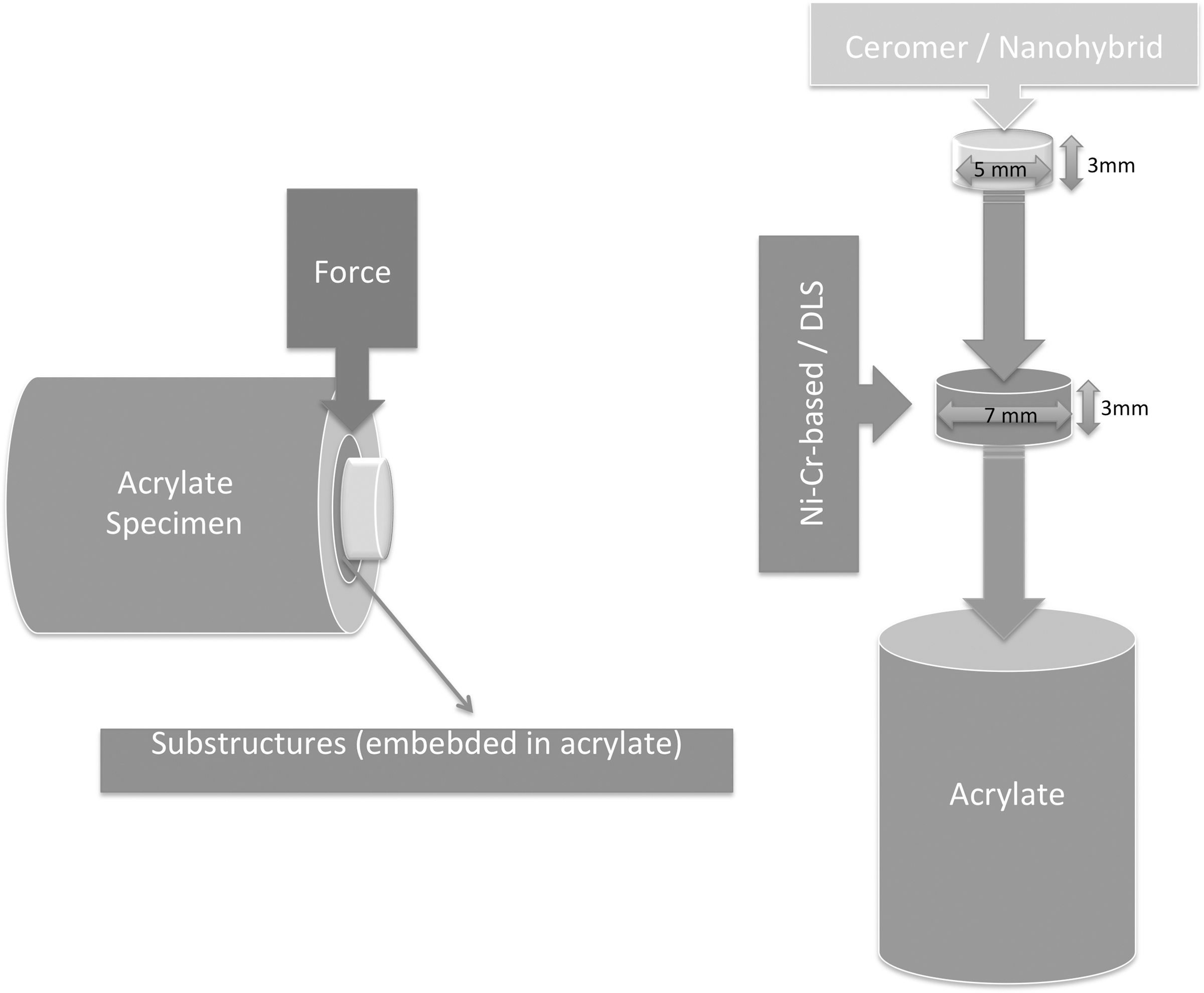
Representative drawing of ceromer and metal infrastructure specimens used in the experiments.
Scanning electron microscopy (SEM) analysis
SEM analysis was performed after the bond strength test (Tescan Mira 3 SEM Device, Brno, Czech Republic). We examined how the super- and infrastructures detached and which type of topography on the laser-applied surfaces were formed (Figs. 2 and 3).
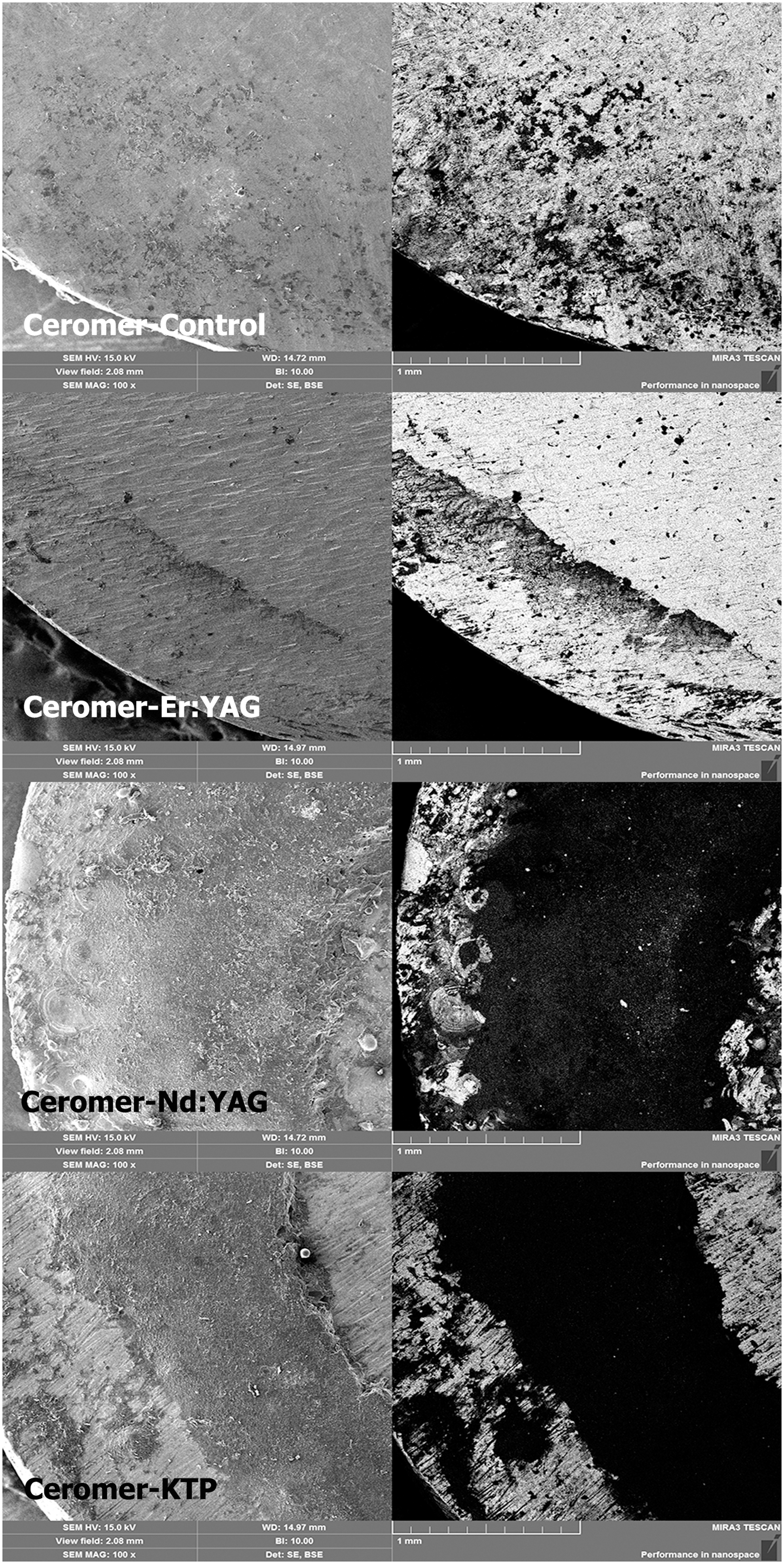
Representative scanning electron microscopy (SEM) images of ceromer-detached surfaces of laser-applied infrastructures.
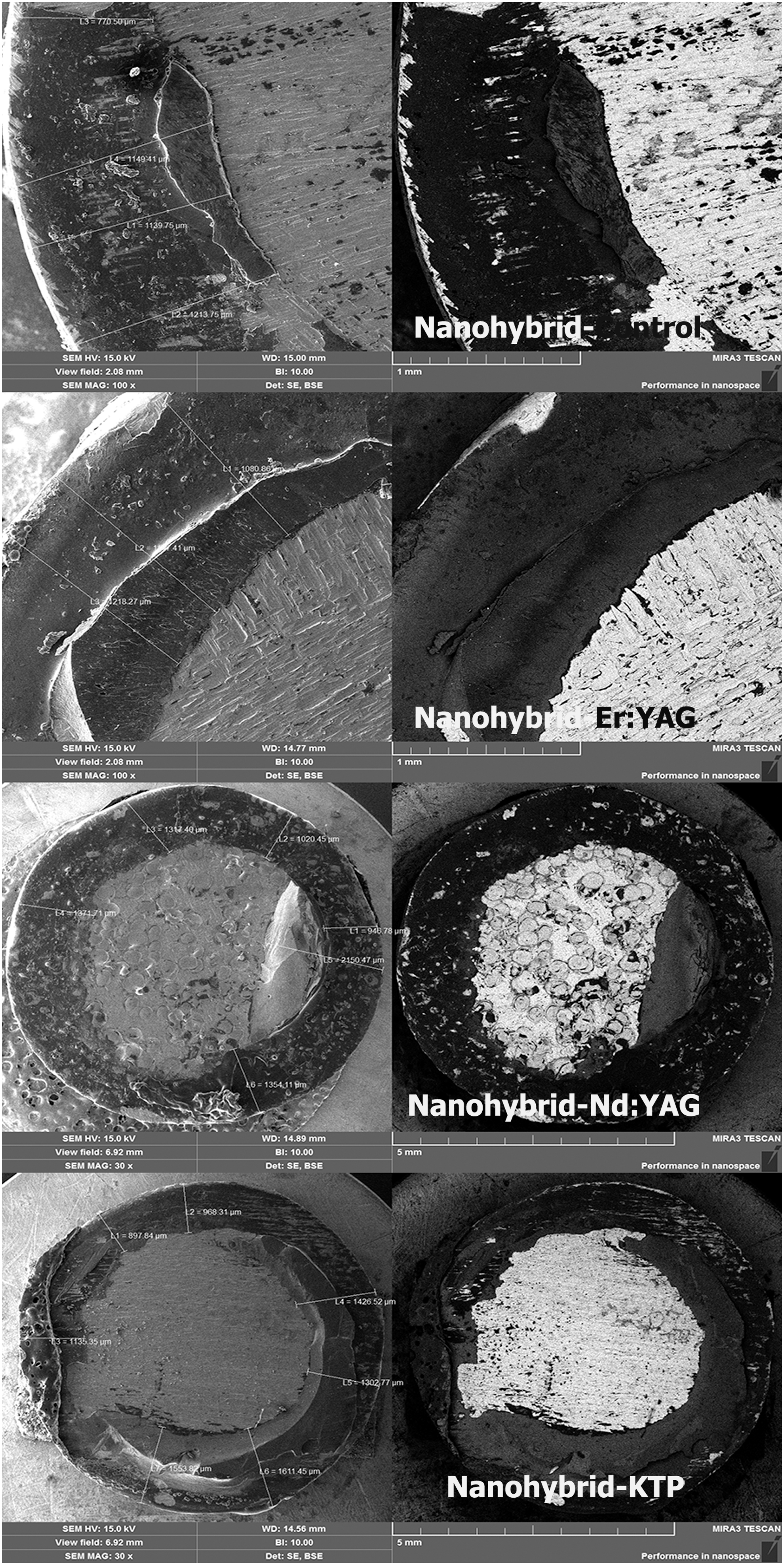
Representative scanning electron microscopy (SEM) images of nanohybrid-detached surfaces of laser-applied infrastructures.
Statistical analysis
By choosing the SBS value as the main numeric variable of the study and assuming a minimal difference of 20% among the study subsets with regard to the SBS value, the number of specimens (i.e., sample size = 8) tested for each subset was computed at a significance level of 5% (α < 0.05). Data are presented as the mean ± standard deviation (SD). After Kolmogorov–Smirnov normality test, the SBS data were analyzed with analysis of variance followed by the post hoc Tukey test for pairwise comparisons. Data are presented as whisker plots with mean and SD lines and scatter dots presenting raw data. Values of p < 0.05 were considered to show significant differences between means.
Results
Figure 4 presents the SBS values of ceromer and nanohybrid composite to the metal infrastructures including the DLS and Ni-Cr-based materials after performing the study procedures including the Er:YAG, Nd:YAG, and KTP laser applications. Overall, in these experimental settings, the combination of the studied super- and infrastructures and surface preparation techniques alone and in combination significantly changed the SBS values of the study subsets (p < 0.05). Then the mean SBS values of the study subsets regarding the applied modality of surface treatment were further compared to determine the performance of used materials during the fabrication of specimens. In the control subsets, the highest SBS value with statistical significance was obtained, in an order of higher to lower value, in the DLS/ceromer, Ni-Cr-based/ceromer, DLS/nanohybrid composite, and Ni-Cr-based/nanohybrid composite subsets (p < 0.05). In the Er:YAG laser subsets, the highest SBS value with statistical significance was obtained, in an order of higher to lower value, in the DLS/ceromer, DLS/nanohybrid composite, Ni-Cr-based/ceromer, and Ni-Cr-based/nanohybrid composite subsets (p < 0.05).
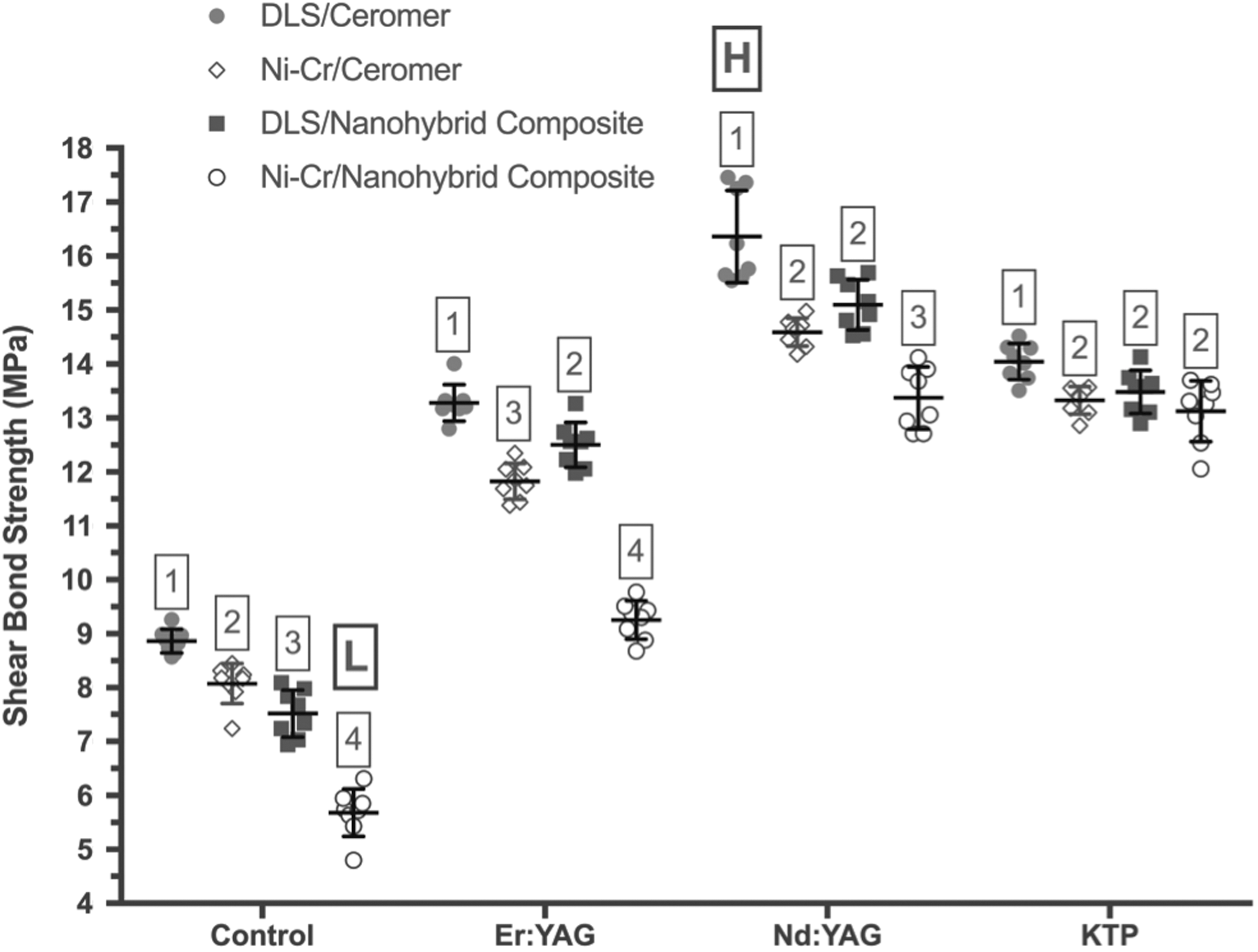
SBS values of ceromer and nanohybrid composite superstructures to direct laser sintered and Ni-Cr-based infrastructures treated with Er:YAG, Nd:YAG, and KTP lasers. Data of eight experiments are presented as whisker plots with mean and standard deviation lines and scatter dots presenting raw data. H and L letters present the highest and lowest SBS values, respectively. The boxed numbers indicate the rank of statistically significant increase in the SBS values in the control, Er:YAG, Nd:YAG, and KTP laser specimens. Overall, in all the specimens, Nd:YAG, KTP, and Er:YAG lasers, in an order of decreasing efficacy, had significant contribution to bonding strength (p < 0.05). Er:YAG, erbium-doped yttrium aluminum garnet laser; KTP, potassium titanyl phosphate; Nd:YAG, neodymium-doped yttrium aluminum garnet; SBS, shear bond strength.
In the Nd:YAG laser subsets, the highest SBS value with statistical significance was obtained, in an order of higher to lower value, in the DLS/ceromer, DLS/nanohybrid composite, and Ni-Cr-based/ceromer, and Ni-Cr-based/nanohybrid composite subsets (p < 0.05), and although the SBS value of DLS/nanohybrid composite subset was higher than that of the Ni-Cr-based/ceromer subset, this difference did not reach statistical significance (p > 0.05). In the KTP laser subset, the highest SBS value with statistical significance was obtained in the DLS/ceromer subset compared with the DLS/nanohybrid composite, Ni-Cr-based/ceromer, and Ni-Cr-based/nanohybrid composite subsets (p < 0.05), and there was no significant difference among the DLS/nanohybrid composite, Ni-Cr-based/ceromer, and Ni-Cr-based/nanohybrid composite subsets (p > 0.05).
Then the mean SBS values of study subsets were further analyzed to examine the performance of laser modalities, regarding the used materials during fabrication of specimens. In all of the DLS/ceromer, Ni-Cr-based/ceromer, and DLS/nanohybrid composite subsets, the highest SBS value with statistical significance was obtained, in an order of decreasing value, in the Nd:YAG laser, KTP laser, Er:YAG laser, and control subsets (p < 0.05). In the Ni-Cr-based/nanohybrid composite subset, the highest SBS value with statistical significance was obtained, in an order of decreasing value, in the Nd:YAG laser and KTP lasers, Er:YAG laser, and control subsets (p < 0.05), and although the SBS value of Nd:YAG laser subset was higher than that of the KTP laser subset, this difference did not reach statistical significance (p > 0.05).
Discussion
In this study, the null hypotheses, which stated that the SBS of ceromer and nanohybrid composite infrastructures to the DLS and Ni-Cr-based infrastructures after surface treatments with the studied laser modalities would not be changed, were rejected. This study demonstrated that (1) overall, Nd:YAG, KTP, and Er:YAG lasers, in order of efficacy, are more effective to improve the SBS of ceromer and nanohybrid composite to all the infrastructures; (2) Nd:YAG laser had, overall, the highest effectiveness in all of specimen types; and (3) KTP laser was the second more effective modality in all of the specimen types; and Er:YAG laser provided less success among the laser modalities in all specimen types.
After the examination of SEM images to assess infrastructure surfaces after the SBS test, the topography of detached surfaces of laser-treated specimens fabricated with the DLS and Ni-Cr-based materials was found differently changed according to the type of applied laser modality. The surface roughness is more pronounced, in a decreasing order of severity, from Nd:YAG, KTP, and Er:YAG laser treatments. Surface treatment with laser modalities can provide microporosities and microretentive areas helping adhesive material used for bonding of super- and infrastructures by increasing the surface area of a roughened surface. Considering superstructures fabricated with the ceromer and nanohybrid composite materials, we observed that microparticles of ceromer remained attached on the detached surface of infrastructure. This finding suggests that the ceramic fillers contained by ceromer play a role by producing more resistance to breakage in the pronounced strength of ceromer to fracture from infrastructure. Overall, SEM data presented moderate accordance with the SBS data in the current study.
No previous research has evaluated different laser surface treatments and their effects on the SBS of prostheses fabricated with currently studied materials. As part of ongoing efforts to improve metal–ceromer bonding, we observed positive effects of laser treatments instead of sandblasting that is a conventional technique roughening the surface of materials for better attachment by mechanical interlocking with an increase in the surface area for their bonding. 20 Owing to the increasing patient demand for aesthetic and durable restorations, materials that exhibit a natural appearance, strength, and durability have been developed. To overcome the less-than-ideal lifespan and wear properties of dentures related to their less-than-ideal fracture resistance, various reinforcing methods involving surface treatment measures involving the application of laser modalities to infrastructures have been proposed. Laser treatments are not standardized and are also less than ideal with their own share of pros and cons, such as not adequately optimized application rules. Detailed information about the physical properties of dental materials, including their response to stress and their appropriateness to clinical needs, is necessary to use them for fabrication of crowns.
Several materials have been used to construct metal–ceramic restorations and there has been a vast improvement in their quality in the past few years. Metal–ceramic dentures have positive properties of metals with aspects of strength, durability, and stability, in addition to aesthetic advantages of ceramics. For optimal wear resistance of these restorations, there is a need to obtain a strong bond on the metal–ceramic interface, which is a chemical bond on the oxidized metal surface with silica atoms of ceramics. Roughness of metal surface affects the bonding quality. To advance the bonding quality for optimal fracture resistance and lifespan of restorations, there is ongoing research with several means, including laser surface preparation. 20
The metal–ceramic crown is popular for restorative dentistry because it has aesthetic properties with the natural appearance of porcelain and has satisfactory strength because of a metal infrastructure. Metal–ceramic crowns have no natural translucency and this induced the development of new materials, including ceromer. Ceromer, ceramic optimized polymers, was developed as supplement to ceramic materials to fabricate inlays/onlays, veneers, and metal-free single-unit crowns. 21,22 It contains both hydrocarbon and silicone and exhibits the properties accepted as intermediate between polymers and ceramics. 23,24 Ceromer restorations offer sufficient mechanical strength for prevention of their fracture and long-term satisfactory color stability during their long-term clinical use. 21,25 –27
Conclusions
Within the limitations of this in vitro study, the following conclusions were drawn.
In current experimental settings, overall, Nd:YAG, KTP, and Er:YAG lasers, in order of efficacy, are more effective to improve the SBS of ceromer and nanohybrid composite to all the infrastructures.
Nd:YAG laser has, overall, the highest effectiveness in all of the DLS/ceromer, DLS/nanohybrid composite, and Ni-Cr-based/ceromer, and Ni-Cr-based/nanohybrid composite specimens.
KTP laser is the second more effective modality in all of the DLS/ceromer, DLS/nanohybrid composite, and Ni-Cr-based/ceromer, and Ni-Cr-based/nanohybrid composite specimens.
Er:YAG laser provides less success among the laser modalities in all the specimen types. Ceromer with DSL infrastructure provides the most powerful bonding after all the surface treatments.
Footnotes
Author Disclosure Statement
No competing financial interests exist.