




Abstract
Objective:
We present a case report of reversal of cognitive impairment, olfactory dysfunction, and quality of life measures in a patient with cognitive decline after multi-modality photobiomodulation (PBM) therapy.
Background:
Transcranial and intranasal PBM has been introduced as a light-based therapeutic technique in which exposure to low levels of red to near-infrared (NIR) light stimulates neuronal function, leading to beneficial neurological effects.
Materials and methods:
Patient received twice-daily PBM therapy at home using three different wearable light-emitting diode (LED) devices. For the first week containing a mixture of continuous wave mode red (635 nm) and NIR (810 nm) LEDs, a prototype transcranial light helmet and a body pad were used. The body pad was placed on various areas on the lower back and the helmet was worn while seated. After the first week of treatment, an intranasal LED device, 10-Hz pulsed wave mode NIR (810 nm), was initiated in the left nostril twice daily. All three devices were applied simultaneously for an irradiation time of 25 min per session.
Results:
The patient showed a significant improvement in the Montreal Cognitive Assessment score from 18 to 24 and in the Working Memory Questionnaire score from 53 to 10. The cognitive enhancement was accompanied by reversal of olfactory dysfunction as measured by the Alberta Smell Test and peanut butter odor detection test. Quality-of-life measures improved and caregiver stress was reduced. No adverse effects were reported.
Conclusions:
PBM therapy may be a promising noninvasive approach for patients with neurodegenerative diseases.
Introduction
Alzheimer's disease (AD) is a debilitating neurodegenerative disorder and the leading cause of disability in elderly adults. The yearly number of new individuals diagnosed with AD and other types of dementia is forecast to double by the year 2050 in the United States. 1 Mild cognitive impairment (MCI) is considered to be a transitional stage between normal brain aging and dementia, and could also be prodromal to the onset of AD. 2 MCI patients show a heightened risk for developing dementia, with annual conversion rates of MCI to AD around 8–15%. Most cases of conversion happen within 3 years of the first appearance of symptoms. 3 Impaired cognition demonstrated by deficits in learning and memory as well as lowered quality of life are the common symptoms of most forms of dementia and AD. 4 In MCI, the capacity for attentional processing and working memory (WM) has been shown to decline; 5 and impaired WM can be a predictive marker of progression to dementia in patients with MCI. 6 In addition to cognitive function, impairment in the sense of smell and lowered olfactory function is associated with MCI, and with the progression from MCI to AD. 7
In 2015, 16.1 million Americans provided unpaid, informal care for people with Alzheimer's or other dementias. These caregivers provided an estimated 18.1 billion hours of unpaid care valued at over $232 billion dollars. 8 Caregivers of patients with cognitive decline suffer negative physical and mental health outcomes tied to their caregiving role. 9 If caregivers are not properly supported, and/or when the dependency/mental condition of the patient worsens, they may lose their ability to provide care, creating added distress to the social dynamic and/or shifting this expense to the more formal health care sectors.
The failure of several human clinical trials testing new drugs for AD underlines the urgent need for novel, noninvasive, alternative, and/or complementary therapies. 10 Therefore, an effective non-pharmaceutical approach for improving outcomes in AD or MCI patients could have major socioeconomic implications. Photobiomodulation (PBM) therapy is an emerging treatment modality in which exposure to low levels of red or near-infrared (NIR) light from lasers or light-emitting diode (LED) stimulates cellular function, leading to beneficial clinical effects. 11 Mitochondrial cytochrome c oxidase (COX) is a likely site for the initial absorption of red/NIR light and this multi-component membrane protein complex has action spectra at the specific wavelengths of 630–670 nm and 800–880 nm. 12 Photon absorption leads to increased adenosine triphosphate (ATP) synthesis, modulation of nitric oxide (NO), and increased tissue oxygenation and blood flow. 13
With respect to neurorehabilitation, transcranial PBM (t-PBM, red/NIR light applied to the head) has been performed for more than a decade to improve brain function. The neuroprotective and procognitive benefits of t-PBM have been demonstrated in several different brain conditions. 14 Pre-clinical evidence suggests that red/NIR light delivered to the scalp/skull can increase neurotrophins, neurogenesis, and synaptogenesis, while at the same time, ameliorating neuroinflammation, neuronal oxidative damage, and apoptosis. 15 Recently, intranasal PBM (i-PBM) therapy has been introduced as an innovative light delivery method, 15,16 which based on the most recent Monte Carlo simulation modeling, has been demonstrated that delivery of light through the nasal cavity could directly irradiate subcortical and cortical regions of the brain in the frontal areas. 17 To date, few studies have reported neuroprotective effects of regular, long-term administration of transcranial and/or i-PBM therapy in terms of cognitive improvements in patients with different types of dementia 16,17a and AD. 18,19
This case report describes improvements in WM performance and cognitive ability, and reversed olfactory dysfunction in one Alzheimer's patient and reduction in caregiver stress following multi-modality PBM therapy (transcranial, intranasal, and whole-body irradiation).
Case Report
A 64-year-old Caucasian female with a history of AD diagnosed by a medical professional in 2011 and confirmed by neuropsychological testing in 2013. She was currently taking the standard drug regimen prescribed for dementia: Memantine 10 mg twice a day and Rivastigmine 9.5 mg once per day; and her standard drug routine included the following: Gabapentin, Omeprazole, Duloxetine, Meloxicam, Bayer Aspirin, Hydroxychloroquine, Alprazolam, and supplements that included Vit. B-12, Citrucel, Vit. D, and magnesium.
She presented on January 27th 2018, with worsening cognitive decline and impaired olfactory function. She had a medical history of previous exposure to toxic chemicals, hip replacement, and heart tissue ablation, and complained of neuropathic pain with a diagnosis of lupus and fibromyalgia. She had an older sister who was diagnosed with dementia of the Alzheimer's type at age 55, and over time, her sister's symptoms had worsened. She reported a maternal aunt and a paternal aunt who had also been diagnosed with AD. Moreover, she reported one paternal uncle who had a memory problem in later years, but was never diagnosed with dementia.
At initial examination, she stated that her main concern was to stop her memory loss and improve its function. She stated that her brain was not functioning well and the diagnosis of dementia and loss of memory scared her. She felt that her diagnosis was a “death sentence.”
The patient's caregiver was a physical trainer who was coping and managing fairly well, but his stress level was high as determined by the Caregiver Self-Assessment Questionnaire (CSAQ). 20 Upon arrival, patient and her caregiver completed the code of ethics and informed consent form, including the information about safety of the intervention. 21 The caregiver and the patient gave their consent to be evaluated and proceeded with a multi-modality home care program that included PBM therapy and personalized health coaching for them both. At the conclusion, she consented to allow this case report to be published.
PBM therapy was applied in 25-min segments, twice daily (morning and evening) for 4 weeks using two different LED devices, including a prototype transcranial “Light Helmet” (Fig. 1a) and a body pad (Fig. 1c), both from ProNeuroLIGHT LLC (Phoenix, AZ) containing a mixture of red and NIR LEDs. The device specifications and treatment parameters are described in detail in Table 1. After the first week of treatment, an intranasal LED device (Fig. 1b) with 810 nm wavelength and 10-Hz pulsed wave (PW) mode (VieLight LLC, Toronto, Ontario, Canada) was commenced in the left nostril twice daily, applied at the same time as the light helmet and body pad devices. The introduction of the intranasal piece was offset because we were examining low-dose irradiation tolerance, while monitoring for adverse effects.

Three types of noninvasive LED devices using red and infrared diodes were used for multi-modality PBM therapy on the patient.
Multimodal Device Specifications and Treatment Parameters
Various areas on the lower back.
#1, transcranial (ProNeuroLIGHT); #2, intranasal (VieLight); #3, body pad (ProNeuroLIGHT).
LED, light-emitting diode; NIR, near infrared.
The patient received PBM therapies for 25 min twice daily (morning and evening). The caregiver followed a written home care plan and monitored every session. PBM therapies were applied to the same sites during each session. The light helmet set gently on the head, the intranasal device was placed in the left nostril, and the body pad was applied directly on the bare skin of the lower back (over any area of pain). Figure 2 shows the patient during the simultaneous application of the light helmet and intranasal devices.
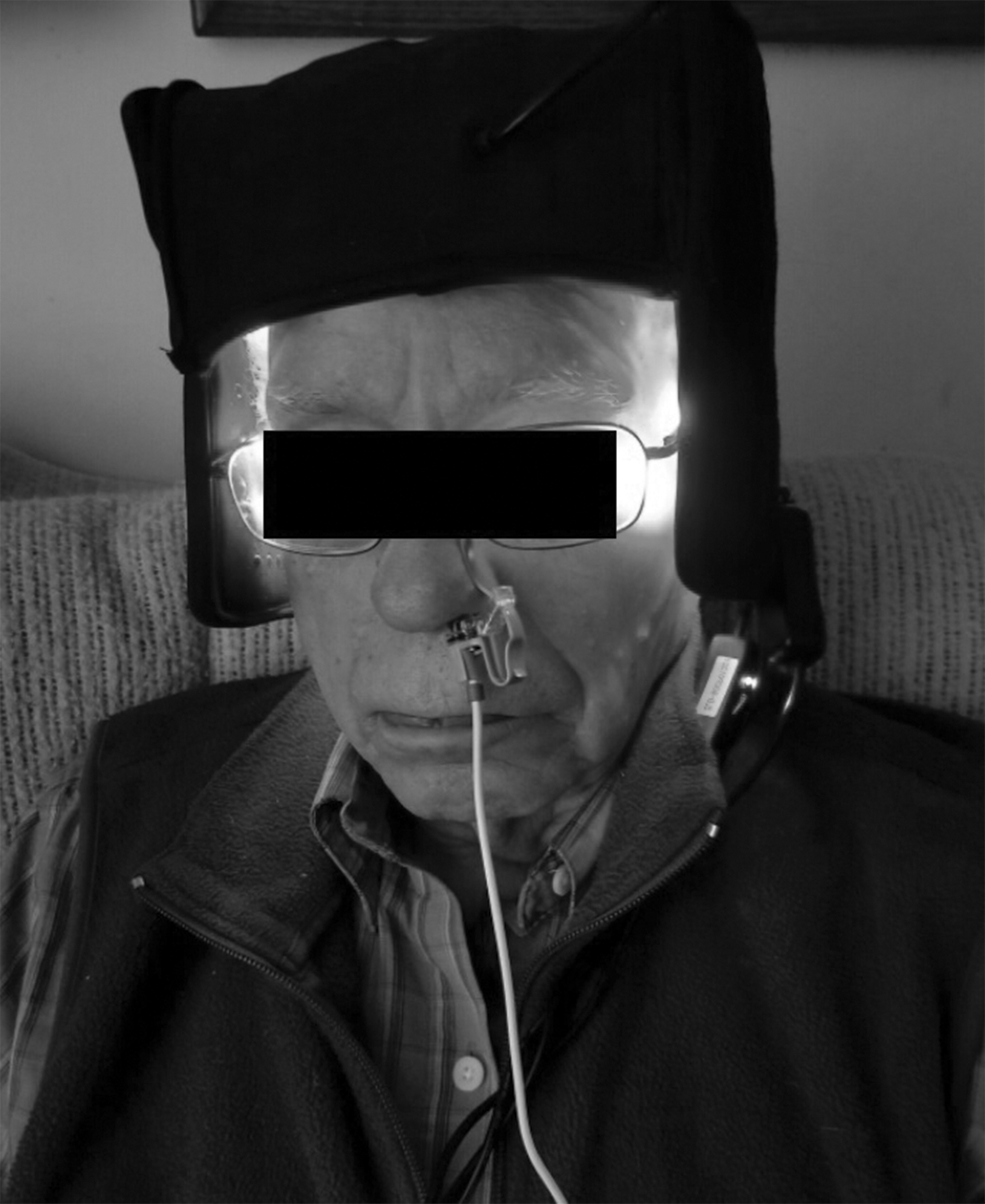
Patient was treated in a sitting position with simultaneous application of the light helmet and intranasal devices (body pad not shown).
The Montreal Cognitive Assessment (MoCA) is a brief cognitive screening test originally developed to detect MCI as a possible prodromal stage of AD. It assesses several cognitive functions, including attention, executive function, language, memory, and orientation. MoCA scores range from zero to 30, with 26 and higher generally considered normal, 22 indicates MCI, and 16 or below indicates dementia. 22 Pre-treatment and post-treatment cognitive assessment revealed MoCA scores of 18 and 24, respectively. Improvements were noted in visual-spatial executive function, mathematical ability, and orientation, while delayed recall did not improve.
The WM Questionnaire (WMQ) is a validated, self-administered scale addressing three dimensions of WM, including short-term storage, attention, and executive control. The total score is out of 120, higher scores indicating more deficits. 23 Compared to patients with traumatic brain injury (TBI) who average a disability score of 35, 24 the initial gross score of our patient was 53, which improved to 10 following 4 weeks of PBM therapy. While she showed change in WM domain (20 to 6), attention domain (15 to 2), and executive domain (18 to 2), her subjective disability of 44%in WM pre-treatment reduced to only 8% post-treatment.
The Alberta Smell Test (AST) is used in the assessment of neurodegenerative diseases and involves the unirhinal presentation of 10 different odorants to each nostril for a total of 20 exposures. The cutoff score for moderate to severe TBI patients is 3.4 (standard deviation = 2.8) correct responses per nostril, 24 and in neurodegenerative diseases, it is 2 out of 10 trials in either nostril. 25 In our case, the patient's pre-treatment AST score was 0 Right 0 Left, which improved to 2 Right 2 Left after treatment.
A quick, noninvasive, peanut butter odor detection test was also employed, which has been described as an ideal instrument for the early detection of AD. 26 The patient's pre-treatment score for the peanut butter test was 0 cm bilaterally with no ability to identify the smell. At post-treatment, she was able to recognize the odor as peanut butter and could detect it at 18 and 10 cm (Left–Right nostrils, respectively).
The “Physical Self Maintenance” (PSM) scale 27 contains ratings of the ability to carry out self-care in areas of toileting, feeding, dressing, grooming, locomotion, and bathing. The caregiver rated the patient as normal in these aspects both before and after the treatment. A somewhat more complex rating of behavior named “Instrumental Activities of Daily Living” (IADL) 27 was also assessed by the caregiver, including telephoning, shopping, food preparation, housekeeping, laundering, use of transportation, use of medicine, and financial behavior. A summary score ranges from 0 (low function, dependent) to 8 (high function, independent) for women. The dependence of the patient on the caregiver was reduced as she became fully independent after 1 month of treatment (pre-treatment and post-treatment scores were 5 and 8, respectively).
At pre-treatment, the caregiver was experiencing a high degree of distress as he reported a caregiver stress level of 6 on the 1–10 scale of the CSAQ as a measure of overall psychological stress response to the duties; post-treatment, the CSAQ score had fallen to 4. Caregiver health status also reduced from 3 to 2.
Table 2 shows the complete descriptive statistics of patients' and caregivers' assessments.
Descriptive Data of Patients' and Caregivers' Assessments
Scores range from zero to 30, with 26 and higher considered normal, 22 indicates MCI, and 16 or below indicates dementia.
Total score is out of 120, higher scores indicating more complaints.
Cutoff score for impairment in neurodegenerative diseases is 2 out of 10 trials in either nostril.
14 is normal.
1 = not stressful; 10 = extremely stressful.
1 = very healthy; 10 very ill.
IADL, instrumental activities of daily living; L, left; MCI, mild cognitive impairment; PSM, Physical Self-Maintenance Scale; R, right; WMQ, Working Memory Questionnaire.
Discussion
This case report showed that in this individual with MCI, the twice-daily multi-modality administration of PBM therapy over a 4-week period improved cognitive abilities as evidenced by enhanced visual-spatial executive function, mathematical ability, orientation, WM performance, as well as quality of life. We also observed that red/NIR PBM therapy surprisingly reversed the olfactory deficit.
WM impairments cause attentional dysfunction, including a difficultly focusing on the reading of text or attending to a conversation, as well as short-term memory problems. 28 A number of brain regions have been implicated as the main components of the human WM system, in which the dorsolateral prefrontal cortex (PFC) and the anterior cingulate cortex are the most important examples. 29 With respect to MCI, evidence has revealed that executive function is related to the integrity of tracts in these brain regions, and MCI is associated with frontal and cingulate cortex dysfunction. 30 The main challenge that PBM therapy, to the brain for neurodegenerative disease, has to overcome is the delivery of a sufficient light dose to the zone of pathology, since there is significant attenuation of the photon intensity across each millimeter of brain tissue. 15 Delivering light through the nasal cavity can reach part of the prefrontal (e.g., medial orbitofrontal cortex and ventromedial PFC); 17 and even deeper cerebral structures such as the hippocampus, 16 and it is possible that the deeper layers of brain could have been adequately treated with NIR i-PBM in our MCI case.
It should be emphasized that, in our case, the intranasal device was applied in the 10-Hz PW mode. This frequency is associated with neural oscillations in the alpha state [electroencephalogram (EEG)] and its neuroprotective effects have been well addressed in previous studies. 15 In accordance with our findings, previous human studies regarding clinical- and home-use single-modality i-PBM therapy have demonstrated an amelioration of cognitive dysfunction in patients with AD. 19,31 The study by Lim. 19 showed that single-modality i-PBM therapy using 810 nm 10-Hz PW mode LED (VieLight LLC) significantly improved cognitive and memory performance of two AD patients as measured by Mini Mental State Examination (MMSE), after 1 year of 25-min once-daily home treatment. It has also been demonstrated that i-PBM therapy using a 632.8 nm laser improved cognitive performance measured by MMSE and Wechsler Memory Scale (WMS) in AD patients. 31
In addition, i-PBM therapy could be absorbed by blood flowing in the nasal mucosa, which could affect the rheological properties of the blood and improve the cerebral microcirculation. Indeed, patients with subcortical vascular MCI exhibited a higher diastolic blood viscosity. 32 It has been shown that 5 days of i-PBM therapy resulted in a decrease in blood viscosity, plasma viscosity, fibrinogen, erythrocyte aggregation index, and erythrocyte deformability index in patients with hyperviscosity. 33 Also, i-PBM therapy produced a positive effect on microcirculation of nasal mucosa in cases with maxillary sinusitis. 34
Further, surprisingly, the changes in mental clarity were noticed almost immediately in our case. After the first 13 applications (week 1) with the light helmet only, the patient stated, “Things are better. I have a better attitude going forward. I notice that my mind seems clearer. I know things now that I didn't know.” The changes noticed can be considered rapid when compared to results from Naeser et al.'s work, 35 who reported that nightly home-use single-modality t-PBM for 9 months (LED diodes, 633 and 870 nm) resulted in improvement in various aspects of cognitive function, including executive function, sustained attention, and memory performance. This study consisted of two TBI patients, receiving LED cluster placed on the scalp: bilateral on the forehead, midline on the hairline, and bilateral on the temples. Berman et al.17a have also shown that single-modality t-PBM using a 1072 nm 10-Hz PW mode LED helmet could potentially reduce the cognitive deficits in dementia patients as shown by improvement in executive function, memory, and visual attention, after 4 weeks of 6 min once-daily treatments.
Most recently, combined transcranial and i-PBM therapy has received attention as a powerful multi-modality therapy for neurodegenerative diseases, by a group of researchers from Canada. 16,18 Twelve weeks of transcranial plus i-PBM therapy significantly improved cognitive performance in the five mild to moderately severe dementia cases, as indicated by MMSE and AD Assessment Scale (ADAS-cog) scores. Their protocol involved weekly, in-clinic use of a transcranial-i-PBM device and daily at-home use of an intranasal device that provided a sufficient irradiation to the bilateral mesial PFC, precuneus/posterior cingulate cortex, angular gyrus, and hippocampus. These regions were specifically targeted because they are nodes of the default mode network. Patients' MMSE mean change from baseline was 2.4 at 6 weeks and 2.6 at 12 weeks, while an MMSE change of six points at 6 weeks was only observed in one of the patients, but these changes were not sustained into week 12. 16 In another study on AD patients, they reported that 2-week home-use application of transcranial-i-PBM therapy using a 40-Hz PW mode LED light resulted in remarkable improvement of cognitive function as indicated by the MMSE score from 21 to 24, AD Cooperative Study-Activities of Daily Living Scale (ADCS-ADL) from 43 to 58, and ADAS-cog from 35.33 to 23.34. 18
It is well established that synaptic assembly and function, and ATP supply both have a critical role in the processing of normal higher-order cognitive functions such as memory, attention, and executive control. 36 Due to the high numbers of mitochondria in neuronal tissue, 37 mitochondrial COX could be a potential mediator to explain how PBM produces an improvement in cerebral bioenergetics and cognitive function. 38 Preclinical studies regarding the neuroprotective benefits of PBM therapy have revealed an effectiveness of specific wavelengths in red (630–670 nm) and NIR (800–830 nm) light regions, which paralleled the red/NIR absorption spectrum of the COX. 38,39
It seems that the observed beneficial cognitive outcomes in our MCI patient could be primarily explained by the increased neuronal metabolic activity due to the wavelengths of 635 and 810 nm, which perfectly match the absorption peaks in COX. NO is a powerful vasodilator, which is photodissociated from its binding sites in COX during PBM and this can also increase the cerebral blood flow (CBF). 15 Therefore, it could be suggested that the observed improvement in cognition is associated with an increase in regional CBF, especially in the frontal lobes after receiving red/NIR light by both transcranial and intranasal approaches. Taken together, these pieces of evidence support the hypothesis that PBM therapy promotes increases in cerebral metabolic capacity that may mediate its memory-improving benefits.
It should also be noted that, in our case, along with transcranial and intranasal application, the patient was subjected to the application of a body irradiation by an LED pad device to various sites of the lower back. In fact, the body pad was applied for an indirect/abscopal effect and musculoskeletal pain complaints. The neuroprotective effects of light irradiation to specific areas of the body other than the brain (indirect or abscopal effects) have been previously reported. 14 In this context, PBM of the bone marrow (tibia) has been proposed to stimulate and mobilize mesenchymal stem cells, and consequently allow their migration to the brain, where they could restore cognitive function in the progressive stages of the AD. 40 Moreover, systemic PBM therapy has resulted in an improvement in WM in middle-aged mice 41 and in a decrease of amyloid-β (Aβ) plaque deposition in transgenic AD mice. 42 Besides animal studies, LED irradiation (660 and 850 nm) to the 12 symmetrical posterior sites (thoracic, lumbar, and thighs) alleviated depression symptoms of patients with low-back pain. 43 It is conceivable that, in our case, brain cells might also be benefited remotely from light stimulation of circulating blood or different underlying organs in a systemic manner. In addition, PBM therapy has been shown to decrease edema and inflammation, induce analgesia, and stimulate healing in a range of musculoskeletal pain conditions. 44
In our case, 25-min irradiation time was selected for delivering optimum light dosages and this was tolerated by the patient. For the light helmet, the fluencies for each 635 and 810 nm LEDs were 112.5 and 46.5 J/cm2, respectively. Based on previous light transmission measurements through the human cadaver skull, 45 at 10 mm depth (the approximate thickness of cadaver skull with intact soft tissue), the LEDs light penetrance percentages of 0.0% and 0.9% for temporal, 0.5% and 2.1% for frontal, and 0.7% and 11.7% for occipital regions were detectible for 633 and 830 nm wavelengths, respectively. Given this, average delivered cortical fluencies of 0.0 and 0.41 J/cm2 for temporal, 0.56 and 0.97 J/cm2 for frontal, and 0.78 and 5.44 J/cm2 for occipital lobes can be expected for red and NIR wavelengths in our study, respectively. Furthermore, for the intranasal probe, the fluence for NIR LED was 10.65 J/cm2. These photon fluencies on the cortical surface as well as tissue levels are in the biostimulatory range for PBM therapy, as reported previously by various studies. It has been shown that 810 nm laser at cortical fluencies of 1.2–12 J/cm2 attenuates Aβ development and increases ATP levels and improves mitochondrial function in the AβPP transgenic mice. 46 Besides animal studies, the therapeutic benefits of chronic transcranial laser treatment using 808 nm with a cortical fluence of 1.2 J/cm2 has been shown in patients with ischemic stroke. 47 For the body pad device, the fluencies for each red and NIR LEDs were the same as the helmet (red: 112.5 and NIR: 46.5 J/cm2). For effective musculoskeletal pain relief using low-level lasers at 660–905 nm wavelengths, studies have recommended skin surface fluence ranging from 150 to 300 J/cm2. 44 Low-intensity NIR laser therapy (1064 nm, a skin surface fluence of 48 J/cm2, for 4 weeks) has also produced a moderate reduction in musculoskeletal low-back pain in patients. 48
The central olfactory system (including the olfactory bulb, anterior nucleus, and prepyriform cortex) is heavily affected in patients with MCI and AD pathology, and it is believed that impaired odor identification in the aforementioned patients is linked to neuropathological changes in the olfactory neurons. 49 MCI patients accumulate significant amounts of Aβ burden in parts of the central olfactory network. 50 Studies in mouse models of AD have also suggested that Aβ deposition in areas of the olfactory network, 51 and overexpression of the tau protein in the olfactory bulb 52 play an important role in the development of olfactory dysfunction. In addition, the accumulation of neurofibrillary tangles (NFTs) in components of the central olfactory system has been shown in elderly individuals with olfactory identification deficits. 53
Besides the observed cognitive benefits of PBM, for the first time in the literature, we detected the reversal of olfactory deficit in our MCI case after multi-modality PBM, which in our opinion was most likely due to the 3 weeks of bi-daily application of i-PBM. During i-PBM therapy, light from the nasal cavity could penetrate to the olfactory bulb, nerves, and epithelium, and even to the olfactory tracts in the brain. It has been shown that PBM therapy decreased the burden of Aβ plaques and phosphorylated tau and NFTs in the neocortex and hippocampus of AD mice. 54
Moreover, it is possible that the vascular network in the nasal septum, Kiesselbach's plexus, and the olfactory anterior and posterior ethmoidal arteries could be directly irradiated by intranasal light. 19 Due to the high concentration of blood vessels making up the network in the nasal cavity, it is possible that systemic light absorption by blood cells could contribute to the observed improved olfactory function in our case. 55 Hemoglobin can take part in the light absorption during PBM therapy at wavelengths between 600 and 700 nm 56 and can amplify the effect of laser light irradiation on blood lymphocytes. 56 Also, 810 nm light absorption by red blood cells has been shown to result in an increase of the ATPase activity and modulation of the erythrocyte membrane proteins. 57 Although the exact underlying mechanisms of the overall beneficial effect are still unclear, it appears that multi-modality PBM can not only enhance cognitive function in MCI but also ameliorate olfactory dysfunction.
Conclusions
This case study provides evidence that 4-week, twice-daily home-use application of multi-modality PBM therapy markedly enhanced cognitive functions and reversed olfactory dysfunction in a, MCI patient. Also, bi-daily applications of PBM therapy was well tolerated by the patient, reduced caregiver stress and overall health, and no side effects were noted. These findings suggest that much larger, controlled trials are necessary.
Footnotes
Acknowledgments
We would like to thank the patient and her family for allowing us to share her story. We would like to acknowledge Marcie M. Denton, President of NeuroHealth Solutions LLC, Kerrville, TX, for her support of this research and the staff for the data management. MRH was supported by US NIH grants R01AI050875 and R21AI121700.
Author Disclosure Statement
Dr. J.O.D. was a paid business consultant for ProNeuroLIGHT LLC, Kerrville, TX.