




Abstract
Objective:
This study compared the effects of different surface treatments on the surface roughness (Ra ), and shear bond strength (SBS) of resin cement to yttria-stabilized tetragonal zirconia (Y-TZP) ceramic and nickel–chromium (Ni–Cr) base metal alloy, respectively.
Materials and methods:
Thirty disk-shaped specimens (3 mm height and 10 mm diameter) of each material (Y-TZP and Ni–Cr) were prepared. Both zirconia and metal specimens were randomly assigned to three equal groups, according to the surface treatments (n = 10): sandblasting, sandblasting + Er:YAG laser, and sandblasting + Nd:YAG laser. Resin cement cylinders (4 mm diameter and 3 mm thickness) were placed on each specimen. The SBS tests were performed at a 1 mm per minute crosshead speed through a knife-edge rod after 5000 thermal cycles. The Ra (μm) of the specimens was measured using a profilometer and evaluated topographically by atomic force microscopy and scanning electron microscopy. Analysis of variance, followed by Tukey's honestly significant difference, in addition to the Kruskal–Wallis test, followed by the Mann–Whitney U test, were used for statistical analysis (α = 0.05).
Results:
Combined sandblasting and laser treatment of the metal groups led to statistically higher Ra values than sandblasting alone (p < 0.05). For Y-TZP, there were no significant differences between the Ra values of the subgroups (p > 0.05). The SBS of the sandblasted metal group was significantly higher than the other two laser-irradiated groups, whereas the SBS of sandblasted zirconia was only significantly higher than the Nd:YAG laser-irradiated group (p < 0.05).
Conclusions:
Combined laser and sandblasting surface treatments resulted in rougher surfaces than sandblasting alone, especially for the metal specimens. Sandblasting, alone, improved the SBS of resin cement in both metal and zirconia, compared with the laser and sandblasting treatments, combined.
Introduction
Porcelain-fused-to-metal fixed dental prostheses, which combine the strength of metal and esthetic features of porcelain, have been used for many years, and are still considered as a preferable choice. 1,2 Nowadays, base metal alloys [e.g., cobalt–chromium and nickel–chromium (Ni–Cr)] are mainly used for the fabrication of fixed metal–ceramic restorations. 1,3 However, to obtain a durable bond between metal alloys and resin cement, without any surface treatment, is a major concern because of the low chemical affinity of luting materials. 3
With the development of computer-aided design and manufacturing technology in recent years, yttria-stabilized tetragonal zirconia (Y-TZP) have been applied as endodontic posts, orthodontic brackets, implant materials, and abutments for implants. 4 Zirconia holds a unique place among oxide ceramics, due to its excellent mechanical properties. 5 However, zirconia ceramics are acid-resistant or nonetchable materials, due to their glass-free and polycrystalline microstructure. Therefore, the adhesion of resin cement to zirconia ceramics may be inadequate in clinical practice. 6 An effective bonding between substructure materials and resin cement or veneering porcelain is necessary to improve retention, fracture resistance, and marginal adaptation for the long-term performance of restorations. 7
Adhesion between resin-based luting cements and prosthetic restorations is achieved by micromechanical interlocking and chemical bonding. 8 Therefore, for an effective micromechanical bonding between resin cement and substructure materials, microporosities should be created, which increases the surface area to secure the long-term retention of adhesively bonded restorations. 7 Several surface treatments are available to enhance the bond strength between resin-based luting materials and metal alloys or zirconia substructures. These treatments include sandblasting, 3,9 –11 silica coating, 11 –13 electrolytic etching, 9 primer application, 14 laser irradiation, 11,15 selective infiltration etching, and experimental hot chemical etching. 16 Air abrasion with aluminum oxide (Al2O3) particles of sizes between 25 and 250 μm is a commonly used surface treatment for metal and ceramic materials. 7,17 The abrasion process removes contaminated layers, increases the area available for bonding, and improves the wettability of luting materials. 7
At present, clinical applications of various types of lasers to both soft and hard tissues are quite effective in dental treatment procedures, such as caries removal, 18 cavity preparation, 19 soft tissue surgery, 20 bleaching, 21 and disinfection of root canals. 22 In addition to currently used surface-treatment methods, laser-induced surface modification and resin bond strength of dental materials such as zirconia 15,23,24 and base metal alloy 3,25 have been investigated. In previous studies, it was concluded that Er:YAG laser irradiation without any additional treatment was not a very effective method for surface roughness (Ra ) in both zirconia 23 and base metal alloy. 3 Moreover, in other studies, Nd:YAG laser treatment, alone, was not as efficient of a method as sandblasting for improvement of resin bond strength of Ni–Cr metal alloy. 25 It was also concluded that Nd:YAG laser neither improved the surface properties nor increased the bond strength of zirconia. 26
Alternatively, several studies 7,11,27 focused on the effects of combined laser and sandblasting treatments. However, the data on the effects of these treatments on the Ra and resin bond strength to Y-TZP and metal alloys are limited, and there is no consensus about the optimal surface treatment. There has been no previous study that compares metal and zirconia with a combination of sandblasting and laser treatments.
This study aimed to investigate and compare the bond strength, Ra , and morphological features of sandblasted and sandblasted + laser-irradiated surfaces of Ni–Cr metal alloys and Y-TZP ceramics. The null hypotheses were that the different surface treatments applied to Y-TZP and the metal alloy would not lead to significant differences between (1) Ra and (2) shear bond strength (SBS) of the resin cement.
Materials and Methods
Specimen preparation
Ni–Cr metal disks (Kera N; Eisenbacher Dentalwaren, Wörth am Main, Germany) and Y-TZP ceramics (Vita In-Ceram YZ; Vita Zahnfabrik, Bad Säckingen, Germany) were fabricated, according to the manufacturer's recommendations. Metal specimens were prepared by the lost-wax technique. Zirconia specimens were cut from a pre-sintered Y-TZP block, using a low-speed diamond saw (IsoMet 1000; Buehler Ltd., Lake Bluff, IL) and the zirconia disks were then sintered at 1530°C for 7.5 h. The final dimensions of the specimens were 10 mm in diameter and 3 mm in thickness. The specimens were embedded in acrylic resin, and one surface of the samples remained uncovered to adhere to the resin cement. All the specimens were then smoothed using silicon carbide papers (grits 600, 1000, and 1200) under water irrigation, followed by ultrasonic cleaning in distilled water for 10 min.
Surface treatments
Thirty specimens of each type of material (metal and Y-TZP) were randomly divided into three experimental groups (n = 10), according to the surface treatment protocols, as follows: Group MS/ZS (sandblasting): sandblasting was performed with 110 μm Al2O3 particles at 4 bar pressure for 15 sec at a distance of 20 mm. Group MS + Er/ZS + Er (sandblasting + Er:YAG laser irradiation): following the same sandblasting procedures per group MS/ZS, the surfaces of the specimens were treated by Er:YAG laser (At Fidelis Plus III; Fotona, Ljubljana, Slovenia). A specific noncontact handpiece (R02) was used, with a wavelength of 2940 nm and a 0.9 mm spot-size placed perpendicular to the specimen surface at 1 mm focal distance, for 15 sec under water and air cooling. For each specimen, a 5 mm diameter circular area was irradiated. The tip was moved across the surface with a scan rate of 1.3 mm/s in a horizontal direction. The laser parameters used were 400 mJ (energy), 4W (power), 10 Hz (frequency), MSP mode (100 μs; pulse width), and 62.88 J/cm2 (energy density). Group MS + Nd/ZS + Nd (sandblasting + Nd:YAG laser irradiation): following the same sandblasting procedures as group MS/ZS, the surfaces of the specimens were treated by Nd:YAG laser (At Fidelis Plus III; Fotona). The treatment was completed with a wavelength of 1064 nm in noncontact mode at 1 mm distance for 15 sec using air cooling with the following parameters: 200 mJ, 2 W (power), 10 Hz (frequency), MSP mode (100 μs; pulse width), and 282.94 J/cm2 (energy density). Laser was delivered using a 300 μm diameter optical fiber perpendicular to the surface. The scanning area and rate was the same with Er:YAG treatment. A laser power meter [Ophir Nova II; thermal head 30(150A)-LP1, Jerusalem, Israel] was used to verify output parameters of Er:YAG and Nd:YAG lasers.
After the surface treatments, all specimens were again ultrasonically cleaned in 99% acetone for 5 min and then immersed in distilled water for another 5 min.
Ra analysis
Ra was determined using a profilometer (Surftest SJ-201; Mitutoyo, Tokyo, Japan). Before measurement of each group, the profilometer was calibrated. For each specimen, nine measurements were recorded at three different locations in perpendicular, oblique, and parallel directions. The Ra (μm) is the average value for a surface that has been traced by a profilometer.
Bonding and testing procedures
Specific Teflon molds possessing a central matrix (4 mm inner diameter and 3 mm thickness) were used for applications of resin cement (Rely X Ultimate; 3M ESPE, St. Paul, MN). First, a bonding agent (Scotchbond Universal; 3M ESPE) was applied for 20 sec and dried for 5 sec. The resin cement was then applied, and the samples were light-cured for 5 sec at a distance of 5 mm away from the surface of the sample, and at an intensity of 1200 mW/cm (Bluephase curing light; Ivoclar Vivadent, Liechtenstein) for initial polymerization. After gently removing the Teflon mold, each side of the resin cement cylinders was light-cured for 20 sec. The bonding process was performed, as recommended by the manufacturers. The bonded specimens were stored in distilled water at 37°C for 24 h and subsequently thermocycled (Thermal Cycler Tester; Dental Teknik, Konya, Turkey) for 5000 cycles between 5°C and 55°C; the dwell and transfer times were 30 and 10 sec, respectively. The SBS tests were performed using a universal testing machine (TSTM 02500; Elista Ltd., Şti., Istanbul, Turkey) at a 1 mm/min crosshead speed through a knife-edge rod. The failure loads were converted into MPa, using the formula SBS = F/A (F is the force in N and A is the adhesive area in mm2). The failure modes were analyzed under a stereomicroscope (Olympus SZ40; Olympus Optical Co., Tokyo, Japan) at 40 × magnification. The failures were classified as adhesive, cohesive, or mixed failure.
Atomic force microscopy and scanning electron microscopy
One specimen from each group was selected for the topographic analysis. Initially, selected specimens were examined by atomic force microscopy (AFM; NT-MDT NTEGRA Solaris, Moscow, Russia), using a gold-doped silicon tip (40 μm; 0.01–0.025 Ωcm) in noncontact mode. Changes in the vertical position provided the height of the images, registered as bright and dark regions. The tip was kept in tapping mode at a constant oscillation amplitude (setpoint amplitude). Fields of view at 25 × 25 μm scan size were considered and recorded in a slow scan rate, for each specimen surface.
The same specimens were used for the scanning electron microscopy (SEM) analysis (EVO LS10; Carl Zeiss, Oberkochen, Germany). For the SEM analysis, the ceramic specimens were gold sputter-coated (Cressington Sputter Coater 108Auto, Cressington MTM-20; Elektronen-Optik-Service, Dortmund, Germany), followed by observations at 700 × and 2.00K × magnification, respectively.
Statistical analysis
Statistical package SPSS software (version 21.0; SPSS, Inc., Chicago, IL) was used at a significance level of α = 0.05, for the statistical analysis. The Shapiro–Wilk and Levene statistical tests were performed on the Ra and SBS values, for evaluation of normal distribution and homogeneity of variances, respectively. Kruskal–Wallis and Mann–Whitney U tests were performed to compare the Ra values of the experimental groups. Two-way analysis of variance and Tukey's honestly significant difference test were conducted to determine statistical differences in the SBS values between subgroups. Further, Spearman's correlation analysis was undertaken to define the association between the Ra and SBS values.
Results
Surface roughness
Table 1 lists the mean, median, and standard deviation of the Ra values (μm), as well as a summarization of the results of the statistical tests indicating significant differences between groups (p < 0.05). Higher Ra values were recorded for the metal groups with laser treatments compared with zirconia laser-treated groups (p < 0.05). However, there was no significant difference between Nd:YAG and Er:YAG in the combined treatment groups for each material (p > 0.05). In addition, sandblasting alone created rougher surfaces for the metal groups relative to the zirconia ones (p < 0.05). The Ra values of the sandblasted + Nd:YAG/Er:YAG laser-treated metal groups were significantly different from those in the sandblasted group (p < 0.05), whereas there were no differences between the Ra of laser-treated and sandblasted zirconia groups (p > 0.05).
Surface Roughness Values (μm)
Different superscript letters in the same column show significant differences (Mann–Whitney U test, p < 0.05).
SD, standard deviation.
Shear bond strength
Material, surface treatment, and their interaction had a significant effect on the SBS (p < 0.05; Table 2). Table 3 summarizes the statistical results, which compared the SBS values between the surface treatments and materials.
Statistical Results of Shear Bond Strength Values
Two-way analysis of variance test, p < 0.05.
Mean (Standard Deviation) Shear Bond Strength Values (MPa)
Different superscript capital letters indicate significant difference in the same column (Tukey's honestly significant difference, p < 0.05), and lowercase letters in the same row (independent samples t-test, p < 0.05).
For metal specimens, sandblasting led to significantly stronger bond strengths than either of the Nd:YAG or Er:YAG laser plus sandblasting treatments (p < 0.05). However, only sandblasting and sandblasting + Nd:YAG combined groups were significantly different for zirconia specimens (p < 0.05). For both metal and zirconia materials, there were no significant differences between the two (Nd:YAG and Er:YAG) laser groups (p > 0.05). In the metal groups, sandblasting, followed by laser treatments, decreased the SBS values when compared with zirconia (p < 0.05), whereas there were no significant differences between metal and zirconia sandblasting groups (p > 0.05).
Based on Spearman's correlation (r) analysis, a meaningful negative correlation between Ra and SBS was observed for metal (r = −0.69, p = 0.000) and zirconia (r = −0.376, p = 0.041). Figure 1 represents the scatterplots for the six subgroups.
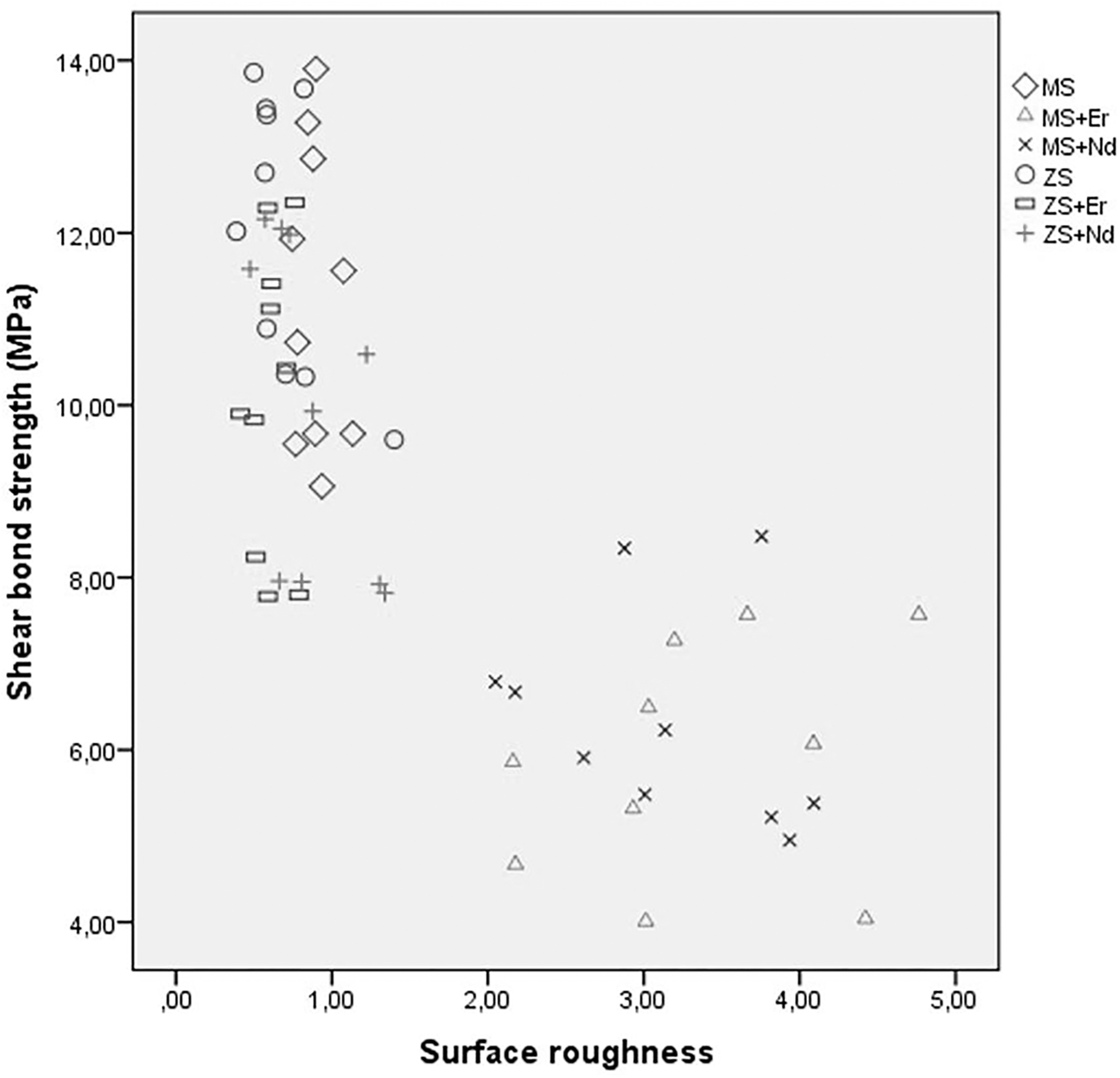
Scatterplots of surface roughness (μm) and shear bond strength (MPa) values.
AFM and SEM analysis
The AFM images of the surfaces of metal and zirconia specimens showed topographic variations after the three different surface treatments (Fig. 2). As seen in the AFM images, the surface morphologies of the laser-irradiated metal groups were similar to each other. Also, irregular surfaces with microporosities resulted from sandblasting (Fig. 2A, B). Similarly, among the zirconia samples, rougher surfaces occurred from S+Nd combined treatment (Fig. 2F). Also, sharp peaks and shallows appeared in the sandblasted (Fig. 2B) and S+Er (Fig. 2D) zirconia groups.

Atomic force microscopy images after surface treatments of the Ni–Cr metal alloy [
Figure 3 highlights the morphologic differences in the metal surfaces, as visualized by SEM. In the images of sandblasted specimens, microretentive grooves and irregularities were seen (Fig. 3A, B). In S+Er micrographs (Fig. 3C, D), blister-like surface bubbles could be observed. Comparatively, for S+Nd-treated samples (Fig. 3E, F), rougher and deeper surfaces were apparent. Figure 4 presents the SEM images of the Y-TZP surfaces. Sandblasting caused the formation of microretentive grooves (Fig. 4A, B). S+Er treatment altered the surface morphology of zirconia, revealing the formation of rare pits (Fig. 4C, D). In viewing the S+Nd images, blister-like bubbles with voids were surrounded by a flat and porous layer (Fig. 4E, F).
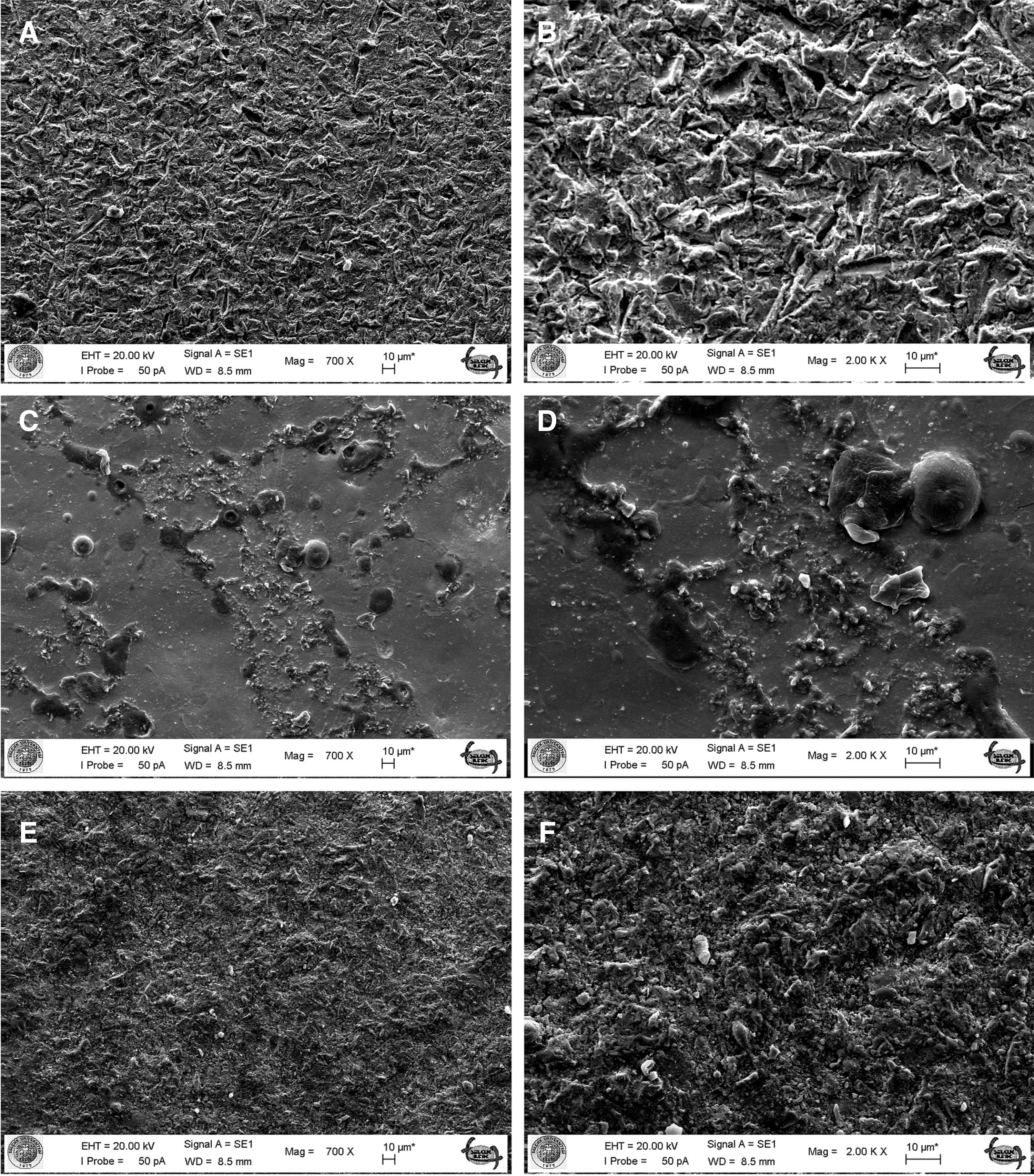
SEM images of surfaces of the Ni–Cr metal specimens exposed to various surface treatments:
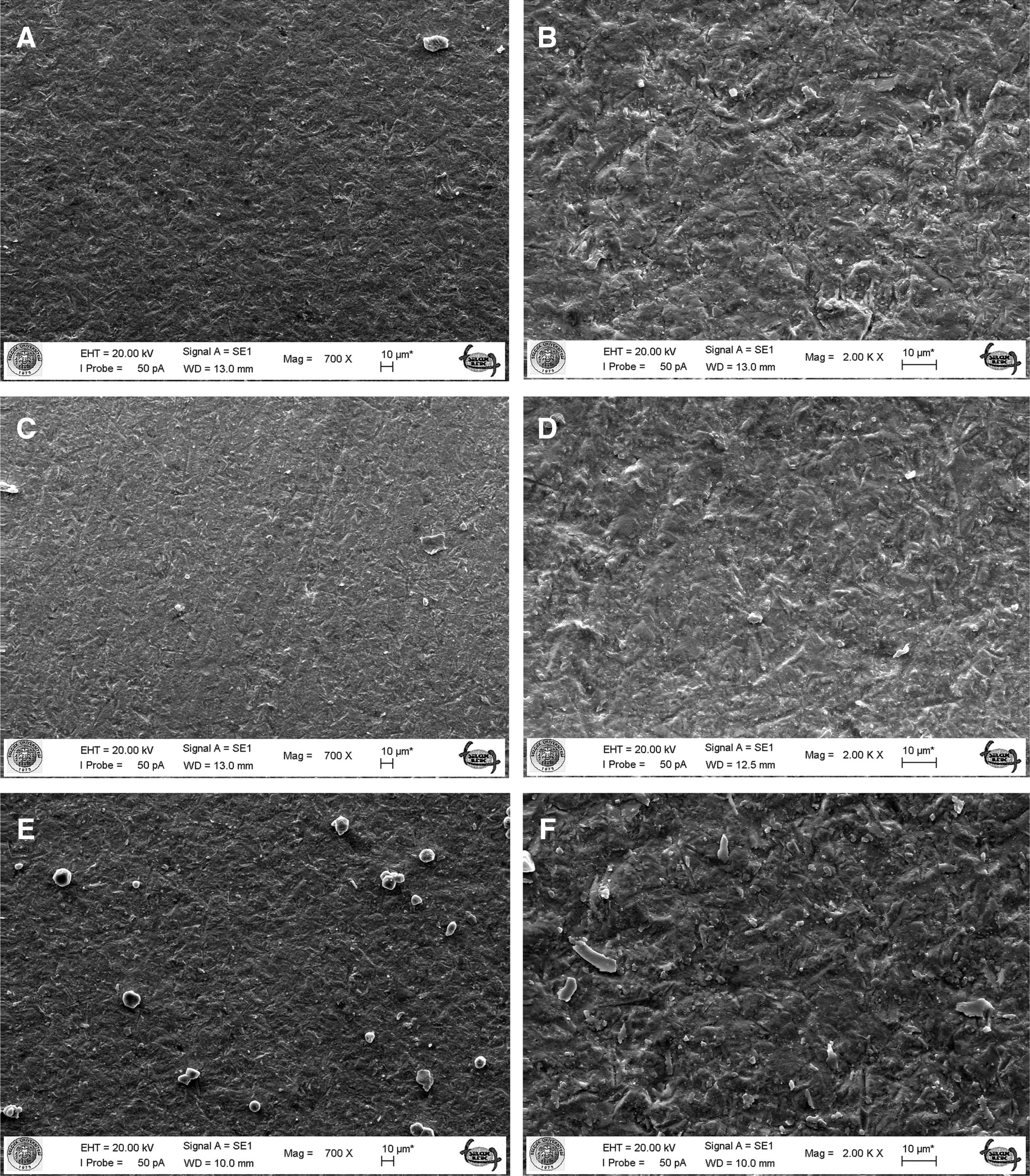
SEM images of surfaces of the Y-TZP specimens exposed to various surface treatments:
Failure mode analysis
Figure 5 displays the failure modes of each group, where the vertical axis of the graph demonstrates the number of the specimens and the bars denote the ratios of the failure types. All failure types of the sequential sandblasted Er:YAG/Nd:YAG laser-irradiated metal groups were seen as adhesive. Adhesive failures were also the predominant failure types in the other groups. Adhesive, mixed, and cohesive failure modes of resin cement were evident in the sandblasted groups of both zirconia and the metal alloy.
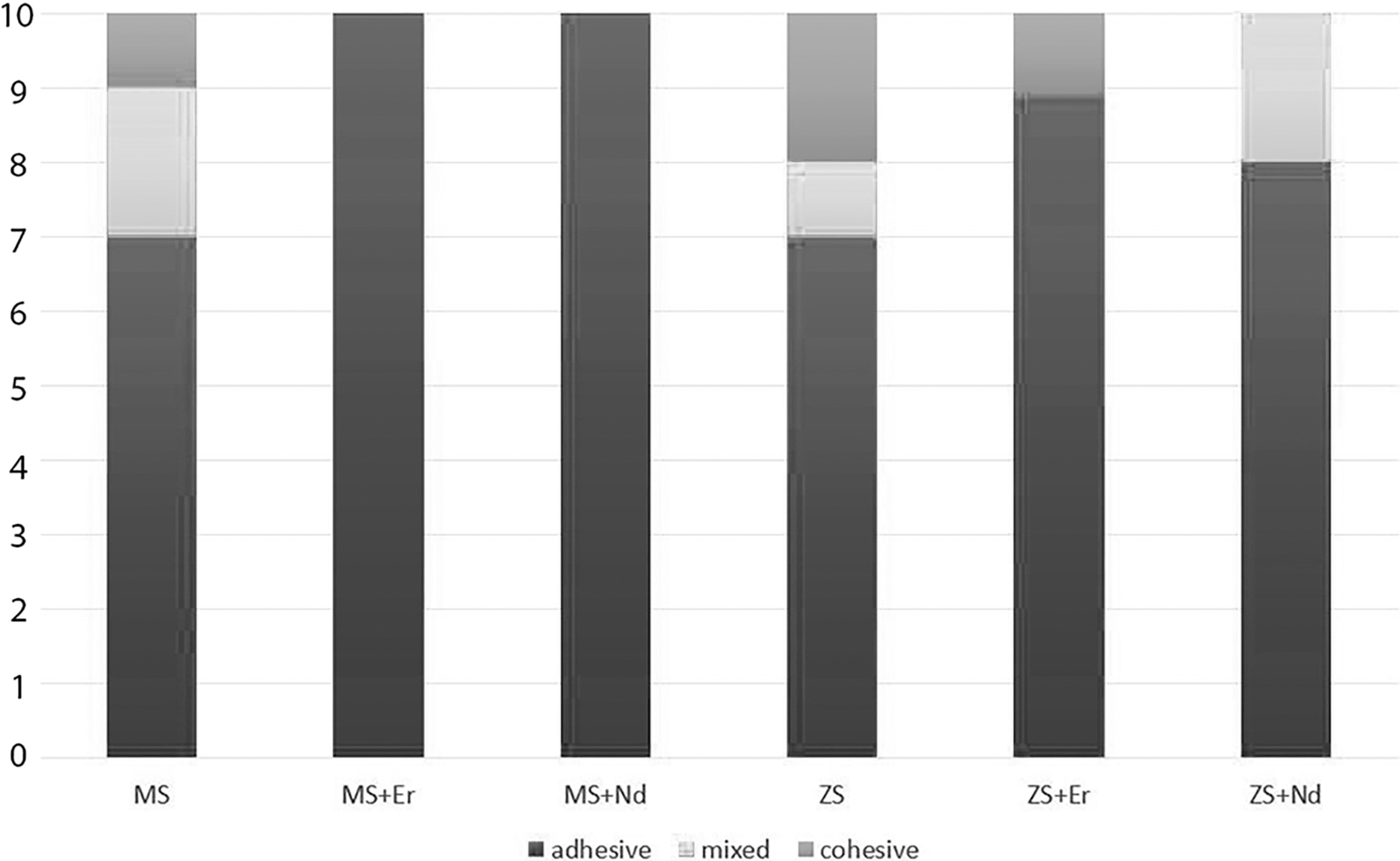
Failure modes observed in the shear bond strength tests.
Discussion
This study evaluated the SBS of resin cement to metal and zirconia surfaces, as well as analyzed the roughness and topography of metal and zirconia surfaces after three different surface treatments.
According to the results, the null hypotheses were rejected since the surface protocols aforementioned had significantly different impacts on both the SBS and Ra of metal and zirconia materials. For both materials, sandblasting led to the highest SBS values compared with combined sandblasting + laser treatment. Nevertheless, higher bond strength values were obtained after Nd:YAG and Er:YAG laser irradiation of sandblasted zirconia surface compared with the metal alloy.
In dental practice, the inferior bonding performance may cause major concern to clinicians, especially when bonding nonretentive fixed partial dentures. 6 For this reason, earlier studies commonly investigated sandblasting using Al2O3 particles of various sizes, for both metal alloys 3,13 and acid-resistant ceramic materials, mainly, zirconia, to obtain a durable and stable bond with resin cement. 6,28 In a recent study by Kunt et al., 3 the Ra of two different base metal alloys was evaluated and sandblasting with 50-μm Al2O3 powder demonstrated the highest Ra values compared with the Er:YAG laser-treated groups without a sandblasting procedure. The authors also concluded that Er:YAG laser irradiation (400 and 500 mJ/10 Hz) of the metal surfaces alone was not an alternative method for surface treatment of base metal alloys. 3 On the basis of the data obtained in this study, the most effective treatment for roughening the surface of the Ni–Cr base metal alloys turned out to be the combined application of sandblasting and laser irradiation. Since the ineffectiveness of the hydrofluoric acid etching and silanization could be due to the lack of silica and glass phase of zirconia, the resin bond strength might be enhanced by airborne particle abrasion. 11 According to Borges et al., 29 airborne particle abrasion using 50-μm Al2O3 was not effective in increasing surface irregularities on zirconia ceramics, for enhancing the bond strength to a resin cement. In this study, air abrasion of both metal and zirconia specimens was conducted using 110-μm Al2O3 particles. This treatment showed highest resin bond strength values for both materials. This finding may be attributed to enhanced microporosity, wettability, and surface energy by using sandblasting. 24
Subaşı and İnan 15 measured the Ra of Y-TZP ceramics after different surface treatments and reported that air-particle abrasion with 110-μm Al2O3 particles was a more effective treatment compared with Er:YAG laser. In addition, there were significant differences between the Ra of the laser and control groups, whereas topographic analysis showed almost similar images. Therefore, the authors concluded that the 400-mJ Er:YAG laser altered the external surfaces of the Y-TZP ceramics slightly when compared with the control group. Similarly, in this study, all of the laser-irradiated Y-TZP groups showed lower roughness values than the metal groups, which might be explained by the low absorption of laser energy due to the white color of zirconia. 15 Likewise, Spohr et al. 30 revealed that ceramics could not effectively absorb 1064-nm wavelength energy emitted by an Nd:YAG laser.
Shiu et al. 31 reported that the combination of Al2O3 and Er:YAG laser treatment on feldspathic ceramic surface resulted in a higher SBS to resin cements than the Er:YAG laser used alone. In another study, Yavuz et al. 32 noted the combination of Al2O3 and Er:YAG laser treatment enhanced the SBS between lithium disilicate-based ceramics and resin cement. According to Kırmalı et al., 7 sandblasting plus Er:YAG laser treatment created rougher surfaces on Y-TZP when compared with other treatments used in the study. In addition, Stübinger et al. 33 observed that the Er:YAG laser was not effective at creating any surface alterations to Y-TZP ceramics and, thus, should not be recommended for surface treatments of Y-TZP ceramic materials. Similarly, Foxton et al. 17 underlined that Er:YAG laser treatment of the zirconia surface did not result in a durable resin cement/ceramic bond. In light of these literature findings, this study combined sandblasting and laser treatment. Although, this study used sandblasting, followed by laser treatment, for combined treatment, the effects of laser irradiation applied before sandblasting should also be evaluated in new studies.
In this investigation, there was no positive correlation between the Ra and SBS for each material. This finding might be related to the order of the surface treatments. AFM and SEM images revealed microporosities after sandblasting, nevertheless, laser treatments applied after sandblasting may alter this morphology, especially in metal specimens. Consistent with this result, an earlier study stated that air abrasion created rough surfaces, but the subsequent application of lasers might destroy this structure. 11
It has been documented that micromechanical resin interlocking can be established by increasing the surface area with microporosity. 27 Nonhomogenous irregularities were observed in SEM images of Er:YAG-irradiated metal specimens. Based on SEM observations, Kunt et al. 3 also emphasized that the laser-induced microexplosions result in the fusing and melting of the superficial layer, followed by solidification to a smooth blister-like surface. Akyıl et al. 11 noted that Nd:YAG laser irradiation with a 2 W output power exhibited a bubbled blister-like appearance on Y-TZP surface. According to these authors, the heat-damaged layer, which consisted of bubbles, might be poorly attached to the infralayer of the substrate and may cause failure even at low forces applied during the SBS test. 11 In this study, the blister-like surface was observed after Nd:YAG laser irradiation of Y-TZP specimens and the lowest SBS values were measured in the sandblasting + Nd:YAG group of Y-TZP.
Moreover, Spohr et al. 30 investigated the debonded specimens using SEM and classified the failure modes as adhesive, mixed, and cohesive. In comparison with this study, the authors 30 found higher bond strength values and observed predominantly mixed failure. This finding may be related to the application of silane after sandblasting and Nd:YAG laser irradiation, the difference in the type of ceramic material (In-Ceram zirconia), or application of graphite powder before laser treatment. Akyıl et al. 11 did not observe any cohesive failure of the substrates (Y-TZP or resin cement). The SBS results of this study concurred with the data presented by Akyıl et al., 11 which found the lower bond strength values for the air-abraded + Er:YAG group compared with the solely air-abraded group. The same authors reported that the difference in SBS values between air-abraded + Er:YAG and air-abraded + Nd:YAG-treated groups were not statistically significant. 11 In accordance with this study, similar Ra and SBS values after Er:YAG and Nd:YAG laser treatments were reported by Kara et al. 34 and Akin et al. 35 found lower SBS values than in this investigation, after various treatments to zirconia surface and they observed predominantly adhesive failure after sandblasting, Er:YAG laser irradiation, and Nd:YAG laser irradiation with noncontact. The variation in the SBS literature results can also be attributed to the use of different surface treatment parameters.
The luting agent used in this study (Rely X Ultimate; 3M ESPE) is a dual-cured resin cement applied with a universal adhesive (Scotchbond; 3M ESPE). This bonding agent contains the monomer 10-methacryloyloxydecyl dihydrogen phosphate (MDP), which was originally designed to bond to metal oxides, although its use has been extended to oxide ceramics. 36 It has been stated that MDP-containing resin cements are preferable to obtain a chemical bond between the hydroxyl groups of the passive zirconia surface and the phosphate ester group of the MDP. 16,36 In this study, only one type of resin cement was used. However, various types of resin cements should be investigated and compared in further studies, to understand the effects of surface treatments on bond strength to dental materials, as well as to select a more proper type of luting cement for clinical applications. da Silva Ferreira et al. 27 mentioned that the extent of the superficial changes on the surfaces depends on the laser energy density and type of material. Therefore, further investigations are also needed to evaluate the effects of combined sandblasting and laser treatment on different dental materials, by using various treatment parameters, as well as long-term aging procedures, and different testing designs. The other limitation of this study was that zirconia and metal disk do not represent clinical condition. Consequently, more clinical evaluation of the combined surface treatments is needed. Moreover, flexural strength and the phase transformation (tetragonal to monoclinic) of zirconia triggered by the surface treatments should be evaluated for the longevity and reliability of restorations, in addition to resin bond strength. The justification for these assessments is that the applied roughening process might create microcracks, process-related flaws, grain pull-out, and phase transformation, which can affect and reduce the strength of the material. 36
Based on the results of this study, sandblasting may serve as an acceptable and durable resin bond to Y-TZP and Ni–Cr metal alloy in clinical practice. Possible negative effects of laser treatment after sandblasting on bond strength should not be ignored for the sake of the restoration longevity.
Conclusions
Within the limitations of this study, the following conclusions could be drawn: Combined treatments were more effective to increase roughness values for base metal alloy compared with Y-TZP ceramic. Sandblasting combined with laser irradiation led to higher SBS values for the zirconia groups than the metal groups. Sandblasting, alone, maintained a superior effect on the bond strength compared with sandblasting + laser, especially for metal alloys.
Footnotes
Acknowledgments
There is no external funding source for this study.
Author Disclosure Statement
No competing financial interests exist.