




Abstract

Introduction
T
At the root of the new health care landscape are powerful drivers for health care change that include: • The explosion of medical knowledge, technologies and information
1
; • Patients/consumers who are increasingly knowledgeable, engaged, and discriminating in decisions about their health care treatment and disease prevention options
2
–4
; • Expectations for health care products and services to achieve quality outcomes, improved safety, and more personalized patient benefits; • Demands from patients, employers, government, and other health care stakeholders for greater value from health care providers' products and services.
The skyrocketing cost of health care is related not only to new technologies, treatments, changing demographics, and increased population, but also to a lack of applied evidence-based practices and quality standards in the use of health care products and services resulting in variances in quality, safety, and cost-effectiveness. 5,6 Commercial interests will always be important drivers in health care. However, they will be balanced with the need for higher levels of quality and value. PPACA is influencing a significant shift in health care drivers, incentives, and disincentives for multiple stakeholders.
Providers, payers, MCOs, and suppliers have been faced with the need to recalibrate their organizational priorities and focus. They are dealing with new concepts such as pay for performance, patient satisfaction, heightened safety vigilance, integrated care, transition management, population management, and the consistent implementation of evidence-based medical knowledge into clinical practice. These shifts are unavoidable and considered to be permanent in the transformation toward an overall system that will generate better outcomes and overall improvement in cost, resulting in a sustainable health care system.
Generating Organizational Innovation and Opportunities through Transformational Health Care Business Change
Creating opportunities for innovation and sustainable financial growth requires health care organizations to adopt new ways of thinking and adding value in the context of the emerging health care landscape. This new thinking is not a one-off relative to existing products and services, nor is it an optimized approach to thinking in the current model. To achieve this new mind-set and poise themselves for innovation and sustainable growth, organizations must put themselves on a path of transformation relative to the new health care paradigm.
Health care stakeholders have taken on health care transformation to varying degrees of the spectrum shown in Figure 1. At one end of the spectrum are organizations that have anticipated the health care shifts and have changed accordingly to put themselves on the path to sustainability and growth, as well as reduced their risk from misalignment with the shift in health care expectations. At the other end of the spectrum are organizations that still function in the old paradigm, not having adapted their ways of doing business to the new health care era. In the middle of the spectrum are those organizations that have made important changes at high levels, and are counting on a trickle-down effect throughout their functions and departments. Those organizations that have avoided transformational change or have not translated it effectively into their functions and departments are at risk for not meeting growth objectives and succumbing to continuous downsizing to meet financial objectives for viability.
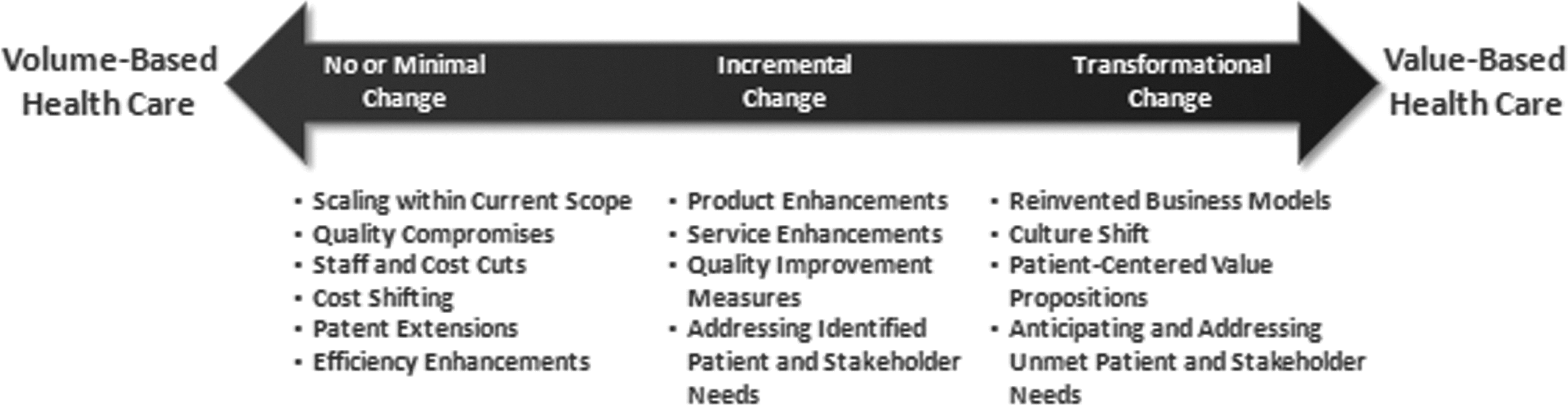
Degree of transformational change in health care organizations relative to emerging health care landscape.
New Targets and New Opportunities for Health Care Organizations
Redefining the scope of an organization's business can be the hallmark of innovation on the path to transformation. New health care targets often are not immediately apparent to an organization as possible business opportunities based on its current vision, mission, and definition or scope of business. However, some organizations have capitalized on new health care targets outside of their traditional business paradigms and are growing as they redefine their missions and reenvision their scope of impact on health care.
Consider the movement toward better management of patient transitions. Walgreens leveraged its knowledge of drug use to ensure safe transition of patients from the hospital to other environments through WellTransitions, addressing an urgent need in health care. 7 This required a change in how Walgreens viewed its role in health care—differently than its competitors in the prevailing paradigm.
Another key target in the emerging health care paradigm is helping people age more successfully, with a better quality of life and ability to manage their health. Palo Alto Medical Foundation's David Druker Center for Health Systems Innovation, a Sutter Health Affiliate, views the health care system's scope of business beyond its hospital and clinic walls with its signature incubation project. Taking on the role of community health partner, the foundation's “linkages Ecosystem” is an example of a hospital system viewing itself as more than a sick care delivery system, embracing the use of quality of life and social health as key determinants of health for the aging population. 8
Improving the health of key vulnerable populations is another important health care target. Recognizing the need to focus on improved outcomes for vulnerable populations, in contrast to broad cost-containment-only strategies, payers and MCOs are employing vertical integration in acquiring specialty MCOs to improve the care of key populations, such as the elderly, through health management services. In the last 3 years, payers and MCOs have poised themselves for the health care paradigm shift through examples such as Humana's acquisition of SeniorBridge 9 and WellPoint's acquisition of CareMore. 10
The shift toward greater safety in product use to improve outcomes and reduce unnecessary sequelae and cost represents another important target in the emerging landscape. For pharmaceutical and device companies, developing safe products is regulated and has been the foundation for developing products that go to market. In contrast, safe use refers to anticipating the use of products in the real world, and embedding measures to optimize safe and effective use. The partnerships between pharmaceutical companies and specialty pharmacies that arose with the advent of the complex management of biopharmaceuticals represents a creative solution to what otherwise could have been a difficult, costly, and ineffective approach to managing these agents in the market place. However, there is even greater opportunity for pharmaceutical and device companies to be innovative in addressing safe use of drugs and devices for at-risk populations as well as in a broader scope of agents.
New Culture and Skill Sets for Leadership in Health Care
Improving patient health outcomes is at the core of the new health care era. Not only the upper management of organizations need to be thinking about health care transformation. Department heads, as well as managers of functions and departments, will need to understand their patient-centered, outcomes-driven purpose in order to create cultures that align with the new health care paradigm. To accomplish this, leaders throughout health care will need to be aware of patient care in a more intimate way to understand the implications of their options and business decisions on patient outcomes. Future health care leaders will need to understand and lead from an evidence-based context rather than from a primarily financial viewpoint. Leaders in all types of health care organizations will need to continually envision, replan, and communicate the value-driven, patient-centric message to staff and employees to inspire ongoing innovation that leverages the knowledge and experience of those who work closest to and best understand patients and patient care.
Assessing an Organization's Paradigm Relative to Health Care Shifts
The first question the leader of a health care organization, function, or department should ask himself or herself is how the organization is fundamentally operating differently today than it was in 2010. Answering this question of how is specifically important to assess the degree to which the organization needs to change. If the answer is not apparent, or indicates no fundamental difference in the organization's strategic direction, culture, or operations, the organization is in need of transformational change. For example, an organization may be operating with fewer people or producing higher volumes than a few years ago. These differences only signify that the organization is doing the same thing with fewer resources. Such tactical adjustments will not sustain an organization. Organizations must consistently work to find new effective ways to help customers and stakeholders, including patients, providers, and government, meet their goals or they will be outpaced by those organizations that do.
In summary, to seize emerging opportunities for growth and innovation effectively, health care organizations must begin the path of transformation by systematically recalibrating their strategies and cultures to align more closely with the shifting goals of the emerging health care landscape. A good place for an organization to begin is by focusing on internalizing and owning patient health outcomes. Once planted, this mind-set and the corresponding changes in strategy and culture will position the organization for meaningful innovation and sustained financial vitality.
Footnotes
Disclosure Statement
Ms. Kirzecky and Mr. Jones are with TKG Healthcare Consulting, which provides management consulting to organizations in the health care industry. The authors declared no other potential conflicts of interest with respect to the research, authorship, and/or publication of this article. This article was self-funded by TKG Healthcare Consulting.