




Abstract
“Population health” has come to describe an array of initiatives supporting new care and reimbursement models that reward health outcomes rather than volume of services. However, without a standard definition of population health and a comprehensive inventory of the core competencies and knowledge its practitioners must possess, ongoing efforts to address community health outcomes will be hampered. A literature search of peer-reviewed and gray literature, a curriculum scan of current graduate health programs, and an expert panel of industry stakeholders were conducted to develop a comprehensive curriculum framework that broadly defines population health. The result is a concept map consisting of 6 domains—3 knowledge and 3 skills-based—and subcategories. This article discusses the implications for teaching population health and the need for further scholarship to define the field from the point of view of health system leaders, academics, and others who need to hire health professionals with these skills. (Population Health Management 2016;19:39–45)
Rising Interest and Needs
P
Never has the preparation of leaders to guide population health improvement been more urgent. Population health experts are in demand to assume leadership and management roles in accountable care organizations (ACOs), patient-centered medical homes, and other integrated health care delivery systems, hospitals, health care provider organizations, health insurers, third-party administrators, pharmaceutical companies, health care consulting firms, government agencies, academic institutions, and community-based advocacy and service organizations. 5 A search of job listings on one broad-based job site found an 8-fold increase in the number of positions posted since 2014 that include “population health” as a responsibility or requirement—clearly demonstrating the need for a health workforce with specific knowledge in the field (Fig. 1). The question for academic institutions is how to build a comprehensive population health curriculum that meets the needs of professionals joining this growing workforce. This article describes the authors' effort to define population health in order to develop a curriculum for population health practitioners.

Trends in jobs announcements on the
Definition
In their seminal 2003 article, Kindig and Stoddart popularized the term “population health” in the United States. They defined population health as “the health outcomes of a group of individuals, including the distribution of such outcomes within the group.” 6 (p381) In the decade since, the term has gained currency while the definition has become fluid to reflect changing health care delivery paradigms. A deeper exploration of these different meanings is necessary to fully appreciate the scope and depth of skills and competencies needed by population health practitioners.
It also is important to note that Kindig and Stoddart 6 clearly differentiate the field of population health from public health, as practiced in the United States. They describe the former as generally broader in scope, assessing and implementing interventions for a diverse range of health determinants such as medical care, education, and income, which are not part of traditional public health practice in many jurisdictions. It is the opportunity to address all factors that might influence health outcomes that makes population health so exciting. As will be discussed, this broadened view of population health that extends the public health model stands in contrast to another perspective that sees the field as merely the expression of a slightly more comprehensive approach to clinical care focusing on specific patient populations. This more narrow version of population health is exemplified by the number of consulting and software firms marketing population health software modules to help clinical practices and health care systems better manage their current patients. 7 This paper attempts to reconcile these opposing views in the pursuit of an overarching curriculum.
The dictionary defines “population” as either (A) “a body of persons or individuals having a quality or characteristic in common” or (B) “the organisms inhabiting a particular locality.” 8 Together, these 2 definitions encompass the different perspectives of population health currently in use by health care and public health professionals. Definition A delineates circumstances wherein individuals are identifiable and can be categorized by a shared characteristic or characteristics or attributed to a health care provider by a contractual arrangement. Conversely, definition B's emphasis on common geography disregards individuals except to broadly ascribe common features to those living in a particular place or jurisdiction.
Similarly, the term “health” can be defined narrowly as the mere absence of disease or injury or more broadly, as the World Health Organization defines it as “…a state of complete physical, mental, and social well-being and not merely the absence of disease or infirmity.” 9
Derived from these definitions, 2 generally distinct views of population health have emerged: a broad, all-encompassing view in which population health is seen as the tool to deliver improved outcomes by tackling large-scale social, economic, and environmental issues and a narrow view that focuses on specific and targeted interventions for discretely defined populations with specific and identifiable disease states. 10
The broader strain of population health is most closely aligned with public health. 4 However, public health is generally seen as a tool of state and federal government exercising its sovereign and constitutionally authorized police power to protect and ensure the health, safety, and welfare of the public, often with little coordination with health care providers. 11 In contrast, population health uses public health tools and techniques to identify and intervene at the community level to create conditions to promote health, prevent disease, and ensure patients recover after medical treatment quickly and completely without adverse outcomes.
More narrowly defined, population health refers to activities that address the specific health needs of discretely defined, enumerated, and engaged patient subpopulations under the scope and care of a particular health care system or clinical team. Frequently termed population health management, this approach is more clinically oriented and relies on practice-generated data and protocols to identify individuals and groups of patients sharing a common clinical characteristic (eg, diabetes, congestive heart failure, asthma). Once these patients are identified, clinical pathways are implemented to ensure they receive evidence-based care to improve outcomes. 10
These 2 distinct population health views can be distinguished by patient attribution. In the broad view, individuals are not identified and may not be attributed to any particular health care provider, whereas in the narrow view they are known (or should be known) to a particular care team. This latter version of population health reflects the typical provider perspective. This research has revealed that practitioners need to broaden their vision to encompass the alternate view to ensure better health outcomes for both their attributed populations and the larger community. 12,13 Conversely, practitioners of traditional public health need to better understand the dynamics between health care providers and their attributed patients and the impact of health care quality and safety on morbidity and mortality. 14
Current Population Health Education
A significant gap exists in current graduate programs in population health. An online search revealed several US-based schools offering degrees (PhD and MS) in population health as well as medical schools that have integrated population health into their curricula, but these programs approach education in population health as either a research-driven discipline or a specific subject included in a larger medical school curriculum. 15 No school was noted as having a mission to graduate practitioners of population health.
The environmental scan revealed a clear need for specific education in applied population health supported by a curriculum reflecting the needs of the practice community. With the passing of the Patient Protection and Affordable Care Act (ACA) and the Health Information Technology for Economic and Clinical Health Act, as well as the steady movement from fee-for-service to value-based reimbursement, knowledge of population health is becoming increasingly necessary to navigate today's health system landscape and achieve real improvements in health outcomes. Because currently there is no certifying body that specifically accredits population health programs and no set of standardized curriculum topics, a significant gap exists.
Aims
The aim of this study is to develop a comprehensive graduate-level population health curriculum that includes a structured list of educational topics. This is achieved by conducting a comprehensive inventory of existing, validated courses and current literature, and gathering input from field experts and interviews with stakeholders. The intention is to describe the content and confines of population health today.
Framework Development
To identify existing curricula, definitions, and other descriptions of the core competencies and knowledge domains encompassed by population health, an extensive search of peer-reviewed and other expert-authored literature was performed (Fig. 2). PubMed and Google Scholar were searched using the phrase “population health.” Seminal articles known to the authors and used in existing population health-related courses were identified initially. Additional articles were identified through citation links, a snowballing technique was used to search for related terms, and a manual search of articles also was performed. Additionally, a search of population health gray literature (lacking formal peer review) was conducted using the collected search terms. Gray literature was included for 2 main reasons: (1) population health is dynamic and gray literature is more likely to be published in a timelier fashion, and (2) commercial firms marketing population health services produce reports and white papers that in essence define the field for their target audiences.
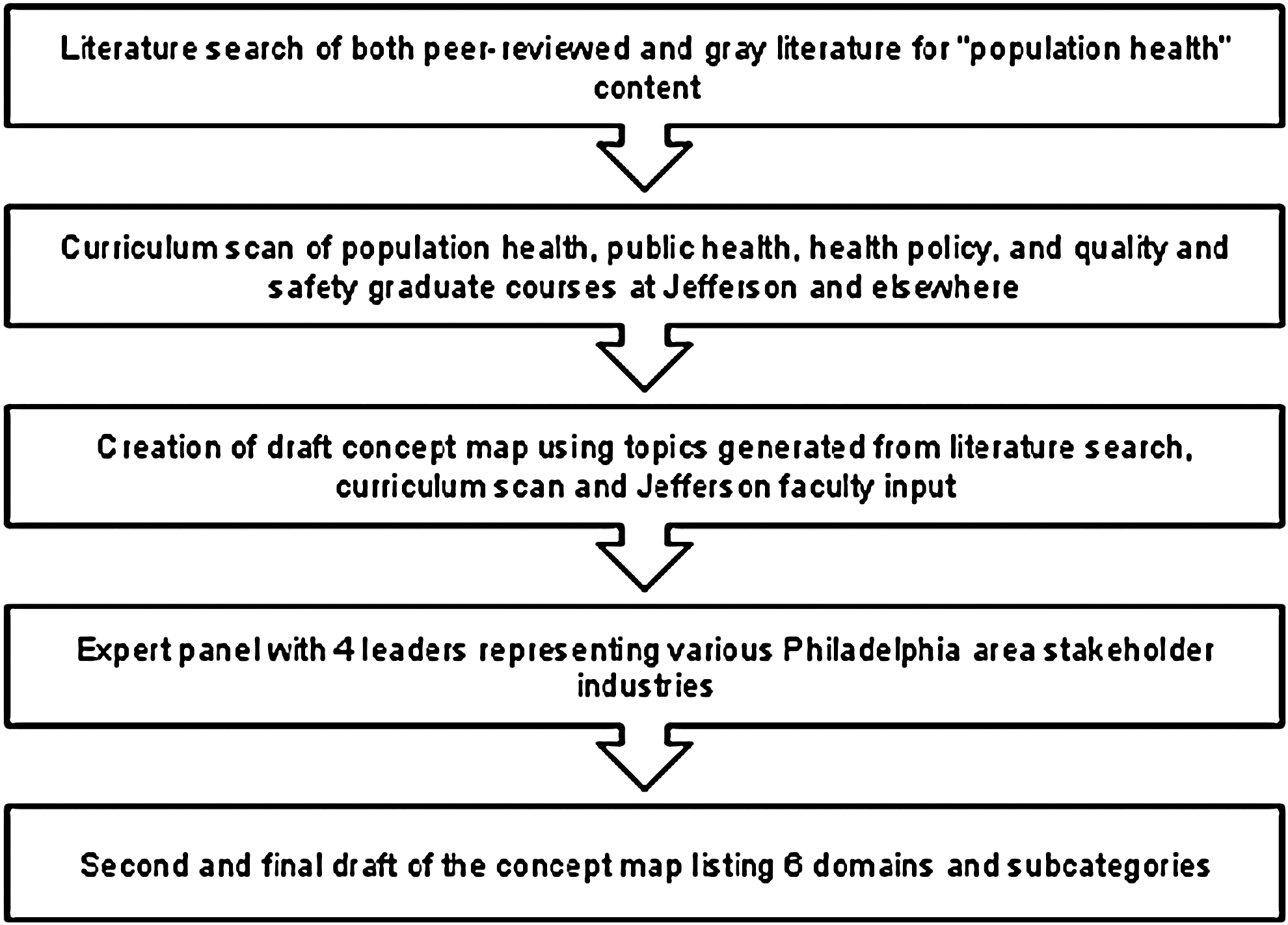
Workflow diagram illustrating the series of steps utilized during the concept map creation process.
The inclusion criteria for all articles were: (1) published online or in hard copy before December 2013, (2) written in English, (3) full article or report (no abstract or executive summary), and (4) (in the case of gray literature) authored by organizations and/or individuals judged to be expert or authoritative in the field. All articles and reports that met the inclusion criteria were reviewed by 2 study authors (KP and DH) to identify knowledge domains and topics deemed appropriate for inclusion in a population health curriculum (deciding vote cast by third author, CG, in cases of indecision). Appropriateness was defined as including “concepts, themes, and defining aspects of population health.”
In addition to a literature review, a curriculum scan of current population health and public health courses at the Jefferson College of Population Health (JCPH) and similar graduate-level institutions offering degrees in related fields was performed. Population health curriculum frameworks developed by public health organizations (eg, Association of Schools and Programs of Public Health, Association for Prevention Teaching and Research) also were identified. 16 –18 A semi-structured analysis was performed to identify common themes and topics related to population health as already defined.
The disparate topics, concepts, and curricular elements identified in the curriculum scans and literature review were organized into an initial concept map of 6 domains and related subcategories. This concept map was expanded and modified after conversations with health-related stakeholders and thought leaders and review by JCPH faculty. An expert panel, consisting of representatives of 4 different Philadelphia area stakeholder sectors impacted by the population health paradigm shift, was conducted. Their input in the curriculum development process was desired because these organizations likely would hire the graduates of population health programs. The discussion centered on the clarification of domain inclusion, the organization of topics, and any gaps in the curriculum.
Population Health Concept Map
After discussion with the 4 stakeholders, the content domains were codified into 3 knowledge domains (Health Systems; Legal, Regulatory & Administrative Frameworks; and Social/Behavioral/Environmental) and 3 skills-based or cross-cutting domains (Analytics, Interpersonal, Process & Design). Each of these domains was further organized into subcategories (Fig. 3).
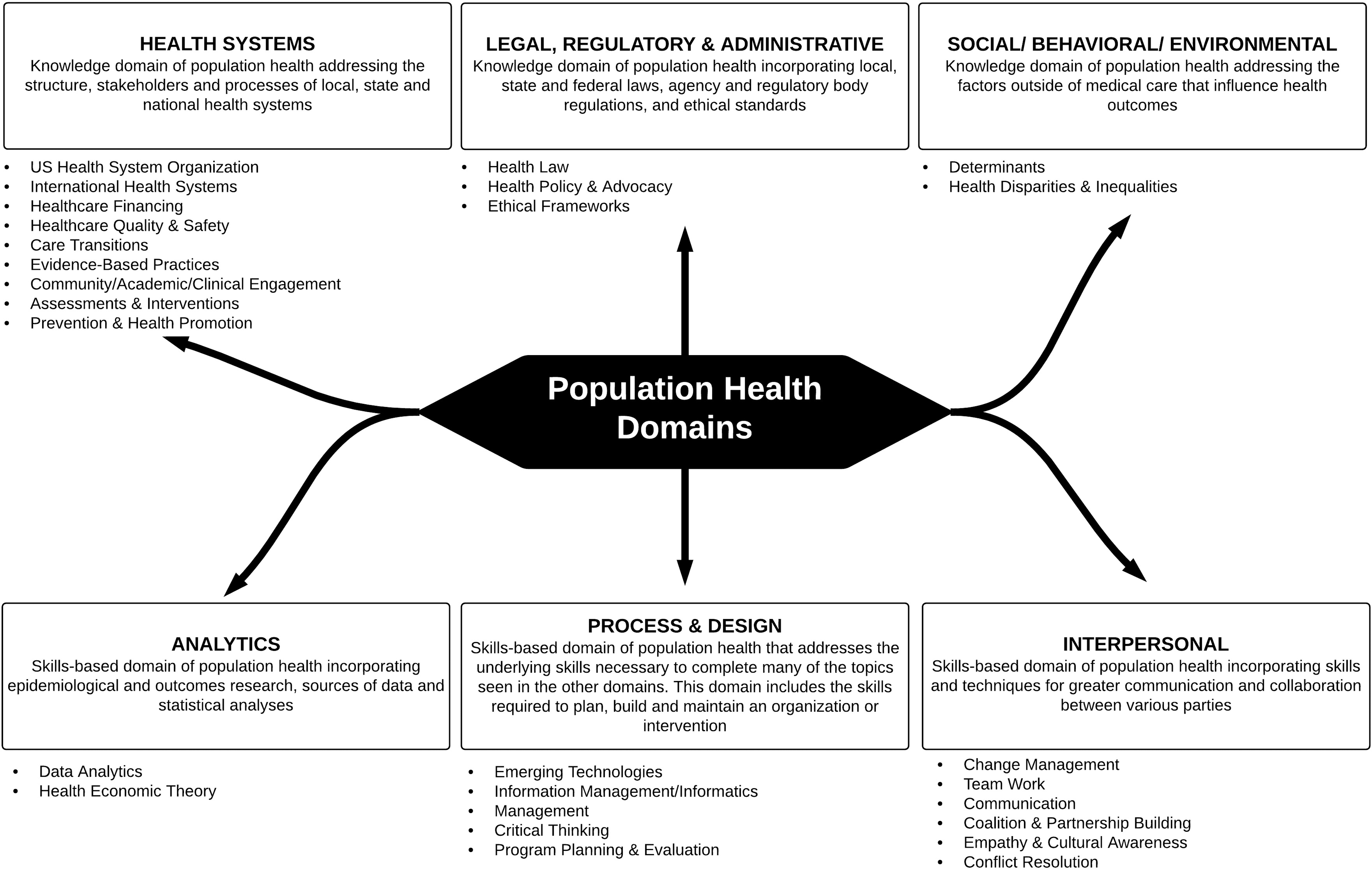
Finalized concept map consisting of six domains—three knowledge-based and three skills-based—each with multiple subcategories.
Health systems
By far the largest of the content domains, the knowledge domain of Health Systems is designed to provide the foundational knowledge necessary to develop a deeper understanding of the historical context and antecedents for population health. The Health Systems domain addresses the structure, stakeholders, and processes of local, state, and national health systems including but not limited to the health care system. An examination of the historical events and political, social, and economic forces clarify and contextualize the challenges faced by health system stakeholders. 19 As national health care expenditures have continued to rise, the development of alternative payment plans, care delivery models, and insurance mandates have been proposed and implemented to curb this trend. The overarching theme of all these innovations is value over volume. 20 –23 A multitude of stakeholders—payers, providers, patients, politicians, and pharmacists, to name a few—have voiced their views on how best to achieve a high-quality and value-driven health care delivery system. 24 –26 Categories and topics in this domain reflect the need for working knowledge of quality and safety measures and processes, physician and patient engagement, competent workforce development, and evidence-based practices to improve the health outcomes of individuals, communities, and populations.
Legal, regulatory, and administrative frameworks
Population health practitioners must function in a constantly evolving legal and regulatory environment and therefore this knowledge domain incorporates local, state, and federal laws; agency, accreditation, and certifying body regulations; and ethical standards. Arguably the most important piece of health care legislation of the 21st century, the ACA is only one of a myriad of mandates changing the practice of medicine and the overall health landscape. 27,28 Even more important than the knowledge of current and past laws and regulations, practitioners must learn to analyze, evaluate, and respond to these new legal and regulatory initiatives. They must understand the political process as it functions at the local, state, and national levels and know how to build and maintain coalitions to advocate for effective health policies.
Social/behavioral/environmental
The third knowledge domain addresses factors that influence individual health outcomes but are not typically noted in the standard medical evaluation. Medical care accounts for only between 10% and 20% of health outcomes. 29,30 Although research clearly documents the contribution of social, behavioral, and environmental factors to the health of individuals, communities, and populations, these factors are infrequently addressed in health interventions. 31 Efforts to address socioeconomic determinants such as poverty, low education, and racial segregation are increasingly seen as innovative strategies to improve population health. Health behaviors or lifestyle factors, particularly cigarette use, alcohol consumption, and physical activity, are often cited as the most influential in terms of health outcomes 32 and are often targeted by public health interventions and policy changes at the local, state, and federal levels. Laws and regulations also have been enacted to address environmental determinants. During the latter half of the 20th century, the US government passed the Clean Water Act, the Clean Air Act, and the Comprehensive Environmental Response, Compensation and Liability Act, which sought to clean pollutants from our common resources—water, air, and land, respectively—thereby improving living conditions and health outcomes. Although policy changes and laws have vastly improved health outcomes among the general population, disparities continue to exist. For example, cigarette use is consistently higher among those with a high school degree or less, 33 and children with high blood lead levels tend to live in older homes and rentals, have family income below the federal poverty level, and be African American. 34,35
Population health practitioners need to know how to identify, measure, and address these broader health determinants as part of any comprehensive effort to improve the health of populations they are responsible for.
Analytics
The skills-based domain of Analytics encompasses epidemiological and outcomes research, sources of data and statistical analyses—all essential for effective population health. In an age where we are being inundated with data—from wearable technology that records physical activity to complex electronic health record and care management software that track patients who miss their appointments—it is vital not only to sort through the mass of data, but also to correlate it with other databases in meaningful ways. Frequently termed “big data,” these numbers can be powerful; their power, though, is dependent on the manner of collection and collation, statistical analysis, presentation, dissemination, and the resulting action. As Thomas Davenport states, framing the question is the most important first step in the analytical process. 36 The question determines which data are collected—including data from atypical or non–health-related sources such as social media, census, education, transportation, among others 37,38 —and how they are normalized, integrated, and stored. In addition to knowing how to identify, collect, and analyze data, population health practitioners must possess the skills necessary to effectively communicate findings to a wide variety of stakeholders, including policy makers, institutional leaders, the media, and lay audiences.
Interpersonal
The second skills-based domain incorporates skills and techniques for greater communication, leadership, and collaboration among stakeholder groups. In a new era of health system evolution driven by emerging technologies, risk-sharing mergers, community health needs assessment requirements, and calls for greater transparency, traditional silos are breaking down. Collaborations among private practices, academic institutions, hospital systems, community organizations, and public health departments are increasingly common in the emerging population health paradigm. 39,40 Health professionals must be able to communicate not only with other health professionals, but also with culturally diverse populations and those with low health literacy. They need the skills to build and maintain high-performing health coalitions that include non-traditional health partners from every community sector.
Process and design
The skill-based Process & Design—the final domain—addresses the underlying skills necessary to accomplish the goals of the other domains. This domain includes the competencies required to plan, build, and maintain an organization or intervention, such as information management/informatics, decision-support models, management, operations, translation and application of research, program evaluation, and other skills necessary for applied population health management.
Discussion
Population health is an emerging field. To our knowledge, the JCPH program is the first graduate curriculum in applied population health developed for practitioners working in or struggling to understand today's shifting health care environment. This being said, the need to establish a common definition of population health and achieve consensus with respect to its content and components has direct implications. These implications affect not only current practitioners, but also educators who need to prepare these practitioners, researchers who need to provide the evidence for both practitioners and educators, and policy makers who need to establish priorities that will influence, if not determine, the nation's health far into the future.
The literature review and curriculum analysis process detailed in this paper has yielded an overarching framework that can be used to develop a comprehensive curriculum for the discipline. Further analysis, including a survey of subject matter experts and opinion leaders, will help to identify more specific curricular topics and rank by order of importance.
Limitations
The literature search was not exhaustive and gray literature (non–peer-reviewed) articles were included. Although outside the scope of traditional scientific literature reviews, the authors felt the resulting curriculum should encompass the broader range of content not yet explored in the published research literature. The lack of a “population health” MeSH term with a standardized definition resulted in the use of a less precise search using related keywords.
Given the fluidity of the field, diversity in the definition of population health is not unexpected, but it makes this paper's results more subject to the biases of the articles included and the individuals included in the expert panel. This is especially true considering that not all industries were represented in the expert panel. The lack of an accrediting body also contributes to this perception.
Conclusion
With population health touted in the health press as a panacea for solving the country's health care problems, it is vital that we accurately define this emerging discipline and the skills required of its practitioners. The demand for job applicants with population health experience is growing. With a properly delineated set of curriculum topics, these professionals can be appropriately educated in this emerging discipline. This extensive curriculum is designed to encompass all aspects of population health, drawing siloed experts into new perspectives and broadening their knowledge and skills base for successful navigation in a rapidly evolving health landscape.
Footnotes
Acknowledgment
The authors would like to acknowledge the contributions of our JCPH colleagues and the expert panel participants.
Author Disclosure Statement
Drs. Harris and Golab, and Ms. Puskarz declared no conflicts of interest with respect to the research, authorship, and/or publication of this article. The authors received no financial support for this article.