




Abstract
The current retrospective observational study was conducted to examine the association between types of chronic conditions and cancer stage at diagnosis among elderly Medicare beneficiaries with prostate cancer using the Surveillance, Epidemiology, and End Results (SEER)-Medicare linked database. The study cohort consisted of elderly men (≥66 years) with prostate cancer diagnosed between 2002 and 2009 (N = 103,820). Cancer stage at diagnosis (localized versus advanced) was derived using the American Joint Committee on Cancer classification. Chronic conditions were identified during the year before cancer diagnosis and classified as: (1) only cardiometabolic (CM); (2) only mental health (MH); (3) only respiratory (RESP); (4) CM + MH; (5) CM + RESP; (6) MH + RESP; (7) CM+ MH + RESP; and (8) none of the 3 types of conditions. Chi-square tests and multivariable logistic regressions were used to test the unadjusted and adjusted associations between types of chronic conditions and cancer stage at diagnosis. The highest percentage (5.8%) of advanced prostate cancer was observed among elderly men with none of the 3 types of chronic conditions (CM, RESP, MH). In the adjusted logistic regression, those with none of the 3 types of chronic conditions were 44% more likely to be diagnosed with advanced prostate cancer compared to men with all the 3 types of chronic conditions. Elderly men without any of the selected chronic conditions were more likely to be diagnosed with advanced prostate cancer; therefore, strategies to reduce the risk of advanced prostate cancer should be targeted toward elderly men without these conditions.
Introduction
C
Few studies have investigated the relationship between specific types of chronic conditions and cancer stage at diagnosis. Findings from these studies suggest that the association between preexisting chronic conditions and cancer stage at diagnosis depends on the types of chronic conditions. For example, 3 studies in the United States using population-based data found that the presence of diabetes was associated with an increase in the risk of advanced stage or grade of prostate cancer at diagnosis. 11 –13 With respect to mental health conditions, a retrospective study found that elderly men with depression were not more likely to be diagnosed with a higher grade of prostate cancer compared to those without depression. 9 Although these studies have highlighted the relationship between specific chronic conditions and cancer stage at diagnosis, many of these studies are outdated, single-institution database studies and suffer from the risk of detection bias because screening for prostate cancer was not included as one of the independent variables. 5 –7 Furthermore, none of these studies examined the association between types of chronic condition combinations and cancer stage at diagnosis among elderly men. Understanding the association between types of chronic conditions and cancer stage at diagnosis is critical for patient-centered care and individualized treatment. 14
Based on a review of the literature to date, it can be concluded that a knowledge gap exists in how specific combinations of conditions affect the cancer stage at diagnosis. Examining associations between combinations of chronic conditions and cancer stage at diagnosis is important because such analyses can inform practitioners on the management of cancer care in the presence of chronic conditions. Therefore, the primary objective of the current study is to examine the associations between types of preexisting chronic conditions and cancer stage at diagnosis among fee-for-service Medicare beneficiaries with incident prostate cancer. It was expected that those with multiple chronic conditions would be less likely to be diagnosed with advanced prostate cancer than those without multiple chronic conditions.
Method
Study design
This study used a retrospective cohort design. The date of diagnosis of prostate cancer was considered as the index date. Preexisting conditions were identified during the year before the index date as depicted in Figure 1.
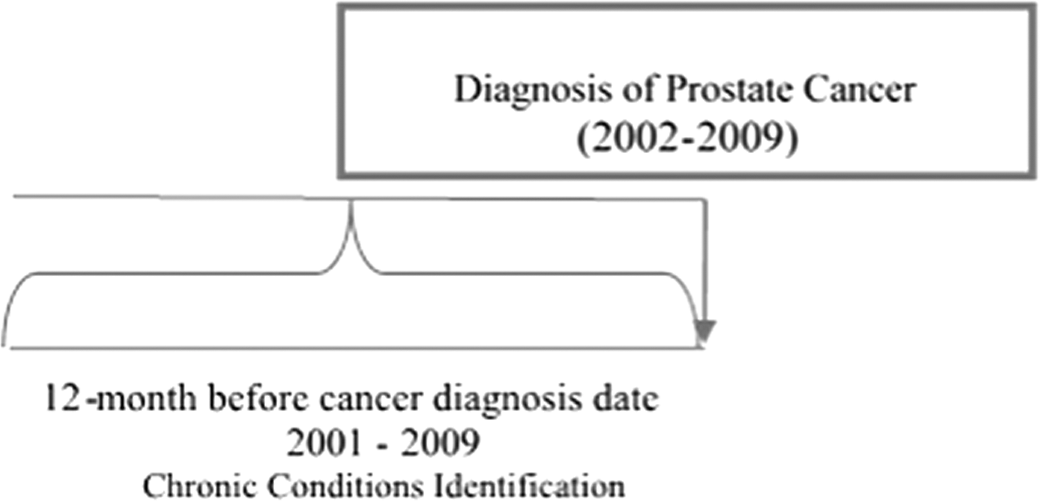
Schematic diagram of the study design for the current study.
Data sources
The current study utilized data from the National Cancer Institute's Surveillance, Epidemiology, and End Results (SEER) Cancer Registries linked with Medicare insurance claims. SEER data are considered to be the most comprehensive and high-quality population-based data on cancer incidence, initial cancer treatment, and vital status. At present, SEER data, comprising 18 population-based cancer registries, cover 24% of the US population. 15 Cases of cancers are provided in a customized file, the Patient Entitlement and Diagnosis Summary File (PEDSF). Nearly 98% of cases of cancers are ascertained from medical records. Medicare is the primary health insurer for 97% of the US population age 65 years and older. 16 A total of 93% of men aged 65 years and older in SEER have been linked to Medicare population enrollment records. 16,17 At present, SEER data are released for those cases of cancer diagnosed until 2009 and their associated claims until 2010. The current study utilized cases of prostate cancer diagnosed between 2002 and 2009 and their linked Medicare claims between 2000 and 2010. Data were included for elderly male (aged 66 years and older) fee-for-services Medicare beneficiaries.
The current study was approved by the West Virginia University Institutional Review Board in 2015. It was approved under the expedited category, which involves use of de-identified data and the requirement for consent is waived.
Study cohort
The study cohort was based on men diagnosed with incident prostate cancer between January 1, 2002, and December 31, 2009 (N = 358,439). Elderly men diagnosed with multiple cancers (N = 65,794), diagnosed with prostate cancer at the time of autopsy or on the death certificate (N = 2944), younger than 66 years of age (N = 97,159), who had unclear vital status (N = 8353), did not have continuous fee-for-service enrollment in Medicare Part A and B during the observation period (N = 74,993), and who had missing information on cancer stage at diagnosis, race, income, education, or county of residence (N = 5395) were excluded. Thus, the final cohort consisted of 103,820 elderly men with incident prostate cancer. Online Appendix 1 (available at
Key dependent variables
Cancer stage at diagnosis (localized versus advanced stage)
American Joint Committee on Cancer Tumor-Node-Metastases (TNM) classifications for staging of prostate cancer were used. Based on the TNM systems, cases were classified into 2 categories: localized and advanced prostate cancer at diagnosis. Localized prostate cancer was classified as cancer with T1 to T2 clinical stage with no regional lymph node (NX-N0) or distant metastasis (M0). Advanced prostate cancer was classified as cancer with T3 or T4 clinical stage with or without regional lymph node (N1) or distant metastasis (M1). 18
Key independent variable
Types of preexisting chronic conditions
Chronic conditions were identified using 1 inpatient or 2 outpatient claims with International Classification of Diseases, Ninth Revision, Clinical Modification diagnostic codes and procedure codes during the year before diagnosis of prostate cancer. Several criteria were used to define clinically meaningful combinations of chronic conditions, including high prevalence, specific organ domains, common pathophysiology, and synergistic management of chronic conditions.
19
Based on prior literature, the conceptual model of chronic conditions measurement, and clinician input, 12 chronic conditions were selected. These 12 chronic conditions were among the 20 conditions selected by the US Department of Health and Human Services for research, policy, program, and practice
20
; they also were also highly prevalent among elderly men with prostate cancer. These conditions were grouped into 3 broad categories using specific organ domains, common pathophysiology, and synergistic management: cardiometabolic conditions (diabetes, coronary artery disease, congestive heart failure, and cardiac arrhythmia), mental health conditions (anxiety, bipolar disorders, depression, schizophrenia, post-traumatic stress disorders, and psychosis), and respiratory conditions (COPD and asthma). Such types of classifications have been used in many studies.
21
–23
These 3 types of chronic conditions were then classified into 8 mutually exclusive categories: (1) cardiometabolic conditions only; (2) mental health conditions only; (3) respiratory conditions only; (4) cardiometabolic and mental health conditions; (5) cardiometabolic and respiratory conditions; (6) mental health and respiratory conditions; (7) all 3 types of conditions; and (8) none of the 3 types of conditions. (See Online Appendix 2, available at
Other independent variables
All the independent variables were measured during the 1 year before prostate cancer diagnosis. The Anderson Healthcare Behavior and Utilizations Model (ABM) 24 was used to classify the potential independent factors associated with advanced prostate cancer. According to the ABM, health care behaviors are determined by individuals and societal characteristics and these are characteristics are classified into 4 types of factors: (1) predisposing, (2) enabling, (3) need, and (4) external environment characteristics.
Predisposing characteristics
Predisposing characteristics represent the set of an individual's characteristics that predispose the individual to the risk of advanced prostate cancer. In the current study, demographic factors (age, race/ethnicity, and marital status) were included as predisposing characteristics. Age at the time of diagnosis was identified from the PEDSF file and was categorized into 2 groups (66 to 74 years, and ≥75 years). Race/ethnicity and marital also was derived from the PEDSF file and categorized into 4 groups: white, African American, Hispanic, and other. Marital status was derived from the PEDSF file and categorized into 4 groups: married, divorced/separated, unmarried, and other.
Enabling characteristics
Enabling characteristics are the set of an individual's or societal factors that enable the individual to use the services that may reduce the risk of advanced prostate cancer. For the current study, enabling characteristics were census tract-level income, census tract-level education, primary care visits, and prostate cancer screening. Healthcare Common Procedure Coding System codes of 84152, 84154, 84153, G0103 17 represented the prostate-specific antigen (PSA) test; and these codes were used to identify prostate cancer screening.
Need characteristics
Need characteristics are the set of an individual's characteristics that determines the need to use the services that may reduce the risk of diagnosis of advanced prostate cancer. A very small percentage of men (<5%) had 42 conditions 25 other than the cardiometabolic, mental health, and respiratory conditions. These conditions were classified into 2 categories, “0–1 condition” and “≥2 conditions.”
External environment characteristics
External environment characteristics comprised an individual's resident-level county, region, county-level radiation oncology units, and urology units, which provides the opportunity to seek care in order to reduce the risk of advanced prostate cancer. The 18 regions of SEER were categorized into 4 groups: (1) Northeast, which included 2 registries from Connecticut and New Jersey; (2) South, which included 5 registries from Atlanta, Greater Georgia, Kentucky, Louisiana, and rural Georgia; (3) North-Central, which included 2 registries from Detroit and Iowa; and (4) West, which included registries from Arizona, Alaska, Greater California, Cherokee Nation, Hawaii, Los Angeles, New Mexico, San Francisco-Oakland, San Jose-Monterey, Seattle-Puget Sound, and Utah. 26
County-level health care resources were derived from Area Health Resource files (AHRF), which is a nationwide county-level health resource files for the United States. The file provides information for approximately 6000 county-level variables including health care facilities, health professionals, resource scarcity, health status, economic activity, health training programs, and socioeconomic characteristics. 26 The number of radiation oncology units and urology units in counties were used to present county-level health care resources. SEER-Medicare files were matched with the AHRF using Federal Information Processing Standards state and county codes. 26 For the purposes of these analyses, the quartiles of radiation oncology units and urology units were calculated.
The year of cancer diagnosis also was included as one of the independent variables.
Statistical analyses
Significant differences in types of preexisting chronic conditions and advanced prostate cancer diagnosis were tested using chi-square tests. Multivariable binary logistic regressions were used to test the association between types of chronic conditions and advanced prostate cancer diagnosis after controlling for the predisposing, enabling, need, and external environment characteristics. All statistical analyses were performed using SAS version 9.4 (SAS Institute Inc., Cary, NC) in 2015.
Results
Study population
Table 1 summarizes the characteristics of the study cohort (N = 103,820). A majority of men were diagnosed with prostate cancer between age 66 and 74 years. The study cohort was primarily white and married. Nearly three quarters of men had a primary care visit and had a PSA screening during the baseline period.
Notes: Based on the data of 103,820 elderly men aged ≥66 years diagnosed with prostate cancer between 2002 and 2009 using SEER-linked Medicare data.
CM = cardiometabolic conditions; MH = mental health conditions; PCP = primary care physician; PSA = prostate-specific antigen test; RESP = respiratory conditions.
Study population by types of chronic conditions
Table 2 reports the characteristics of the study population by types of chronic conditions. Overall, 53.8% of the study population had either cardiometabolic, mental health, or respiratory conditions during the year before prostate cancer diagnosis and 46.2% of the study population had none of these conditions. The majority of men had only cardiometabolic conditions, followed by men with both cardiometabolic and respiratory conditions, only respiratory conditions, cardiometabolic and mental health conditions, only mental health conditions, and mental health conditions and respiratory conditions. Significant differences in the predisposing, enabling, need, and external environment factors by types of chronic conditions were observed among elderly men with incident prostate cancer.
Notes: Based on 103,820 elderly men aged ≥66 years diagnosed with incident prostate cancer between 2002 and 2009. Significant group differences by types of chronic conditions combinations were based on Chi-square tests.
CM = cardiometabolic conditions; MH = mental health conditions; PCP = primary care physician; PSA = prostate-specific antigen test; RESP = respiratory conditions.
P < .001; ** .001 ≤ P < .01; * .01 ≤ P < .05
Types of chronic conditions and cancer stage at diagnosis
Table 3 describes the relationship between the types of chronic conditions and cancer stage at diagnosis. Overall, 94.6% of the study cohort were diagnosed with localized prostate cancer and 5.4% were diagnosed with advanced prostate cancer. Significant relationships between types of chronic conditions and cancer stage at diagnosis were observed. As compared to men with all 3 types of chronic conditions, a lower percentage of men with cardiometabolic and respiratory conditions were diagnosed with advanced prostate cancer.
Notes: Based on 103,820 elderly men aged ≥66 years diagnosed with prostate cancer between 2002 and 2009. Significant differences by types of chronic conditions were based on the log-likelihood test using a logistic regression for adjusted models and chi-square tests for difference in the rates of stages by types of chronic conditions. Adjusted model controlled for predisposing (age, race/ethnicity, marital status), enabling (income, education, access to care, cancer screening), need (number of other chronic conditions), and external environment factors (county-level radiation unit, urology units, regions, year of diagnosis).
CM = cardiometabolic conditions; MH = mental health conditions; RESP = respiratory conditions; Ref = reference group; Sig = level of significance.
P < .001; ** .001 ≤ P < .01; * .01 ≤ P < .05
Table 3 also reports adjusted odds ratios (AOR) and 95% confidence intervals (CI) from the logistic regression on cancer stage at diagnosis. After adjusting for predisposing, enabling, need, and external environment factors among elderly men with prostate cancer, elderly men with none of the 3 conditions were 44% more likely to be diagnosed with advanced prostate cancer compared to those with all the 3 types of chronic conditions. Furthermore, elderly men with a PSA screening test during the year before diagnosis were 55% less likely to be diagnosed with advanced prostate cancer compared to those without a PSA screening test during the year before diagnosis of prostate cancer (AOR = 0.45, 95% CI = 0.43–0.48).
Discussion
One in 2 elderly men (54%) with incident prostate cancer had a preexisting chronic condition from the list of selected cardiometabolic, mental health, and respiratory conditions. The most prevalent types of chronic conditions were cardiometabolic and respiratory chronic conditions (15%). These findings suggest that elderly men with prostate cancer have significant disease burden prior to the diagnosis of prostate cancer.
In this study cohort, 1 in 10 elderly men with prostate cancer was diagnosed with advanced prostate cancer. Estimates from this study are consistent with the published literature on rates of advanced prostate cancer. 7,27,28 In the current study, it was observed that elderly men without the commonly prevalent chronic conditions had advanced prostate cancer at diagnosis. These study findings add to the conflicting hypotheses and findings of the relationship between the presence of chronic conditions and risk of advanced prostate cancer at diagnosis. One of the hypotheses is that individuals with chronic conditions may be less likely to be diagnosed with advanced prostate cancer because of increased contact with the health care system for care of their chronic conditions. 29 Conversely, the theory of competing demand postulates that the care of chronic conditions may take attention away from early symptoms of cancer and that individuals with chronic conditions may be more likely to be diagnosed with advanced prostate cancer. The role of competing demands for care of chronic conditions on advanced prostate cancer at diagnosis has been documented. For example, men with prostate cancer and preexisting congestive heart failure were more likely to be diagnosed with advanced prostate cancer compared to those without congestive heart failure. 3,30 Although the current study found that elderly men with chronic conditions other than cardiometabolic, respiratory, or mental health conditions were 43% more likely to be diagnosed with advanced prostate cancer, future research studies should examine the impact of less common conditions such as inflammatory-related conditions, smoking associated disorders, and sexually transmitted disease on prostate cancer risk, as these conditions also share common risk factors for developing prostate cancer.
Closer examination of the current study results suggested that elderly men who had a PSA screening test during the year before prostate cancer diagnosis were less likely to have advanced prostate cancer compared to those without a PSA screening test during the year before prostate cancer diagnosis. Furthermore, a significantly lower proportion of elderly men with none of the 3 types of chronic conditions had a PSA screening or visit(s) to a primary care physician during the year before diagnosis of cancer compared to those with the 3 chronic conditions. Taken together, these findings suggest that contact with the health care system may help improve screening for some patients and reduce the risk of advanced prostate cancer. The study's findings are consistent with the systematic review from the European Association of Urology, in which PSA screening reduced the risk of advanced prostate cancer. 31
However, PSA screening for prostate cancer has been controversial in the United States. For example, the US Preventive Services Task Force recommends against routine PSA screening for younger men aged 50 to 69 because the harms of PSA screening outweigh the benefits in terms of reducing the risk of mortality and advanced prostate cancer diagnosis. 32 In light of the controversies surrounding PSA screening, American Urological Association 33 and American College of Physicians 34 guidelines recommend that PSA screening should be considered through a shared-decision making process between the provider and the patient. Therefore, the current study findings suggest the need for routine PSA screening for those with none of the 3 common types of chronic conditions among elderly fee-for-service Medicare beneficiaries.
This study has many strengths. Historically, the role of chronic conditions in cancer has been examined using comorbidity indices or number of chronic conditions. The current study is the first to provide comprehensive information on the role of specific types of chronic conditions and their combinations in prostate cancer diagnosis. This study used the largest population-based registry to assess the association between the types of chronic conditions and cancer stage at diagnosis among elderly men with prostate cancer. This study is timely and is aligned with the goals of the Office of Cancer Survivorship and the Institute of Medicine regarding the management of prostate cancer in the presence of preexisting chronic conditions.
The study findings must be interpreted in the context of limitations. As the current study used observational data, the causal associations between the presence of types of chronic conditions and cancer stage at diagnosis could not be determined. The study population was restricted to men ≥66 years of age; therefore, the findings cannot be generalizable to younger men with prostate cancer. Although, this study identified the presence of chronic conditions using validated codes from the literature, the clinical severity and seriousness of chronic conditions could not be determined. Furthermore, the current study utilized registry-linked administrative claims data, which either have no information or limited validity of codes to identify body mass index, exercise, and smoking status, which may be associated with severity of cancer stage at diagnosis.
Conclusion
Elderly men without cardiometabolic, mental health, or respiratory conditions were more likely to have advanced prostate cancer at diagnosis. Therefore, strategies to reduce the risk of diagnosing prostate cancer at an advanced stage need to target the subgroup without these conditions. Future research studies are needed to examine the relationship between cancer stage at diagnosis and common conditions, such as inflammation-related conditions, smoking associated disorders, and sexually transmitted disease, on prostate cancer risk, as these conditions also share common risk factors for developing prostate cancer.
Footnotes
Author Disclosure Statement
Drs. Raval, Madhavan, Mattes, and Sambamoorthi declared no conflicts of interest with respect to the research, authorship, and/or publication of this article.
The authors received the following financial support: This project was supported by the Agency for Health Research and Quality (AHRQ) Grant no: R24HS018622-03 and National Institute of General Medicine Sciences Grant (U54GM104942). The content is solely the responsibility of the authors and does not necessarily represent the official views of AHRQ and the National Institutes of Health.
References
Supplementary Material
Please find the following supplemental material available below.
For Open Access articles published under a Creative Commons License, all supplemental material carries the same license as the article it is associated with.
For non-Open Access articles published, all supplemental material carries a non-exclusive license, and permission requests for re-use of supplemental material or any part of supplemental material shall be sent directly to the copyright owner as specified in the copyright notice associated with the article.
