




Abstract

G
The focus on value-based care provides an opportunity to improve health outcomes. However impactful value-based payment models may be, they are insufficient to drive population health improvement. New leadership competencies will be required to redesign a health system that addresses the causes of disease, eliminates disparities, and promotes equity as the path to improving population health. Importantly, this requires leadership grounded in values of diversity, inclusion, and equity. Leaders who embody these values and possess a passion for healthier communities are needed to address critical systemic issues. These leaders also will inspire cultural change that embraces improved health outcomes, particularly for those who have historically been excluded from access to care.
The values associated with leadership excellence for population health improvement are shown in Figure 1.
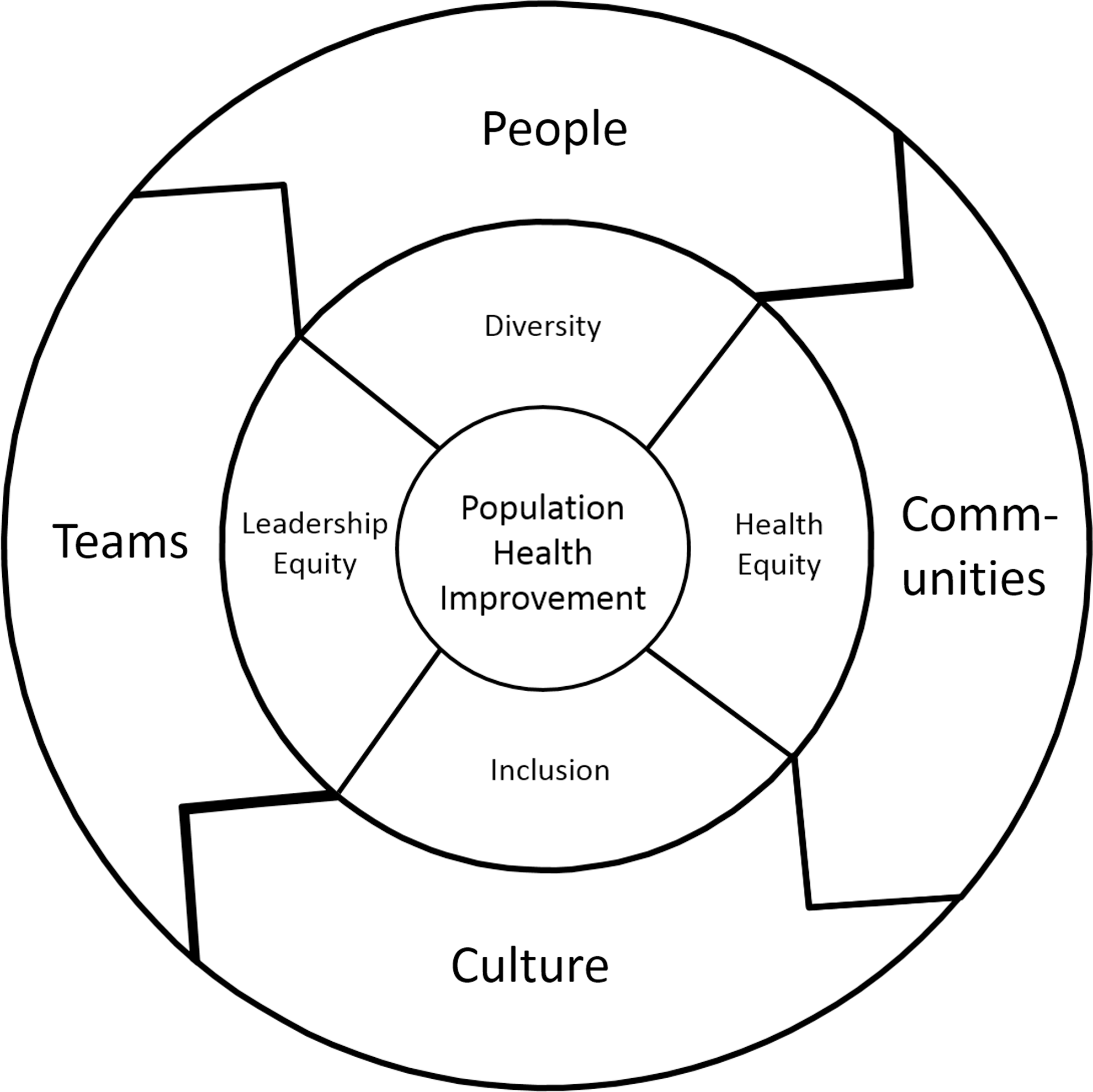
Essential values for leadership excellence in population health improvement.
Health Care Changes
Improving the health of our nation's population and controlling the increase in health expenditures will require major changes in traditional policies, practices, and assumptions. 4 US health outcomes are worse than those of much poorer nations and the US health care industry has failed to demonstrate value that is commensurate with financial investments. 5
Today's health care institutions will increasingly be held accountable for improving the health of a diverse, multicultural society. Although the issue of disparities or uneven treatment among racial and ethnic groups has been addressed by many organizations, there has been virtually no evidence of significant improvement in health disparity and equity in decades. 6 Consequently, today's health leaders are being challenged to develop innovative approaches to improve population health.
There will be significant challenges in redesigning traditional systems of care. A different model of leadership excellence is needed. The future of effective population health improvement will be determined by leadership excellence on individual, interpersonal, organizational, and community levels. At their core, leaders must have the vision and capacity to work with diverse members of an expanded health care team and community partners. An uncompromising commitment to diversity, inclusion, and equity at all levels of organizational and community engagement is required to achieve population health improvement.
Diversity
Understanding the strategic significance of diversity in health care and the business case for diversity is important. Historically, diversity has been defined as representation within the workforce of people with demographic differences (age, race, sex, ethnicity, and sexual orientation). Diversity is about people and respecting and valuing the differences they bring to health care.
Diversity can become a critical component of an effective strategy and a gateway to the innovation and creativity required for a transformation to population health improvement. 7 There is significant research on the value of diversity in business growth and performance. Business sectors outside of health care analyze the strategic importance of diverse leadership. Research studies repeatedly demonstrate a direct connection between a company's gender diversity and its financial success. 8 However, health care organizations have not yet embraced the ability of diverse leadership to drive organizational performance and improved outcomes within the diverse communities they serve.
For example, incorporating gender diversity into population health leadership seems relatively easy to address given that the health care workforce is composed of a strong pipeline of over 75% women. However, gender diversity of health care leadership has not changed substantially in many years. Women represent a proportionately small percentage of hospital chief executive officers and of hospital/health system board members. Despite an increasingly diverse patient population, similar patterns of low representation exist for racial and ethnic minorities in health care executive positions. Simply put, health care leaders do not reflect the communities they serve.
Identifying the lack of diversity in health leadership is not enough to create a catalyst for change. Action needs to be taken in the form of intentional inclusion to close the gap between diversity and equity. Diversity programs or a diverse workforce will not automatically produce equity. An inclusive culture is required to produce leadership equity that ultimately will lead to more equitable health care.
Inclusion
Diversity is about people and inclusion is about culture. Inclusion puts diversity into action by respecting and valuing differences and by ensuring that an organization's practices reflect inclusion. An inclusive culture is designed to reap the benefits of a diverse workforce by channeling what otherwise might be disparate resources and perspectives in a positive direction. The result can be deep inquiry or breakthroughs that would not occur otherwise. An inclusive culture also positions health care organizations to listen and respond to their communities with openness and flexibility.
Many young leaders who are women or racial and ethnic minorities currently work in management positions in hospitals and health systems. Unfortunately, they often are not ascending into the most influential leadership positions, even though their career aspirations are similar to men and those in the majority. 9 Health systems must examine potential sources of unconscious bias in hiring, performance reviews, and promotions. Just as rooting out unconscious bias at the bedside will improve health equity, rooting out this bias in the executive suites and board rooms also will be important to achieve population health goals.
Leadership Equity
The concept of leadership equity is a value that will differentiate organizations in their quest to achieve population health improvement. Leadership equity is the intentional cultivation and strategic inclusion of diverse leaders and teams into the design and delivery of care. Leadership equity promotes shared accountability for the health of a population through effective collaboration and partnership. By embracing leadership equity, governing boards and executive leaders have the opportunity to resolve a long-standing deficit in health care diversity.
Health Equity
A focus on health equity as determined by measures of population health is a critical component of health system performance. Health equity is the just and fair access to care, and caring, that results in equitable health outcomes for all. In this approach care does not refer to traditional medical care exclusively. The term care is intentionally broad enough to acknowledge the multiple contributors to health and illness, such as social and economic determinants.
The composition of communities across the country is changing dramatically. Racial and ethnic minorities are a growing percentage of the population. More than 100 million people, who are low income and racial and ethnic minorities, experience disproportionately higher rates of disease, fewer treatment options, reduced access to care, and greater mortality. Leaders must be able to address the challenges of these increasingly diverse and complex communities.
Leadership Imperative
Population health improvement presents extraordinary opportunities. The model described here focuses on the transformative importance of the values of diversity, inclusion, leadership equity, and health equity among health care leaders as drivers of population health improvement. Achieving the aims of population health improvement will be dependent on a new caliber of leaders who respond to the moral and ethical challenges that have resulted in unjustifiable health disparities and inequities in the United States and beyond.
Footnotes
Author Disclosure Statement
Drs. Lemak and McDonagh and Ms. Paris declared no conflicts of interest with respect to the research, authorship, and/or publication of this article. The authors received no financial support for this article.