




Abstract

F
Questions have emerged regarding the best approach to working with patients to help manage their health and to promote a healthy lifestyle. Because these are behavioral issues, the obvious answer is the involvement of psychologists, but not necessarily clinical psychologists. The discipline of clinical psychology deals with psychopathology, diagnostics, and mental and behavioral issues. Health psychology focuses on the behaviors of how and why people stay healthy, why they become ill, and how they respond to illness. In addition, health psychologists develop interventions to help people recover from illness and maintain health. 2 With the shift to patient-centered care in population health management, the topic of health psychology is a natural fit to aid in this new dynamic.
There are numerous ways that behavioral interventions can be established in the health care continuum for optimum population health management. To illustrate this, the center of Figure 1 depicts a care continuum with the traditional fee-for-service perspective limited to illness being diagnosed and treated. The population health perspective includes genetic makeup, socioeconomic inputs, lifestyle, screening, and treatment adherence support. An area of increasing interest relates to addressing social determinants of health beginning at an early point in the health care continuum. The National Academy of Medicine claims that “powerful drivers of health lie outside the conventional medical care delivery system,” and efforts to improve health can begin in the educational, labor, criminal justice, transportation, and social welfare systems. 2
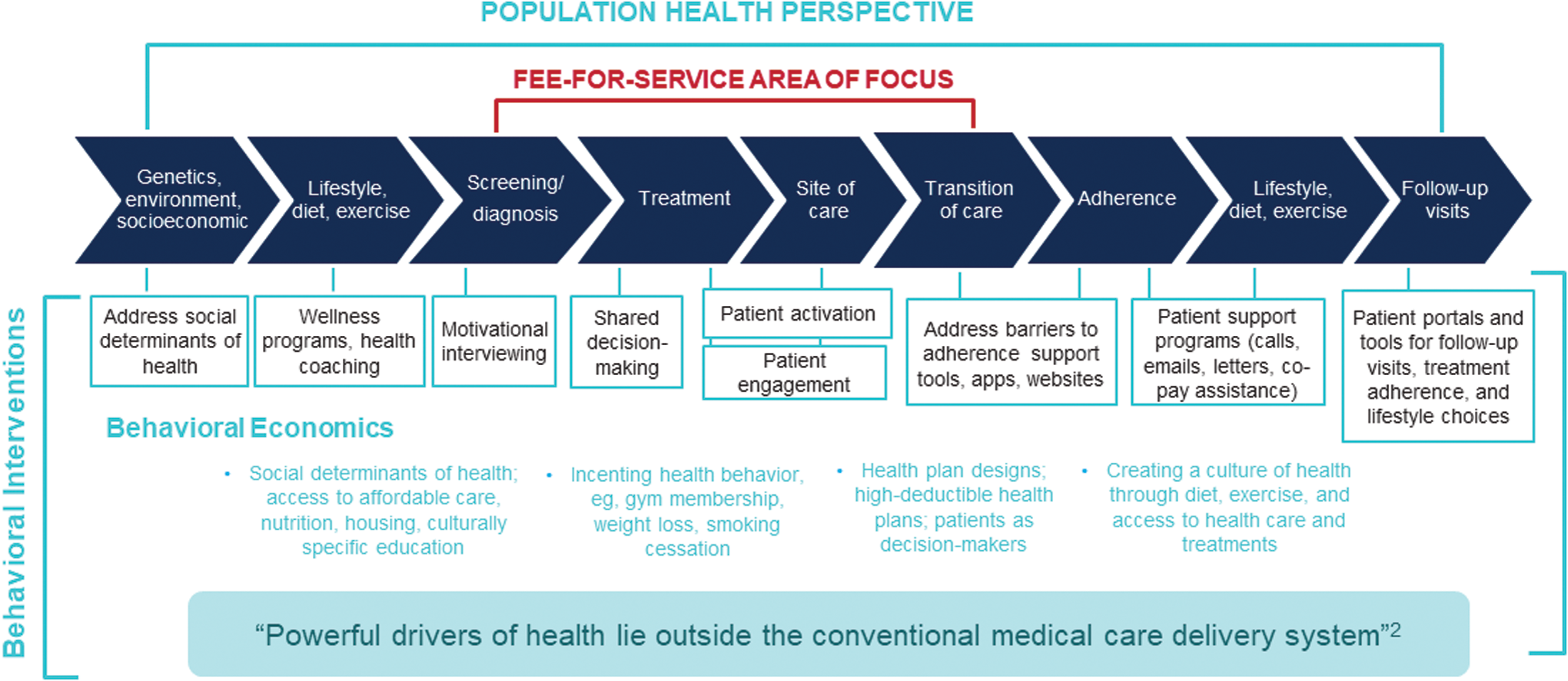
Behavioral interventions throughout the care continuum. Color images available online at
More directly addressing lifestyle, diet, and exercise are promoted through wellness programs offered by employers, health plans, and other stakeholders with the goal to improve health behaviors. These programs approach behavioral change in a variety of ways, such as points programs based on weight loss or smoking cessation efforts, and smartphone apps or websites that track progress. Some programs offer health coaching through telephonic support to assist in addressing barriers to positive health behavior.
Tools for the health care provider (HCP) include training in motivational interviewing and shared decision making. These 2 interventions encourage patients to come to their own conclusions about their health care rather than relying on HCPs to make the decision. Motivational interviewing focuses on inspiring the patient to make a commitment to move from unhealthy behavior to healthy behavior. Key components of motivational interviewing are assessing the patient's readiness to change and addressing barriers to taking the necessary steps. Shared decision making happens once a patient is ready to adopt a more healthy behavior and is ready to select his or her course of action from a range of treatment options. The treatment choice, along with any necessary lifestyle changes, is a joint decision between the patient and his or her HCP. As one would assume, the outcomes are much more favorable when the patient is involved in the decision to address his or her illness and is committed to the treatment plan.
Two similar topics related to the patient's commitment to his or her health care are patient activation and engagement. Patient activation is a patient's willingness to manage his or her own health care, and patient engagement is the patient's behavior as a result of his or her activation. 3 A fascinating platform called the Patient Activation Measure, offered by Insignia Health (Portland, OR), provides a quantitative approach to assessing and addressing patient behavior. 4 Insignia Health has developed a survey that can be used to assess a patient's activation level to predict future emergency room visits, hospital admissions, and medication adherence. Through the allocation of targeted resources and tools, a patient's activation level can be increased, translating to positive patient outcomes and reduced health care costs. Other behavioral interventions include a variety of patient support tools, apps, email, and telephonic outreach programs designed to support patient adherence to treatment regimens and a healthy lifestyle.
Another important component in the behavioral aspect of health care is behavioral economics, which is economic choices influencing behavior. For example, in addressing the social determinants of health, access to affordable care and prescription drugs for low-income families has a direct positive impact on their health. Other financial influencers are incentive plans for better health offered by some health and wellness programs, health care plans that provide interactive programs, and educational materials to help employees meet their health goals.
As payers and providers search for better ways to increase the quality of health care and reduce costs, the patient emerges as a key stakeholder. As a result, understanding the psychology behind health care can be just as important as the interventions themselves.
Footnotes
Author Disclosure Statement
The authors declare that there are no conflicts of interest. The authors received no financial support for the research, authorship, and/or publication of this article.