




Abstract
Mass shootings are a public health crisis and have become more frequent on U.S. university campuses over the past decade, with the number doubling since 2000. Due to this alarming trend, many institutions have developed response strategies for active shooting events. Yet, the extent to which these response strategies address the needs and minimize harm for students, faculty, and staff has not been evaluated critically after a campus mass shooting. Michigan State University (MSU) experienced a mass shooting on February 13, 2023. Before, during, and 6 months following this tragedy, the university employed an estimated 18 strategies to inform, support, and protect its students, faculty, and staff. While MSU continues to address concerns and roll out programs related to this event, here we aimed to (1) create a timeline of resources and communication provided by MSU from the event to 6 months post-event; (2) critically evaluate the extent to which these resources met the needs of students, faculty, and staff through a survey among persons involved in public health research; and (3) identify potential areas for improvement in the university’s responses. We used an online survey where participants (n = 10) rated the university responses and provided additional comments. From our survey, we recommend that, in the event of a campus shooting, other universities are attentive to re-engaging with the community within which the university is situated, holding communal events on campus, offering pauses in classes, and enhancing mental health services. These responses were seen as crucial to re-establish campus life and learning.
Importance
In the past 50 years, 12.8% of all U.S. mass shootings have occurred on a school campus. 1 Mass shootings, or those involving three or more victims, 2 have been deemed “a public health crisis” due to the direct deaths and also the increased mental health issues (e.g., PTSD, anxiety) experienced by the affected community. 3,4 While gun control legislation and social and mental health service expansion may be the most effective prevention strategy when mass shootings happen, institutions must respond and many may not be well prepared.
The objectives were to (1) outline the responses provided by Michigan State University (MSU) following a campus shooting; (2) evaluate how these actions met the needs of students, faculty, and staff; and (3) identify areas for improvement and make recommendations for other universities that may face this trauma. To achieve these objectives, university communications and actions were compiled along a timeline. Each item was then evaluated by students, faculty, and staff (n = 10) using an anonymous survey [20 questions about each timeline item (n = 18) and communication style (n = 2)].
This project was not considered human subjects research because participants did not provide any information about themselves.
Timeline of the Events
Please see Figure 1. For examples of each of these events in more detail, please refer to Supplementary Data S1. Briefly, at 8:18 p.m. on February 13th MSU staff, faculty, and students received a message with the subject line “Shots fired” (timeline item #1). Subsequent messages contained shelter-in-place orders, “Run.Hide.Fight.” directions, and URLs to report one’s safety. Also, MSU conducted multiple news briefings (#2), established a reunification center (#3), and announced a weeklong closure (#4). In the days following, MSU and the city organized vigils (#5) and bolstered mental health resources (#7). Also, MSU continued to relay pertinent information regarding the buildings affected (Berkey Hall and the Student Union), including that they would both remain closed until further notice (#8). In addition, campus organizations established “listening centers” (#9). Before reopening, the graduate student body organized “Spartan Sunday,” a collaborative event inviting community members, faculty, students, and staff to campus (#6). Lastly, MSU authorized all courses to shift to Credit/No-Credit, if desired and advised faculty to modify syllabi (#10, #11). In the ensuing weeks, MSU invited service animals to campus (#12), the Wharton Center for the Arts offered free admission to performances (#13), and an art piece was installed on campus, titled “Together We Heal, Grow, and Soar (#14).” MSU also introduced a new notification system to campus devices (#15), planned for a new video surveillance system (#16), classroom door locks (#16), and requiring key card entry into campus buildings from 6:00 p.m. to 7:00 a.m. (#17). Administratively, MSU separated the roles of the police chief, vice president, and chief safety officer (#18). Finally, in preparing for the new academic year, MSU decided that classes would not be held on February 13th, 2024 and that the classroom building affected would not host classes in the Fall semester.
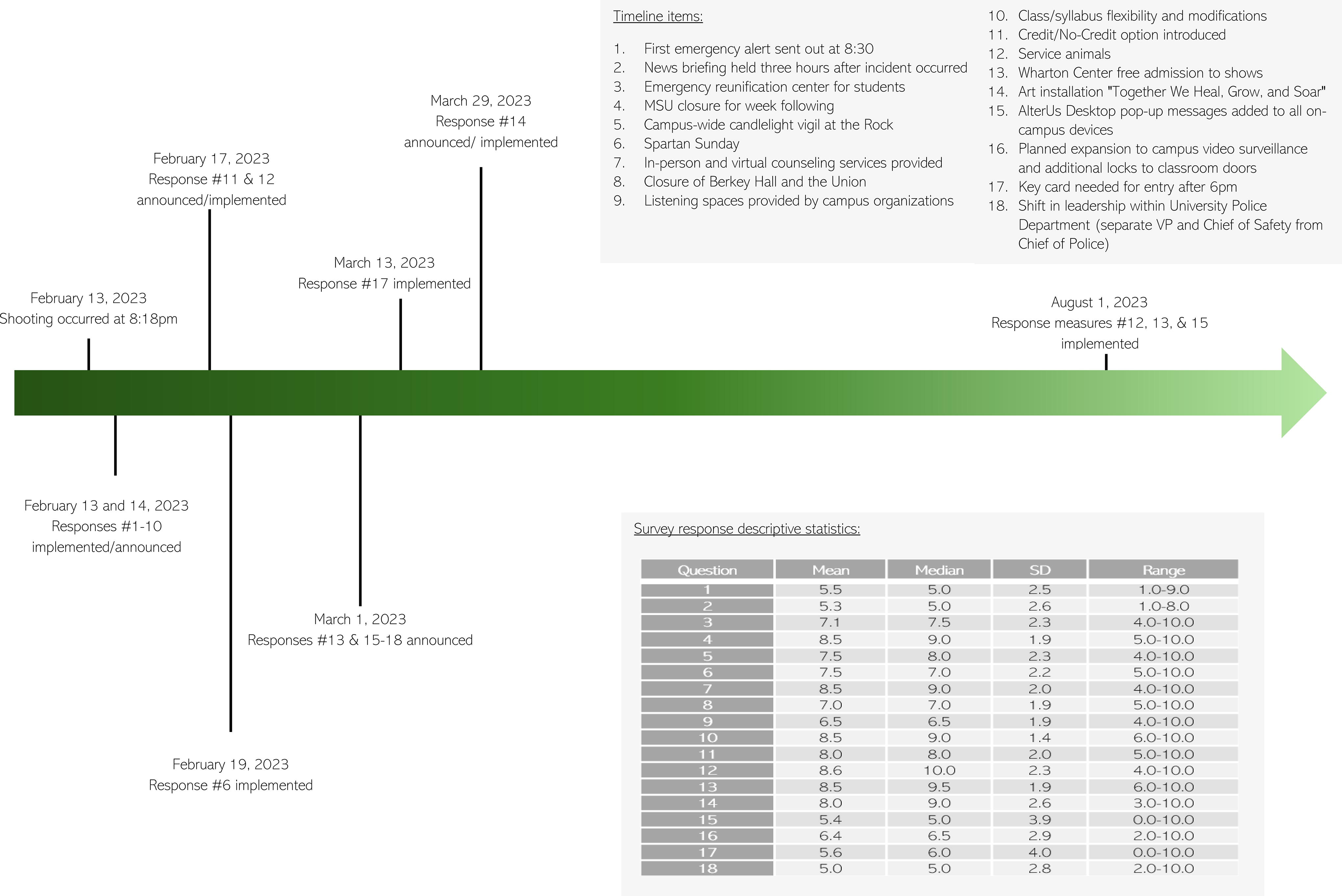
Timeline of events and survey results.
Survey Results
In the survey, the highest scores for satisfaction were for service animals (mean = 8.63), followed by free admission to performances, course/syllabus flexibility, counseling services and the week-long university closure (all means = 8.56).
Three themes emerged from the free response items: skepticism, gratitude, and acceptance. Respondents were skeptical of the effectiveness of some security measures (e.g., key card entry after 6 p.m.). One respondent wrote, “Literally pointless, can get anyone to open the door for you.” Also, there was contention about opening one directly affected building while keeping the other closed, “…It feels like the university is trying to make everyone happy by using both extremes.” Conversely, there was also a notion of gratitude from respondents towards some of MSU’s responses. Namely, the modifications to courses were seen as “essential.” One respondent shared that the Credit/No-Credit option, “has really helped relieve some of the academic stress and has allowed me to prioritize self-care.” Likewise, the call for flexibility within courses was important as one student shared, “in one of my classes, we were allowed to attend via Zoom after two weeks of campus reopening and the assignment burden was reduced by about 20%. I think this was appropriate to help students heal.” Lastly, many of the actions taken by MSU were met with acceptance and seen as necessary.
From the questions pertaining to communication style (i.e., wording of messages shared, and official information relayed via social media), there was consensus that MSU could have done better. Namely, the use of Run.Hide.Fight. was poorly received, one respondent shared, “‘Run.Hide.Fight.’ could have been better, may have caused unnecessary fear and hysteria which adds to trauma.” Meanwhile, the use of social media brought mixed emotions, as explained by these conflicting comments, “Social media really helped my parents get reliable information” versus “Too much misinformation.”
Recommendations
The objective here was to assess MSU’s response to a campus shooting through student, faculty, and staff’s perceptions and then provide guidance for other institutions that may be faced with a similar situation.
The survey showed that the verbiage used within MSU’s emergency messages elicited panic. Specifically, the use of “Run.Hide.Fight.” was poorly received. Actually, Run.Hide.Fight. is endorsed by the Federal Bureau of Investigation as the recommended approach for handling active shooter scenarios. 5 Nevertheless, its implementation during the event brought hysteria. The authors recommend the inclusion of this language in training programs to familiarize students, faculty, and staff with these messages before an event. Then, those who are on the campus would likely better recognize the more familiar urgent call to action.
During the shooting on MSU’s campus, one critical point in time was the identification and apprehension of the shooter. Moving forward, MSU plans to update its campus video surveillance network and centralize the security systems to facilitate streamlined access to footage. The survey suggests that students and employees feel increased surveillance is vital to bolster campus safety. Following a shooting, it is essential that people are given adequate time and resources to return to the space(s) affected. The authors recommend the closure of the buildings directly affected, the organization of events for individuals to gather and promote a sense of community, and the installation of art intended to encourage, celebrate, and commemorate the community, while also honoring those lost.
The authors also recommend the bolstering of existing mental health resources. Beyond offering virtual options for those who wished to remain off campus, MSU collaborated with the city and offered in-person services off campus. MSU also provided long-lasting academic accommodations. Namely, MSU facilitated Credit/No-Credit options, alleviating potential stress on students. Following a campus shooting, it is imperative that the institution supplement the mental health resources available and reduce academic pressure. If a mass shooting occurs on a campus, it is imperative that the institution bolsters therapy opportunities, offers academic accommodations, and hosts community-engaged events. These responses may aid in diminishing negative health outcomes and healping the entire campus return to learning.
Footnotes
Supplementary Material
Supplementary Data S1
References
Supplementary Material
Please find the following supplemental material available below.
For Open Access articles published under a Creative Commons License, all supplemental material carries the same license as the article it is associated with.
For non-Open Access articles published, all supplemental material carries a non-exclusive license, and permission requests for re-use of supplemental material or any part of supplemental material shall be sent directly to the copyright owner as specified in the copyright notice associated with the article.
