




Abstract
Maximum life span (MLS) and abundance of mitochondrial DNA (mtDNA) insertions in the nuclear DNA (NUMTs) were analyzed in 17 animal species with completely sequenced mitochondrial and nuclear genomes. Highly significant positive correlations were found between MLS and NUMT number, total size, or density (both in mammals and all animal species). In mammals, NUMT abundance correlated positively with the mtDNA guanine content and negatively with adenine and thymine contents, but did not correlate with such longevity-associated variables as the body mass and resting metabolic rate.
Introduction
Although the relevance of NUMTs for phylogenic analyses is well recognized, their ontogenetic functions and especially relevance to aging and longevity remain poorly studied. Here we analyze for the first time correlations of NUMT abundance with maximum life span (MLS), as well as with the longevity-associated gross morphophysiological (body mass, metabolic rate) and molecular variables (mtDNA size and base composition).
Materials and Methods
The species used in this work stand in three criteria: (1) They have a reference genome build, (2) their genome can be searched using the Basic Local Alignment and Search Tool (BLAST) at the National Center for Biotechnology Information (NCBI) web site (
NUMT abundance was assessed by three variables—NUMT number, total size, and density (NUMT total size/nDNA size). Correlative analyses were carried out for the whole set of 17 animal species or the mammalians (10 species). Taking into account the requirements to the sampling homogeneity, correlations of NUMTs with the body gross morphophysiological and mtDNA indices were studied only on the mammalian species.
Results
NUMT number, total size, and density correlate with MLS
Highly significant positive correlations were found between MLS and NUMT number, total size or density in the set of 17 animal species (Fig. 1A). The correlations remained highly significant for the mammalian species, as well (Fig. B).
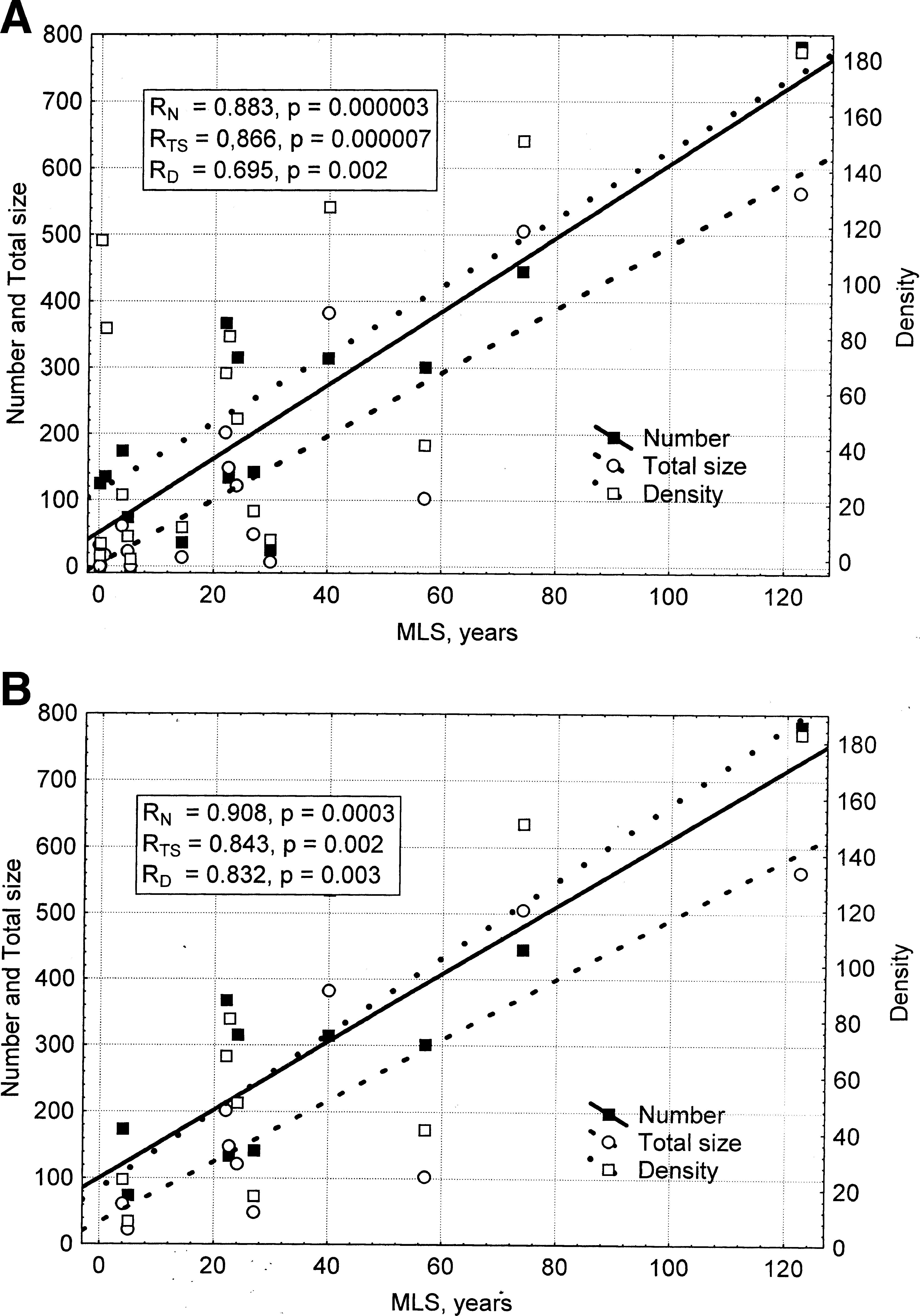
Relationships between the maximum life span (MLS) and NUMT number (Number), total size (Total size, in kbp) and density (Density, in NUMT bp per 1 Mbp of nDNA) for 17 animal species (
NUMTs do not correlate with body mass or metabolic rate
Mammalian longevity has been shown to correlate positively with body mass 11 or resting (basal) metabolic rate (RMR). 12 However, no significant correlations of any of the NUMT variables with body mass or RMR in 10 mammalian species were observed (p < 0.1).
NUMTs correlate with mtDNA base composition
mtDNA base composition strongly correlates with mammalian longevity. 12 The present analysis revealed significant correlations between the mtDNA base composition and NUMT abundancy. Guanine content of mtDNA correlated positively with NUMT number (R = 0.738, p = 0.015), total size (R = 0.827, p = 0.003), and density (R = 0.757, p = 0.011), whereas for the thymine content, the correlations were negative (R = −0.637, p = 0.047; R = −0.729, p = 0.017; R =−0.801, p = 0.005, respectively). Adenine content showed a tendency toward a negative correlation with NUMT number (R = −0.571, p = 0.085), total size (R = −0.569, p = 0.086) and density (R = −0.553, p = 0.088). Although the mtDNA cytosine content did not show significant correlations with any of the NUMT indices, the highest correlations with NUMTs were found for GC content (R = 0.788, p = 0.005; R = 0.836, p = 0.003; R = 0.784, p = 0.008; for NUMT number, total size and density, respectively). As could be expected, strong correlations were also found between the base composition of NUMTs and mtDNA (data not shown).
Discussion
The fragments of mtDNA in nDNA have first been discovered in “wet” experiments with in vitro hybridization of the mouse liver mtDNA and nDNA. 13 Progress in bioinformatics tools and the growing number of sequenced genomes offer the possibility for thorough analysis of NUMT homology with mtDNA in silico.
It is understood that differences in query limits and genome datasets could provoke significant variations of the NUMT hits number. 8 For a comparative analysis, it seems almost imperative therefore to estimate NUMT hits by the same program, as has been done in this research. Randomization and adequate sample size are other important requirements in such investigations. In this study, randomization was ensured by the fact that all available species have been included in the analysis. Unfortunately, the number of such species is still relatively small—an inevitable and typical situation for most pioneering studies.
There are large interspecies variations of NUMT abundance and MLS. The analysis of 17 animal species (from C. elegans to humans), as well as 10 mammalian species revealed highly significant positive correlations between MLS and the NUMT number, total size, or density. The same trends were shown earlier by us, based on the analysis of literature data on NUMTs in 12 animal species. 14
The NUMTs number, total size, and density also correlate with the mtDNA base composition: Positively with guanine content but negatively with thymine or adenine. However, the NUMT abundance did not correlate with other well-known longevity-associated factors—body size and RMR. The lack of significant correlation between these “gross” variables and NUMTs could indicate the existence of specific channels responsible for the positive association of longevity with NUMTs.
This association between NUMT abundance and MLS is a remarkable biological relationship, although at this moment it seems difficult to comprehend. It is generally assumed that NUMTs could hardly be advantageous because they possess no positional, transcriptional, or translational features that might indicate beneficial consequences. Moreover, the overall population of NUMT is supposed to be evolutionarily deleterious or neutral. 15 Emerging findings could alter such attitude. It was suggested that NUMTs are associated with unique mode of chromosome protection. The mtDNA fragments are inserted into naturally occurring double-strand breaks of nDNA by the nonhomologous ends-joining repair system. These repair events are usually associated with partial loss of the broken site. NUMTs may decrease or completely prevent such losses, thus protecting the nuclear genome. 16
In discussion of the NUMT role in aging and longevity, two principally different types of NUMT transfers should be distinguished: Horizontal (ontogenic) and vertical (phylogenic). Damages of the mitochondrial membrane can lead to the escape of mtDNA into the cytoplasm and its further “horizontal” transfer into the nucleus. The first experimental evidance of mtDNA horizontal transposition into nDNA came apparently from the filamentous ascomycete fungus Podospora anserina. In the senescent fungus, mtDNA is almost completely fragmented and presented in form of plasmids that are transposed into the nucleus, integrated into nDNA, and provoked quick senescence and death. 17 It was also suggested that the accumulation of mtDNA fragments in the nDNA could change the genetic information and promote cancer and aging. 18,19 These events should be of extremely low probability, due to the strong barriers—mitochondrial membrane and nuclear envelope, as well as numerous checking systems. However, under stressful or pathological conditions, the rate of mitochondrial membrane desintegration could increase, whereas effectiveness of the controlling mechanisms could decline. These kind of alterations should elevate the probabilty of NUMT generation, as was observed in aging 17,20 and ionizing radiation. 21
Concluding Remarks
Although the generation of NUMTs during ontogenesis is often provoked by stressful damage and could result in augmentation of the genome instability and accelerated aging, phylogenic NUMT transpositions are paradoxically associated with longer MLS. It is not excluded that phylogenetic progress was generally associated with elevated NUMT abundance and longevity. Suffice it to mention that the evolutionary youngest order of primates is apparently the one with a remarkably high NUMT repertoire and longevity. The larger NUMT pool could indicate an enhanced "dialog" between nDNA and mtDNA in longer-lived species. An alternative, yet not mutually exclusive, explanation suggests that NUMTs could be necessary in certain critical situations as mtDNA pro-matrices. The direct exchange of genetic information between the two genomes of a eukaryotic cell seems a fateful event, and exciting discoveries, including the role of NUMT in aging and longevity, are ahead in this area.